
Lifecycle of Recycled Electronics vs. Landfilled Waste
Recycling electronics is far better than landfilling them - for the planet, your wallet, and even data security. Here’s why:
- Resource recovery: Recycling recaptures valuable materials like gold, copper, and aluminum that landfilling wastes forever.
- Energy savings: Recycling one million laptops saves enough energy to power 3,657 U.S. homes for a year.
- Toxicity risks: Landfilling electronics leads to harmful toxins like lead and cadmium leaching into soil and water.
- Data security: Certified recyclers securely destroy sensitive data, unlike devices discarded in landfills.
- Legal compliance: Many states prohibit landfilling electronics, with fines reaching up to $70,000 per violation per day.
Recycling is not just about reducing waste - it’s about recovering resources, cutting pollution, and avoiding long-term environmental damage. Certified recyclers follow strict safety protocols, ensuring proper disposal and protecting both the planet and your organization.
Recycling vs. Landfilling: Core Concepts
E-Waste and ITAD Explained
E-waste refers to discarded electronics like computers, monitors, smartphones, and servers. In the U.S., about 3.36 million tons of outdated electronics are generated every year, making up roughly 1% of the total municipal solid waste stream.
This is where IT Asset Disposition (ITAD) comes in. ITAD involves managing the end-of-life process for electronics, focusing on secure data destruction, asset management, and proper disposal through certified recycling facilities. Unlike landfilling, ITAD ensures sensitive data is securely destroyed while valuable materials are recovered. Understanding these basics is key to evaluating how electronics are handled throughout their lifecycle.
Lifecycle Assessment Framework
A Lifecycle Assessment (LCA) examines every stage of an electronic product’s life: from raw material extraction and design to manufacturing, usage, and disposal. This approach helps organizations pinpoint ways to reduce environmental impact and conserve resources. It also underscores the importance of the disposal method - whether recycling or landfilling - on the environment.
When electronics reach the end of their life, they are either recycled or sent to a landfill. According to the EPA's Waste Management Hierarchy, recycling and reuse are considered preferred methods, while landfilling is seen as the least favorable option. With lifecycle insights in hand, ensuring compliance with proper disposal methods becomes essential.
Regulations and Compliance Requirements
In the U.S., regulations are in place to ensure e-waste is handled safely and responsibly. California, for example, enforces some of the strictest e-waste regulations, particularly for hazardous components found in electronics.
Certain materials, like Cathode Ray Tube (CRT) glass from older monitors and TVs, contain high levels of lead and are classified as hazardous waste under the Resource Conservation and Recovery Act (RCRA) when disposed of. To address this, the EPA has established two certification standards - R2 (Responsible Recycling) and e-Stewards - which require recyclers to meet strict environmental, worker safety, and data security standards through third-party audits.
"Certified electronics recyclers have demonstrated through audits and other means that they continually meet specific high environmental standards and safely manage used electronics." – U.S. Environmental Protection Agency
For Bay Area businesses and organizations, working with certified recyclers is non-negotiable. It ensures legal compliance, guarantees the secure destruction of sensitive data, and ensures hazardous materials are handled safely. These measures not only protect the environment but also safeguard your organization from legal and reputational risks, highlighting the clear benefits of certified recycling.
How Recycled Electronics Are Processed
Design and Use: Building for Reuse
The journey toward better electronic recycling starts well before a device lands in a recycling facility - it begins in the design phase. Source reduction focuses on creating products that use fewer materials, last longer, and incorporate recycled content right from the start. By designing electronics with modular components, manufacturers make it easier to upgrade specific parts, like batteries or memory, instead of replacing the entire device.
"Designing and manufacturing electronics with the environment in mind is critical for developing more sustainable products." – U.S. Environmental Protection Agency
Products designed for easy disassembly allow recyclers to efficiently extract valuable materials such as gold and copper. This approach minimizes the use of hazardous substances, reducing risks for workers and the environment. Devices that meet EPEAT (Electronic Product Environmental Assessment Tool) standards or carry the Energy Star label are specifically tailored for energy efficiency and easier recycling at the end of their life cycle.
Collection, Sorting, and Processing
When electronics reach the end of their usability, they enter the recycling system through community drop-off sites, retailer programs, or manufacturer take-back initiatives. At certified recycling facilities, the first step is sorting and cleaning. Devices that are still functional are refurbished and resold, extending their usefulness.
For electronics that can’t be repaired, recycling involves dismantling and mechanical separation to recover valuable materials. Certified recyclers meeting R2 or e-Stewards standards ensure that all sensitive data is securely destroyed while recovering materials like gold, palladium, aluminum, and glass. This process not only maximizes material recovery but also delivers environmental and economic benefits.
Benefits of Electronics Recycling
Properly recycling electronics offers both environmental and economic rewards. Recycled materials take far less energy to process compared to mining and refining raw resources, which helps cut down greenhouse gas emissions and pollution.
Economically, recycling plays a major role. In the U.S., recycling and reuse activities contribute 757,000 jobs, $36.6 billion in wages, and $6.7 billion in tax revenues annually. For every 1,000 tons of material recycled, the process supports 1.57 jobs and generates $76,000 in wages. Additionally, recovered materials re-enter the supply chain as raw materials for new products, creating a circular system that conserves resources and reduces the demand for energy-intensive mining.
What Happens to Landfilled Electronics
The Landfill Disposal Process
When electronics are tossed into regular trash bins, they take the same route as everyday household waste - straight to municipal landfills. In 2018, U.S. landfills received over 146 million tons of municipal solid waste, accounting for half of all waste generated that year. Out of the 2.7 million tons of consumer electronics like TVs, computers, and phones produced in 2018, only about 1 million tons were recycled. That means a large portion ended up either buried in landfills or incinerated.
Once electronics are buried in landfills, they remain there for centuries, trapped under layers of other waste. Unlike organic materials that break down over time, electronics are made of materials like plastics, metals, and glass, which don’t decompose.
"Once in landfills, the precious metals and other materials in these products cannot be recovered."
– U.S. Environmental Protection Agency
This permanent loss of valuable resources comes with a steep environmental price. The materials that could have been reused are wasted, and the risks of contamination grow.
Environmental and Health Risks
Landfilling electronics doesn’t just waste resources - it creates serious environmental and health hazards. Unlike recycling, which recovers useful materials and reduces pollution, landfilling electronics leads to the release of toxic substances. Components like CRT glass can leach toxins such as lead, arsenic, and cadmium into the soil and groundwater.
The problem doesn’t stop at contamination. The demand for new electronics drives manufacturers to mine fresh raw materials, a process that consumes enormous amounts of energy and releases significant greenhouse gases. For example, producing just one ton of laptops emits 10 tons of carbon dioxide. On the flip side, recycling one million laptops saves enough energy to power 3,657 U.S. homes for an entire year.
Global Informal Disposal Issues
Outside the U.S., the improper handling of electronics compounds these problems on a global scale. Many used electronics are shipped from developed nations to countries that lack the infrastructure or regulations to manage them safely. In these regions, informal e-waste processing methods - like open-air burning and acid baths - are used to extract metals. These primitive techniques expose local communities to toxic dioxins and hundreds of harmful chemicals.
Globally, e-waste has ballooned to 62 million tons as of 2024, making it the fastest-growing waste stream in the world. Yet, only 22.3% of this waste is processed in proper recycling facilities. The problem is growing five times faster than recycling efforts can keep up. Even more troubling, approximately 16.5 million children are involved in industrial sectors like informal e-waste processing, where they face constant exposure to hazardous materials that jeopardize their health and development.
What REALLY Happens To Our Old Electronics?
sbb-itb-855056e
Side-by-Side Comparison: Recycling vs. Landfilling
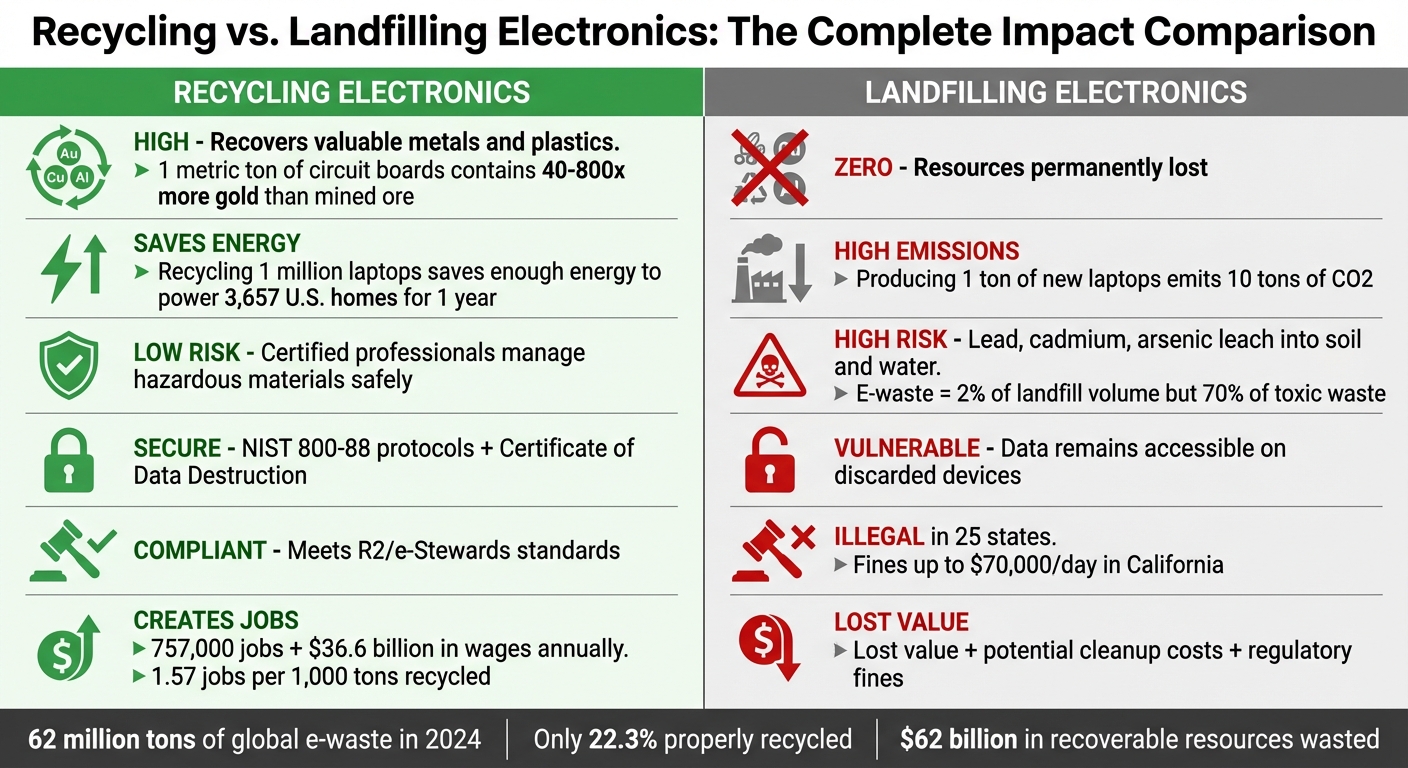
Electronics Recycling vs Landfilling: Environmental Impact and Benefits Comparison
Environmental and Resource Impact Comparison
When you look at the bigger picture, the environmental advantages of recycling stand out. Recycling and landfilling lead to vastly different outcomes for the planet. Recycling electronics helps recover valuable materials like gold, copper, glass, and aluminum, putting them back into the supply chain. On the other hand, landfilling permanently wastes these resources.
Recycling also saves energy by reducing the need to mine and process raw materials. For example, recycling one million laptops saves enough energy to power 3,657 U.S. homes for a year. Additionally, certified recycling programs handle hazardous materials - like the lead in CRT glass - using strict safety protocols to prevent contamination of soil and water.
| Impact Dimension | Recycling / Reuse | Landfilling / Disposal |
|---|---|---|
| Resource Recovery | High; recovers valuable metals and plastics | Zero; resources are permanently lost |
| Energy Use | Lower; reduces energy for mining and processing | Higher; requires extraction of new materials |
| Pollution | Cuts greenhouse gas emissions and overall pollution | Increases risk of toxic leaching and emissions |
| Toxicity Risk | Low; managed by certified professionals | High; risks to health and the environment |
| Economic Impact | Creates green jobs and supports recycling industry | Leads to lost value and potential cleanup costs |
(Data source: RAG)
Recycling doesn’t just conserve resources - it also addresses data security and ensures compliance with legal regulations.
Data Security and Legal Compliance
Data security is another critical area where recycling outshines landfilling. Certified recyclers with credentials like R2, e-Stewards, and NAID AAA follow NIST 800-88 protocols to completely destroy data on devices, providing a Certificate of Data Destruction as proof. In contrast, simply deleting files or performing a factory reset leaves data vulnerable if devices end up in landfills.
Legal compliance adds another layer of importance to proper recycling. Federal laws, such as the Resource Conservation and Recovery Act (RCRA), hold organizations accountable for their e-waste from creation to final disposal. In fact, disposing of electronics in landfills is illegal in 25 U.S. states. Penalties can be steep - up to $70,000 per violation per day in California and federal fines as high as $37,500 per day.
Cost and Value Recovery Analysis
From an economic perspective, recycling is often the smarter choice. While recycling fees (e.g., $15–$25 per monitor in San Diego) might seem like a downside, the recovery of valuable materials and potential tax incentives for donations can offset these costs.
Landfilling may appear cheaper at first glance, but it comes with hidden expenses. For example, business disposal fees in Los Angeles County can reach $0.40 per pound, and organizations face the risk of regulatory fines and long-term environmental liabilities. Recycling not only preserves resources but also shields organizations from these hidden costs and legal risks.
Implementation Guide for U.S. Organizations
Setting Up Landfill-Free E-Waste Programs
Incorporating e-waste management into your Environmental Management System can be streamlined by aligning with ISO 14001 guidelines.
Start by rethinking procurement. Tools like the Electronic Product Environmental Assessment Tool (EPEAT) and ENERGY STAR can help you choose electronics that are built to last, energy-efficient, and easier to recycle.
Data security is another key step. Follow the NIST 800-88 standards for media sanitization. Use logical destruction methods for devices that can be resold, while opting for physical destruction for assets that are either sensitive or unsuitable for resale.
When choosing recycling partners, look for certifications like R2 or e-Stewards and verify their credentials. A great example is the National Renewable Energy Laboratory (NREL), which has developed a robust electronics lifecycle management program. Their approach covers everything from purchasing and usage to the final disposition of electronics, ensuring sustainable practices throughout.
To secure asset transport, use GPS-tracked vehicles and tamper-evident seals to prevent data breaches. Additionally, measure your program’s environmental impact with the Electronics Environmental Benefits Calculator (EEBC), which helps estimate greenhouse gas reductions and energy savings.
Following these steps and working with reliable recycling partners are essential for building a landfill-free e-waste program. By implementing these strategies, organizations can effectively collaborate with certified recyclers to manage e-waste responsibly.
How Rica Recycling Supports Your E-Waste Goals
Rica Recycling helps organizations in the San Francisco Bay Area achieve 100% landfill-free electronics disposal by offering certified recycling services that comply with California's e-waste regulations. Whether you’re a business, school, or other organization, Rica Recycling provides flexible options, including pickups and drop-offs, for safely disposing of items like computers, laptops, servers, monitors, and more.
We also prioritize data security. Our secure data destruction services include issuing Certificates of Data Destruction, ensuring that sensitive information is completely erased before recycling begins. From IT asset recovery to appliance recycling, we help you stay compliant with California's stringent hazardous waste laws.
For added convenience, we host complimentary drop-off events where organizations can recycle items such as computers, servers, monitors, printers, and cell phones. For appliances, we offer responsible recycling at $50 per item through our drop-off service. By partnering with Rica Recycling, your organization can meet legal requirements while contributing to resource recovery and minimizing your environmental footprint.
Conclusion
Opting for recycling over landfilling isn’t just a choice - it’s a necessity for energy conservation, resource recovery, and safeguarding our environment. Consider this: recycling one million laptops saves enough energy to power 3,657 U.S. homes for an entire year. Plus, a single metric ton of circuit boards contains 40–800 times more gold and 30–40 times more copper than mined ore. When electronics are discarded in landfills, these valuable materials - and the energy savings they represent - are lost forever. This highlights the importance of shifting from a linear "use and discard" model to a circular approach that prioritizes resource recovery.
Certified recycling also shields organizations from serious liabilities. While e-waste makes up just 2% of landfill trash, it accounts for 70% of the toxic waste found there. In states like California, hazardous waste violations can lead to penalties as high as $70,000 per violation per day. Beyond environmental risks, landfilling electronics leaves sensitive data vulnerable. Certified recyclers eliminate this risk by ensuring secure, documented destruction of data-bearing devices.
The global e-waste problem is staggering. In 2022 alone, the world generated 62 million tons of e-waste, but only 22.3% was recycled properly, leaving behind $62 billion worth of recoverable resources. By focusing on formal recycling, we can also prevent approximately 93 million tons of CO2-equivalent emissions annually, thanks to the reuse of materials and reduced reliance on mining.
For organizations in the San Francisco Bay Area, Rica Recycling offers a practical, landfill-free solution. Our certified services include secure data destruction with certificates, compliance with California’s strict regulations, and environmentally responsible disposal. Whether you choose convenient pickups or take advantage of complimentary drop-off events, we make it easy for businesses, schools, and other organizations to turn old electronics into valuable resources instead of toxic waste.
The transition from the outdated "take-make-dispose" model to a circular system of resource management isn’t just a goal - it’s the only sustainable way forward. By embracing certified recycling, organizations can not only meet regulatory requirements but also play a vital role in sustainable electronics lifecycle management.
FAQs
What are the environmental advantages of recycling electronics instead of sending them to a landfill?
Recycling electronics brings considerable benefits compared to simply tossing them into a landfill. When electronics are recycled, valuable materials like copper, gold, aluminum, rare-earth elements, and high-grade plastics can be recovered and reused. This not only reduces the need for energy-intensive mining and manufacturing but also helps conserve limited resources and cuts down on greenhouse gas emissions.
On top of that, recycling keeps harmful substances like lead, mercury, and cadmium from seeping into the soil and groundwater. This protects both ecosystems and public health. It also helps minimize landfill waste, leaving more space for other types of materials. For businesses and residents in the San Francisco Bay Area, partnering with certified recyclers such as Rica Recycling ensures these benefits are achieved responsibly and in line with California’s e-waste regulations.
How does recycling electronics help protect your data?
Recycling electronics with certified IT asset disposition (ITAD) services guarantees that your data is securely erased or destroyed. These services follow rigorous protocols, including a documented chain of custody, to ensure sensitive information is safeguarded from unauthorized access.
When you recycle devices like computers, servers, and laptops responsibly, you’re not only minimizing the risk of data breaches but also supporting efforts to reduce electronic waste. Proper e-waste recycling helps protect your privacy and keeps you in line with important data security regulations.
What are the consequences of improperly disposing of electronic waste?
Improperly disposing of electronic waste (e-waste) can lead to severe legal and financial troubles. Electronics often contain hazardous substances like lead, mercury, and cadmium, which are strictly regulated under federal laws such as the Resource Conservation and Recovery Act (RCRA). Breaking these laws can result in civil penalties, criminal charges, and hefty fines. For instance, in California, dumping e-waste illegally can lead to fines exceeding $10,000 per ton, with even steeper penalties for repeat violations or failing to properly document disposal.
The consequences don’t stop at fines. Improper e-waste disposal can pollute the environment, triggering expensive cleanup efforts and potential lawsuits. There’s also the risk of data breaches if discarded devices still hold sensitive information. To steer clear of these risks, working with certified e-waste recyclers like Rica Recycling can help ensure compliance with regulations, protect the environment, and secure your data.