
Ultimate Guide to E-Waste Reporting Tools
E-waste reporting tools are software solutions that help businesses track and document the lifecycle and proper disposal of electronic waste. These tools are essential for compliance with strict U.S. regulations, particularly in states like California, where non-compliance can result in fines as high as $70,000 per day.
Key takeaways:
- Who needs to report? Businesses generating 11,000 lbs or more on-site or handling 220 lbs off-site must submit reports to California's DTSC by February 1 annually.
- Why it matters: E-waste contains hazardous materials like lead and mercury, requiring thorough documentation to prevent environmental harm and avoid penalties.
- New regulations: Starting January 1, 2026, California includes battery-embedded products in its e-waste program, increasing reporting responsibilities.
- How tools help: Modern tools automate reporting, track assets from pickup to recycling, and generate compliance documents like Certificates of Recycling.
Using these tools ensures businesses stay compliant, avoid fines, and contribute to sustainable e-waste management practices.
EPR Manage: Simplify Compliance with Footprint Computation & Recycling Assessment
Why E-Waste Reporting Matters for Compliance
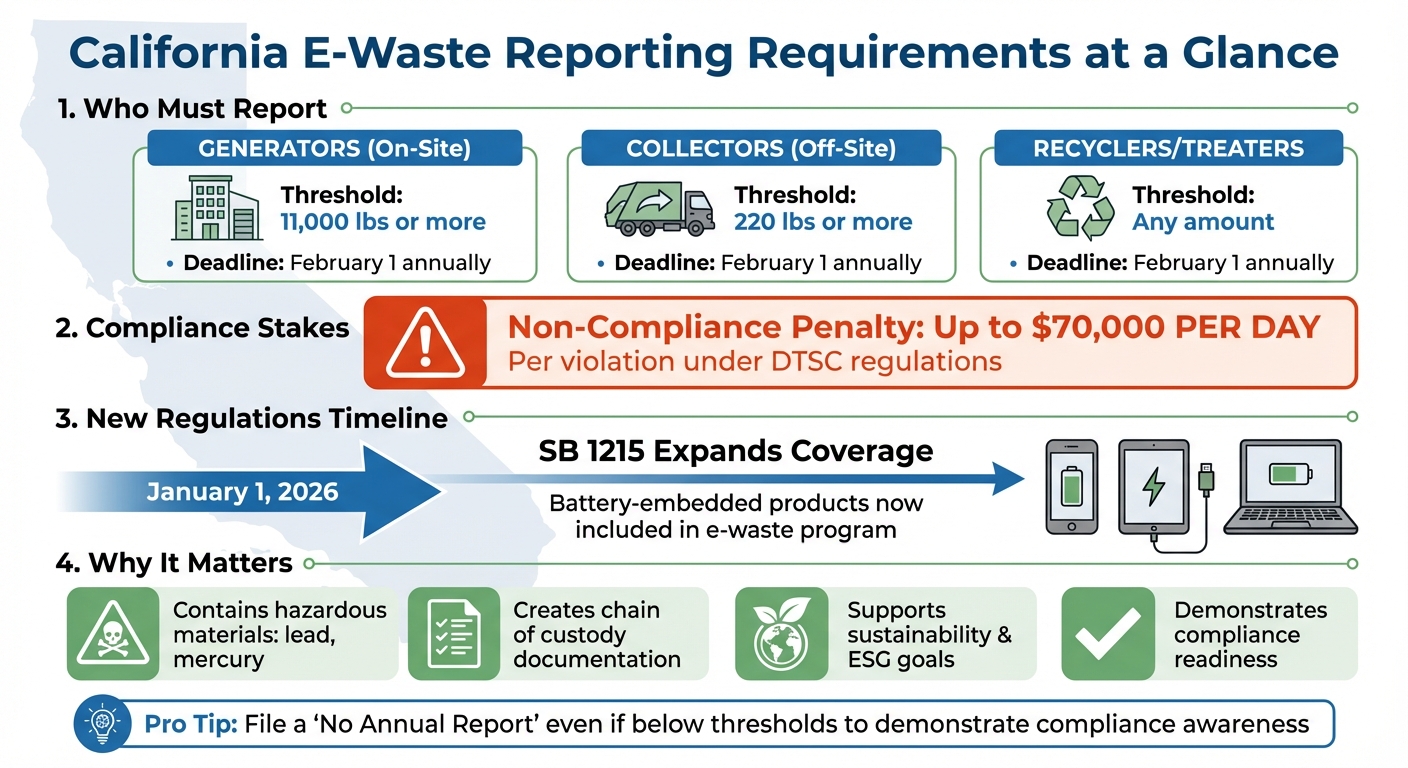
California E-Waste Reporting Requirements and Compliance Thresholds
Understanding Compliance Requirements
California's e-waste regulations place specific responsibilities on businesses, schools, and organizations to ensure proper handling and documentation of electronic waste. Universal waste handlers who generate 11,000 pounds or more on-site, accept 220 pounds or more off-site, or process any amount of e-waste are required to submit an annual report to the Department of Toxic Substances Control (DTSC) by February 1 each year, covering the previous calendar year's activities.
Because e-waste contains hazardous materials, thorough documentation is critical. These reports create a clear chain of custody, detailing the quantities of waste handled and shipped off-site. This process ensures that hazardous materials are not improperly disposed of or destroyed, helping to maintain compliance and protect the environment.
Starting January 1, 2026, Senate Bill 1215 added battery-embedded products to California's Covered Electronic Waste Recycling Program. This change broadens the scope of devices subject to mandatory reporting, making compliance even more important for organizations handling such materials.
Even if an organization does not meet the weight thresholds, filing a "No Annual Report" is a smart move. It confirms an understanding of the regulations and demonstrates compliance readiness, which can be beneficial during inspections or audits. This proactive step aligns organizations with regulatory expectations and sets a solid foundation for the sustainability initiatives discussed next.
| Summary of Reporting Requirements | Weight Threshold | Annual Deadline |
|---|---|---|
| Generators (on-site) | 11,000 lbs or more | February 1 |
| Collectors (off-site) | 220 lbs or more | February 1 |
| Recyclers/Treaters | Any amount | February 1 |
How Reporting Supports Sustainability Goals
Filing accurate e-waste reports does more than just help organizations avoid fines - it also lays the groundwork for sustainable practices. These reports provide crucial data that organizations can use to track their progress toward reducing waste. For example, California's Recycling and Disposal Reporting System (RDRS) collects data on the types and quantities of materials sold, transferred, or disposed of, offering the metrics needed to measure steps toward zero-waste goals.
Additionally, these tools help track the entire lifecycle of IT assets, from their initial use to final disposal. This ensures secure data destruction and responsible recycling, keeping harmful materials out of landfills. The DTSC emphasizes this point:
"E-waste is a hazardous waste. Disposing of it in landfills may harm both human health and the environment."
Transparent reporting also strengthens brand reputation and trust. By verifying that recycling partners meet environmental standards, organizations can show stakeholders, customers, and the public that they are committed to responsible waste management. With the United States ranking as one of the largest e-waste producers globally, maintaining detailed records demonstrates a genuine effort to address this pressing issue.
The expanded regulations also bring new accountability for manufacturers. They are now required to report annually on products sold and provide consumers with information on recycling options. This approach encourages a circular economy, where resources are reused and recycled, fostering a more sustainable system for managing electronic waste. By working together - manufacturers, handlers, and recyclers - organizations can create a more effective and responsible e-waste management framework.
Key Features of E-Waste Reporting Tools
Data Collection and Tracking
A solid e-waste reporting system starts with centralized asset management, offering organizations a clear view of their e-waste lifecycle. Tools like ERI's Optech™ provide secure, 24/7 access to real-time updates, enabling users to monitor every asset from pickup to its final destination. This "cradle-to-grave" approach ensures businesses can verify whether items were refurbished, resold, or recycled, which is essential for meeting federal RCRA requirements.
These systems often include serialized item manifests, documenting key details like the make, model, and serial number of each asset received. This level of tracking creates a reliable audit trail, making it easier to meet reporting thresholds - such as handling 11,000 lbs or more of e-waste on-site - and simplifies annual filings. By pairing robust data collection with automation, these tools make compliance significantly less burdensome.
Automated Reporting and Analytics
Relying on manual processes for e-waste reporting can lead to errors and inefficiencies. Modern tools solve this problem by automating the creation of compliance and sustainability documents. For instance, platforms like CalRecycle's RDRS and DTSC's UWED Notification and Reporting System allow businesses to submit quarterly or annual data directly to state agencies, covering material types and quantities.
Automation also enhances environmental tracking. These tools can produce detailed mass balance reports, breaking down the weights and categories of recovered materials like gold, silver, and copper, which aligns with circular economy objectives. Some platforms, such as the EPA's ReCon tool, even calculate the carbon and greenhouse gas savings from using recycled materials in manufacturing. ERI's Optech™ portal takes this a step further by offering these features at no extra cost to clients. With these capabilities, automated tools simplify compliance while providing meaningful insights into environmental impact.
Integration with Recycling Services
The best reporting tools seamlessly connect with certified recycling providers, making the entire disposal process more efficient. This integration minimizes manual errors and ensures a smooth chain of custody from pickup to final recycling. For example, working with providers like Rica Recycling guarantees automated delivery of Certificates of Recycling and Data Destruction, adhering to standards such as NIST 800-88 and DoD 5220.22-M for secure IT asset disposition.
Additionally, integration with internal enterprise systems offers a unified view of IT asset lifecycle management, further streamlining operations. By combining these features, e-waste reporting tools not only simplify compliance but also enhance the overall recycling workflow.
How Reporting Tools Support ITAD Processes
Tracking IT Asset Lifecycle
When it comes to IT asset disposition (ITAD), effective reporting begins with serialized tracking. This process starts as soon as assets leave the organization, with systems meticulously documenting each device by its make, model, and serial number. This creates a verifiable chain of custody, covering every step of the process - whether it's processing, refurbishment, or recycling. To put the scale of the issue into perspective, in 2020, a staggering 53.6 million tons of e-waste were generated worldwide, but only 17.4% was properly documented as recycled.
Modern reporting tools take this a step further by offering real-time visibility into the asset's journey. These systems categorize equipment for reuse, refurbishment, or material recovery and integrate seamlessly with internal platforms. Features like barcode tracking and CCTV verification add layers of security, creating an automated, transparent audit trail. This level of transparency not only helps organizations recover maximum value from their assets but also aligns with sustainability goals. For instance, R2v3-certified facilities are required to prioritize reuse when feasible and recycle materials - even when recycling costs exceed disposal costs. Accurate tracking is therefore not just beneficial but essential for compliance with these standards.
Beyond lifecycle tracking, these systems also ensure secure data handling, forming the backbone of strong ITAD practices.
Secure Data Destruction Reporting
Data destruction reporting is critical, especially in a world where the average cost of a data breach reached $4.45 million in 2023. Reporting tools play a vital role by issuing Certificates of Data Destruction. These certificates confirm that assets have been securely wiped or destroyed in line with NIST 800-88 standards, providing verifiable proof for compliance with regulations.
These certificates aren’t just generic documents - they include detailed information like serial numbers, destruction methods, and completion dates. This creates a reliable paper trail that meets the stringent requirements of standards like HIPAA, GLBA, and PCI DSS. With automated reporting systems, this documentation is available 24/7 through secure portals, ready to be accessed during audits. For organizations partnering with certified providers, both recycling and data destruction certificates are automatically generated. This eliminates the need for manual tracking while significantly reducing the risk of data breaches.
Recycle Electronics Responsibly
Schedule a pickup or drop off your e-waste at Rica Recycling to ensure eco-friendly, secure, and compliant electronics recycling in the Bay Area.
Schedule NowUsing E-Waste Reporting with Rica Recycling Services
Certified Recycling and Compliance Support
Rica Recycling combines hands-on e-waste disposal with advanced digital compliance tracking. Every item processed is meticulously documented with its make, model, and serial number, ensuring compliance with NIST 800-88 and R2 standards. Over the past 20 years, Rica Recycling has handled over 30 million pounds of e-waste, all while adhering to a strict 100% landfill-free policy.
Their Certificates of Destruction provide clear, verifiable evidence that sensitive data has been securely erased, meeting the requirements of HIPAA, PCI-DSS, and GDPR. These certificates include detailed device information and specific data destruction methods, making audit preparation straightforward. With California's updated SB 1215 regulations set to take effect on January 1, 2026, businesses will face tighter rules regarding battery-containing devices like smartphones and tablets. Rica Recycling’s compliance framework is designed to simplify meeting these new standards.
Rica Recycling also employs chain-of-custody tracking from the moment of pickup to final processing. This tracking ensures secure transport in line with ITAD best practices, supporting both compliance audits and sustainability goals.
Convenient Pickup and Drop-Off for E-Waste
Rica Recycling doesn’t just focus on compliance - they make the physical process of e-waste disposal hassle-free. Their Hayward facility is optimized for efficiency, allowing drop-offs to be completed in under two minutes. This quick turnaround minimizes interruptions for businesses managing large volumes of e-waste.
For organizations needing on-site support, Rica Recycling offers pickup services that seamlessly integrate with their reporting tools. Through their IT Asset Recovery program, they manage end-to-end asset recovery, including on-site pickup, certified data destruction, and even hardware refurbishment or resale. By tagging items with unique identifiers before disposal, businesses gain access to detailed audit trails and real-time reporting. This not only simplifies inventory tracking but also aids in budget forecasting. With the ITAD market projected to hit $32.36 billion by 2032, efficient asset recovery can help businesses save money while maintaining full compliance documentation.
Best Practices for Using E-Waste Reporting Tools
Training Teams on Tool Usage
Proper training is essential when it comes to using e-waste reporting tools and meeting compliance deadlines. For example, in California, annual hazardous waste generation reports must be submitted by February 28 each year. Missing these deadlines can lead to steep penalties, such as fines of up to $70,000 per violation per day for DTSC infractions, with federal RCRA violations imposing fines as high as $37,500 daily.
To ensure safety and compliance, introduce a Job Safety Analysis (JSA) for decommissioning tasks. This involves workers reviewing and acknowledging potential hazards like sharp objects, heavy lifting, or unstable equipment. Such preparation not only safeguards employees but also ensures proper documentation of handling procedures. Teams should also be trained to separate hazardous materials into clearly labeled and covered containers to avoid contamination. Additionally, emphasize the importance of maintaining Waste Transfer Notes (WTNs) for at least two years, as these records are vital during inspections by local authorities.
| Training Area | Key Focus for Reporting Tools | Compliance Requirement |
|---|---|---|
| Data Security | NIST 800-88 Sanitization | Certificates of Destruction |
| Record Keeping | Waste Transfer Notes (WTN) | 2-Year Minimum Retention |
| Safety | Job Safety Analysis (JSA) | OHSAS 18001 Standards |
A well-trained team not only ensures compliance but also strengthens your organization's ability to conduct thorough audits and adapt processes as needed.
Regular Audits and Updates
Training is just the start - regular audits are equally important to keep your reporting tools in sync with changing regulations. It's critical to audit all handlers, including subcontractors, to confirm proper recovery practices. As Anja Ffrench, Director of Communications at Computer Aid International, points out:
"Companies need to significantly improve their disposal procedures as failing to do so can have huge reputational as well as environmental costs."
Conduct quarterly reviews of your reporting tool's data fields to verify they align with current laws. These audits are also an opportunity to spot any gaps in chain-of-custody documentation, such as missing pickup dates, incomplete location details, or final disposition reports. By staying proactive, you can avoid costly violations and maintain a strong compliance record.
Conclusion
E-waste reporting tools have become a must-have for organizations managing electronics disposal. These systems provide real-time insights into the asset lifecycle, automatically generating crucial compliance documents like Certificates of Recycling and Certificates of Data Destruction. They also help measure environmental impact through detailed mass balance reports. Beyond compliance, these tools shield businesses from hefty fines that can climb to $70,000 per violation per day. At the same time, they promote sustainability by quantifying the ecological benefits of proper e-waste management.
The stakes couldn’t be higher. Poor e-waste practices not only harm the environment but also pose serious security risks. Services such as Rica Recycling offer a comprehensive solution by combining R2v3-certified processing with user-friendly reporting portals. Their 24/7 tracking access and commitment to a 100% landfill-free policy make it easier for businesses to align with ESG goals.
"How your business handles end-of-life equipment sends a message, good or bad." – Colt Recycling
The financial upside of proper e-waste management is equally striking. While some electronics may carry disposal costs, others can generate revenue through remarketing or material recovery. For example, one recycling service managed to process over 24 million pounds of electronics in a year through corporate partnerships. By leveraging effective reporting, businesses can turn e-waste from a financial burden into a managed asset.
FAQs
What happens if you don’t comply with e-waste reporting regulations?
Non-compliance with e-waste reporting rules can lead to serious legal and financial repercussions. Companies that fail to follow California’s strict e-waste laws risk facing hefty fines, enforcement measures, and even potential civil or criminal charges.
But the impact doesn’t stop there. Ignoring these regulations can harm a company’s reputation, casting doubt on its commitment to sustainability and responsible practices. Following e-waste laws isn’t just about avoiding penalties - it's about playing a part in protecting the environment and ensuring electronic waste is disposed of responsibly.
How do e-waste reporting tools contribute to sustainability?
E-waste reporting tools equip organizations with precise data on discarded electronics, enabling them to take concrete steps to reduce waste. These tools monitor the types and quantities of devices that are sold, transferred, or disposed of, offering transparency that helps meet state regulations and landfill diversion targets. By examining this data, businesses can spot patterns, set waste reduction goals, and implement reuse or refurbishment initiatives to cut down on electronic waste.
Many modern platforms come with features like real-time dashboards, in-depth analytics, and environmental impact reports, making it simpler to track progress and share results. For instance, they can showcase metrics like the amount of waste diverted from landfills or the value of recovered materials, reinforcing an organization’s dedication to sustainability. Combined with reliable recycling services, such as those from Rica Recycling, these tools ensure e-waste is processed responsibly, aligning with California's e-waste laws and contributing to a cleaner environment.
How will the inclusion of battery-embedded products impact e-waste reporting requirements?
Starting January 1, 2026, California will treat devices with non-removable batteries as covered battery-embedded products under its e-waste regulations. What does this mean for businesses? They’ll need to track and report these items separately from other electronics. On top of that, companies will be required to set up a Covered Battery-Embedded Waste Recycling Fee Account and pay a per-unit fee based on their sales figures.
To stay compliant, e-waste reporting tools should be equipped to identify battery-embedded devices, calculate the applicable fees, and produce accurate reports. For businesses in the Bay Area, teaming up with a certified recycler like Rica Recycling can make the process much smoother. They can handle battery-embedded devices efficiently, ensure secure data destruction, and provide all the documentation required for state compliance filings.