
Ultimate Guide to R2v3 Certification
R2v3 Certification is the latest global standard in electronics recycling, replacing the older R2:2013 in July 2023. It ensures recyclers follow strict protocols for data protection, worker safety, and eco-friendly practices. Key updates include a modular framework with Core Requirements (mandatory for all) and Process Requirements (specific to tasks like repairs or data sanitization). This approach prioritizes repair and reuse over recycling, supporting a circular economy.
Why it matters:
- Prevents improper disposal of electronics, which affects 75% of e-waste worldwide.
- Helps businesses avoid legal risks, like the $35M fine Morgan Stanley faced for mishandling customer data.
- Aligns with regulations to protect sensitive data and reduce toxic waste.
How to get certified:
- Conduct a gap analysis to assess compliance.
- Define your facility’s activities for auditing.
- Implement an Environmental, Health, and Safety Management System (EHSMS).
- Train staff and prepare for audits.
Certification costs range from $6,000 to $20,000 for preparation and audits, with annual maintenance fees. Facilities must meet stringent requirements across 10 core clauses, covering areas like data security, hazardous materials, and safe transport.
R2v3 offers businesses a framework to manage e-waste responsibly, reduce risks, and improve data security while supporting reuse and recycling.
Why R2v3 Certification Matters for Secure IT Asset Disposition in California
sbb-itb-855056e
Key Components of the R2v3 Standard
The R2v3 standard is built on a solid framework to ensure that certified facilities adhere to strict operational, safety, and environmental protocols.
Core Requirements vs. Process-Specific Requirements
R2v3 divides its standards into two main categories: Core Requirements and Process Requirements. The Core Requirements, outlined in Clauses 1 through 10, are mandatory for every certified facility, no matter what services they provide. These clauses cover essential elements like operational practices, safety measures, and compliance with legal standards.
Process Requirements, on the other hand, are specialized modules found in Appendices A–F. These apply only to facilities performing specific tasks, such as data sanitization, testing and repair, or materials recovery. A facility is audited only for the appendices that relate to its actual operations. For instance, a recycler that doesn’t handle refurbishing won’t be audited for Appendix C, which covers Test and Repair.
Facilities must include all R2-related processes they perform in their certification scope. They’re not allowed to omit processes just to avoid stricter requirements. The specific appendices a facility complies with are listed on its R2 Certificate, making it easy for customers to confirm the facility’s technical capabilities.
Now, let’s break down the 10 Core Requirements that form the backbone of R2v3.
The 10 R2v3 Clauses Explained
Each of the 10 Core Requirements addresses a key aspect of responsible electronics recycling:
- Clause 1 (Scope): Requires listing all R2 activities on the certification to ensure transparency during auditing.
- Clause 2 (Hierarchy of Management): Emphasizes reuse and repair over recycling, aligning with circular economy principles, and prohibits the disposal of Focus Materials.
- Clause 3 (EH&S Management System): Mandates a certified Environmental, Health, and Safety Management System to safeguard workers and the environment.
- Clause 4 (Legal & Other Requirements): Ensures facilities have a compliance plan covering import/export laws and labor standards.
- Clause 5 (Tracking Throughput): Requires detailed records of all incoming, outgoing, and internal inventory.
- Clause 6 (Sorting & Categorization): Implements the R2 Equipment Categorization (REC) system to classify items by functionality and data sanitization status. Facilities can either use the REC directly or align their internal systems with it.
- Clause 7 (Data Security): Focuses on protecting data by requiring secure storage and proper sanitization of all devices containing information.
- Clause 8 (Focus Materials): Demands a management plan and downstream flowchart for handling hazardous materials.
- Clause 9 (Facility): Covers risk assessments, insurance, and a formal closure plan with financial backing to ensure environmentally safe decommissioning if operations cease.
- Clause 10 (Transport): Sets guidelines for the safe and legally compliant packaging and transportation of materials.
The six Process Requirements include:
- Appendix A: Downstream Recycling Chain
- Appendix B: Data Sanitization
- Appendix C: Test and Repair
- Appendix D: Specialty Electronics (e.g., telecom or medical equipment)
- Appendix E: Materials Recovery (manual dismantling)
- Appendix F: Brokering
Facilities seeking certification for Appendix C or F must also hold a Quality Management System certification, such as ISO 9001 or RIOS.
How to Achieve R2v3 Certification
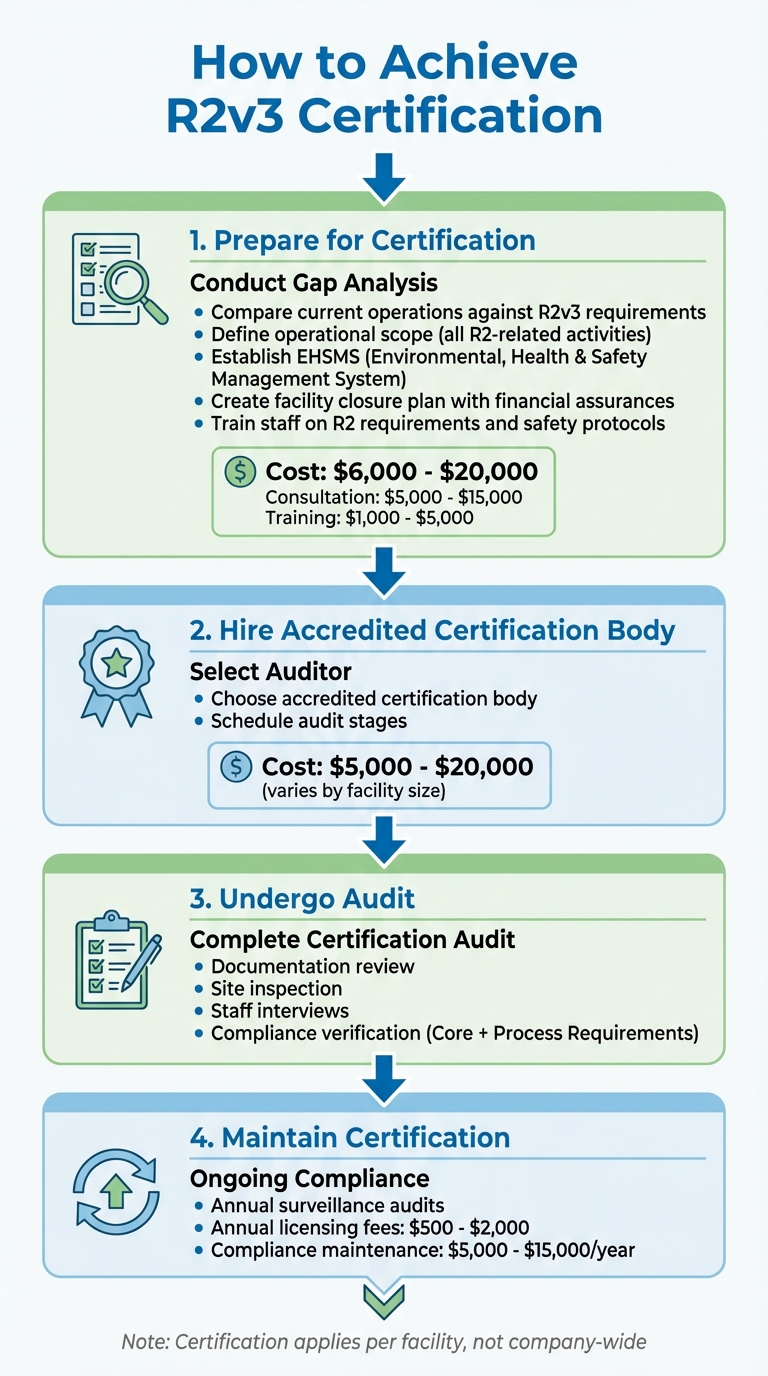
R2v3 Certification Process: 4 Steps to Achieve Compliance
Preparing for Certification
The first step toward R2v3 certification is conducting a gap analysis. This self-assessment compares your current operations against R2v3 requirements, helping you identify areas that need improvement before bringing in third-party auditors.
Next, it's crucial to define your operational scope. This means clearly outlining all R2-related activities your facility handles, such as data destruction, repair, materials recovery, or brokering. You cannot selectively choose which processes to certify - every relevant activity must be included on your certificate and will be audited accordingly.
You'll also need to establish a well-documented Environmental, Health, and Safety Management System (EHSMS). This system should address everything from worker safety measures to proper handling of hazardous materials. Additionally, a facility closure plan with financial assurances is required. This plan ensures that, in the event of a shutdown, your site can be decommissioned safely and responsibly.
Training your staff is another key step. Your team must fully understand R2 requirements, downstream due diligence, and safety protocols. Running internal audits can help identify and resolve non-conformities before undergoing the official certification audit.
Preparation costs typically range from $6,000 to $20,000. This includes consultation services (approximately $5,000–$15,000) and employee training sessions (around $1,000–$5,000). Once your systems are ready, you can move on to the formal audit phase.
Audit and Certification Process
To begin the audit process, hire an accredited certification body. The audit is conducted in stages, with costs usually falling between $5,000 and $20,000, depending on the size and complexity of your facility. Auditors will review your documentation, inspect your site, and conduct interviews to ensure compliance with both Core and Process Requirements.
Once certified, you'll face ongoing costs, including annual licensing fees ($500–$2,000) and compliance maintenance expenses ($5,000–$15,000). You'll also need to schedule annual surveillance audits to maintain your certification.
It's worth noting that certification applies to individual facilities - not your entire company. Each location must undergo its own audit based on its specific activities and operations.
Benefits and Global Adoption of R2v3 Certification
Key Benefits for Certified Organizations
R2v3 certification offers more than just compliance - it opens up new business opportunities. According to SERI, "R2 Certification opens doors to business opportunities that otherwise remain locked. Increasingly, customers are demanding certification from their potential partners as a cost of entry to doing business". This makes the certification a valuable asset for organizations looking to expand their market reach.
One of the standout benefits is enhanced data security. Certified organizations must follow strict sanitization protocols that align with NIST 800-88 and DOD 5220.22-M standards, ensuring sensitive data is permanently erased or destroyed. Additionally, adherence to frameworks like HIPAA, GDPR, CCPA, GLBA, and FERPA helps reduce legal risks and liabilities. The certification also emphasizes a "Hierarchy of Reuse", which prioritizes repair and refurbishment over recycling. This approach not only supports a circular economy but also boosts brand reputation, appealing to customers, investors, and stakeholders who value ethical and sustainable practices.
These combined benefits - operational efficiency, legal risk mitigation, and reputational enhancement - are key drivers behind the growing adoption of R2v3 certification worldwide.
Global Adoption Trends and Applications
The advantages of R2v3 certification have made it a game-changer in the global electronics recycling industry. By creating a unified framework for safe and sustainable reuse and recycling, the standard has significantly transformed the sector. Its development was no small feat, involving over 5,100 volunteer hours and addressing more than 900 industry-specific challenges, a testament to the industry's dedication to professional standards.
Adoption rates are climbing rapidly, especially as certification becomes a requirement for securing corporate and government contracts. Non-certified facilities are increasingly excluded from lucrative opportunities, highlighting the competitive edge certification provides. For instance, some R2v3-certified recyclers have scaled their operations to collaborate with over 10,000 organizations, including small businesses and Fortune 100 companies, by implementing advanced data wiping and physical destruction methods.
However, challenges remain. In the U.S., only 15–20% of electronic devices are recycled properly, while globally, just 17% of electronic waste is formally recycled, according to UN estimates. This gap underscores the critical need for certified facilities to close the loop on electronic waste recycling.
These global trends demonstrate how R2v3 certification is becoming an essential tool for organizations committed to sustainability and robust data security practices.
Rica Recycling: R2v3-Compliant E-Waste Management
Certified Electronics Recycling Services
Rica Recycling has brought the globally recognized R2v3 standards to the San Francisco Bay Area, setting a high bar for responsible electronics recycling. Their services cover everything from electronics recycling to IT asset recovery, ensuring that every device is traced from start to finish. Each item entering their facility is logged by brand, model, and serial number, creating a detailed record that supports R2v3's chain of custody requirements. This meticulous documentation also helps businesses with corporate sustainability reporting, making it easier to track environmental efforts.
Following the R2v3 Hierarchy of Management principle, Rica Recycling goes beyond recycling by identifying, repairing, and refurbishing functional electronics. These refurbished devices are then redistributed to underserved communities, extending their life cycles and supporting the circular economy. To make their services accessible, they provide both pickup and drop-off options for businesses, schools, and organizations throughout the Bay Area, regardless of size.
100% Landfill-Free Policy and Data Security
True to R2v3's strict guidelines, Rica Recycling has a zero-landfill policy for functional electronics. Non-functional devices are manually disassembled, ensuring hazardous materials like mercury, lead, and cadmium are handled safely while valuable materials are recovered.
Data security is another cornerstone of their operations. Using certified data sanitization methods that comply with NIST 800-88 and HIPAA standards, Rica Recycling ensures sensitive information is securely destroyed before recycling. Clients receive certificates of destruction, providing peace of mind and protection against data breaches. These practices not only meet R2v3's stringent data security requirements but also help California businesses stay compliant and safeguard their information.
Conclusion
R2v3 certification has reshaped the way electronics recycling is approached, creating a framework that emphasizes both environmental protection and data security. Despite the growing problem of electronic waste, only a small percentage is properly recycled worldwide. The majority is mishandled, leading to environmental harm from hazardous materials.
The certification's impact extends beyond safeguarding the planet. By requiring strict data sanitization measures, R2v3 helps organizations sidestep hefty financial penalties. Industry examples highlight the risks of non-compliance, making adherence not just a moral choice but a practical necessity.
One of the standout features of R2v3 is its Hierarchy of Management principle, which prioritizes reuse and repair over recycling. This approach not only conserves resources but also supports social initiatives like bridging the digital divide by extending the life of refurbished devices. Additionally, the recovery of valuable materials brings economic benefits, demonstrating how sustainability and profitability can go hand in hand.
R2v3 certification offers businesses a robust framework to align with environmental and regulatory goals. It provides a clear pathway for meeting ESG objectives while maintaining compliance with local, national, and international regulations. The certification’s emphasis on downstream accountability ensures transparency across the recycling chain, reducing the risk of hazardous materials ending up in unregulated facilities.
As the focus on sustainability grows and regulations tighten, R2v3 certification stands out as a reliable system for managing e-waste responsibly. It not only protects the environment and secures sensitive data but also promotes a circular economy that benefits businesses and communities alike.
FAQs
Which R2v3 appendices does my facility need?
Your facility needs to pinpoint the process requirements that are relevant to your operations and make sure they’re included in your R2v3 certification scope. This is particularly critical if your operations involve tasks like downstream recycling, data sanitization, testing, repair, or handling specialty electronics. These areas are detailed in the R2v3 appendices, so take time to review them carefully and identify the specific requirements that align with your activities.
How long does R2v3 certification take to earn?
Earning R2v3 certification usually takes companies about 8 to 12 months. However, the exact timeline can shift depending on factors such as how prepared the organization is and the complexity of its operations.
What proof should I ask for from an R2v3 recycler?
Request official documentation, such as an R2v3 certification or an audit report, to verify that the recycler adheres to top-tier standards for environmental protection, data security, and responsible recycling. These documents confirm compliance with the R2v3 standard and demonstrate that the recycler follows established best practices for safely and responsibly managing e-waste.