
CalRecycle Funding Programs: What to Know
CalRecycle provides grants, payments, and loans to help California organizations improve recycling systems and reduce waste. Programs target local governments, schools, nonprofits, tribal entities, and businesses. Key highlights include:
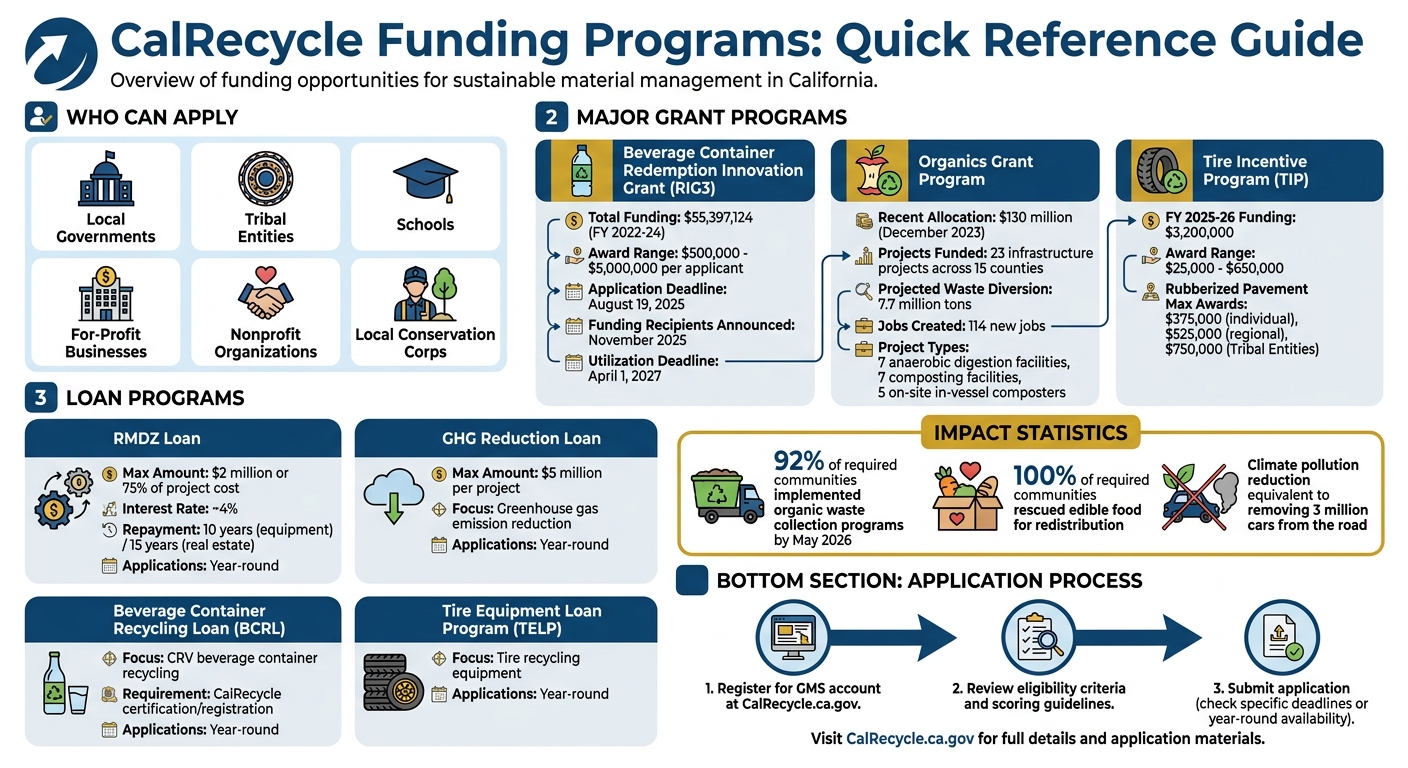
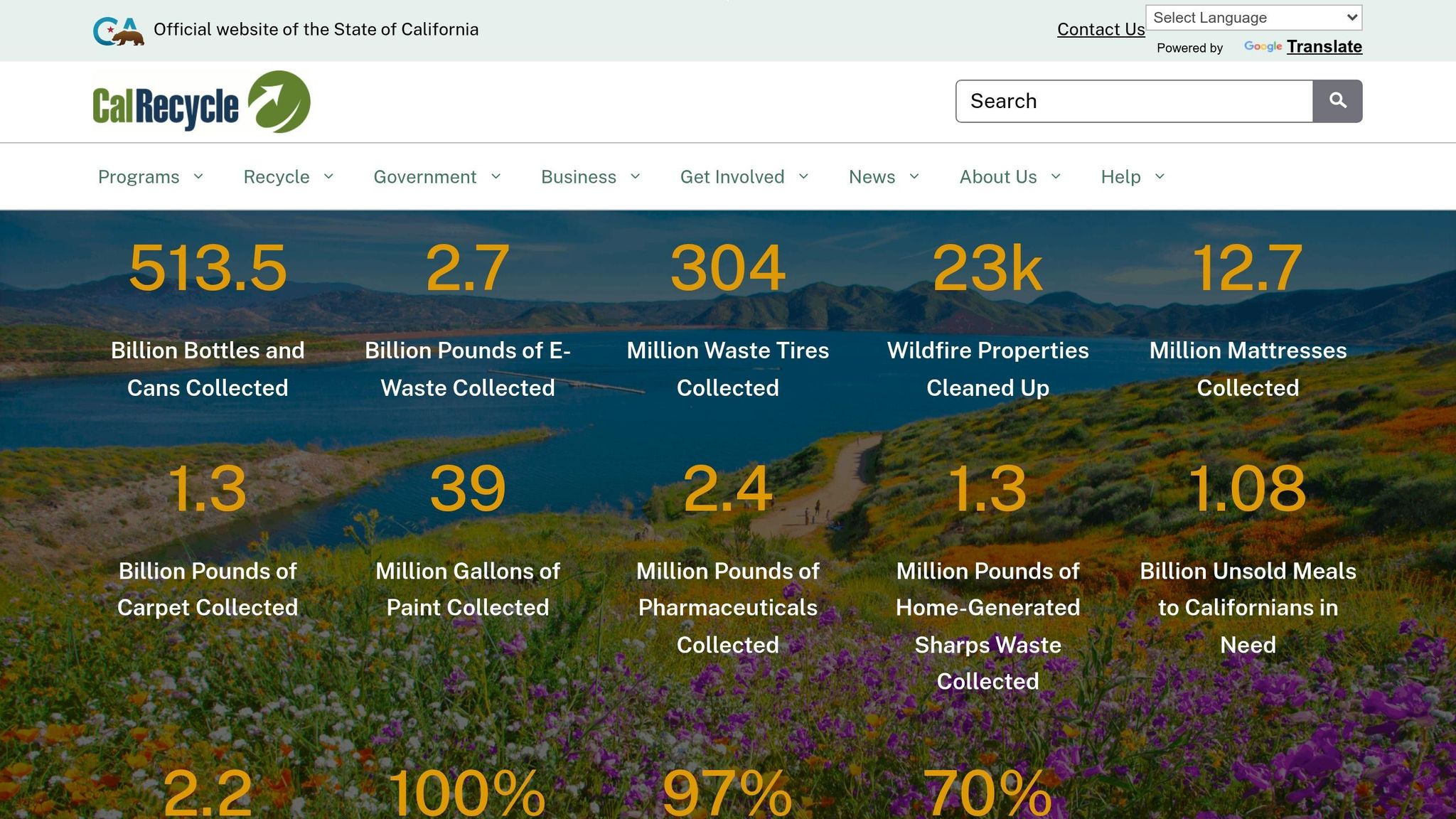
- Organic Waste Collection: By May 2026, 92% of required communities implemented programs, and 100% rescued edible food for redistribution. These efforts aim to cut pollution equivalent to removing 3 million cars from the road.
- Funding Opportunities: Grants and loans support projects like organics recycling, tire reuse, beverage container recycling, and greenhouse gas reduction.
- Eligibility: Local governments, nonprofits, schools, businesses, and tribal entities can apply for various programs tailored to their needs.
- Application Deadlines: Some programs have fixed deadlines (e.g., May 7, 2026, for Cycle 37 of the Local Enforcement Agency Grant), while others accept applications year-round.
CalRecycle’s funding programs are designed to build infrastructure, reduce waste, and promote recycling. To apply, visit their Grants Management System (GMS) and follow the specific requirements for each program.
CalRecycle Funding Programs Overview: Grants vs Loans Eligibility and Amounts
CalRecycle Grants 101 Informational Workshop
sbb-itb-855056e
Who Can Apply for CalRecycle Grants and Loans?
CalRecycle funding is open to a variety of public and private organizations. Eligible groups include local governments, tribal entities, schools, for-profit businesses, nonprofit organizations, and local conservation corps. This broad eligibility ensures that many recycling and waste management initiatives can access the funding they need.
Each program is tailored to specific groups and their unique needs:
- Local governments can apply for programs like SB 1383 assistance, Household Hazardous Waste grants, and tire cleanup initiatives.
- For-profit businesses are eligible for infrastructure-focused programs, such as the Tire Incentive Program.
- Schools can benefit from grants supporting organics recycling, edible food recovery, and beverage container recycling.
- Tribal entities may qualify for environmental cleanup and recycling infrastructure grants, including the Farm and Ranch Solid Waste Cleanup program.
- Nonprofits can access grants for workforce development, community composting, and food waste prevention and rescue.
Some programs are open to multiple types of entities. For example, the Organics Grant and Food Waste Prevention and Rescue Grant are available to local governments, schools, nonprofits, and for-profit businesses. On the other hand, certain programs are more specific, such as the Local Enforcement Agency Grant (for governments) and the Tire Incentive Program (for businesses).
Grants provide direct funding, while loan programs require repayment and are designed for infrastructure investments. Examples include:
- The Recycling Market Development Zone (RMDZ) Loan, which supports businesses creating products from recycled materials.
- The Greenhouse Gas Reduction Loan, aimed at building infrastructure to convert organic and recyclable waste into new products.
- The Beverage Container Recycling Loan, which focuses on expanding recycling infrastructure for beverage containers.
For beverage container programs, recycling center businesses must first obtain certification and receive a "Notice to Proceed" to qualify for funding. Additionally, the Beverage Container Redemption Innovation Grant Program (RIG3) offers a total of $55,397,124 for fiscal years 2022–23 and 2023–24, with individual awards ranging from $500,000 to $5,000,000 per applicant.
Main CalRecycle Grant Programs
CalRecycle offers several targeted grant programs designed to tackle specific recycling challenges across California. These grants aim to address everything from beverage container recycling to the management of organic waste and repurposing of used tires. Each program provides organizations with tailored funding opportunities to enhance their recycling efforts. Let's dive into the details of the Beverage Container Recycling Grant Program.
Beverage Container Recycling Grant Program
The Beverage Container Redemption Innovation Grant Program focuses on funding reverse vending machines (RVMs) to assist retail dealers in meeting in-store redemption requirements. These projects must be situated in "unserved" convenience zones or "no zone" areas where consumers lack easy access to recycling options. Eligible applicants include registered dealers, 501(c)(3) nonprofit organizations, and authorized private businesses. Dealers are required to submit an affidavit confirming their decision to redeem in-store before receiving a Notice to Proceed.
This program follows a reimbursement model, meaning recipients cover costs upfront and are reimbursed later. For the 2025 funding cycle, the application deadline has been extended to August 19, 2025, with funding recipients announced in November 2025. The deadline for utilizing the funds is April 1, 2027.
Organics Grant Program
The Organics Grant Program supports efforts to divert food and yard waste from landfills. As part of California Climate Investments, it uses cap-and-trade funding to reduce greenhouse gas emissions while turning organic waste into valuable products like renewable natural gas, compost, and soil amendments.
In December 2023, CalRecycle allocated $130 million to 23 infrastructure projects across 15 counties. These initiatives are projected to divert 7.7 million tons of organic waste from landfills and create 114 new jobs. The funded projects include seven anaerobic digestion or codigestion facilities, seven composting facilities, and five on-site in-vessel composters.
"California has the opportunity to close the loop with organics by transforming the single largest part of our waste stream into a supply stream for local businesses." - Scott Smithline, Director, CalRecycle
Notable past grants include funding for CR&R Inc.'s anaerobic digestion project in Perris and Santa Barbara County's facility at the Tajiguas Landfill, which processes organic materials into biogas and compost.
Tire-Derived Product Grant Program
CalRecycle offers two main funding tracks for tire recycling: the Tire Incentive Program (TIP) and the Rubberized Pavement Grant Program. For the 2025–26 fiscal year, TIP received $3,200,000, with individual awards ranging from $25,000 to $650,000.
The Tire Incentive Program provides financial assistance to manufacturers creating high-value tire-derived products, helping them competitively price and market these goods. Eligible applicants include manufacturers, waste tire processors, rubber compounders, and producers of devulcanized rubber or calendared rubber sheets.
The Rubberized Pavement Grant Program supports road surfacing projects that use recycled California tires, such as Rubberized Asphalt Concrete (RAC) and Chip Seal. Roads built with RAC reportedly last 50% longer than those using traditional materials. Maximum funding awards are $375,000 for individual applications, $525,000 for regional applications, and $750,000 for Qualifying Tribal Entities.
Stay tuned to see how CalRecycle's loan programs contribute to expanding recycling infrastructure.
CalRecycle Loan Programs and Application Deadlines
CalRecycle offers four loan programs aimed at expanding recycling efforts across California: the Recycling Market Development Zone (RMDZ) Loan Program, the Greenhouse Gas Reduction (GHG) Loan Program, the Beverage Container Recycling Loan Program (BCRL), and the Tire Equipment Loan Program (TELP). What’s great is that most of these programs accept applications year-round, so businesses and organizations can apply whenever they’re ready. Applications are managed online through CalRecycle's Grants Management System (GMS). Below is a snapshot of each program, including how to apply and key financial details.
Recycling Market Development Zone Loan Program
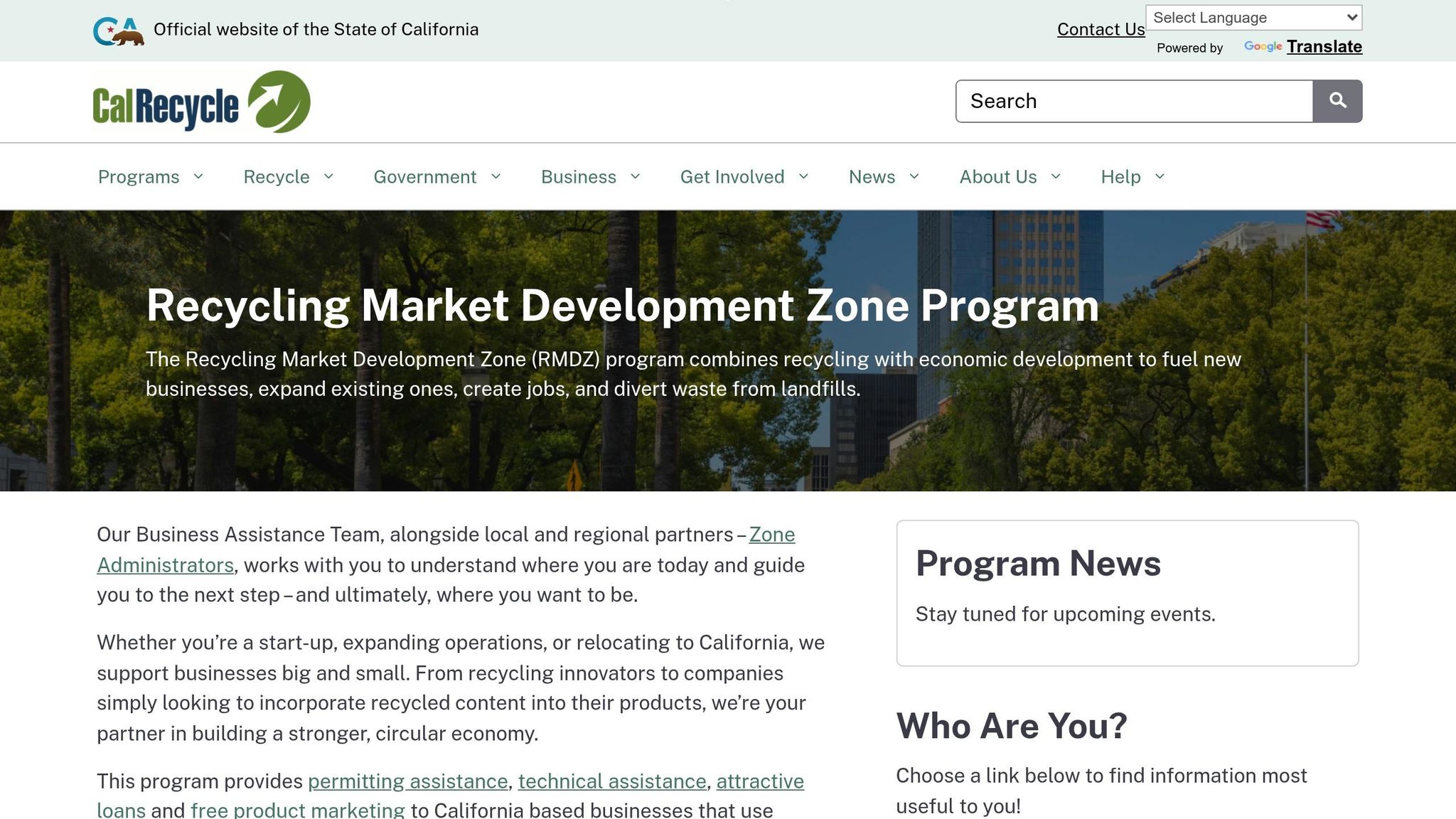
The RMDZ Loan Program supports businesses and nonprofits that transform post-consumer or post-industrial waste into new products. To qualify, applicants must operate within designated zones. Eligible entities include for-profit businesses, nonprofit organizations (excluding private schools), and local government bodies.
Here’s what you need to know:
- Loan Amount: Up to $2 million or 75% of the project cost, whichever is lower.
- Interest Rate: Around 4%, depending on financial qualifications.
- Repayment Terms: Up to 10 years for equipment purchases or 15 years for real estate investments.
To get started, submit an application form or email BZAssist@CalRecycle.ca.gov. For questions about financial eligibility, reach out to Loans@calrecycle.ca.gov.
Greenhouse Gas Reduction Loan Program
The GHG Loan Program is tailored for projects that convert waste into useful products while cutting down greenhouse gas emissions. This program supports infrastructure for processing California-generated organics and recyclables, with a focus on composting, anaerobic digestion, and advanced recycling methods.
Key details include:
- Loan Amount: Up to $5 million per project.
- Requirements: Applicants must demonstrate measurable reductions in greenhouse gas emissions.
When applying, be ready to provide detailed metrics on how your project will lower emissions.
Beverage Container Recycling Loan Program
The BCRL program is designed to help organizations involved in recycling California Redemption Value (CRV) beverage containers. To qualify, applicants must be certified or registered with CalRecycle. This program emphasizes funding for capital equipment and infrastructure that boosts the collection and processing of beverage containers statewide.
Tire Equipment Loan Program
The TELP focuses on financing equipment used to recycle waste tires into new products. Eligible applicants include waste tire processors, manufacturers of tire-derived products, and businesses using waste tires generated in California. The program aims to expand tire recycling by funding equipment that transforms waste tires into useful materials and products.
How to Apply for CalRecycle Funding
CalRecycle processes most grant and loan applications through its online Grants Management System (GMS). To get started, visit the "Application and Grant Management Tools" page, where you'll find essential forms, search features, and helpful site guidance. Each grant or loan listing provides key details like eligibility criteria, funding amounts, grant timelines, and information about past recipients.
To improve your chances, check out the scoring criteria and grant writing tips available on the Tools page. Make sure to register for a GMS account early and confirm your organization type to avoid any eligibility issues. Additionally, pay close attention to the deadlines and submission requirements for each program to ensure your application is completed on time.
Deadlines differ depending on the program. For example, Cycle 37 of the Local Enforcement Agency Grant Program closes on May 7, 2026, while Cycle 5 of the Beverage Container Redemption Innovation Grant Program remains open until June 30, 2026. Some loan programs, like the Recycling Market Development Zone Loan Program and the Greenhouse Gas Reduction Loan Program, accept applications on a rolling basis, giving you the flexibility to apply when it suits you.
If you need assistance, you can email CalRecycle at Grants@calrecycle.ca.gov or sign up for their listserv to stay updated on the latest information.
How Rica Recycling Supports Local Sustainability
CalRecycle provides funding to strengthen recycling infrastructure across California, and Rica Recycling brings that vision to life at the local level. Based in the San Francisco Bay Area, Rica Recycling specializes in certified electronics recycling, IT asset recovery, and secure data destruction. These services align with the state's goal of shifting from a throwaway culture to a fully circular economy. By focusing on local needs, Rica Recycling connects state-level initiatives with tangible community benefits.
CalRecycle's mission underscores this commitment:
"Protecting California's environment and climate for the health and prosperity of future generations through the reduction, reuse and recycling of California resources, environmental education, disaster recovery and the transition from a disposable to a fully circular economy."
Rica Recycling embodies this mission with a 100% landfill-free policy, ensuring that electronics are recycled rather than discarded. Its IT asset recovery program extends the life of devices through refurbishment and reuse - an essential step in building a resilient circular economy, as highlighted by CalRecycle. Additionally, the company’s certified secure data destruction services protect sensitive information for businesses and organizations. For electronics that can no longer be reused, Rica Recycling employs certified recycling methods to recover materials in compliance with California's stringent e-waste regulations.
Conclusion
CalRecycle funding programs serve as a critical resource for California’s shift from traditional waste disposal to a circular economy. These grants and loans enable local governments, businesses, and organizations to develop the infrastructure needed to transform waste into reusable resources. By May 2026, 92% of California communities required to implement residential organic waste collection programs reported compliance, while 100% of required communities expanded efforts to rescue unsold, edible food for people in need. These efforts are expected to reduce climate pollution on a scale equal to taking 3 million cars off the road.
For businesses pursuing zero-waste goals, CalRecycle’s ongoing loan opportunities - such as the Recycling Market Development Zone (RMDZ) and Greenhouse Gas Reduction (GHG) loans - offer essential support for infrastructure projects. These programs help turn post-consumer materials into new products, delivering both environmental and economic benefits. Additionally, they provide businesses with resources to adapt to evolving state regulations.
Rica Recycling adds another layer of support by offering certified electronics recycling, secure data destruction, and IT asset recovery. Together, state funding and specialized services provide a practical route for organizations to meet sustainability goals while safeguarding sensitive data and minimizing landfill contributions.
Local governments and businesses can tap into CalRecycle funding to modernize infrastructure and reduce their environmental footprint. The Grants Management System (GMS) provides helpful tools, such as grant writing advice and scoring criteria, to improve applicants’ chances of success.
FAQs
Should I apply for a CalRecycle grant or a loan?
Choosing between a CalRecycle grant or loan comes down to what your project needs most. Grants are a great option if you're working on initiatives like circular waste systems. They don't need to be repaid, but they come with strict requirements and a competitive application process. On the other hand, loans, such as the Tire Equipment Loan Program, provide access to larger funding amounts. However, they do need to be repaid. Carefully review the eligibility criteria, deadlines, and terms to determine which option aligns best with your project's goals.
What documents do I need before applying in CalRecycle’s GMS?
Before you start your application in CalRecycle’s GMS, make sure you’ve gathered all the necessary documents. This includes the completed application form, any required supporting materials, and any authorization or certification documents specified in the application guidelines. Take the time to review these guidelines thoroughly to ensure you meet all the requirements before submitting your application.
How can my organization use CalRecycle funding with Rica Recycling for e-waste?
Your organization can tap into CalRecycle funding to boost e-waste recycling efforts. This includes opportunities to collaborate with certified recyclers like Rica Recycling. These funds can help cover essential services such as:
- E-waste collection: Conveniently gather and manage discarded electronics.
- Secure data destruction: Protect sensitive information with proper disposal methods.
- Responsible recycling: Ensure discarded materials are processed in line with environmental standards.
Rica Recycling also guarantees compliance with California's e-waste regulations, helping your organization align with sustainability goals while making the most of CalRecycle grants or loans.