
Covered Electronic Waste Program: Overview
The Covered Electronic Waste (CEW) Recycling Program is California’s system for managing the recycling and disposal of certain electronic devices. Established under the Electronic Waste Recycling Act of 2003, it aims to reduce hazardous waste and offers free recycling options funded by fees paid at the point of sale. As of January 1, 2026, the program includes devices with non-removable batteries, addressing risks posed by modern electronics like smartphones and earbuds. Key points:
- Funding: Fees collected at purchase fund recycling efforts, shifting costs from taxpayers to producers and consumers.
- Covered Devices: Video display devices (e.g., TVs, monitors) and battery-embedded products (e.g., smartphones, earbuds).
- Fee Structure: Fees range from $6 to $10 for screens and 1.5% of the price (capped at $15) for battery-embedded devices.
- Manufacturer and Retailer Rules: Labeling, reporting, and compliance are required to sell devices in California.
- Program Goals: Reduce hazardous materials, promote recycling, and encourage responsible e-waste management.
This program reflects California’s commitment to addressing e-waste challenges and ensuring proper disposal of harmful materials.
Legal Framework and Program History
These legislative milestones lay the foundation for California's approach to tackling e-waste challenges.
The Electronic Waste Recycling Act of 2003 (SB 20/50)
In September 2003, California took a groundbreaking step by becoming the first state to implement an e-waste recycling system through the Electronic Waste Recycling Act. At the time, the U.S. was discarding over 4.3 million tons of appliances and electronics annually, while California households alone had amassed an estimated 6,000,000 outdated computer monitors and TVs. Each year, about 10,000 computers and televisions in the state became obsolete, but only 20% were being recycled.
To address this growing problem, the Act introduced a funding model that shifted the financial burden of e-waste management. Starting July 1, 2004, retailers began collecting an Electronic Waste Recycling Fee at the point of sale. These fees fund the Electronic Waste Recovery and Recycling Account, which reimburses authorized collectors and recyclers, allowing for free collection services.
The legislation also placed new responsibilities on manufacturers. As of January 1, 2005, manufacturers were required to label all covered devices with their brand name and, by July 1, 2005, submit annual reports detailing hazardous materials. Additionally, California aligned with European Union standards by banning the sale of devices containing high levels of heavy metals, effective January 1, 2007. The Act aimed to eliminate stockpiled and outdated electronic devices entirely by December 31, 2007. These measures set a strong precedent for future e-waste management policies.
2022 Updates Under Senate Bill 1215
In response to evolving environmental challenges, California expanded its e-waste program in September 2022 with Senate Bill 1215. This legislation introduced covered battery-embedded products (CBEP) - devices with batteries that cannot be easily removed using standard household tools. The law addressed concerns over the rise of items like smartphones, tablets, and wireless earbuds, which often contain non-removable lithium-ion batteries posing environmental risks.
Beginning January 1, 2026, consumers purchasing new or refurbished CBEPs will pay a Covered Battery-Embedded Waste Recycling Fee equal to 1.5% of the retail price, capped at $15.00 per product. CalRecycle determines the fee rate annually on October 1, with adjustments taking effect the following January. Starting August 1, 2028, the agency may establish different fee categories based on battery types.
Manufacturers also face stricter requirements. They must identify products that qualify as CBEPs, label devices with both their brand name and battery chemistry, maintain records for at least three years, and provide consumers with recycling information. Businesses can also schedule an e-waste pickup to ensure compliance. Certain products, such as Class I, II, and III medical devices, energy storage systems, and electronic nicotine delivery systems, are excluded from the CBEP definition. These updates demonstrate California’s ongoing efforts to address emerging e-waste concerns and encourage sustainable recycling practices.
sbb-itb-855056e
Covered Devices and Program Scope
Devices Covered by the Program
The program focuses on two main categories: Video Display Devices (VDDs) and Covered Battery-Embedded Products (CBEPs).
VDDs include any device with a screen larger than four inches (measured diagonally) that the Department of Toxic Substances Control has identified as potentially hazardous. This category includes televisions (CRT, LCD, LED, OLED, or plasma) and devices like monitors, laptops, tablets, portable DVD players, and smart displays.
CBEPs, starting January 1, 2026, encompass devices with non-removable batteries. This includes most modern smartphones, many wireless earbuds, smartwatches, and similar electronics with integrated batteries. Manufacturers are required to evaluate their products and notify retailers by April 1 for VDDs and July 1 for CBEPs.
By focusing on these categories, the program ensures that recycling fees are applied to devices posing greater environmental risks, forming the basis for compliance and fee application.
Exclusions and Device Definitions
Certain devices are excluded from the program. For VDDs, exclusions apply to devices integrated into motor vehicles, industrial or commercial equipment, and major household appliances such as refrigerators, washers, dryers, dishwashers, and microwave ovens. CBEPs also have specific exclusions, such as Class II and III medical devices, energy storage systems as defined by California's Public Utilities Code, and electronic nicotine delivery systems (vapes).
The program uses an "ease of removal" test to determine if a battery-powered device qualifies as a CBEP. If a battery can be removed with basic household tools, like a screwdriver, it is classified as a "loose battery" and excluded from the program. Similarly, battery packs and power banks that can be manually removed without tools are not considered CBEPs. Smartphones with non-removable batteries, however, are subject to CBEP fees.
Additionally, used devices that have not been refurbished are exempt from program fees. Refurbished devices - those tested, repackaged, and labeled by manufacturers to meet factory specifications - are treated the same as new products and incur the same fees.
Program Funding and Fee Structure
California E-Waste Recycling Fee Structure and Covered Devices
Electronic Waste Recycling Fee
California's Covered Electronic Waste (CEW) program operates through consumer fees collected at the point of sale or lease for new and refurbished devices. These fees apply to both Video Display Devices and, starting January 1, 2026, Covered Battery-Embedded Products.
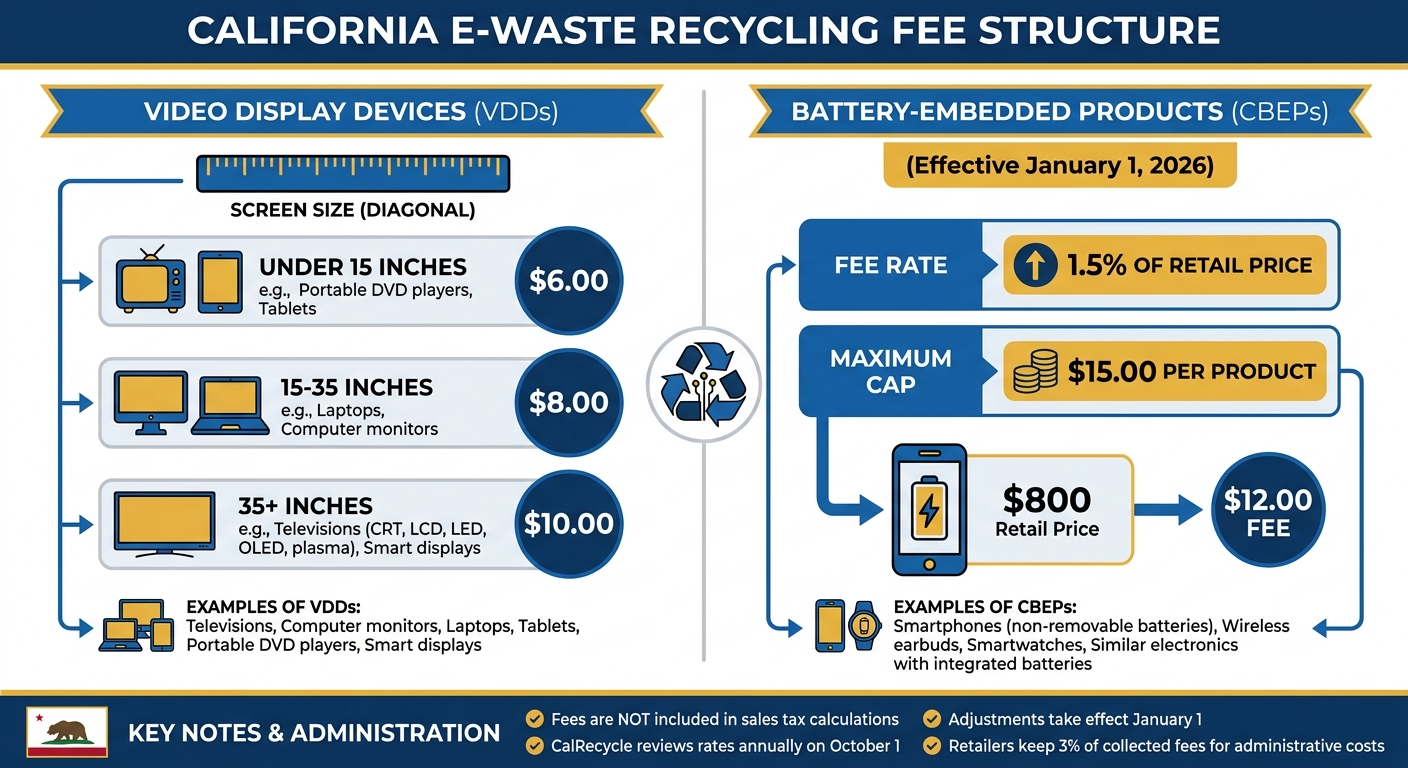
The fee rates depend on the type and size of the device. For Video Display Devices, the fees are based on the diagonal screen size: $6.00 for screens under 15 inches, $8.00 for screens 15–35 inches, and $10.00 for screens 35 inches or larger. For Covered Battery-Embedded Products, the fee is 1.5% of the retail price, capped at $15.00. For example, a smartphone priced at $800 would carry a $12.00 fee.
These fees are not included in sales tax calculations. CalRecycle reviews the rates annually by October 1, with any adjustments taking effect the following January 1. The maximum fee for Covered Battery-Embedded Products is updated yearly based on the California Consumer Price Index. This system ensures consistent funding to support the program's operations and environmental initiatives.
How Fees Are Used
The fees collected are deposited into the Electronic Waste Recovery and Recycling Account (EWRRA), which finances the program's activities. This structure reflects California's dedication to responsible e-waste management.
The funds are primarily used to make recovery payments to authorized collectors and recycling payments to approved recyclers who handle discarded devices in compliance with state standards. Additionally, the revenue supports administrative costs for agencies like CalRecycle, the Department of Toxic Substances Control, and the California Department of Tax and Fee Administration.
Retailers are allowed to keep 3% of the fees they collect to cover their collection and transmission expenses. The program also maintains a reserve fund, capped at 5% of the account balance, and allocates up to 2% of annual deposits for public education efforts on e-waste hazards and recycling opportunities.
Compliance Requirements and Program Operations
The program's mission to reduce hazardous e-waste relies on strict rules and operational standards to ensure compliance across all participants.
Collector and Recycler Approval Process
Collectors and recyclers must obtain approval from CalRecycle before managing covered electronic waste or filing payment claims. Once approved, they must follow the operational and business standards outlined in the California Code of Regulations (Title 14, Division 7, Chapter 8.2, Article 2.2). Recyclers, in particular, are required to use approved methods for processing and ensure proper removal of materials from the recycling stream. They must also submit recycling payment claims in compliance with strict procedures. To meet audit requirements, participants must maintain detailed records and file Net Cost Reports as needed.
While collectors and recyclers focus on operational compliance, manufacturers and retailers must meet their own set of regulatory standards.
Manufacturer and Retailer Obligations
Manufacturers are required to visibly label all covered devices. Without proper labeling, these devices cannot be sold in California. Additionally, manufacturers must submit annual reports to CalRecycle by July 1, detailing information such as device sales, hazardous material baselines, recycled content estimates, and measures taken to design products for recycling. They also need to provide consumers with clear recycling instructions, which can be shared through toll-free numbers, websites, or product packaging. Retailers must be informed about the compliance status of the devices they sell.
Retailers, on the other hand, must register with the California Department of Tax and Fee Administration (CDTFA) to collect recycling fees at the point of sale or lease. Retailers with an average monthly fee liability of $20,000 or more are required to make payments via electronic funds transfer. The CDTFA also mandates that all filings be completed electronically through its online services.
To ensure compliance, the program enforces strict penalties for violations.
Enforcement and Penalties
CalRecycle and the Department of Toxic Substances Control (DTSC) oversee compliance and can determine if a manufacturer is non-compliant. If a manufacturer fails to meet requirements, selling their products in California becomes illegal. Violators may also face administrative civil penalties. State procurement rules further support compliance by requiring bidders for state agency contracts to adhere to the Electronic Waste Recycling Act. Non-compliance can disqualify bidders from procurement opportunities, reinforcing California's environmental goals.
Retailers who unknowingly sell a covered device without collecting the required fee are not penalized if the error is due to CDTFA oversight. Exporters must also follow strict handling regulations to prevent illegal dumping and ensure responsible e-waste management.
Program Impact and Results
California's Covered Electronic Waste Program has reshaped how electronic waste is managed, delivering clear benefits for both the environment and businesses. By establishing a solid regulatory framework and fee structure, the program has shifted the burden of responsibility from taxpayers to producers and consumers. This approach highlights California's leadership in e-waste management, setting a model for innovative practices that benefit both the economy and the environment.
California's E-Waste Recycling Leadership
Through this program, California has emerged as a leader in e-waste recycling, successfully recovering valuable materials while preventing toxic substances from polluting the environment. The recycling process extracts metals like gold, silver, copper, palladium, platinum, lithium, and aluminum. This reduces dependency on raw material extraction, cuts energy use in manufacturing, and helps lower greenhouse gas emissions.
Additionally, the program has been instrumental in keeping hazardous substances - such as lead from Cathode Ray Tube (CRT) glass and heavy metals in circuitry - out of soil and water. The upcoming 2026 expansion to include Covered Battery-Embedded products will further enhance these efforts by targeting devices like smartphones, earbuds, and smartwatches, ensuring even more materials are recovered.
Benefits for Businesses and Organizations
The program doesn't just deliver environmental benefits - it also supports businesses and organizations by streamlining compliance and advancing sustainability goals. By funding recycling through point-of-sale fees, it keeps recycling services accessible and free for the public, while shifting costs away from local governments and taxpayers.
Moreover, the program bolsters the domestic recycling and refurbishing industry, creating green jobs and boosting the value of U.S. exports. Refurbished electronics often find new life in schools, nonprofit organizations, and low-income households, offering affordable access to essential technology. Businesses, in turn, can meet compliance requirements and environmental targets by partnering with certified recyclers who ensure proper handling and secure data destruction.
Rica Recycling is a prime example of how businesses can align with these goals. Offering certified electronics recycling and IT asset recovery services in the Bay Area, Rica Recycling provides convenient pickup and drop-off options, secure data destruction, and a commitment to a 100% landfill-free policy. This allows organizations to stay compliant while actively contributing to California's environmental leadership.
Conclusion
California's CEW Program stands as a model for tackling e-waste responsibly. By placing the financial burden on producers and consumers instead of taxpayers, it has created a reliable funding system that makes recycling both accessible and affordable, while protecting the environment from harmful waste.
The program’s strength lies in its ability to adjust and grow. Starting with video display devices, it will expand on January 1, 2026, to include battery-embedded products, addressing new waste challenges and evolving technologies. This approach underscores California’s leadership in e-waste management.
The program not only protects the environment but also simplifies compliance for businesses. Working with certified recyclers ensures electronic waste is handled correctly, sensitive data is securely destroyed, and California's strict environmental regulations are met. Rica Recycling supports Bay Area organizations with convenient pickup and drop-off services, all while maintaining a 100% landfill-free commitment.
With its goal of achieving complete collection and recycling of covered electronic waste, California demonstrates its dedication to environmental progress. By holding manufacturers accountable, prioritizing consumer convenience, and enforcing robust regulations, the CEW Program continues to set a high standard for e-waste management across the nation. This comprehensive approach cements California’s role as a leader in sustainable e-waste solutions.
FAQs
How can I tell if my device is a CBEP with a non-removable battery?
A device qualifies as a CBEP (Covered Battery-Embedded Product) with a non-removable battery if its battery cannot be taken out easily using common household tools, such as screwdrivers or coins. This classification is outlined under California regulations and pertains to devices specifically designed with embedded batteries that users cannot service themselves.
Where can I take covered electronics for free recycling in California?
Covered electronics can be recycled at no cost at facilities that participate in California's Covered Electronic Waste Recycling Program. To find these locations, visit the CalRecycle website. Before heading out, it’s smart to call ahead to verify their services, operating hours, and whether any additional fees might apply.
Do refurbished or used devices still have to pay the CEW recycling fee?
Refurbished or used devices are required to pay the CEW recycling fee if they are sold as new or refurbished products at retail. This fee is charged at the point of sale or lease for all covered electronic devices, including refurbished items, as mandated by California regulations.