
ITAD Services and Local Government Recycling Programs
Every year, the U.S. generates 6.9 million tons of electronic waste, yet only 15% is recycled properly. IT Asset Disposition (ITAD) services and local government recycling programs aim to tackle this issue, but they do so in different ways. Here's a quick breakdown:
- ITAD Services: Ideal for businesses and organizations handling sensitive data. They focus on secure data destruction, refurbishing, resale, and detailed compliance documentation. ITAD services often recover value from used electronics, turning disposal into a potential revenue stream.
- Local Government Recycling Programs: Designed for community convenience, offering where to recycle your electronic waste through free or low-cost drop-off sites and collection events. These programs prioritize accessibility and material recovery but may lack the advanced data security measures that ITAD services provide.
Quick Comparison
| Feature | ITAD Services | Local Government Recycling |
|---|---|---|
| Goal | Secure data destruction, resale | Prevent landfill waste |
| Data Security | Certified wiping/shredding | Basic destruction methods |
| Accessibility | Pickup (25+ devices) | Drop-off sites, events |
| Financial Impact | Recover costs via resale | Free or low-cost for residents |
Best Approach: Use ITAD for data-sensitive devices and local programs for non-sensitive electronics. This hybrid strategy balances security, cost recovery, and disposal convenience.
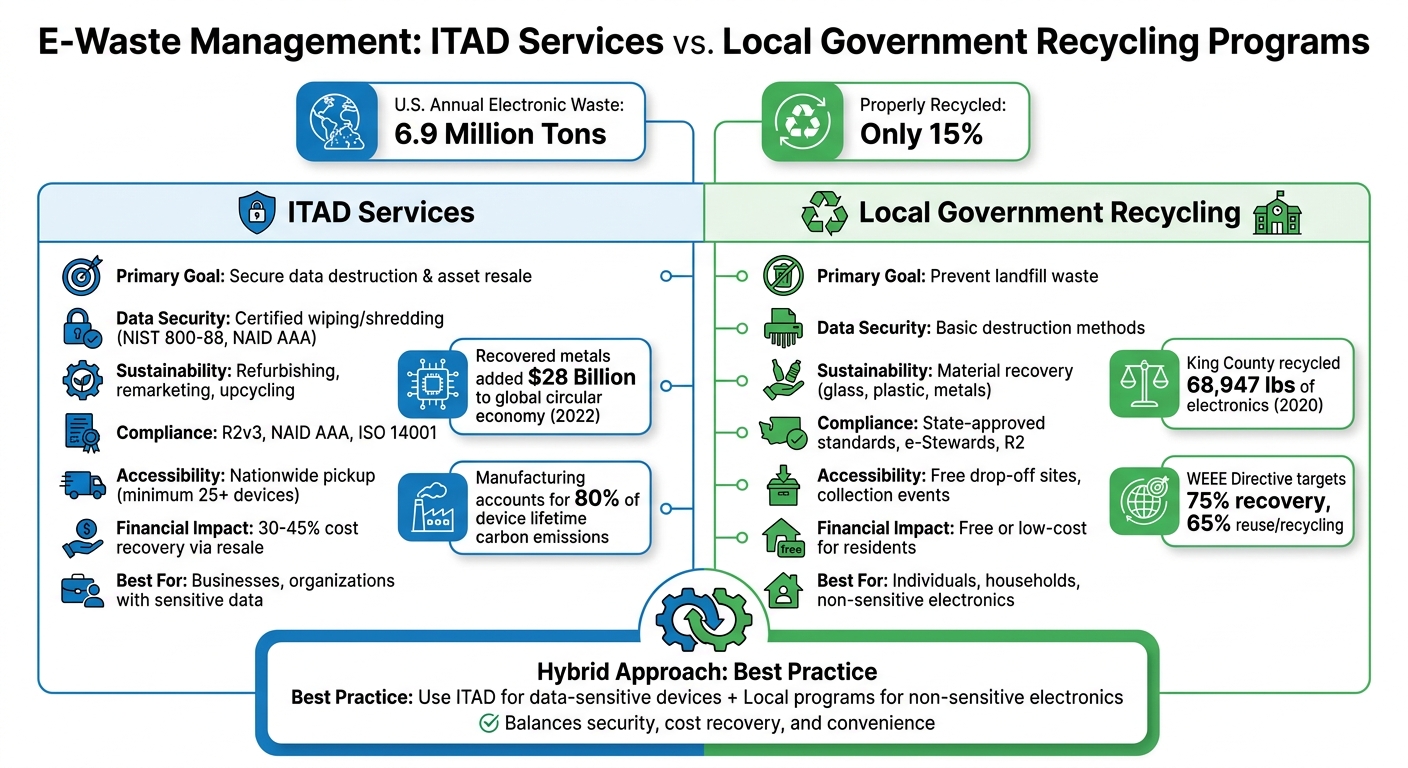
ITAD Services vs Local Government Recycling Programs Comparison
1. ITAD Services
Data Security
ITAD providers ensure sensitive data is securely handled using certified sanitization methods that adhere to federal standards. Following guidelines like NIST SP 800-88, they employ three main techniques: Clear (basic software erasure), Purge (permanent deletion), and Destroy (physical shredding). For government agencies managing classified information, mobile shredding units can destroy hard drives on-site before equipment is removed - an essential service for departments dealing with sensitive citizen records or law enforcement data.
Providers certified under NAID AAA undergo unannounced audits and maintain a strict chain-of-custody process. Every step, from pickup to final destruction, is thoroughly documented. This level of tracking ensures compliance with regulations such as HIPAA, FISMA, and various state data privacy laws.
Compliance with Regulations
ITAD services simplify the complex legal landscape surrounding environmental responsibility, especially for local governments. Vendors with R2v3 (Responsible Recycling) certification ensure that downstream processors meet stringent environmental standards, while ISO 14001 certification signals a commitment to sustainable practices throughout the process.
For IT and telecom equipment, the WEEE Directive sets ambitious targets of 75% recovery and 65% reuse/recycling by weight. ITAD providers support these goals with detailed documentation and weighted scoring matrices, which also help meet public records requirements during procurement. Beyond meeting legal obligations, these services promote sustainability by prioritizing reuse and recycling over disposal.
Sustainability Practices
ITAD services go beyond compliance to actively contribute to the circular economy. Instead of defaulting to recycling, they emphasize repair, refurbishment, and resale, extending the lifespan of IT assets. This approach reduces the need for new manufacturing, which can account for up to 80% of a device's lifetime carbon emissions. When reuse isn’t an option, providers implement zero-landfill and zero-incineration policies, recovering raw materials like metals, glass, and plastics from non-functional components. For instance, in 2022 alone, recovered metals added $28 billion to the global circular economy.
"IT asset recycling not only limits the production of electronic waste, but also limits the demand for brand-new IT devices and materials." – Evernex
Additionally, asset recovery programs can reduce disposal costs by 30% to 45% through the resale of refurbished equipment. This turns what might have been a financial burden into a potential revenue stream for government agencies operating on tight budgets.
Accessibility and Convenience
Specialized ITAD vendors enhance convenience by offering multi-site pickups, flexible scheduling, and real-time tracking through platforms like ServiceNow. Many even provide complimentary pickups for government agencies, schools, and non-profits. Larger jurisdictions can benefit from consolidated procurement strategies, such as Indianapolis's citywide "Unigov" ITAD contracts, which standardize compliance and achieve cost savings across departments. These logistical efficiencies make it easier for governments to manage e-waste securely and sustainably.
In the San Francisco Bay Area, Rica Recycling sets a strong example of ITAD in action. Their certified, secure, and eco-friendly e-waste recycling services align with rigorous regulatory standards while actively supporting local government sustainability initiatives.
sbb-itb-855056e
2. Local Government Recycling Programs
Sustainability Practices
Local government recycling programs play a vital role in keeping electronics out of landfills while recovering materials like glass, plastic, and metals. By requiring recyclers to hold certifications such as R2 or e-Stewards, these programs ensure that valuable resources are recovered efficiently and that hazardous materials, including heavy metals, are managed responsibly. This not only conserves resources but also helps protect soil and groundwater from contamination.
"Recycling conserves resources and keeps toxic materials out of the landfill. Glass, plastic, and metals can be recycled and used again in other products." – King County Department of Executive Services
For example, in 2020, King County, Washington, recycled 68,947 pounds of electronics as part of its Sustainable Purchasing Executive Policy (CON 7-22-EP). This policy mandates the use of e-Stewards certified recyclers by county agencies, demonstrating a commitment to sustainability and resource conservation.
Compliance with Regulations
Local governments must navigate a web of state and federal e-waste regulations. Landfill bans, for instance, require municipalities to update signage at waste transfer stations and closely monitor waste flows. In North Carolina, a ban on disposing of computer equipment and televisions, effective since July 1, 2011, has pushed municipalities to actively promote recycling options.
Programs like E-Cycle Washington add another layer of regulatory requirements. Local governments in smaller cities and counties must register as official collectors with the state Department of Ecology to participate in the manufacturer-funded Standard Plan. These entities are also required to submit annual Satisfaction Reports by March 1, assessing service accessibility and outreach efforts. Similarly, Wisconsin's "Responsible Units" must educate residents about landfill bans and provide clear guidance on recycling locations. These compliance measures work in tandem with ITAD services to encourage sustainable e-waste management.
Accessibility and Convenience
Making recycling convenient for residents is a top priority for local programs. Many offer permanent drop-off sites, host periodic one-day collection events, and partner with retailers to simplify access. Manufacturer-funded initiatives, such as E-Cycle Wisconsin and E-Cycle Washington, further ease the process by providing free recycling for households and small businesses, reducing the financial burden on taxpayers.
"E-Cycle Washington now has a FREE, convenient and environmentally responsible recycling program for computers, monitors, laptops and televisions for households and small businesses." – King County
In smaller communities, collaboration is often key. Joint collection events and shared vendor contracts help maximize efficiency. Public outreach efforts, including state-provided toolkits, social media campaigns, and informational brochures, ensure residents are well-informed about where and how to recycle their electronics.
Data Security
While local government recycling programs excel in accessibility and environmental compliance, their approach to data security can be less rigorous. Many municipal policies require contracted recyclers to securely destroy personal information on collected devices. However, these programs often lack the detailed audit trails and adherence to NIST SP 800-88 sanitization standards that ITAD services provide. For most residents disposing of personal devices, the security measures offered by local programs are adequate. However, agencies handling sensitive or classified information may need to rely on more advanced solutions to meet stricter security requirements. This distinction highlights a key difference between local recycling programs and ITAD services, particularly when data security is a critical concern.
Advantages and Disadvantages
This section dives into the practical strengths and limitations of ITAD services and local government recycling programs, offering a side-by-side comparison of their roles in e-waste management.
ITAD services focus on asset recovery and extending the lifespan of electronics. By refurbishing, remarketing, and upcycling devices, these services contribute to a circular economy rather than simply discarding equipment. For businesses, this can be a win-win: ITAD programs often offset disposal costs by 30–45% through certified resale and liquidation processes. They also prioritize data security, adhering to NIST 800-88 standards and maintaining a documented chain of custody. However, one drawback is that ITAD services typically require a minimum of 25 devices for pickup, which may limit their usefulness for individuals or small-scale disposals.
On the other hand, local government recycling programs stand out for their accessibility and community reach. They provide free or low-cost drop-off locations, host collection events, and eliminate financial barriers for residents and small businesses. These programs aim to prevent e-waste from ending up in landfills, aligning with state environmental goals. However, they often lack advanced data security measures and do not offer the financial recovery opportunities that ITAD services provide.
Here’s a quick comparison of the two approaches:
| Feature | ITAD Services | Local Government Recycling |
|---|---|---|
| Primary Goal | Extending lifecycle and recovering value | Preventing landfill waste |
| Sustainability | Refurbishing, remarketing, upcycling | Basic recycling of materials |
| Compliance | Certifications like R2v3, NAID AAA, NIST 800-88 | State-approved standards, ISO 14001 |
| Accessibility | Nationwide pickup (minimum 25+ units) | Local drop-off centers, events |
| Data Security | Certified wiping and shredding | Basic destruction methods |
| Financial Impact | Revenue recovery via remarketing | Free or low-cost disposal services |
To get the best of both worlds, many organizations adopt a hybrid approach. For high-value or data-sensitive assets like servers and laptops, ITAD services are ideal for maximizing return on investment and ensuring security. Meanwhile, less sensitive, non-data-bearing items can be directed to local recycling programs. This strategy balances cost recovery, regulatory compliance, and sustainability while addressing data security concerns.
At Rica Recycling, we take pride in offering certified IT asset disposition services that prioritize both data security and environmental responsibility. Every step of our process is designed to deliver peace of mind and support sustainable e-waste management.
Conclusion
When deciding between ITAD services and local government recycling, it all comes down to your specific e-waste needs. If you're an individual or a small household looking to get rid of non-sensitive electronics - like old cables, monitors, or appliances - local government drop-off sites are a convenient, free way to recycle while supporting community recycling initiatives.
On the other hand, businesses, schools, and organizations dealing with data-bearing devices such as laptops, servers, or storage units should turn to certified ITAD providers. These services ensure secure and compliant data destruction, which is crucial for sensitive information and meeting regulatory requirements like HIPAA or FISMA.
A hybrid approach often works best for many. For example, organizations might rely on ITAD providers for high-value, data-sensitive equipment while routing non-sensitive items to local recycling programs. This approach helps balance financial returns, environmental responsibility, and security needs.
"The most effective government ITAD programs combine rigid security protocols with flexible logistics. Vendors who understand budget cycles and accommodate fiscal year-end equipment refreshes while maintaining compliance documentation provide greatest value to public sector clients." - STS Electronic Recycling
FAQs
How do I know if a device is data-sensitive?
Devices are considered data-sensitive if they store information that demands secure protection. This means taking steps to ensure all sensitive information is thoroughly erased before disposal, preventing any unauthorized access once the device is no longer in use. Examples of such devices include computers, laptops, and servers, which often hold personal, financial, or organizational data.
What proof do I get after data destruction?
After your data has been securely erased, you'll usually be given a certificate of data destruction. This certificate acts as proof that the process was handled properly, meeting both data security requirements and environmental guidelines.
Can I combine ITAD with local recycling?
IT asset disposition (ITAD) services can complement local recycling programs to manage e-waste responsibly while aligning with sustainability objectives. By working together, these efforts ensure electronics are disposed of properly, with a focus on protecting the environment and maintaining data security.