
Checklist for Choosing an ITAD Partner
When retiring IT equipment, selecting the right IT Asset Disposition (ITAD) partner is critical to protect your data, comply with regulations, and avoid hefty fines. A poor choice can lead to data breaches, environmental violations, and financial risk. Here’s what you need to know:
- Certifications Matter: Look for R2v3, e-Stewards, NAID AAA, ISO 14001, and SOC 2 Type II certifications. These ensure compliance with data security and recycling standards.
- Data Security Is Key: Verify secure data destruction methods (e.g., NIST 800-88, shredding) and demand detailed Certificates of Destruction.
- Regulatory Compliance: Ensure adherence to laws like HIPAA, PCI-DSS, and California’s e-waste regulations (SB20/SB50).
- Transparency: Request audit trails, serialized asset tracking, and downstream recycler documentation.
- Service Options: Choose a partner offering flexible pickups, resale services, and landfill-free policies.
- Environmental Responsibility: Confirm zero-landfill practices, proper hazardous material handling, and ESG reporting.
- Customer Support: Test responsiveness, demand clear SLAs, and ask for client references.
For businesses in California, Rica Recycling provides certified services that meet strict legal and security requirements. Use these steps to evaluate ITAD providers and safeguard your business.
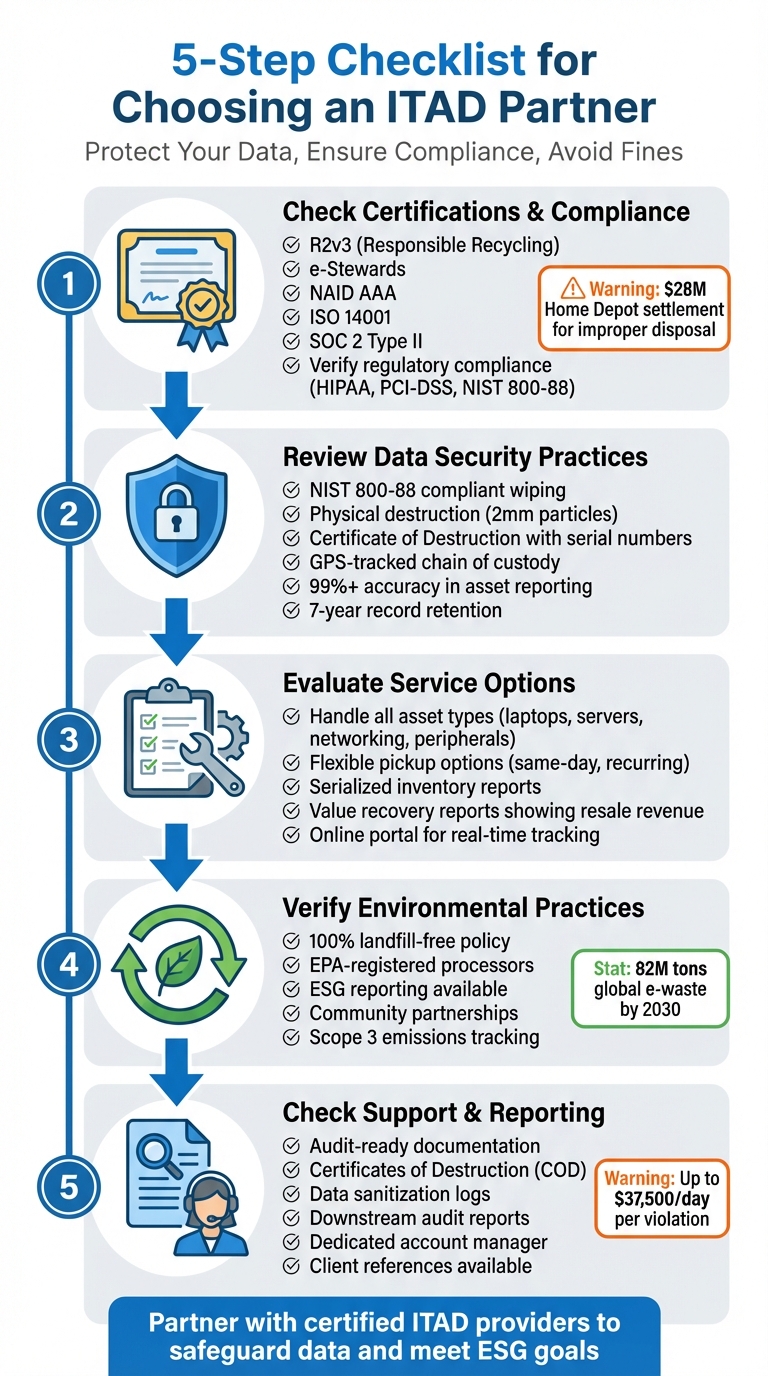
5-Step Checklist for Choosing a Certified ITAD Partner
Step 1: Check Certifications and Legal Compliance
When choosing an ITAD partner, certifications and compliance with legal standards should be top priorities. Certifications go beyond memberships - they prove that a third party has audited the company to ensure adherence to strict standards. Memberships, on the other hand, often just require a fee.
Confirm Industry Certifications
Certain certifications highlight a provider’s commitment to high operational standards. Here are the key ones to look for:
- R2v3 (Responsible Recycling): This global standard emphasizes responsible electronics reuse and recycling, with a focus on downstream vendor checks and prioritizing reuse.
- e-Stewards: This certification bans exporting hazardous e-waste to developing countries and prohibits the use of prison labor, aligning with strong ESG commitments.
- NAID AAA: Widely recognized for data destruction, this certification includes unannounced audits, forensic drive tests, and stringent physical security measures.
- ISO 14001: This confirms the provider has a formal Environmental Management System in place.
- SOC 2 Type II: Ideal for sensitive data, this certification demonstrates audited internal security controls.
- DLIS: Essential for handling military-grade technical data.
After verifying these certifications, make sure the provider complies with all relevant regulations.
Review Regulatory Compliance
Regulatory compliance is non-negotiable. For example, California enforces some of the nation’s strictest e-waste laws, and non-compliance can lead to hefty penalties. In 2018, Home Depot faced a $28 million settlement for improper hazardous e-waste disposal.
Check for adherence to EPA guidelines and specific regulations like:
- HIPAA: For healthcare data.
- PCI-DSS: For payment processing systems.
- NIST 800-88 Rev. 1 or DoD 5220.22-M: For media sanitization standards.
These ensure proper data destruction and compliance with industry-specific requirements.
Request Audit Trail Documentation
A reliable ITAD partner will provide detailed audit trails for every step of the process. This includes serialized tracking for each asset, GPS transport logs, and thorough vendor due diligence reports. A 2023 UNITAR report revealed that only 22.3% of "recycled" e-waste actually reached appropriate facilities.
Before committing, ask for sample reports that include:
- Asset lists
- Sanitization certificates
- Policies on subcontractor evaluations
"In a state like California - where audits, investigations, vendor assessments, and contract scrutiny are common - chain of custody is often the difference between 'we believe we did it right' and 'we can prove we did it right.'" - DES Technologies
Proper documentation ensures transparency and accountability throughout the process.
sbb-itb-855056e
Step 2: Review Data Security Practices
Protecting data is a top priority in IT asset disposition (ITAD). Many hardware-related data breaches happen because sensitive information isn’t properly erased or monitored at the end of its lifecycle. Your ITAD partner should have strong processes in place to safeguard your data from the moment they pick up the equipment to its final destruction.
Check Data Destruction Methods
For functional drives intended for reuse, software-based wiping that complies with NIST 800-88 standards is essential. For devices that are highly sensitive or no longer functional, physical destruction methods like shredding or cryptographic erasure are more suitable. Advanced shredding technologies can reduce media to particles as small as 2mm. The method selected should match the type of media being processed.
Always request a Certificate of Destruction for each asset. This certificate should include critical details such as serial numbers and the exact destruction method used. However, secure destruction is just one part of the equation - continuous tracking of assets throughout the process is equally important.
Verify Chain-of-Custody Tracking
After ensuring proper destruction methods, the next step is verifying secure chain-of-custody tracking. A dependable ITAD partner should maintain a secure, documented chain of custody from the initial pickup to the final stage of destruction. This includes recording every transfer with timestamps, signatures, and condition reports to create a reliable audit trail.
"The chain of custody is only as strong as its weakest link - and that link is often inside your own organization." - Stephanie A, IER Pro
Look for providers that use trained personnel, GPS-tracked vehicles, and tamper-evident transport systems. Top-tier ITAD partners aim for over 99% accuracy in reporting on every processed asset. Additionally, regulations like HIPAA and SOX require businesses to keep data destruction records for up to 7 years, so your ITAD partner should offer long-term access to this documentation.
To ensure accuracy, compare the vendor’s manifest with your internal records and address any discrepancies immediately.
Confirm Zero Landfill Policy
A zero-landfill policy is essential for both environmental protection and data security. Reputable ITAD providers dismantle non-functional e-waste into raw materials for reuse.
This commitment should be backed by certifications such as R2v3 or e-Stewards, which involve independent audits of both environmental and data security practices throughout the recycling chain. Ask your ITAD partner how they evaluate their downstream recyclers, as data security relies on every step of the chain.
For example, Rica Recycling enforces a strict 100% landfill-free policy, ensuring both environmental responsibility and data security. They also provide certificates of data destruction for all storage devices, giving clients peace of mind.
Step 3: Review Service Options and Flexibility
When choosing an ITAD partner, it’s not just about data security. They should also offer services tailored to your specific asset types. From laptops and desktops to servers, networking equipment, storage devices, and office electronics like printers, your provider needs to handle a wide range of IT assets. Equally important is their ability to provide flexible logistics that align with your operational needs.
Evaluate Asset Recovery Services
Different IT assets require different methods of sanitization. For devices like hard drives, SSDs, and servers, secure data removal is critical before resale or recycling. Even peripherals, such as printers, may contain internal hard drives or cached data, which need thorough inspection. This variety in processing needs highlights the importance of selecting a partner with the capability to manage all asset types effectively.
| IT Asset Category | Data Sensitivity | Handling Requirement |
|---|---|---|
| Laptops/Desktops | High | Secure drive wiping or physical destruction |
| Servers/Data Centers | Very High | Specialized removal; RAID array sanitization |
| Networking Gear | Medium | Erasure of config files, certificates, and credentials |
| Peripherals (Printers) | Low/Medium | Check for internal hard drives or cached document storage |
| Storage Media (Tapes) | High | Degaussing or physical shredding |
For large-scale projects, like decommissioning or relocating IT assets, it’s a good idea to schedule a planning call with your ITAD provider. Sharing an equipment list or photos when requesting a quote can help ensure accurate pricing and confirm their ability to handle specialized hardware. Many providers also offer refurbishment and resale services for functional equipment, which can offset disposal costs. As Quantum Lifecycle notes, "Refurbishment delivers the highest environmental and financial return, so landfills should be the last resort".
Review Pickup and Drop-Off Options
A reliable ITAD partner should offer flexible logistics. Look for options like same-day or next-day pickups for urgent projects, as well as recurring pickup plans for ongoing e-waste needs. In the Bay Area, e-waste pickup costs typically range from $79.99 to $150, depending on volume and location. Some providers also offer on-site services, such as removing equipment directly from desks, server racks, or storage areas, which enhances security and efficiency while maintaining chain-of-custody standards.
If your operations are in the Bay Area, confirm that the provider services key locations like San Francisco, San Jose, Oakland, and nearby areas such as Walnut Creek and Fremont. For example, Rica Recycling offers both pickup and drop-off options, including free drop-off for most e-waste items.
To ensure secure handling during transit, check if the provider uses GPS-monitored trucks. For larger projects, inquire about specialized services like palletizing, labeling, and rack breakdown support.
Request Value Recovery Reports
Detailed reporting is what sets a professional ITAD partner apart. Your provider should supply serialized asset inventory reports that include details like make, model, serial number, asset type, and final disposition - whether the item was resold, recycled, or destroyed. Such documentation is essential for internal audits and compliance.
Ask for value recovery reports that show how many units were resold, the resale price for each, and the percentage of revenue returned to your organization. As Exit Technologies explains, "By turning ITAD into a revenue stream, value recovery adds measurable ROI to what is often viewed as a compliance exercise".
Before committing, request a sample value recovery report to ensure it meets the needs of your finance team. Providers with centralized online portals for on-demand reporting and real-time tracking of asset status and value make the process even smoother. Some even offer guaranteed buyback programs or upfront fair-market-value assessments, which can help with budgeting for future hardware upgrades. These detailed reports complete the secure and compliant ITAD process discussed earlier.
Step 4: Review Environmental Practices
Your ITAD partner's environmental practices play a key role in ensuring sustainable asset disposition and achieving ESG goals. With global e-waste expected to hit 82 million tons by 2030, selecting a provider with strong sustainability efforts not only helps your organization meet its ESG commitments but also prevents hazardous materials from ending up in landfills. Here's how to evaluate their diversion strategies, local involvement, and ESG reporting.
Verify E-Waste Diversion Methods
Beyond data security and compliance, a provider’s environmental policies are a critical indicator of their overall reliability. Look for ITAD partners that adhere to a 100% landfill-free policy, ensuring devices are refurbished, donated, or processed for material recovery. Functional equipment should be tested and repaired to support a circular economy, while non-functional items are broken down to extract valuable materials.
Handling hazardous components like leaded CRT glass, mercury switches, and lithium-ion batteries requires specialized expertise to avoid environmental harm. Make sure your ITAD partner collaborates with EPA-registered and R2-certified processors to manage these materials responsibly. For instance, Rica Recycling has processed over 30 million pounds of e-waste in two decades while maintaining a landfill-free approach - highlighting a long-term commitment to sustainability.
Ask about their "reuse vs. recycle" ratio. Refurbishing devices typically yields better environmental and financial outcomes compared to simply recovering raw materials. Providers that engage in community diversion programs, such as hosting electronics drop-off events in partnership with local schools or governments, show a proactive effort to reduce toxic waste in places like Bay Area landfills.
Check Local Community Partnerships
Effective e-waste diversion is only part of the equation. Providers that actively engage with local communities demonstrate a deeper commitment to sustainability. Look for ITAD partners that offer revenue-sharing or donation programs for functional equipment, helping schools and nonprofits gain access to affordable technology. Some even tailor programs for K-12 schools and universities, allowing districts to generate revenue from retired Chromebooks and tablets, which can be reinvested in new tech.
A local presence is also important. Providers with facilities in areas like Hayward reduce the emissions tied to transporting heavy IT assets over long distances. Collaborations with school districts, nonprofits, and government agencies further reflect a provider’s dedication to regional sustainability efforts that go beyond basic compliance.
Request ESG Reports
Reputable ITAD providers publish Environmental, Social, and Governance (ESG) reports to document their e-waste diversion efforts and carbon reduction initiatives. These reports are essential for internal audits and communicating with stakeholders. Advanced providers can even assist in calculating Scope 3 emissions, which measure the indirect environmental impact across your supply chain.
Ask for ESG reports that include detailed downstream audit trails to ensure no illegal e-waste exporting occurs. These reports should clearly document the final destination of each asset - whether it’s recycled, resold, or destroyed - and include tracking details like make, model, and serial numbers. This level of transparency aligns with the rigorous reporting standards discussed earlier, giving you confidence in your ITAD partner's practices.
Step 5: Check Reporting and Customer Support
Thorough reporting and dependable customer support are essential for a successful ITAD partnership. Without these, even the most secure and responsible provider can leave you vulnerable to compliance issues or operational setbacks. Here’s what to look for before committing to a provider.
Review Reporting and Documentation
Your ITAD provider should deliver audit-ready documentation that covers every step of the asset lifecycle. At the very least, you should receive Certificates of Destruction (COD). These certificates confirm how assets were processed, how data was handled, and the final destination - whether reuse, resale, or recycling. This serves as legal proof of data elimination in line with regulations like HIPAA and GDPR.
Additionally, you should expect data sanitization logs detailing the method used (e.g., NIST 800-88), the outcome, technician ID, and timestamps for each device. Value recovery reports can provide insight into refurbished hardware sales, resale channels, and the residual value returned to your organization. For added assurance, downstream audit reports confirm that secondary recyclers adhere to proper recycling standards.
"An ITAD certificate is a formal document that confirms how your IT assets were processed at the end of life, what was received, how data was handled, and where each asset ultimately went."
– Alta Technologies
Ask if the provider offers a centralized online portal to track assets in real time, schedule pickups, and access on-demand reports. Some advanced providers can even integrate reporting systems with your internal IT asset management tools (ITAM), automating audit summaries. Look for audit-ready bundles that combine intake logs, destruction records, and recycling certificates into a single, easy-to-share package for regulators or auditors.
Once reporting is squared away, the next step is ensuring the provider’s support team is responsive and reliable.
Test Support Responsiveness
A responsive support team is key to a smooth ITAD process. Before signing a contract, evaluate how quickly the provider responds to your initial inquiries. Top-tier providers often assign dedicated account managers to act as your main point of contact, simplifying communication. Confirm whether you’ll have a dedicated representative or be routed through a general support queue.
"A responsive and supportive vendor is essential for a smooth and hassle-free disposition process."
– eLoop
Review the Service Level Agreements (SLAs) to ensure they clearly outline response times and collection windows. Ask if the provider uses advanced ERP systems like NetSuite for automated reporting - manual spreadsheets can lead to unnecessary delays and errors. A good support team will also proactively update you on the status of your assets, from the moment they leave your facility until their final disposition. This combination of transparency and accessibility helps ensure compliance and keeps your operations running smoothly.
Ask for Client References
A provider’s reputation is a strong indicator of their reliability and service quality. Reputable ITAD vendors should be able to share case studies and client testimonials that highlight their expertise. To ensure they can meet your specific needs, request references from organizations in your industry, whether you’re in healthcare, education, or finance.
"ITAD is a long-term partnership that requires an ongoing commitment to trust, full transparency, security, quality and the utmost confidentiality at all times."
– tier1
Don’t just take the provider’s word for it - verify their certifications through official certifying body websites to confirm credentials like R2v3 or e-Stewards status. You can also check reviews on platforms like the Better Business Bureau (BBB), Google, or industry-specific review sites. Many reliable providers offer indemnification guarantees backed by insurance, protecting you from liability in case of data breaches or improper disposal. This level of accountability, paired with strong references, shows a commitment to building a lasting partnership rather than just completing a single transaction.
Conclusion
Selecting the right ITAD partner is crucial for safeguarding your data, managing risks, and adhering to responsible recycling practices. A poor choice can lead to serious consequences, including data breaches, regulatory fines of up to $37,500 per day per violation, and damage to your reputation.
This checklist highlights that every detail - from secure data destruction to responsible recycling - plays a critical role. Certified providers are key. By working with R2v3 or e-Stewards certified recyclers, organizations benefit from verified data destruction, documented chain-of-custody processes, and environmentally responsible recycling practices. A zero-landfill policy not only reduces environmental risks but also aligns with sustainability goals.
For businesses in the San Francisco Bay Area, Rica Recycling stands out as a trusted provider of certified electronics recycling and ITAD services. They ensure full compliance with California regulations, offer secure data destruction, and maintain a 100% landfill-free policy. Whether you need on-site pickup or prefer drop-off services, they provide audit-ready documentation and responsive customer support.
Given the risks, it's essential to partner with a provider that prioritizes certification, security, transparency, and environmental responsibility at every stage. Use this checklist to thoroughly evaluate potential partners, confirm their credentials, and establish a relationship that safeguards your data, optimizes asset recovery, and showcases your dedication to sustainable business practices.
FAQs
Which ITAD certifications matter most for my industry?
When choosing ITAD certifications, the best options depend on your goals for compliance, security, and environmental responsibility. Certifications like R2v3 and e-Stewards are well-regarded for promoting ethical e-waste recycling and maintaining data security. For broader standards, ISO 9001, 14001, and 45001 focus on quality management, environmental safety, and workplace safety, respectively. Meanwhile, NIST SP 800-88 and ISO 27001 are essential for industries that demand rigorous data destruction and information security protocols.
How can I confirm data destruction for each device?
To ensure your data is securely destroyed, ask your ITAD provider for a certificate of destruction (COD). This document serves as proof that all digital media has been properly and securely destroyed. Trusted providers typically adhere to standards such as NIST SP 800-88 and may include detailed reports outlining the destruction process. If you want extra peace of mind, you can opt for on-site destruction services, allowing you to observe the process firsthand and confirm your data is irretrievable.
What reports should I require for audits and ESG?
When working with your ITAD partner for audits or ESG purposes, make sure to request detailed reports that cover key areas. These should include inventory documentation, data destruction verification, and records of environmental compliance. Confirm that the reports verify secure data sanitization or destruction methods, such as those adhering to NIST SP 800-88 standards, and proper handling of any hazardous materials.
Additionally, ask for metrics on recycling and waste diversion. These figures can help you align with sustainability goals and showcase your commitment to responsible e-waste management, ensuring compliance and maintaining transparency.