
Massachusetts hazardous waste compliance starts with knowing what you generate - and how much you generate each month. I recommend assigning one person to lead compliance, documenting each waste stream, and checking your generator category before setting storage and pickup schedules.
This checklist helps you work through 310 CMR 30.000, from waste classification to final disposal:
Classify and register: Document waste types, calculate monthly totals, and confirm site IDs and notifications.
Control storage: Check containers, labels, inspections, and accumulation limits. General storage deadlines are 180 days for SQGs and 90 days for LQGs.
Prepare staff: Keep training records, emergency procedures, and spill supplies ready.
Verify shipments and recycling: Check transporters, receiving facilities, manifests, electronics custody, and data-destruction records.
Keep records and fix gaps: Track reports, assign correction deadlines, and confirm each fix before closing it.
My starting rule: <u>recycling does not automatically remove waste from regulation</u>. Use this checklist as a starting point, then verify current MassDEP rules and your facility’s requirements. Review it at least annually and whenever your waste, business, or receiving facilities change.
Checklist: Classify Waste and Register Your Facility
Identify and Document Each Waste Stream
Departments must notify the compliance lead before introducing a new chemical, process, product, or recycling vendor.
Create a separate record for each waste stream. Include its source, process, composition, form, quantity, frequency, container type, and destination. Don’t group solvents, batteries, mercury-containing lamps, electronic equipment and components, used oil, contaminated absorbents, or other separate streams under a generic label.
Compare each stream against federal listed-waste codes; ignitability, corrosivity, reactivity, and toxicity criteria; and Massachusetts requirements. Support the review with process knowledge, purchasing records, product labels, supplier information, and safety data sheets. If questions remain, obtain representative sampling and testing. An SDS alone does not establish waste classification.
Record the determination, supporting evidence, any assigned waste code, the responsible employee, and the review date. Before classifying electronics and batteries as hazardous waste, check whether they qualify for universal-waste management.
Use these records to assign your generator category.
Determine Your Generator Category
Assign your generator category using monthly regulated waste totals. Track waste oil separately, and keep acute hazardous waste and acute spill residues separate in your calculations.
Confirm the current Massachusetts counting rules first. Under the federal thresholds used in Massachusetts guidance:
Very Small Quantity Generator: Generally generates no more than 220 pounds (100 kilograms) of nonacute hazardous waste per month and no more than 2.2 pounds (1 kilogram) of acute hazardous waste.
Small Quantity Generator: Generates more than 220 pounds (100 kilograms) but less than 2,200 pounds (1,000 kilograms) of nonacute hazardous waste per month.
Large Quantity Generator: Generates 2,200 pounds (1,000 kilograms) or more of nonacute hazardous waste, more than 2.2 pounds (1 kilogram) of acute hazardous waste, or more than 220 pounds (100 kilograms) of acute spill residue or soil in a month.[8][9][10]
Keep scale tickets, vendor receipts, container tare weights, and shipment records whenever possible. For waste measured in gallons, document a waste-specific density or conversion factor rather than using a generic conversion.
Maintain a separate on-site inventory that includes container counts and sizes, actual or estimated weights, waste codes, accumulation start dates, and storage locations.
Reassess your status when a new waste stream begins, production changes, or a cleanup produces additional waste. Your generator category can change from month to month. Review waste-oil rules separately, including MA01 and MA98.[12][13]
Your category and waste codes determine which IDs and reports you need. Once you’ve assigned the category, confirm registration and notification requirements.
Confirm Required IDs and Notifications
Verify registration requirements before starting regulated hazardous-waste operations. Use EPA’s RCRAInfo/myRCRAid portal to submit the Site Identification Form and complete MassDEP review when required.
Confirm the legal facility name, physical location, mailing address, site contact, owner and operator information, emergency contact, NAICS code, generator category, waste codes, waste streams, storage locations, and planned management methods.
Verify the site’s EPA identification number. It follows the site, not the owner.
Update registration when ownership, location, contacts, operations, waste types, generator category, or management methods change. When operations end, follow deactivation or closure procedures.[1][14][15]
Managing Containerized Waste and Uncontainerized Waste Under the MCP (310 CMR 40.0000)
Checklist: Manage Waste Storage and Emergency Readiness
Massachusetts Hazardous Waste Storage Limits
Once you’ve identified your waste streams, generator category, and IDs, put storage controls and emergency procedures in place.
Maintain Containers and Accumulation Areas
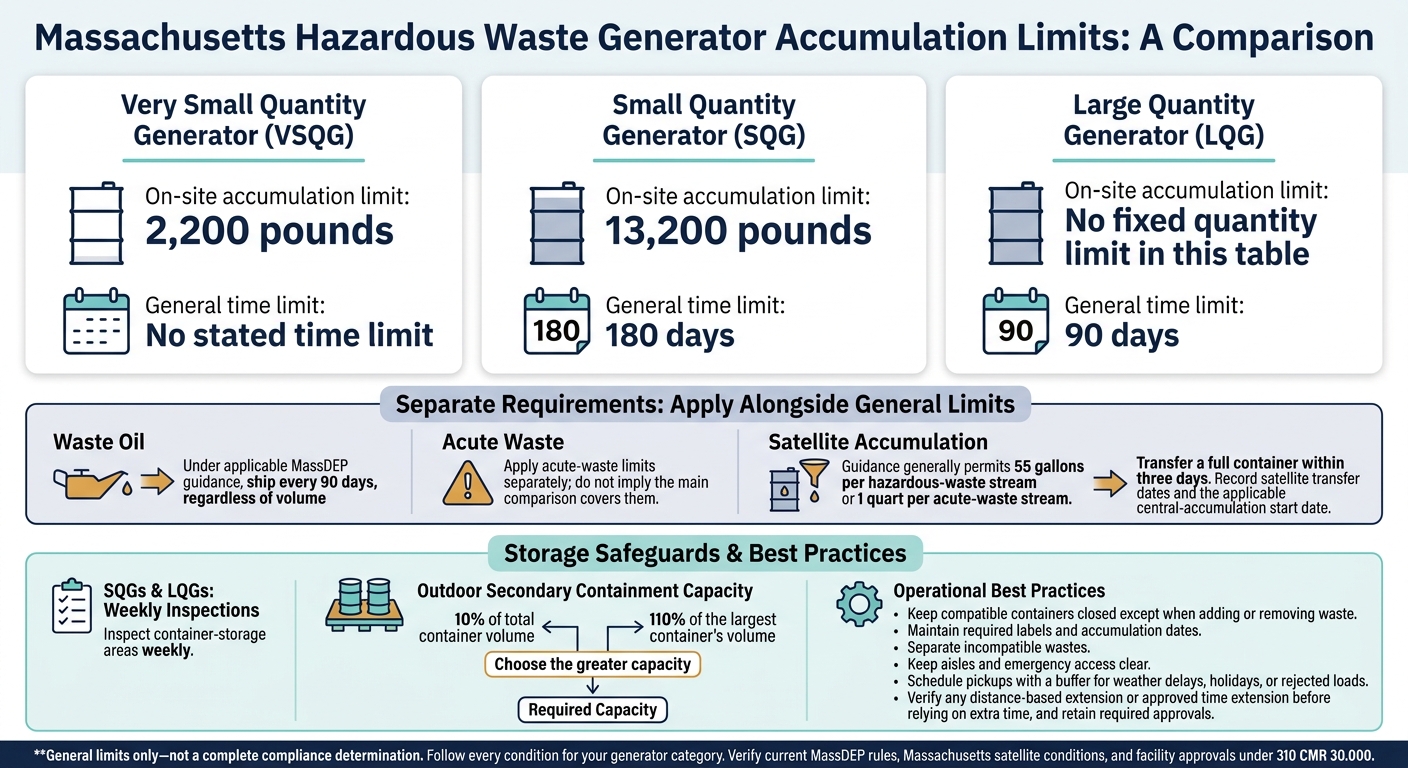
Use containers compatible with the waste. Keep them closed except when adding or removing waste, and label each with the waste description, hazards, and required accumulation date. Separate incompatible wastes, keep aisles clear, post HAZARDOUS WASTE signs, and restrict access. Check impervious floors for cracks and inspect nearby floor drains.[14][2][7] Where required, outdoor secondary containment must hold at least 10% of total container volume or 110% of the largest container’s volume, whichever is greater.[4]
SQGs and LQGs must inspect container-storage areas weekly. Log the area, date, inspector, container condition, labels, closures, containment, drain protection, emergency-equipment access, and equipment checks. For each problem, document the immediate control, responsible employee, correction deadline, and completion date. Fix leaks, incompatible storage, and blocked exits immediately - don’t wait for the next inspection.[9][2][18]
Check Accumulation Quantity and Time Limits
Follow the limits below along with every condition for your assigned category. Schedule pickups with enough time for weather delays, holidays, or rejected loads. Before relying on extra time, verify any distance-based extension or approved time extension and keep the required approvals.[14][4]
Generator category | On-site accumulation limit | General time limit |
|---|---|---|
VSQG | 2,200 pounds[1] | No stated time limit |
SQG | 13,200 pounds[1] | 180 days |
LQG | No fixed quantity limit in this table[1] | 90 days |
Apply waste-oil and acute-waste limits separately. Under applicable MassDEP guidance, ship waste oil every 90 days, regardless of volume. Check Massachusetts satellite conditions instead of assuming federal allowances apply. Guidance generally permits 55 gallons per hazardous-waste stream or 1 quart per acute-waste stream; transfer a full container within three days. Record satellite transfer dates and the applicable central-accumulation start date, and flag approaching limits in your shipment schedule.[14][16][20]
Train Staff and Plan for Emergencies
Train employees before they handle waste. Keep records of training dates, duties, topics, and refresher needs.[11][17] Make sure spill supplies, communication devices, fire extinguishers, and emergency contacts are accessible.[2][18]
Maintain emergency procedures. LQGs need a written contingency plan and must coordinate with local emergency responders.[19][21] Share waste hazards, storage locations, access points, and evacuation routes with responders. Update those arrangements when work processes or personnel change.[21]
Include the 24-hour MassDEP Emergency Response Line, 888-304-1133, in spill procedures, along with required notifications.[22]
Checklist: Verify Shipments, Recycling, and Records
Once waste leaves accumulation, check the transporter, destination, and records before closing the file.
Check Transporters, Destinations, and Manifests
Check authorization before pickup. Confirm that the transporter is licensed or otherwise authorized to handle the waste. Check that the receiving facility is authorized for the waste codes and planned management activity.[14] Match the manifest against the shipment record, including IDs, destination, waste descriptions and codes, quantities and units, container counts and types, and emergency information. Include Massachusetts-specific codes, such as MA01 for waste oil, and use EPA’s e-Manifest system through RCRAInfo when required.[5][1]
Keep the shipment open until acceptance is confirmed. Match the final signed manifest or receipt against the shipment record. Investigate rejected loads, quantity differences, and missing receipts. Start counting from the date the initial transporter accepts the waste: LQGs must inquire about missing signed manifests after 45 days, and LQGs and SQGs generally must submit Exception Reports after 60 days. Since December 1, 2025, most generators must submit those reports electronically through e-Manifest.[27]
Document Electronics Recycling and Data Destruction
Check authorization for electronics recyclers and data processors, too. For electronics already identified as waste, document where the material goes downstream and who holds custody. Some Massachusetts electronic-waste and cathode-ray-tube materials may qualify for a conditional exemption when managed for donation or recycling. If the conditions aren’t met, the materials can fall back under hazardous-waste regulation.[26]
Document the determination, equipment condition, destination, intended recycling activity, and applicable waste codes. Confirm that the recycler is authorized for the material and process. Certification is one qualifier - not proof of authorization or data destruction.[23]
Keep an asset-level inventory that records device type, manufacturer, model, serial number or asset tag, source department, transfer date, carrier or employee, receiving facility, processing outcome, and final disposition. File the electronics recycling receipt separately from the hazardous-waste manifest.
For data-bearing devices, request a certificate that identifies the destruction or sanitization method, completion date, quantity, asset identifiers, and responsible processor. Match it against the inventory. A destruction certificate alone does not prove hazardous-waste compliance.
Keep Records and File Required Reports
After confirming each shipment, file the paperwork and track retention deadlines. Keep Massachusetts manifests for at least three years from initial transporter acceptance. Retain them longer if an enforcement matter or agency requirement extends that period.[2][28][24]
Keep electronics custody and destruction records separate from hazardous-waste files. Maintain a written retention schedule for waste determinations, inspections, training, emergency documents, and reports. Assign an owner and backup to follow up on missing receipts and track reporting deadlines.
Massachusetts LQGs must submit biennial reports through RCRAInfo, generally by March 1 of each even-numbered year.[1][6][25] Match report totals against shipment records and save submission confirmations.
Conclusion: Address Gaps and Review Compliance
Use the records above to close remaining gaps with a written corrective-action log. Include every unresolved compliance issue involving classification, generator status, IDs, storage, inspections, training, emergencies, shipments, recycling, data destruction, and reports. Give each item an owner, a corrective action, a deadline, and evidence of completion.
Address issues that could cause an immediate release or exceed a storage limit first. These include leaking containers, incompatible wastes, missing labels, expired accumulation dates, and shipments without required documentation.
Verify each correction before marking it closed. Document the fix with updated waste determinations, photographs of labeled and closed containers, inspection logs, training records, emergency-equipment test records, signed or electronically completed manifests, certificates of recycling or destruction, and copies of submitted notifications or reports. Oral assurances aren’t enough to close an item.
Review the checklist annually and whenever waste streams, quantities, processes, ownership, location, or receiving facilities change. Recalculate generator status and update notifications as needed.[1][2]
Before closing the log, check current MassDEP guidance, applicable regulations, and facility approvals. Recycling and secure data destruction do not replace Massachusetts hazardous-waste compliance.
FAQs
What if a one-time cleanup changes my generator category?
A one-time cleanup can move your business into a higher hazardous waste generator category. If it does, you must meet all state and federal requirements that apply to that category. These typically mean stricter recordkeeping, reporting, and handling procedures.
Keep detailed records of all materials processed, including serial numbers and disposal manifests.
What should I do if a pickup delay risks exceeding storage limits?
If a pickup is delayed, work with your certified recycler to adjust pickup frequency and stay within storage limits [1]. Need pickup sooner? Look for partners that offer same-day or next-day pickup [2].
To reduce delays, set a regular pickup schedule based on how much waste your organization generates [1]. Use clear Service Level Agreements (SLAs) to define collection windows and response times [3][2].
How can I verify an electronics recycler’s Massachusetts authorization?
Check the certifying organizations’ official websites to confirm that the recycler’s R2 or e-Stewards certifications are current. Visit the ANSI-ASQ National Accreditation Board (ANAB) website for an updated list of accredited certifying bodies.
Ask the recycler directly for recycling certificates, downstream tracking reports, and credentials. Use these documents to review its compliance history, how openly it shares details about its work, and whether it follows regulatory requirements.