
Checklist for Starting E-Waste Upcycling Programs
E-waste upcycling programs focus on giving electronic devices a second life through refurbishment and repurposing, rather than breaking them down into raw materials. With only 15-20% of e-waste being properly recycled in the U.S., these programs aim to reduce landfill waste, recover valuable materials, and support schools and families with refurbished electronics. Here's how to start one:
- Assess Community Needs: Identify common e-waste items (e.g., computers, phones) and resources for safe handling. Conduct a waste audit to understand local patterns.
- Prepare Your Facility: Set up organized storage areas and secure tools for disassembly and data destruction.
- Partner with Certified Recyclers: Work with recyclers certified under R2v3 or e-Stewards for proper disposal and regulatory compliance.
- Run Workshops: Teach upcycling skills like component repair and safe data wiping while emphasizing safety measures.
- Set Up Collection Systems: Use labeled bins in high-traffic areas to collect and sort items for upcycling, donation, or recycling.
- Track and Expand: Monitor results, refine processes, and grow the program based on feedback and community engagement.
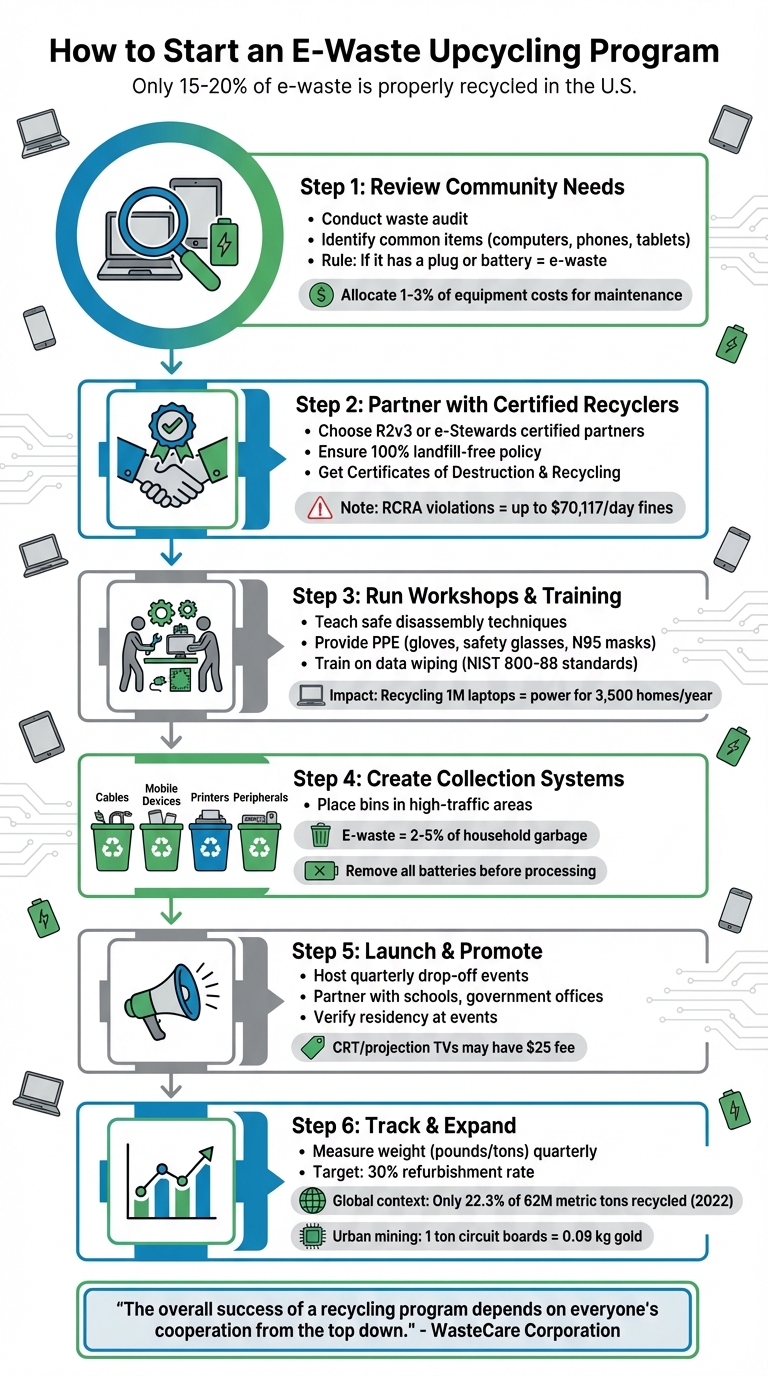
6-Step Guide to Starting an E-Waste Upcycling Program
From HomeLab to E-Waste: Giving Old Tech a New Purpose at Free Geek
sbb-itb-855056e
Step 1: Review Community Needs and Available Resources
Start by assessing the types of e-waste in your community and the resources available for handling it. The most common items include computers, laptops, tablets, smartphones, and batteries. Other frequently discarded electronics include televisions (both CRT and flat-panel), printers, VCRs, DVD players, stereos, and scanners.
Here’s a simple rule to guide you: if a device has a power plug or runs on a battery, it qualifies as e-waste and shouldn’t be treated as regular trash. This step is essential for developing an efficient and safe upcycling process.
List Common E-Waste Items
Understanding the types of e-waste you’re dealing with is critical for safe handling and compliance with regulations. Many electronics contain hazardous materials, so accurate identification is key. The California Department of Toxic Substances Control (DTSC) emphasizes this point:
"The devices that DTSC tested contained concentrations of metals (lead and copper) high enough to make them hazardous wastes when they are discarded. Unless you are sure they are not hazardous, you should presume these types of devices need to be recycled".
Conduct a waste audit by surveying your community or facility to identify discarded electronics and their collection points. This process helps uncover patterns and informs your collection strategy. Interestingly, many items are not broken but are simply outdated or missing software. These can often be upcycled once data is securely erased. Proper assessment ensures you can separate items suitable for upcycling from those requiring specialized recycling.
Check Available Space and Tools
Once you’ve identified the e-waste in your community, evaluate your facility’s capacity to manage it. Designate storage areas and ensure you have the necessary tools for safe handling, such as disassembly tools and equipment for secure data destruction. Storage areas should be convenient yet organized to avoid clutter - placing bins where e-waste is commonly generated improves collection efficiency.
Essential tools include precision screwdrivers for disassembly and digital tools for securely wiping data. Before upcycling, remove batteries and perform a factory reset or professional data wipe. For broken electronics, wear gloves and store damaged parts in sealed bags to prevent hazardous material leaks.
Consider piloting a small-scale program to test your space and tool setup. If the volume of e-waste increases over time, you may need additional equipment, such as balers or compactors, to reduce the storage footprint. Plan to allocate 1%-3% of your equipment costs annually for maintenance.
Step 2: Partner with Certified Recyclers
When e-waste items can’t be upcycled, certified recyclers play a critical role in ensuring they’re processed safely and responsibly. These professionals handle materials that require specialized treatment, ensuring compliance with both environmental and data security regulations.
Use Recycling and ITAD Services
Certified recyclers offer services like secure data destruction, material recovery, and proper disposal of hazardous materials such as lead and mercury. For example, just one electrical relay can contain around 3.5 grams of mercury, which must be handled with care to avoid environmental harm. This type of processing requires expertise and proper facilities.
Take Rica Recycling, for instance. They provide certified ITAD (IT Asset Disposition) services, including secure data destruction, asset recovery, and convenient options for pickup or drop-off. Their commitment to a 100% landfill-free policy ensures that every item is either upcycled, resold, or recycled properly - never discarded irresponsibly. For organizations running upcycling programs, partnering with a service like Rica Recycling helps manage items that can’t be repurposed while staying environmentally conscious. They also host free electronics drop-off events, making it easier for communities to engage in eco-friendly e-waste disposal.
To enforce data security, ensure all SIM/SD cards are removed, perform factory resets, and sanitize hard drives following NIST 800-88 guidelines. Certified recyclers adhere to these standards, safeguarding sensitive information and ensuring regulatory compliance.
Meet Regulatory Requirements
Compliance with e-waste regulations is non-negotiable. By 2026, 25 states and the District of Columbia will have specific e-waste recycling laws in place. Many of these laws prohibit throwing electronics into regular trash due to their hazardous components. Violating the Resource Conservation and Recovery Act (RCRA) can lead to fines of up to $70,117 per day for each violation.
To stay compliant, choose recyclers certified under R2v3 or e-Stewards standards. These certifications guarantee adherence to environmental regulations, downstream accountability, and proper export documentation.
Always request proper documentation from your recycling partner. Certificates of Destruction confirm that data-bearing devices were securely sanitized, while Certificates of Recycling provide an audit trail for environmental compliance. This documentation is especially important for organizations governed by regulations like HIPAA or GLBA, which require destruction records to be kept for at least six years.
Step 3: Run Upcycling Workshops and Training
After establishing partnerships with certified recyclers, the next step is to engage your community by teaching practical upcycling skills. Workshops offer hands-on experiences that not only develop useful skills but also highlight the environmental consequences of discarded electronics.
Organize Hands-On Training
Workshops should focus on active participation. For instance, in March 2026, educators from the University of South Florida attended a workshop at eSmart Recycling's Tampa facility. They learned to disassemble electronics and solder circuit boards as part of a STEM program.
Before each workshop, audit and sort the equipment to identify items suitable for refurbishment versus those better suited for component recovery. This process helps participants differentiate between devices that can be revived and those that can be mined for valuable materials. Encourage practical exercises like swapping components or installing lightweight operating systems such as Linux to breathe new life into older hardware.
Safety is critical. Provide proper personal protective equipment (PPE), including cut-resistant gloves, safety glasses, face shields for CRTs, and N95 respirators. Also, ensure participants follow safe practices for battery removal and storage.
Data security should be a key focus. Teach participants that deleting files or performing factory resets isn't enough to protect sensitive information. Demonstrate how to use data-wiping software or physically remove hard drives, or hire professional data destruction services following guidelines from NIST SP 800-88.
After the hands-on activities, reinforce the learning with straightforward and easy-to-follow educational materials.
Develop Educational Materials
Supplement the training with guides and videos that participants can refer to later. These materials should explain the dangers of hazardous substances like lead, mercury, cadmium, and beryllium in electronics, while emphasizing the benefits of responsible e-waste management. For example, recycling one million laptops saves enough energy to power over 3,500 U.S. homes for a year. Additionally, recovering precious metals from electronics is far more efficient than mining them from ore.
Introduce the concept of urban mining to show the financial and environmental value of extracting precious metals from printed circuit boards. Provide step-by-step instructions to help participants identify and recover valuable components during disassembly.
Point participants to additional resources like iFixit for repair guides and Call2Recycle for battery handling tips. Schools looking to repurpose old computers can explore platforms like Neverware's CloudReady, which helps convert outdated hardware into functional devices. A checklist for preparing devices - covering tasks like backing up data, deactivating software licenses, and signing out of cloud accounts - can ensure an organized approach to disassembly.
Inspire participants with real-world examples and expert advice, and explain how to verify recycling partners through certifications like R2 or e-Stewards. By equipping your community with the knowledge and tools to handle e-waste safely and effectively, you can maximize the impact of your upcycling program.
Step 4: Create Collection and Sorting Systems
Now that your team is trained and ready, it’s time to implement a system for collecting and sorting e-waste. A well-organized system not only encourages community participation but also ensures items are handled responsibly.
Place E-Waste Collection Bins
Start by setting up clearly labeled bins in busy locations like schools, offices, government buildings, and community centers. With e-waste making up 2% to 5% of household garbage, making drop-offs convenient can lead to higher participation rates.
Organize the bins by categories such as "Cables & Power Cords", "Mobile Devices", "Printers & Scanners", and "Keyboards/Peripherals". This simple step makes it easier for participants to understand what’s accepted and reduces sorting efforts later. Commonly collected items include computers, tablets, smartphones, printers, VCRs, DVD players, and even microwaves.
Avoid leaving CRT monitors or TVs on curbs or in unsecured areas. These devices often contain up to six pounds of lead, and broken glass can create serious environmental hazards. To handle them safely, store these items in secure locations until they can be sent to certified recyclers like Rica Recycling, which adheres to a 100% landfill-free policy and complies with California’s strict e-waste regulations.
Sort and Process Collected Items
Once your bins are in place and filling up, the next step is sorting and processing. Before anything else, ensure all SIM and SD cards are removed from devices. Data security is critical - simply deleting files or performing a factory reset isn’t enough. Use tools like DBAN for hard drives or manufacturer-specific software for solid-state drives to securely erase data. In some cases, physically removing hard drives may be necessary before recycling.
Sort the collected items into three main categories:
- Donation: For devices that are still functional and can be securely wiped.
- Refurbishing/Upcycling: For items that have repair potential or resale value.
- Recycling: For broken, outdated, or unsafe electronics.
Make sure to remove all batteries before processing, as they require separate handling. For example, a desktop computer may contain 27 grams of lead, while a single cell phone holds 1 gram of mercury - both can harm soil and water if not disposed of properly. When handling broken electronics, always wear gloves and store damaged parts in sealed bags to prevent hazardous leaks.
Step 5: Launch and Promote the Program
With your e-waste sorted and ready, it’s time to officially launch your program and get the community involved. The goal here is to make participation simple, visible, and rewarding for everyone. This step takes your collection system to the next level by actively encouraging community engagement.
Hold Community Drop-Off Events
Quarterly drop-off events are a great way to kick things off. Host them at accessible locations like school parking lots, municipal garages, or community centers. Scheduling these events on Saturday mornings is ideal since it accommodates working residents who may not be available during the week.
To streamline the process, use a curbside unloading system where staff handle items directly from participants' vehicles. Make sure to verify residency by requiring a current utility bill and a matching driver’s license. For items that can’t be upcycled, partner with certified recyclers like Rica Recycling. They offer free drop-off for standard electronics and adhere to a 100% landfill-free policy in line with California regulations.
Be clear about what items are accepted and any associated costs. For example, some programs charge a $25 cash-only fee for recycling older CRT or projection TVs due to higher processing expenses. To avoid confusion, post lists of accepted items (e.g., computers, printers, phones, and tablets) and prohibited ones (e.g., hazardous waste or large appliances) at the event.
Spread Awareness Through Local Networks
Boost the success of your drop-off events with strong outreach efforts. Use various communication channels to connect with different groups in your community. Collaborate with local government offices like City Halls and Departments of Public Works to share announcements through their platforms and public spaces. Schools and universities can also be valuable partners. For instance, in April 2026, Engineers for a Sustainable World teamed up with a certified recycler to host a collection event in Kingston, Rhode Island.
Timing your events to coincide with existing community gatherings can increase turnout. A great example comes from the "Daffodil Days" festival in Wickford Village in April 2026, where an e-waste collection event was integrated into the festivities, attracting local participants. Similarly, partnerships with groups like religious organizations or youth programs - such as Boy Scouts Pack 1 working with Arnold Mills United Methodist Church in Cumberland - can extend your reach.
Make collection bins easy to use by labeling them with clear, large signs that include both words and pictures to show what’s accepted. Matching the bin colors to those used in local curbside recycling programs can also encourage participation. Keep the momentum going by sharing updates on social media or through signs at events, showing how much has been collected and highlighting program goals. These updates help build excitement and encourage ongoing involvement. All of these efforts lay the groundwork for tracking progress and expanding the program.
Step 6: Track and Expand the Program
Once your program is up and running - from collecting to upcycling - it's time to focus on tracking its progress and finding ways to expand. Without keeping tabs on your results, it’s hard to know what’s working, what’s not, or where you can improve.
Track Program Results
Start by keeping detailed records of the e-waste you process. Measure the total weight in pounds or tons each quarter to assess your program's impact. For context, in 2022, only 22.3% of 62 million metric tons of e-waste was recycled properly. Tracking your contribution can help you see how your efforts fit into the bigger picture.
Another key metric to monitor is refurbishment rates. Aim for about 30% of collected items to be refurbished. Additionally, keep track of how many beneficiaries - like schools or nonprofits - receive donations of refurbished items. This data will help you demonstrate the social benefits of your program.
Equally important is ensuring secure data destruction. Partner with certified recyclers, such as Rica Recycling, to guarantee compliance and maintain community trust.
"Reporting is the only way to measure the success of your e-waste recycling program. Communities need to keep records of what they're recycling and how much they're recycling."
– Kelly Rautenbach, CheckSammy
Use this data to identify trends, refine your processes, and guide the future growth of your program.
Grow Based on Feedback
If participation isn’t meeting expectations, it might be time to tweak your approach. Consider adding more convenient drop-off locations or updating your outreach strategies. Another idea is to form "Lean Green Teams" - advocacy groups within your community or organization. These teams can gather feedback from participants and promote the program within their networks.
As the program evolves, look into advanced upcycling methods like urban mining, which involves extracting valuable materials from discarded electronics. For example, one ton of printed circuit boards can yield 0.09 kg of gold, a concentration up to 10 times higher than natural ore.
You could also expand into educational initiatives. For instance, offering STEM workshops can teach students valuable skills like electronics teardown and soldering. A great example of this is the "STEM Everywhere" program launched in Tampa in March 2026. Through a partnership between eSmart Recycling, Scoutlier, and the University of South Florida, this program provides hands-on electronics recycling workshops and learning kits to local high schools.
As you scale, strengthen your relationships with certified recyclers. Rica Recycling, for example, offers IT asset recovery (ITAD) services, making it easier to handle larger volumes from corporate IT refresh cycles. This can help you move beyond residential collections. Always ensure your recycling partners provide proper destruction and destination certificates to confirm compliance and transparency.
Conclusion
Starting an e-waste upcycling program doesn’t have to be complicated. The essentials include establishing strong leadership, performing a waste audit to assess your materials, setting up collection systems, collaborating with certified recyclers, and hosting workshops to educate and involve your community.
"The overall success of a recycling program depends on everyone's cooperation from the top down." – WasteCare Corporation
Certified recyclers play a crucial role in ensuring compliance with regulations and secure data destruction. They manage hazardous materials responsibly, provide tracking data, and offer insights on the quality of collected materials. For those in the San Francisco Bay Area, Rica Recycling offers certified electronics recycling and IT asset recovery services with a commitment to a 100% landfill-free policy. This makes it easier to align with California’s e-waste regulations while advancing sustainability efforts. Partnering with a trusted recycler like this strengthens every phase of your program.
FAQs
What e-waste items should we accept first?
When launching an e-waste upcycling program, start with items that are frequently discarded, safe to process, and contain materials worth recovering. Examples include computers, laptops, monitors, televisions, cell phones, and microwaves. These devices are common in households and businesses and need careful handling to avoid environmental damage. Concentrating on these types of e-waste tackles significant waste streams while promoting awareness about responsible disposal in your community.
How do we securely wipe data before donation?
To make sure your data is securely wiped before donating a device, follow these steps:
- Back up anything important: Save files, photos, or other data you want to keep before starting the process.
- Use professional-grade data destruction software: Choose software that complies with industry standards to erase data securely.
- Overwrite the data multiple times: This ensures your information can't be recovered.
- Double-check the erasure: Use verification tools or try accessing the device to confirm the data is gone.
- Physically remove storage components: For extra peace of mind, take out hard drives or other storage devices before donating.
These precautions safeguard your personal information and help ensure responsible handling of electronic waste.
Do we need a certified recycler for leftover items?
Using a certified recycler for leftover e-waste is a smart choice. These facilities guarantee proper handling, follow strict regulations, and prioritize safety. They also help minimize environmental harm and ensure your data stays secure. For instance, companies like Rica Recycling offer certified services for disposing of electronics responsibly, including secure data destruction and compliance with legal requirements.