
Ultimate Guide to Employee E-Waste Training
Electronic waste (e-waste) is a growing challenge for businesses, with improper disposal leading to environmental harm, legal risks, and missed opportunities for resource recovery. Here's what you need to know:
- E-waste basics: Includes discarded electronics like computers, batteries, and smartphones. In 2022, over 68 million tons of e-waste were generated globally, but only 17% was properly recycled.
- Risks: Toxic materials like lead and mercury can harm ecosystems and health. Mishandling can also lead to data breaches, with 15 million Americans falling victim to identity theft in 2023.
- Employee training benefits: Proper training helps businesses comply with regulations, recover valuable materials (e.g., copper, gold), and protect sensitive data.
- Key training areas: Safe handling, sorting procedures, regulatory compliance, and data destruction methods.
- Success stories: Companies like Microsoft have achieved waste diversion rates of 90% through employee education and recycling initiatives.
Proper e-waste management isn't just about compliance - it safeguards your business, employees, and the planet. Below, we break down how to build an effective training program, measure its success, and partner with certified recycling services.
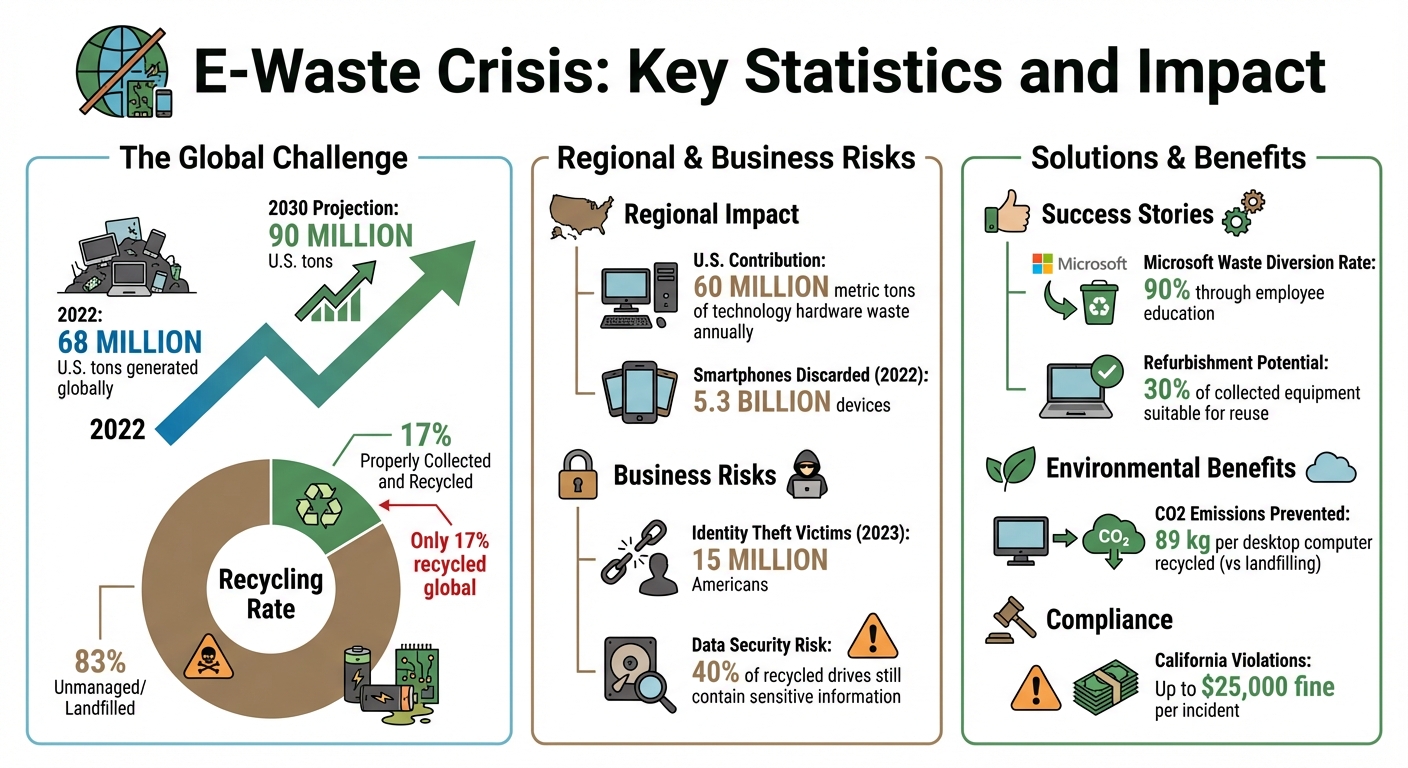
Global E-Waste Statistics and Impact 2022-2030
E-Waste Basics: What Employees Need to Know
What Is E-Waste?
E-waste, short for electronic waste, refers to discarded or end-of-life electronics. This includes everything from computers and smartphones to cables, batteries, and other electronic devices. In a workplace setting, common examples are computers, laptops, printers, monitors, smartphones, servers, keyboards, mice, networking equipment, charging cables, and desk phones.
The numbers around e-waste are staggering. In 2022 alone, the world generated over 68 million U.S. tons of e-waste, with projections suggesting this could climb to 90 million U.S. tons by 2030. Despite this, only 17% of it is properly collected and recycled. For perspective, more than 5.3 billion smartphones were discarded in 2022, and the U.S. contributes nearly 60 million metric tons of technology hardware waste annually.
For employees, understanding e-waste goes beyond environmental concerns. Discarded electronics often contain sensitive data, making them a potential risk for data breaches. In fact, 15 million Americans became victims of identity theft in 2023. Proper e-waste management not only protects sensitive information but also aligns with corporate sustainability initiatives, making it a critical issue for everyone in the workplace.
Environmental and Health Risks
Improper disposal of e-waste - whether through landfilling or incineration - can have serious consequences. Electronics often contain harmful substances like lead, mercury, and cadmium, which can leach into the soil and groundwater, damaging ecosystems. Burning e-waste to recover metals releases toxic gases, such as brominated dioxins, which contribute to air pollution and climate issues. These pollutants can also enter the food chain through crops, posing risks to both human and animal health.
The dangers don’t stop there. Prenatal exposure to these toxins has been linked to developmental delays and long-term health problems in children. On top of the health risks, improper disposal wastes valuable materials like gold, copper, and rare earth elements. This increases the demand for mining, which is both resource-intensive and harmful to the environment. Understanding these risks highlights why employees need to be aware of the hazardous materials in everyday devices.
Recognizing Hazardous Components
Knowing which components in e-waste are hazardous is key to managing it safely. Many common parts in electronics pose serious risks:
- Circuit boards: Contain lead, mercury, and brominated flame retardants, which can cause neurological damage and contaminate soil.
- Lithium-ion batteries: Found in laptops and smartphones, these can ignite or explode if damaged or improperly handled.
- CRT monitors: Older models include leaded glass and mercury, while modern flat-panel displays may also have mercury.
- Cables and plastic casings: Often treated with brominated flame retardants, which release toxic dioxins when burned.
- Fluorescent lamps: Contain mercury vapor that can harm ecosystems.
Even physical risks exist, such as broken glass from monitors, which can cause injuries and release toxic dust. Employees should regularly check e-waste containers for signs of damage, like broken glass or leaking components, as these pose immediate hazards. Rechargeable batteries, in particular, should be separated and stored in proper containers to prevent fires.
In states like California, certain e-waste items - such as CRT glass and batteries - are classified as universal waste, requiring specific handling and documentation procedures. By understanding these hazards, employees can see why proper training in e-waste management is essential for reducing risks and ensuring safety in the workplace.
sbb-itb-855056e
How to Build an E-Waste Training Program
Setting Training Goals and Objectives
Start by defining clear and actionable training objectives. These should align with your company's sustainability goals and ESG commitments, such as conserving resources, reducing your carbon footprint, or working toward certifications that improve your competitive edge.
A key focus should be data security. Employees must understand how to permanently erase sensitive information from electronics before recycling. As Leon Altomonte, Content Contributor at SafetyCulture, explains:
"By integrating e-waste recycling into operations, companies can reduce its carbon footprint, potentially qualifying for green certifications and incentives that can boost its market competitiveness".
Beyond compliance and security, consider the broader environmental impact. Recycling e-waste minimizes the energy required to manufacture new components, which significantly reduces greenhouse gas emissions. Your objectives could include hitting specific landfill diversion targets, increasing material recovery rates, or supporting circular economy initiatives.
Once you’ve set these goals, you can design a curriculum that blends theoretical knowledge with practical application.
Developing the Curriculum
E-waste includes all types of end-of-life electronics relevant to your organization. Build your training program around four main areas:
- Regulatory compliance: Cover requirements like OSHA standards, California's Extended Producer Responsibility laws, and any industry-specific rules.
- Sorting procedures: Teach employees how to categorize electronics and identify items that need special handling.
- Safe handling practices: Focus on managing toxic materials, avoiding physical hazards, and mitigating fire risks.
- Data security protocols: Include methods like wiping hard drives, encryption, and physical destruction of sensitive components.
Tailor the depth of training to specific roles. Frontline employees need hands-on instruction in hazard recognition and proper use of personal protective equipment (PPE). Managers, on the other hand, should focus on regulatory reporting and strategies for mitigating hazards across the facility. These foundational elements prepare employees for hands-on exercises that reinforce their learning.
Adding Hands-On Learning Activities
Theory alone isn’t enough - practical exercises are essential for retention and confidence. Set up sorting demonstrations where employees can practice identifying and correctly categorizing different types of e-waste. This ensures they can distinguish between standard electronics and items like lithium-ion batteries or CRT monitors that require special handling.
Incorporate PPE demonstrations to show how to properly fit and maintain equipment like nitrile gloves, cut-resistant gloves, respirators, and steel-toe boots. Provide supervised opportunities for employees to practice dismantling techniques, focusing on high-risk components like capacitors. Create realistic scenarios where employees can respond to challenges such as damaged batteries, shattered glass from monitors, or computers with uncleared data.
These hands-on activities also help employees connect the dots between procedures and their purpose. For example, seeing how a damaged lithium-ion battery can ignite or how broken CRT glass releases toxic dust underscores the importance of following safety protocols. By turning abstract rules into real-world skills, employees are better equipped to handle e-waste safely and effectively.
Training Delivery Methods and Best Practices
In-Person Classroom and Workshop Sessions
In-person training works best for tasks that require precision and immediate feedback, like dismantling electronics or correctly using personal protective equipment (PPE). These sessions are crucial for activities such as handling CRT monitors or ensuring PPE fits properly, as instructors can step in to correct errors and answer questions in real time.
For teams with diverse backgrounds, skip long lectures and focus on visual aids like pictograms, color-coded labels, and peer-led demonstrations. This hands-on method not only breaks through language barriers but also helps employees build muscle memory for safe practices.
Plan these sessions during slower production periods to avoid disrupting operations. To reinforce learning, pair annual comprehensive training with short monthly "toolbox talks" that focus on specific risks, like battery handling or new equipment safety. These practical sessions, combined with flexible online modules, create a well-rounded training approach.
Online Learning Modules
Online modules are a great way to complement in-person training by providing foundational knowledge in a flexible, accessible format. These digital tools are particularly useful for remote teams and can cover topics like hazard recognition, regulatory guidelines, and company policies. Virtual facility tours can also be included, giving employees a clear picture of how materials flow through recycling processes.
Mobile-friendly platforms allow employees to learn at their own pace, making these modules ideal for onboarding new hires or sharing updates. Adding interactive features like quizzes, progress tracking, and scenario-based exercises can make even dry compliance topics more engaging.
However, while online training is excellent for theory, it should always be paired with in-person sessions for tasks that involve physical hazards or require precision.
Scheduling Regular Refresher Training
Regular refresher training is key to maintaining safety standards and staying aligned with changing e-waste regulations. Annual sessions and quick daily safety reminders help keep skills sharp and knowledge up to date. Digital audit checklists can also identify gaps in understanding, enabling you to tailor refresher content to address specific areas of weakness.
Incorporate brief reminders during shift changes, role transitions, or immediately after workplace incidents. Encourage workers to report near-misses and pause work if conditions feel unsafe - this builds a culture where safety and compliance are always front and center.
Track employee participation and recycling progress for ESG reporting. Celebrate milestones publicly and recognize "recycling champions" to keep motivation high. Small rewards or public acknowledgment often work better than one-time training sessions to maintain long-term engagement.
Introducing E-Waste: Dr. Diana Ceballos Interview (Part 1)
Core Training Topics for E-Waste Management
These training topics serve as the foundation for an effective e-waste management program. Building on the hazards discussed earlier, they outline practical steps to ensure safety, compliance, and data security.
Safety Procedures and Personal Protective Equipment (PPE)
Employees need clear guidance on how to safeguard themselves from the risks associated with e-waste. Chemical exposure from substances like lead, mercury, and cadmium requires the use of respirators equipped with N95 or cartridge filters. For physical hazards, such as broken CRT glass, staff should be equipped with cut-resistant gloves, safety goggles, and face shields. When dealing with broken CRTs, they should evacuate the area immediately, ventilate the space, and avoid breaking the glass tube to prevent implosions and the release of harmful phosphor powder.
Proper handling of lithium-ion batteries is critical. These batteries should never be incinerated. Instead, they should be stored in puncture-proof containers to reduce the risk of fires. Employees must also be trained to sort e-waste by type - keeping batteries separate from CRT monitors - to avoid dangerous chemical reactions. For leaks caused by batteries or capacitors, spill kits should be readily available, and employees should know how to use them effectively.
In addition to personal safety, employees must follow regulatory guidelines to ensure safe and compliant e-waste management.
Regulatory Requirements and Compliance
Understanding and adhering to legal standards is non-negotiable. California's Electronic Waste Recycling Act (SB 20/SB 50) bans landfill disposal of covered devices such as CRTs, laptops, and TVs. Businesses are required to work with approved handlers, and violations can lead to hefty fines of up to $25,000 per incident. Employees should be trained on documentation requirements, including the use of manifests for transporting over 220 lbs of e-waste and maintaining records for at least three years for audits.
The EPA's Universal Waste Rule simplifies the management of items like batteries, lamps, and electronics. This includes proper containment, labeling items with "Universal Waste - [item]" and the date of accumulation, and conducting monthly inspections. Companies generating over 220 lbs of e-waste per month must determine their generator status under the Resource Conservation and Recovery Act (RCRA) and use authorized transporters. Employees should also be familiar with biennial reporting requirements and the use of electronic manifests through the eManifest system.
Safety and compliance are essential, but the final piece of the puzzle is ensuring data security during the e-waste disposal process.
Data Security and Destruction
A 2019 GAO report revealed that 40% of recycled drives still contained sensitive information, such as Social Security numbers, highlighting the importance of thorough data destruction training. Employees should be trained on the three methods outlined in NIST 800-88: Clear (overwriting data 3-7 times using DoD 5220.22-M standards), Purge (degaussing magnetic media or zeroizing encryption keys), and Destroy (shredding drives into particles smaller than 0.08 inches or incineration). For SSDs, cryptographic erasure is the recommended approach.
Certificates of destruction are crucial and should include details such as device serial numbers, destruction methods, dates, and certifier credentials (e.g., R2, RIOS, or NAID accreditation). Employees must verify these certificates and flag any missing media lists. Maintaining chain-of-custody documentation ensures accountability from collection to final destruction. Companies like Rica Recycling provide serialized certificates confirming complete data sanitization in compliance with California SB 1386 requirements.
Working with Certified Recycling Services
Collaborating with a certified e-waste recycler not only demonstrates proper disposal methods but also reinforces employee adherence to legal and environmental guidelines. This partnership delivers measurable benefits in areas like data security and environmental responsibility.
Benefits of Certified Recycling Providers
Certified recyclers handle tasks that often go beyond what most companies can manage internally. They ensure compliance with regulations by keeping accurate records, using approved transporters, and following both state and federal e-waste laws.
Another key benefit is data security. Certified recyclers use stringent data destruction processes and provide serialized certificates that document device serial numbers, destruction methods, and dates. This reduces the risk of data breaches and protects businesses from potential liabilities.
Environmental responsibility is equally critical. With over 50 million tons of e-waste generated globally every year, certified recyclers play a vital role in preventing toxic materials from being improperly discarded, which can pollute the air and soil. They also recover valuable resources like gold, silver, and rare earth elements, cutting down the need for environmentally harmful mining practices.
Rica Recycling Services and Training Support
Rica Recycling takes a 100% landfill-free approach, ensuring every device is either refurbished, recycled, or processed responsibly. For businesses focused on employee training in e-waste management, partnering with Rica Recycling provides a clear example of proper disposal practices. Employees can see firsthand how collected items are handled, reinforcing the training they receive.
The company simplifies the process with free electronics drop-off services for items like computers, monitors, servers, printers, cell phones, and cables. For larger organizations, Rica Recycling offers IT asset recovery services that turn outdated equipment into value while safeguarding sensitive data. Their data destruction services include certificates of destruction that comply with California SB 1386, ensuring a transparent chain of custody. This collaboration not only supports training goals but also establishes a foundation for ongoing tracking and improvement.
Measuring Training Program Success
Once your training program is up and running, measuring its success is key to refining it over time. Gathering concrete data ensures you can assess whether employees are applying what they’ve learned and contributing to measurable outcomes.
Pre- and Post-Training Assessments
Start by testing employees both before and after the training. This helps confirm whether they’ve grasped critical concepts and pinpoint any lingering gaps in knowledge. For example, these assessments can verify that workers understand complex safety protocols and can demonstrate the skills needed to manage hazardous e-waste materials effectively. If you’re using a Learning Management System (LMS), it can automate tracking completion rates and scores, which also simplifies compliance audits for OSHA and ANSI requirements.
Focus your assessments on specific areas like battery handling, data security protocols, and identifying hazardous materials. If certain mistakes show up repeatedly, you’ll know which areas to prioritize in future training cycles. This targeted approach ensures employees aren’t just going through the motions but are actually retaining and applying what they’ve learned.
Tracking E-Waste Metrics
E-waste metrics provide a clear picture of how effective your program is. These metrics align with the hands-on activities and curriculum goals mentioned earlier. Keep track of data such as:
- The volume of e-waste diverted from landfills (measured in pounds or tons)
- The percentage of devices successfully refurbished or reused
- Disposal compliance rates
For context, only 22% of the 62 million metric tons of e-waste generated in 2022 were managed properly. Monitoring these numbers can help you gauge your program’s impact.
Environmental data is another valuable metric. For instance, recycling one desktop computer can prevent up to 89 kilograms of CO2e emissions compared to landfilling. Additionally, track the percentage of e-waste processed by certified recyclers and how quickly data destruction certificates are issued. Since roughly 30% of collected equipment is typically suitable for refurbishment and reuse, tracking this percentage can reveal whether employees are correctly identifying reusable items.
Collecting Feedback for Program Improvement
Feedback is essential for identifying areas where your training program might need adjustments. Tools like post-training surveys, anonymous suggestion boxes, and focus groups can give you insights into what’s working and what isn’t. If possible, begin with a small pilot group before rolling the program out across your organization. This lets you make tweaks based on real-world feedback before a full-scale launch.
For example, in March 2026, educators from the University of South Florida visited the eSmart Recycling facility in Tampa to participate in hands-on electronics teardowns and soldering exercises. Reflecting on the experience, one participant noted:
"They have to touch the dusty old equipment. That's where the real learning happens."
This feedback led to incorporating hands-on activities into training programs for local high schools. By monitoring completion rates, practical application, and employee satisfaction, you can continuously refine and improve your training program.
Conclusion
This guide has covered the key steps to effective employee training on e-waste management, showing how these practices can contribute to broader organizational success. Employee e-waste training goes far beyond just meeting compliance requirements - it lays the groundwork for making sustainability a core part of daily operations. When employees know how to safely handle hazardous materials like lead and mercury, securely manage data destruction, and correctly sort and recycle electronic waste, they not only protect themselves but also help safeguard the environment and ensure compliance with Cal/OSHA and California e-waste regulations.
The benefits aren’t just about avoiding penalties. Proper recycling helps recover useful materials and prevents harmful toxins from entering landfills. With trained employees, your organization minimizes environmental risks while contributing to a cleaner, safer planet.
But the value doesn’t stop at compliance. The bigger reward comes from fostering a workplace culture that prioritizes safety and sustainability. Regular training sessions and safety meetings not only reduce workplace injuries and costs but also weave sustainability into the fabric of your company’s culture.
To make the process even smoother, working with certified recyclers can be a game-changer. Rica Recycling, serving businesses in the San Francisco Bay Area, provides the expertise needed to maintain 100% landfill-free practices, ensure secure data destruction, and comply with California’s strict regulations. By pairing thorough employee training with certified recycling services, your company can meet environmental goals while protecting both employees and sensitive data.
Investing in employee education lowers risks, enhances compliance, and strengthens workforce engagement. Start small with pilot programs, refine your approach based on feedback, and scale up strategies that work.
FAQs
What e-waste items require special handling at work?
Proper disposal of e-waste at work is essential, especially for items that require special handling. These include electronics containing hazardous materials like lead or mercury, devices with sharp or dangerous components, and heavy machinery. Mishandling these items can lead to chemical exposure or physical injuries. Ensuring they are disposed of safely and responsibly helps protect both employees and the environment.
How often should employees get e-waste refresher training?
Employees should undergo e-waste refresher training at least every three years to stay informed about updated procedures. However, depending on your organization's specific needs or any regulatory changes, more frequent training might be required. For instance, general training standards, such as those from OSHA, often recommend annual retraining in certain situations. It's a good idea to review your training schedule regularly to ensure it aligns with compliance requirements and supports effective e-waste management practices.
What should I require from a certified recycler for data destruction?
Make sure the certified recycler adheres to well-known standards such as R2 or e-Stewards®. These certifications ensure both secure and eco-friendly data destruction practices. They are validated by an independent, accredited third-party auditor to uphold rigorous safety and sustainability criteria.