
I’d start with one rule: reuse and repair before recycling. Inventory your retired electronics, assign responsibility for data protection, and require records showing where each device ends up.
The EPA estimated that the U.S. collected 38.5% of discarded consumer electronics for recycling in 2018.[4] But collection alone doesn’t tell us how many devices returned to use.
These five partnership models divide the work:
Business–recycler ITAD: Businesses and asset-disposition providers manage equipment testing, secure data removal, resale, and recycling.
Manufacturer–retailer take-back: Brands and stores offer return channels with clear acceptance rules and processing records.
School–community collection: Schools, families, nonprofits, and recyclers pair supervised collection with repair and donation.
Public–private hubs: Public agencies and businesses share staffed collection sites, costs, safety duties, and transport.
Repair and refurbishment: Owners and repair partners test, fix, and place devices back into service.
Quick Comparison
Model | Best fit | What to arrange first |
|---|---|---|
Business–recycler ITAD | Business equipment replacements | Asset inventory and custody records |
Manufacturer–retailer take-back | Customer device returns | Accepted items, fees, and return options |
School–community collection | School and household drives | Supervision, secure storage, and pickups |
Public–private hubs | Regular local collection | Site funding, staffing, and safety rules |
Repair and refurbishment | Devices worth fixing | Testing, parts, data wiping, and recipients |
My starting point: run a small pilot, confirm battery-handling and data-security duties, and measure verified outcomes - not just pounds collected. Track devices returned to use, recycled material, costs, and missing records separately.
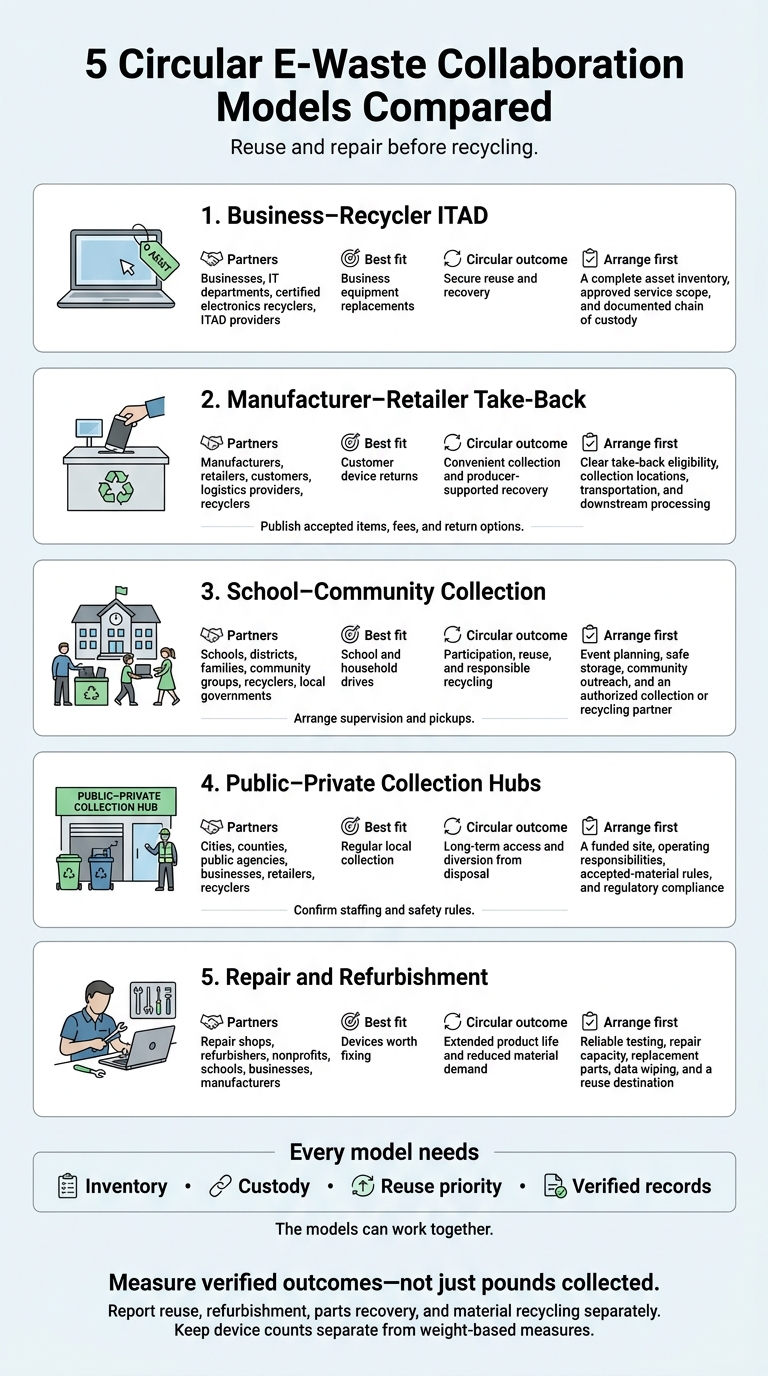
5 Circular E-Waste Collaboration Models Compared
Requirements for Circular E-Waste Programs
Apply these controls to every partnership model:
Extend equipment life before replacing it. Start with maintenance, software updates, and hardware upgrades. Then prioritize reuse, repair, refurbishment, and parts recovery over recycling. Weigh repair costs, expected remaining life, parts availability, security requirements, and recoverable component value - not resale value alone.[5][8]
Put shared responsibilities in writing. Specify who approves equipment transfers, pays for transport and repairs, assesses reuse potential, handles batteries and hazardous components, and supplies final records. Make collection easy with scheduled pickups, secure staging, and clear acceptance rules. Keep loose or damaged lithium-ion batteries separate from electronics. Never put them in household trash or standard recycling bins.[7]
Track data sanitization for each asset. Identify storage drives and removable media, assign responsibility for sanitization, and require verification tied to each asset’s serial number. Use verified erasure for reusable devices and documented destruction for the rest. Deleting files alone does not count as completed sanitization.[5][10]
Require records that show where equipment goes after pickup, including downstream processors, reuse destinations, and final treatment. Ask for recognized third-party certification backed by chain-of-custody records - not just a general “recycled” claim.[3][10] Before collection begins, confirm acceptance rules, storage requirements, and local legal duties for the site, device type, and organization type.
Review results regularly. Track devices reused, repair success, added service life, pounds collected or recycled, costs, and data-sanitization completion. Use reliable tools for any estimates of environmental impact.[9] Report reuse, refurbishment, parts recovery, and material recycling separately so a large recycling total doesn’t hide missed chances for reuse. These requirements apply to the first collaboration model: business–recycler ITAD partnerships.
1. Business–Recycler ITAD Partnerships
Partner Roles and Collection Access
The business manages asset records and approvals. The ITAD partner handles testing, sanitization, transport, recovery, and reporting.
Activity | Business or organization | ITAD partner |
|---|---|---|
Asset records | Provide asset records. | Check items against the manifest. |
Assessment | Identify sensitivity, condition, and requirements. | Test and grade equipment. |
Data protection | Approve standards and exceptions. | Perform and document sanitization or destruction. |
Logistics | Prepare equipment and site access. | Provide pickup instructions and transport. |
Disposition | Approve recovery paths. | Redeploy, resell, recover parts, or recycle. |
Reporting | Keep records and review outcomes. | Provide certificates, totals, and downstream records. |
Choose pickup for large clear-outs and drop-off for smaller loads. Before signing a contract, check certification scope, acceptance rules, and downstream records. Before scheduling servers, racks, UPS units, or appliances, confirm who packs them, loading access, stairs, lift-gate needs, and fees. [11][1][15]
With roles assigned, set clear rules for custody.
Data Security and Chain of Custody
Define exactly when custody transfers, how to handle serial-number mismatches, and what happens when erasure fails. Request sample certificates before collection. Each should list the media, method, date, operator, and verification result.
An erased drive should not receive a destruction certificate. Include incident-notification deadlines and record-retention terms in the agreement. [14][17]
Once custody controls are in place, choose the highest-value recovery path for each asset.
Reuse and Recovery Pathways
Start with redeployment, followed by repair, refurbishment, resale, parts recovery, and recycling. Require checks of operating-system support, battery health, repair costs, and resale value. Put fees and credits in writing so the settlement reflects actual recovery. [11][13]
Documented Results
Require a closeout report linking each asset to its final status, resale proceeds, sanitization result, recycling weight, and downstream records. Report reuse separately from recycling. Landfill-free does not mean reuse or full material recovery.
Start with one department’s equipment replacement cycle, and fix missing records before expanding the program. [11][1][16]
2. Manufacturer–Retailer Take-Back Programs
Partner Roles and Collection Access
Manufacturer–retailer take-back programs use brand and retail channels to return devices to use before sending them to recycling. Manufacturers can define accepted items, handling rules, funding, recovery targets, and approved processors. Retailers can supply collection space, train staff, promote the program, verify items, and schedule pickups.
Use EPA guidance as the baseline for drop-off, mail-in, and community collection events. Make participation straightforward: publish accepted brands, device types, quantity limits, fees, hours, location details, and preparation instructions. [7][5]
With those roles in place, define how the program will track and secure each return.
Data Security and Chain of Custody
Give each participant a receipt or batch ticket showing the date, location, material type, weight, count, and trade-in or donation ID. At pickup, the carrier should supply a load ID and transfer record. The processor should then match that record to the received weight and final outcome.
Ask participants to back up their devices first, but don't rely on self-deletion. Restrict access during storage and transport. After pickup, send data-bearing devices for secure erasure or destruction. [7][3]
Reuse and Recovery Pathways
Screen every return before dismantling it. Identify the device, test its core functions, assess repair costs and demand, securely erase its data, and assign its next step. Use those results to keep working devices in use, repair units worth fixing, and send the rest for parts recovery or recycling.
Record test results, cosmetic grade, repair decisions, data-sanitization status, resale or donation destination, and the reason for recycling. Each screened item should have a clear recovery record. [5][18]
Documented Results
Report the partnership's reuse and recovery outcomes: pounds and units collected, collection channel, coverage, reuse-screening rate, reuse/refurbishment rate, recycled pounds, disposal quantity, and completion date. Specify whether reuse rates are measured by unit or weight, and label estimates separately.
Back up these results with processor receipts, certificates of recycling or reuse, weight tickets, destruction certificates for destroyed data-bearing devices, shipment records, and final disposition reports. [3][18]
3. School–Community Collection Partnerships
This model applies the same custody and reuse rules to schools, with extra attention to student safety and family participation.
Partner Roles and Collection Access
Schools can use e-waste drives to address the problems of electronic waste by putting usable electronics back into circulation. The school coordinates collection, names a coordinator, and provides supervised space. Families, nonprofits, and recyclers share preparation, placement, and processing tasks. Parent groups recruit families and volunteers, while nonprofits find recipients for usable equipment. The recycling partner supplies containers, arranges transportation, and provides processing records. Put these duties in writing.
Start with a quarterly Saturday drive. Add permanent drop-offs only when locked storage, staffed hours, and regular pickups are in place. Publish accepted items, quantity limits, and instructions for damaged batteries at least two weeks before each drive.
Data Security and Chain of Custody
Send families clear preparation instructions: back up data, sign out of accounts, remove SIM cards, and factory reset devices when appropriate. District-owned devices require district-approved sanitization.
Keep collected devices in locked storage, and document each pickup with a load ID and receiving signature. Before closeout, match school inventory records to the processor’s sanitization or destruction records. [19][20]
Reuse and Recovery Pathways
After collection and intake, route usable devices to supervised repair or donation. Pair drives with supervised repair demonstrations and lessons on extending device life. Students can practice basic troubleshooting without handling sensitive data or exposed batteries.
Have qualified staff assess equipment before a nonprofit places it with families or educational programs. Record completed repairs and confirmed recipient handoffs, not just planned donations. Keeping functional electronics in use longer can support schools and low-income families. [13][5]
Documented Results
Track participating households, students, staff, nonprofits, and volunteers, along with pounds collected, verified reuse units, repaired units, and recycled weight. Use these records to expand the next drive, repair program, or donor partnership.
Back landfill-diversion claims with final processing records, including any disposal. Weight alone does not prove diversion.
4. Public–Private Collection Hubs
Partner Roles and Collection Access
A public–private hub makes sense when demand supports a permanent collection point. Before launch, put responsibilities in writing: site control, permits, utilities, security, labor, insurance, containers, transport, battery handling, and final processing.
Publish accepted items, operating hours, service area, eligibility rules, appointment windows, quantity limits, and fees up front. Make clear whether the hub serves households, businesses and schools, or both.
Use permanent hubs for steady volume and events for pilot programs or areas with limited collection access.
Factor | Permanent hub | Collection event |
|---|---|---|
Best fit | Steady, recurring demand | Pilot programs or underserved areas |
Access | Regular staffed hours and repeat visits | Limited dates and appointment windows |
Operating needs | Continuous security, weather protection, and storage | Traffic control, queue controls, and load limits |
Data Security and Chain of Custody
Contracts should specify approved sanitization or destruction methods, authorized personnel, record-retention rules, breach-notification duties, and audit rights. Track transfers beyond the first receiving facility, including reuse partners and downstream processors.
Treat every device as data-bearing at intake. Tag each item and record its donor, intake date, device type, serial number, condition, and destination. Keep it in locked storage until it is sanitized, destroyed, or transferred.
Screen batteries separately. Do not accept damaged batteries through normal intake; route them only through a qualified battery or hazardous-waste partner. Store accepted batteries in approved noncombustible containers, away from heat and combustible materials, and establish clear emergency procedures.[21][23]
Reuse and Recovery Pathways
After intake and screening, send reusable devices to reuse partners, repairable equipment to a refurbisher, and everything else to a certified electronics recycler. Document each handoff, require disclosure of downstream facilities, and prohibit disposal or export without authorization. Track every battery handoff until it reaches the correct processor.[22]
Documented Results
Publish costs, transport miles, turnaround time, reuse and refurbishment rates, incidents, and final destinations. Report reuse, refurbishment, material recovery, hazardous-waste treatment, and disposal separately. Leave donor identities out of published results.
5. Repair and Refurbishment Partnerships
Repair and refurbishment partnerships keep devices in use longer when they can be fixed but aren’t ready for direct reuse.
Partner Roles and Collection Access
Set up scheduled pickups or designated drop-off points. The owner or collection partner logs each device, and the repair or refurbishment partner grades it, assesses whether it can be repaired, tests core functions, identifies missing parts, and selects a recovery path.
Use a checklist covering power, battery health, display, ports, storage, memory, damage, and accessories. After triage, verify data status before repair work starts.
Data Security and Chain of Custody
Verify wiping before any repair or reuse. Record the asset tag or serial number, transfer date and time, handler, storage location, wiping method, verification result, and final outcome. Destroy media that cannot be wiped or send it to controlled recycling.[19][14][24]
Reuse and Recovery Pathways
Prioritize internal redeployment, followed by donation or resale of suitable equipment. Refurbishment should include a licensed OS reinstall, security updates, and final checks of the hardware, battery, charger, ports, and connectivity.
Disclose the device’s condition and limitations, along with warranty and return terms. Record the recipient, device identifier, transfer date, included accessories, and condition grade.
Test recovered parts separately before reuse. Send unusable residuals to a qualified electronics recycler and obtain recycling confirmation. Track reuse and parts-recovery handoffs separately from recycling to show how much value was recovered.
Documented Results
Report repaired and refurbished units returned to use, reuse outcomes, tested parts recovered, and the weight of recycled residuals.
Estimate added service life using the number of devices returned to use and their expected remaining life. Base that estimate on condition, battery health, manufacturer support, and intended use, and label it as a projection. Track warranty returns to check repair and refurbishment quality.
Compare Models and Plan Your Partnership
Use this table to compare each model’s participants, intended outcome, and launch requirements. All five rely on the same core rules: inventory, custody, reuse priority, and verified records.
Model | Primary participants | Main circular outcome | Key prerequisite |
|---|---|---|---|
Business–Recycler ITAD | Businesses, IT departments, certified electronics recyclers, ITAD providers | Secure reuse and recovery | A complete asset inventory, approved service scope, and documented chain of custody |
Manufacturer–Retailer Take-Back | Manufacturers, retailers, customers, logistics providers, recyclers | Convenient collection and producer-supported recovery | Clear take-back eligibility, collection locations, transportation, and downstream processing |
School–Community Collection | Schools, districts, families, community groups, recyclers, local governments | Participation, reuse, and responsible recycling | Event planning, safe storage, community outreach, and an authorized collection or recycling partner |
Public–Private Collection Hubs | Cities, counties, public agencies, businesses, retailers, recyclers | Long-term access and diversion from disposal | A funded site, operating responsibilities, accepted-material rules, and regulatory compliance |
Repair and Refurbishment | Repair shops, refurbishers, nonprofits, schools, businesses, manufacturers | Extended product life and reduced material demand | Reliable testing, repair capacity, replacement parts, data wiping, and a reuse destination |
Choose a model that fits your equipment, space, budget, and goals. Then use this checklist to assign duties, check compliance, and agree on reporting.
[ ] Assigned duties: Name one owner for each task: inventory, reuse approval, data destruction, transport, battery handling, reporting, and incident response.
[ ] Safety and compliance: Confirm permits, staff training, emergency procedures, and battery-handling rules. State-specific reporting may also apply.[12]
[ ] Custody and downstream records: Require transfer confirmations, sanitization or destruction records, reuse documentation, and evidence of final disposition.
[ ] Reuse priorities: Follow a reuse-first order: redeploy, repair or refurbish, donate or resell, then recycle.
[ ] Convenient participation: Publish accepted items, hours, preparation instructions, and any fees. Offer accessible pickup or drop-off options when possible.
[ ] Partner disclosure: Disclose subcontractors, processors, destination countries, and destinations for rejected items.
Set a monthly or quarterly scorecard before the first pickup. Measure actual circularity - not just how much material moves through the program. Report both pounds collected and devices actually returned to use.
Reuse rate = reused devices ÷ devices received.
Material recovery rate = recovered commodity pounds ÷ pounds processed.
Verified landfill-diversion rate = pounds with documented non-landfill outcomes ÷ pounds received.
State each numerator, denominator, and reporting period. EPA guidance separates reused, recycled, and landfilled/incinerated outcomes. Don’t treat every form of diversion as the same circular result.[2][6]
Track reporting completeness as the share of pounds with complete custody, downstream, and final-disposition records. Label unresolved material as unverified. Keep device counts separate from weight-based measures to avoid double-counting, and assess the partnership using verified final outcomes rather than weight alone.[6]
Conclusion: Start With Inventory and Shared Duties
Once you’ve chosen a model, keep the program simple: inventory first, shared duties second, and verified outcomes last. The models work together. Collection brings devices in, accountable partners protect data, and reuse, repair, and recycling keep assets in circulation.
Let your inventory guide the mix. Record each device’s type, model, serial number or asset tag, condition, location, storage media, battery type, ownership, and likely next step: donate, repair, resell, or recycle. Then use that baseline to match assets with partners.
Assign one accountable owner to each handoff: pickup or drop-off, packaging, custody records, data sanitization, repair decisions, resale or donation, recycling, and final reporting. Clear duties help the partnership work. Document data sanitization before equipment leaves your control.[19]
Start with one department or a short pilot collection. Before launch, define accepted items, repair options, recycling arrangements, and reporting deadlines. Review devices returned to use, pounds recycled, data-destruction records, costs, and handling issues. The pilot should prove secure handling, clear records, and repeatable results. Expand only when it shows secure handling and verified outcomes - not just volume.
FAQs
Can we combine multiple e-waste collaboration models?
Yes, you can - and should - combine e-waste collaboration models to meet different needs within your organization. Use IT Asset Disposition (ITAD) services for high-value equipment or devices that hold sensitive data, such as servers and laptops. These services help protect data and recover value through resale.
For non-sensitive or end-of-life electronics, use local government recycling programs or community collection events. These options make recycling convenient and accessible while supporting your organization’s waste reduction and resource conservation goals.
How do we budget for an e-waste pilot?
Put financial responsibilities in writing upfront. Then estimate costs and outcomes based on monthly collection targets (in pounds), processing costs per pound, any IT asset recovery revenue, landfill diversion, and data security results - including certificates issued and devices wiped or destroyed.
Report monthly or quarterly. Review partner agreements annually to keep them aligned with actual pickup, processing, and data-destruction needs. [1]
What should we do if downstream records are missing?
Work with a certified IT asset disposition (ITAD) provider to address gaps in chain-of-custody records [1]. Set clear communication and reporting standards so you can track e-waste from collection through final processing or destruction [1].
Keep asset tracking reports and certificates of destruction for compliance and internal records [2][3]. Ask your provider to confirm that devices were handled according to NIST 800-88 standards and state-specific e-waste regulations [2][3][4].