No single certificate makes federal IT asset disposal compliant. I start with 3 checks: approval to dispose of the equipment, the receiving facility’s certification and scope, and a data-sanitization plan.
Here’s what I check before scheduling pickup:
Disposal authority: Confirm ownership, contract terms, and the approved route for reuse, transfer, donation, sale, or recycling.
Facility credentials: Verify the exact location and services covered by R2 or e-Stewards when required.
Data protection: Select Clear, Purge, or Destroy under NIST SP 800-88 Rev. 2 and agency policy.
Records: Link each asset to custody logs, sanitization results, and final disposition, then retain those records under agency rules.
The same checks apply to Bay Area providers, including Rica Recycling. My rule: verify the paperwork before pickup, and reconcile every asset before closeout.
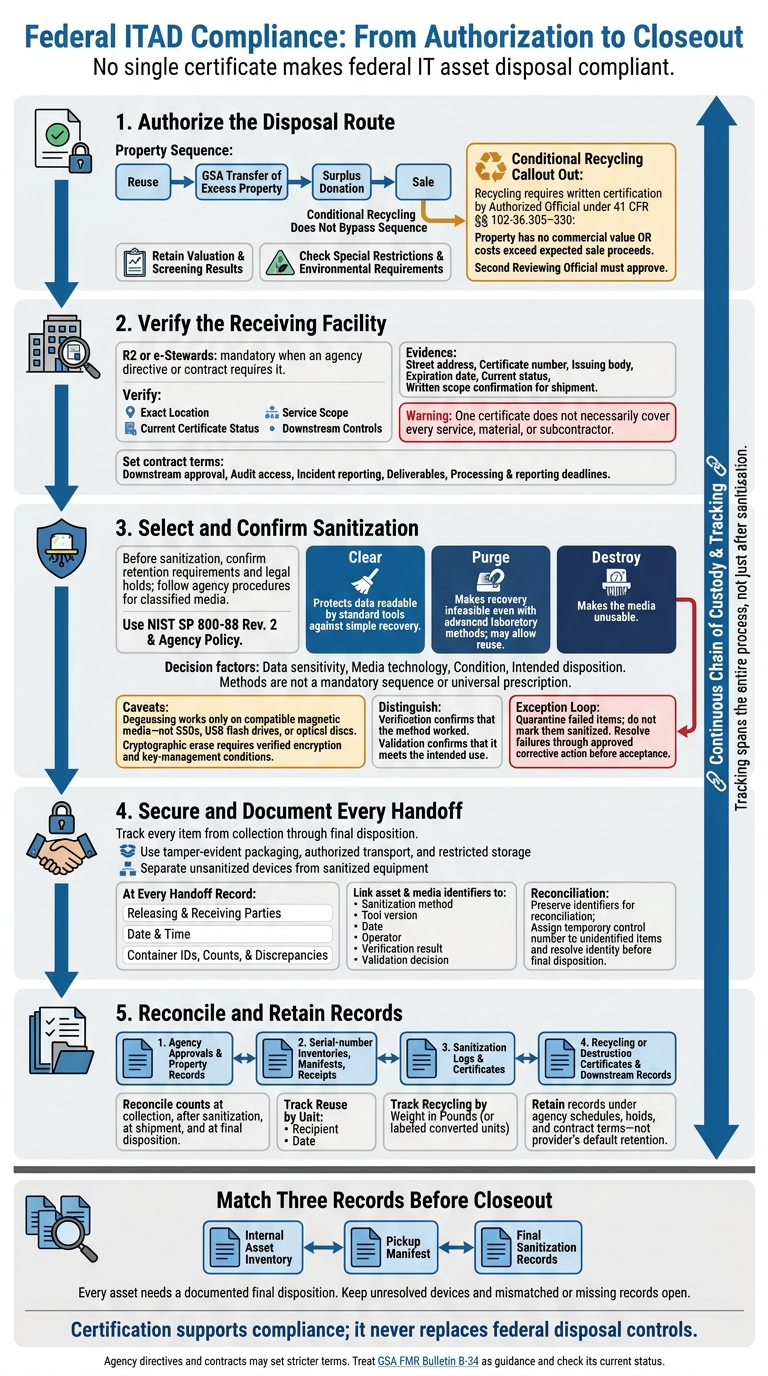
Federal ITAD Compliance: From Authorization to Closeout
Federal Property Rules and Recycler Certifications
Federal ITAD rules come from the FMR, environmental law, electronic waste issues, and security mandates. Agency directives and contracts may set stricter terms. Treat GSA FMR Bulletin B-34 as guidance, and check its current status before relying on it.
Choose an Authorized Disposal Route
Once authority and data controls are in place, confirm the approved property disposal route and the receiving facility’s certified scope.
Review 41 CFR Chapter 102, Subchapter B, especially Parts 102-35 through 102-38. The usual sequence is reuse, GSA transfer of excess property, surplus donation, and sale. Before proceeding, check for special authority or restrictions covering classified equipment, hazardous materials, foreign excess property, or other restricted assets.
Recycling does not bypass that sequence. Under 41 CFR §§ 102-36.305–330, an authorized official must certify in writing that the property has no commercial value or that care and handling costs would exceed expected sale proceeds. A second reviewing official must approve that determination. Keep the valuation, screening results, and approvals that support the chosen route.
B-34’s guidelines direct electronics to certified recycling or refurbishment and prohibit disposal in landfills or incinerators. A manufacturer take-back arrangement still needs a qualifying processing facility. Check Resource Conservation and Recovery Act (RCRA) and state requirements for regulated waste, batteries, and hazardous components, too. Require proof of the necessary environmental permits.
After approving the disposal route, verify that the receiving facility’s certification and scope cover the actual shipment.
Verify R2 or e-Stewards Facility Certification
B-34 recognizes R2 and e-Stewards, but certification is mandatory only when an agency directive or contract requires it. Independently verify the receiving facility through the program directory or certification body, and require notice of changes to the facility or its downstream processors. One certificate does not necessarily cover every service, material, or subcontractor.
Verification area | R2 | e-Stewards | Evidence to request |
|---|---|---|---|
Facility identity | Verify the named location and certified operations | Verify the named location and certified operations | Street address, certificate number, issuing body, expiration date, and current status |
Service scope | Check coverage for the proposed processing work | Check coverage for the proposed processing work | Written scope confirmation for storage media, servers, batteries, displays, and other shipment contents |
Downstream controls | Review vendor qualification, monitoring, and material tracking | Review downstream restrictions, tracking, and export and disposal controls | Downstream policy, facility disclosures, chain-of-custody records, and applicable authorizations |
Contract evidence | Tie certified operations to the actual assignment | Tie certified operations to the actual assignment | Sample reports, audit-access terms, change-notification requirements, and recycling or destruction certificates |
Data Sanitization and Chain of Custody
Once the facility is approved, focus on each data-bearing item. Certified disposal alone does not complete the compliance work. Track every item from collection through final disposition, with records linking its identifier to its sanitization result.
Before sanitization, confirm retention requirements and legal holds with records-management, privacy, legal, and security officials. Follow agency security procedures for classified or specially controlled media.
Then choose the sanitization method for each media type.
Choose Clear, Purge, or Destroy
Use NIST SP 800-88 Rev. 2 and agency policy to match the method to the media and its intended disposition. Clear protects data readable by standard tools against simple recovery. Purge makes recovery infeasible even with advanced laboratory methods and may allow reuse. Destroy makes the media unusable.
Base the outcome on data sensitivity, media technology, condition, and intended disposition - not a blanket rule. Deleting files or performing a routine factory reset may leave information recoverable.
Media condition and reuse plan | Possible outcome | Agency decision needed | Supporting records |
|---|---|---|---|
Healthy hard drive for internal reuse | Clear or Purge | Confirm that sensitivity and the method permit reuse | Media ID, method, verification and validation results |
SSD planned for external reuse | Purge: cryptographic erase if encryption and key removal are verified; destroy if not | Confirm device support and encryption coverage | Sanitization record with approval, logs, and results |
Failed hard drive or inaccessible flash storage | Destroy or another approved method for inaccessible areas | Approve escalation; quarantine pending action | Failure and disposition record |
USB device, optical disc, or embedded storage | Technology-specific Clear, Purge, or Destroy | Confirm that the method covers the media | Sanitization record with media ID, method, and results |
Degaussing works only on compatible magnetic media - not SSDs, USB flash drives, or optical discs. Cryptographic erase requires verified encryption and key-management conditions. A device’s encryption support alone does not make cryptographic erase acceptable.
Verification confirms that the method worked. Validation confirms that it meets the intended use.
Record Sanitization and Secure Each Handoff
Record the asset and media ID, media type, method, tool version, date, operator, verification result, and validation decision. Include failed attempts, corrective actions, required approvals, and destruction details where applicable.
Quarantine failed items; do not mark them sanitized. Give unidentified items a temporary control number and resolve their identity before final disposition.
Use tamper-evident packaging, authorized transport, and restricted storage. Keep unsanitized devices separate from sanitized equipment. At every handoff, record the releasing and receiving parties, date and time, container IDs, counts, and discrepancies.
Remove property decals and sensitive papers only after preserving the identifiers needed for reconciliation. After each handoff, lock the record trail to support audit review.
Retain Property and Disposal Records
Keep four linked record sets:
Agency approvals and property records: Document whether the disposition was authorized and which assets were involved.
Serial-number inventories, manifests, and receipts: Show who held each item, when, and in what count.
Sanitization logs and certificates: Identify the method used and whether verification and validation supported acceptance.
Recycling or destruction certificates and downstream records: Document what final processing occurred and where.
Reconcile counts at collection, after sanitization, at shipment, and at final disposition. Investigate mismatches before closing the record.
Track reuse by unit, including the recipient and date. Track recycling by weight in pounds or clearly labeled converted units. Retain the complete record set under agency schedules, holds, and contract terms - not the provider’s default retention period.
Federal ITAD Checklist and Bay Area Service Planning
Use this checklist to turn federal requirements into a vendor-ready scope before pickup begins.
Complete the Federal ITAD Compliance Checklist
Start with authority, not scheduling. Confirm the authorized disposition route, then verify that required screening and property-system reporting are complete.[2][1][5]
Before contracting, get written confirmation of the facility’s current certificate, scope, location, and downstream controls. Contract terms should cover subcontractor and downstream-processor approval, equivalent controls, audit rights, incident-reporting deadlines, escalation contacts, and required deliverables. A prime contractor’s certificate does not extend to downstream facilities.
Set closeout requirements in the contract so everyone knows what must happen before the work is accepted. Reconcile assets, review sanitization results and exceptions, collect disposal and environmental records, and retain final totals in the audit file.
Request an itemized quote covering transport, labor, packing, destruction, certificates, storage, special handling, and resale credits. Set processing and reporting deadlines to prevent indefinite storage.
Confirm Bay Area Services With Rica Recycling
Apply these same controls to any local provider, including Bay Area services.
For Bay Area projects, Rica Recycling offers electronics recycling, IT asset recovery, secure data destruction, and pickup or drop-off options. Local service does not replace federal procurement authority or ITAD compliance.[3][4]
Send an equipment inventory and request written confirmation of accepted equipment, fees, transportation controls, certificate details, facility certifications, service scope, subcontractors, California e-waste compliance, contract eligibility, and agency-specific requirements.
Conclusion: Certification Does Not Replace Federal Disposal Controls
Close the file only when the checklist, inventory, and disposal records match. Federal ITAD compliance requires a documented chain of controls - not just a certificate. The audit file must connect authorization, facility scope, sanitization, custody, and final records.
At closeout, reconcile three records to document chain of custody: the internal asset inventory, the pickup manifest, and the final sanitization records. Every asset needs a documented final disposition. Keep the disposition open for any device with unresolved issues, missing records, or records that don’t match.
Environmental claims support due diligence, but they don’t prove lawful federal disposal or secure data removal. An auditor must be able to trace each device from agency authorization to its documented final disposition. Certification supports compliance; it never replaces federal disposal controls.
FAQs
Who is liable if a federal ITAD contractor mishandles data?
Your organization is still accountable for the data and devices under its control, even when you hire a certified IT asset disposition (ITAD) provider. If that contractor mishandles data - or you can’t provide audit-ready proof of secure disposal - your organization may bear the liability.
Regulatory penalties and legal consequences can still apply. To help protect your organization from liability, maintain an unbroken chain of custody and verifiable proof of destruction tied to each asset’s serial number.
What if agency disposal rules conflict with contract terms?
Put legal and regulatory compliance first, and apply the strictest regulatory standard. NIST guidance sets a technical baseline, but it doesn’t replace legal or contractual obligations. Records requirements, retention policies, and legal holds take priority over vendor contract terms.
Agencies and organizations remain liable for their data. Before you finalize your disposal policy, have a legal or compliance advisor review any conflicts.
How should we handle missing assets at ITAD closeout?
Begin a formal, documented investigation immediately. Before finalizing ITAD closeout, reconcile your internal asset inventory with the pickup manifest and final sanitization or destruction certificates.
Record every missing or unverified asset, the steps taken to locate it, and the final resolution. Retain these investigation records in your permanent audit trail.
Maintain an accurate chain of custody from the start. Use serial-level tracking and tamper-evident packaging to help prevent gaps.