
Public-private partnerships can make electronics easier to recycle - but I’d measure success by what happens after pickup. Start with clear duties: public agencies provide access and oversight; private operators handle transport, reuse, data protection, and processing.
Here’s what I’d put in place before launch:
Map service gaps: Check drop-off access, storage, and processing capacity.
Protect devices and data: Keep usable equipment separate, track custody, and require sanitization records.
Set written rules: Assign costs, safety duties, reporting deadlines, and audit rights.
Check local requirements: For a Bay Area program, verify California rules and provider qualifications before a small pilot.
Track results: Measure reuse, recycling, disposal, household access, and costs - not just pounds collected.
The key distinction: a pickup receipt is not proof of recycling or data destruction. I’d require final records and set contract review triggers, such as unexplained weight differences above 5%. That’s a program control, not a legal limit.
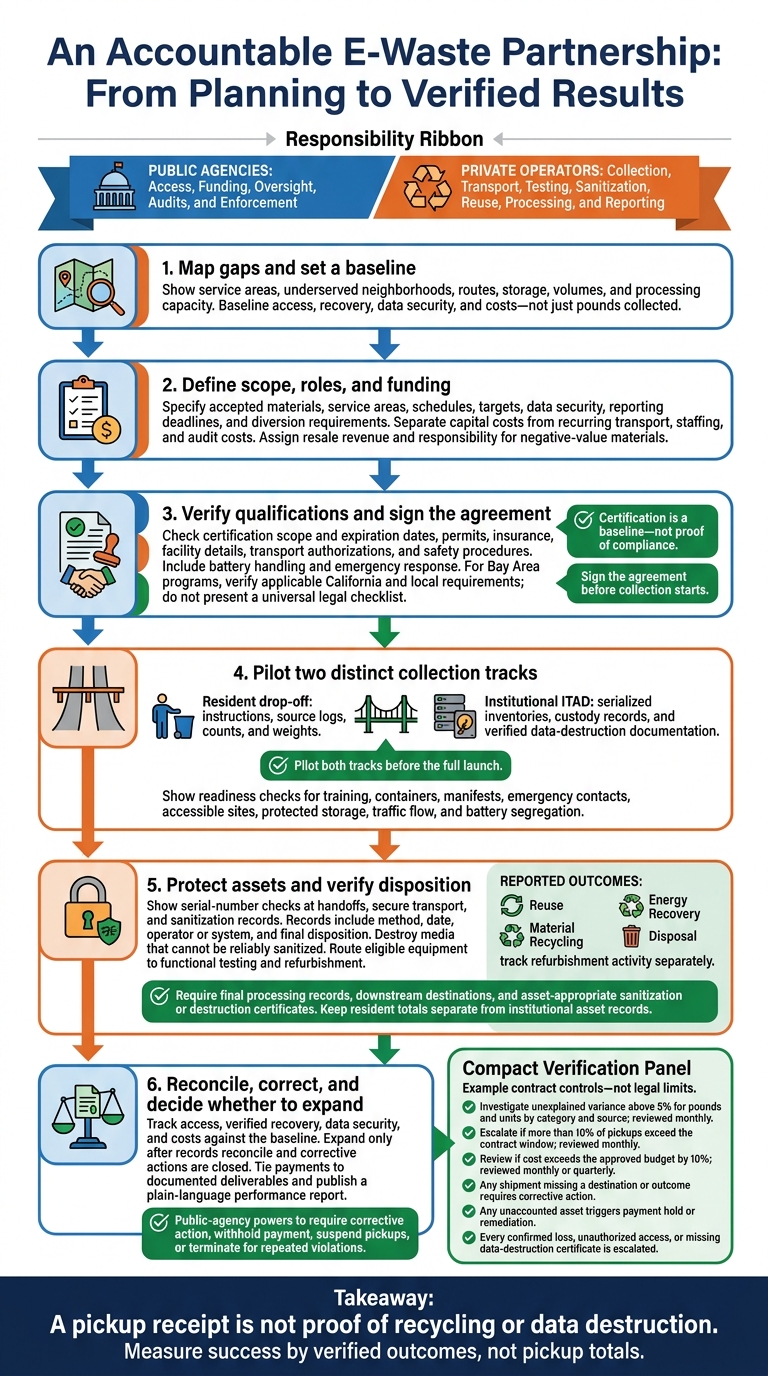
An Accountable E-Waste Partnership: From Planning to Verified Results
How Partnerships Improve E-Waste Recycling
Once gaps are mapped, partnerships can extend access and add capacity while keeping oversight in place.
Expand Collection Access and Processing Capacity
Public collection sites and school events give residents more places to drop off electronics. Private recyclers supply logistics, equipment, and processing capacity. Evening or weekend hours and locations near public transit can make drop-offs easier.
Measure neighborhood participation, not just the number of sites, to decide where service needs to change. Locate storage and processing separately so truck traffic, noise, fire risk, and battery hazards do not cluster in neighborhoods already carrying these burdens.
Collection is only part of the job. Partners must also preserve device value and protect data.
Protect Data and Prepare Equipment for Reuse
Check serial-number inventories at every handoff, use locked or monitored transport, and require sanitization records for each asset. Those records should include the method, date, operator or system, and final disposition.
Destroy media that cannot be reliably sanitized. Computers and servers suitable for reuse can move to functional testing and refurbishment when security requirements allow.
Public purchasing policies can support reuse by setting clear requirements for refurbished equipment: performance, warranties, repairability, and life-cycle costs. For remaining materials, require verified recycling, acceptable material quality, and verified recycled content.
Track reuse, refurbishment, recycling, and residual disposal separately. Collected equipment should not automatically count as recycled.[2]
Whether a partnership delivers better results or creates new problems depends on how it is governed.
Compare Gains, Risks, and Controls
Results depend on local travel distances, participation, equipment condition, commodity prices, and contract terms. Set a baseline, then compare costs and outcomes using consistent definitions. Gross collection weight measures volume; verified processing records show what was reused, recovered, or disposed of.
Partnership mechanism | Potential benefit | Operating risk | Required control |
|---|---|---|---|
Public collection sites and events | Easier access and higher participation | Low turnout, contamination, unsafe storage, or uneven geographic coverage | Set site standards, outreach targets, accepted-material rules, staffing requirements, battery procedures, and ZIP-code reporting |
Shared processing capacity | Greater throughput and potentially lower unit costs | Bottlenecks, inaccurate weights, or undocumented downstream handling | Set capacity requirements; require calibrated scales, maintenance plans, backup facilities, inspections, and service-level agreements |
Technical testing and refurbishment | Longer product life and greater value recovery | Data exposure, unreliable refurbished equipment, or costly repairs | Require sanitization standards, functional testing, warranty terms, repair-cost thresholds, and separate reuse reporting |
Shared public and private funding | Stable service and broader infrastructure investment | Cost overruns, commodity-price volatility, or unclear payment responsibility | Define rates, eligible costs, adjustment formulas, and performance payments; require independent review |
Plan and Run an Accountable Partnership
Once you choose a partnership model, put it in a contract and operating plan.
Set Scope, Roles, and Funding
Before issuing a request for proposals (RFP), map sites, routes, storage, volumes, intended outcomes, and underserved areas. The contract should spell out accepted materials, service areas, schedules, targets, data security, reporting deadlines, and diversion requirements.
Separate capital costs from recurring costs. Cages and scales belong in the capital budget; transport, staffing, and audits are recurring expenses. Identify funding from grants, institutional budgets, manufacturer support, and service fees. State who receives resale revenue and who pays to handle negative-value materials.
Clearly assign public oversight and private execution, along with supporting duties for other partners.
Stage | Public agencies | Recycling/ITAD operator | Manufacturers | Institutions | Community groups |
|---|---|---|---|---|---|
Planning | Set goals and requirements | Confirm feasibility | Provide take-back information | Estimate volumes | Identify access barriers |
Collection | Provide sites and event support | Supply staff, containers, and transport | Support take-back channels | Consolidate equipment | Promote participation |
Processing | Set safeguards | Test, sanitize, repair, resell, or recycle | Support refurbishment | Approve reuse destinations | Connect devices with eligible users |
Reporting | Audit and enforce terms | Submit records and correct deficiencies | Report take-back results | Review certificates and invoices | Provide feedback |
With scope and funding settled, check that the operator can meet safety and compliance requirements.
Check Provider Qualifications and Safety Controls
Use accredited third-party certification, such as R2 or e-Stewards, as a starting point. Separately verify permits, insurance, facility address, covered activities, and expiration date.[1][4] Certification is a baseline - not proof of compliance. Check permits and contract terms separately.[3] Also check applicable transport authorizations, workers’ compensation, and worker-safety procedures.
The site plan should address lifting, personal protective equipment (PPE), and traffic separation. Verify procedures for handling lithium-ion batteries, preventing short circuits, isolating damaged batteries, and meeting applicable packaging requirements.
Assign emergency contacts and response duties for fires, battery thermal events, spills, injuries, theft, vehicle incidents, and data breaches.
Set Reporting, Audit, and Enforcement Rules
Sign the agreement before collection starts. Put ownership transfer, service levels, pricing, data security, reuse approval, residue handling, subcontractors, downstream processors, incident response, insurance, records, and reporting deadlines in writing.
Require final processing records and asset-appropriate sanitization or destruction certificates. A pickup receipt does not prove that equipment was sanitized or recycled.
Start collection only when training, containers, manifests, and emergency contacts are in place. Expand only after records reconcile and corrective actions are closed. Give the public partner audit access and the right to require corrective action, withhold payment, suspend pickups, or terminate the agreement for repeated violations.
Launch and Measure a Bay Area Program
Put those contract controls to work in a Bay Area launch plan.
Check California Rules and Site Readiness
Before announcing collection dates, review EPA guidance, CalRecycle rules, DTSC guidance, local zoning, and fire-code requirements.[5][6][7] Confirm current device eligibility, universal-waste rules, transportation obligations, and event notifications.
Covered electronic waste (CEW) is just one regulated e-waste category. Funding and handling rules depend on the material. CalRecycle payments require eligible material, compliant handling, and supporting records - not simply discarded electronics.[8] The public partner controls access and compliance, while the private partner handles pickup, processing, and reporting.
Keep resident drop-off separate from institutional ITAD for businesses, schools, and public agencies. Resident drop-off requires clear instructions, source logs, counts, and weights. Institutional ITAD requires serialized inventories, custody records, and verified data-destruction documentation.
Use a signed launch checklist to cover local code checks, site accessibility, weather-protected storage, traffic flow, battery segregation, and spill and fire procedures. Pilot both tracks before the full launch.
With the site plan in place, check the operator’s capabilities before signing a contract.
Evaluate Rica Recycling for Bay Area Services
For a local provider example, evaluate Rica Recycling against the same controls. It offers Bay Area electronics recycling, IT asset recovery, pickup, drop-off, appliance recycling, and secure data destruction with certificates, and states that it complies with California e-waste requirements and follows a 100% landfill-free policy. Before contracting, request current certification scope and expiration dates, accepted-material lists, service territory, pickup capacity, fees, insurance, sample certificates, downstream destinations, and data-destruction methods.
Track Recovery, Access, Data Security, and Costs
After launch, track access, verified recovery, data security, and costs using the metrics below. These contract thresholds are program controls, not legal limits. Keep resident totals separate from institutional asset records so commercial volume doesn’t mask gaps in household access.
Metric | Data source | Frequency | Responsible party | Corrective-action threshold |
|---|---|---|---|---|
Pounds and units by category and source | Scale tickets, intake logs, inventory system | Monthly | Recycler and program manager | Investigate unexplained variance above 5% |
Reuse, material recycling, energy recovery, and disposal weights | Processor disposition reports and downstream certificates | Monthly or quarterly | Recycler | Any shipment missing a destination or outcome |
Collection-site coverage and service access | GIS map, event attendance, resident survey, appointment records | Quarterly | Public agency | Add access points if a target community lacks reasonable coverage |
Pickup response time and completion rate | Work orders and carrier timestamps | Monthly | Provider | Escalate if more than 10% of pickups exceed the contract window |
Asset inventory and chain-of-custody completion | Serial-number logs, transfer forms, certificates | Per shipment and monthly summary | ITAD provider | Hold payment or require remediation for any unaccounted asset |
Data-security incidents and destruction records | Incident log, destruction certificates, audit samples | Immediate notification and quarterly report | ITAD provider and agency security lead | Escalate every confirmed loss, unauthorized access, or missing certificate |
Program cost per pound and per unit, in U.S. dollars | Invoices, payroll, transportation, and scale data | Monthly or quarterly | Finance lead | Review if cost exceeds the approved budget by 10% |
Revenue, grants, and capital investment, in U.S. dollars | General ledger, grant records, equipment invoices | Quarterly | Finance lead | Reforecast when funding falls below the approved operating plan |
Battery, fire, spill, injury, and compliance incidents | Safety and regulatory incident logs | Immediate and quarterly summary | Site operator | Correct immediately after any reportable or repeat incident |
Check shipment-level records to verify gains in access, recovery, and data security. Use those records to support landfill-free claims, and disclose how residuals and rejected loads are treated.
Conclusion: Assign Responsibilities and Verify Results
Once scope and controls are set, put responsibilities in writing. Public agencies set access, funding, and accountability rules. Private operators handle collection, transport, reuse, data destruction, and downstream processing.
Use the inventory and gap assessment to identify underserved areas. Then match service requirements to transport and processing capacity.
Before a limited pilot and full launch, check provider qualifications, funding, safety, chain-of-custody, and reporting controls. After the pilot, base expansion on verified records - not claimed volume.
Measure success by verified outcomes, not pickup totals. Compare recovery, access, and data-security results against the baseline. Tie payments to documented deliverables, publish a plain-language performance report, and keep public audit and enforcement authority in place.
FAQs
How can smaller communities afford an e-waste partnership?
Smaller communities can cut costs by working with nearby cities or counties. They can pool resources, share transportation routes, and use joint vendor contracts. Federal, state, or private grants can help pay for transportation, recycling fees, and staff training.
Certified recyclers like Rica Recycling can provide accurate quotes for budgeting and help communities meet compliance requirements. In some regions, manufacturer-funded programs offer free recycling for households and small businesses, lowering costs for local taxpayers.
Who is liable if a recycling partner loses sensitive data?
Organizations are still responsible for protecting sensitive data when disposing of equipment. Working with certified recyclers, such as Rica Recycling, helps reduce that risk through NIST SP 800-88-compliant wiping or physical destruction, a secure chain of custody, and detailed certificates of data destruction. These certificates serve as legal documentation to support compliance with regulations such as HIPAA and SOX.
How can residents verify a program’s landfill-free claims?
Look for third-party certifications, such as R2 or e-Stewards. Both require facility audits and standards for handling materials in ways that protect the environment. Verify R2 certification status through Sustainable Electronics Recycling International (SERI).
Ask for documented chain-of-custody records or certificates of recycling, too. These should track materials from collection to their final destination and show that they’re refurbished or recycled into new materials - not sent to landfills.