
Evaluating Toxicity in E-Waste Plastics
E-waste plastics, found in discarded electronics like smartphones and computers, are a growing problem due to toxic substances such as heavy metals (e.g., Lead, Mercury, Chromium) and brominated flame retardants (BFRs). These additives improve product safety but create serious health and environmental risks, especially when improperly disposed of, like through open burning.
Key points:
- Toxins in e-waste plastics: Lead (2,207.7 μg/kg), Mercury (1.5 mg/kg), Chromium (523.7 mg/kg), and Antimony (7,203.3 μg/kg) are common and harmful.
- Health risks: Exposure can lead to cancer, DNA damage, and oxidative stress, particularly affecting children and pregnant women.
- Environmental impact: Open burning releases toxins into air, soil, and water, contaminating ecosystems and food chains.
- Testing methods: Chemical tests (e.g., GC-MS, Py-GC-MS) identify toxins, while biological assays (e.g., USEtox) assess their risks.
- Regulations: Federal (EPA, RCRA) and California laws enforce strict handling and recycling standards, including bans on hazardous substances in electronics.
- Safe recycling: Certified processes, like those by Rica Recycling in the Bay Area, ensure proper disposal, avoiding landfills and reducing toxic exposure.
Proper testing, compliance with regulations, and safe recycling practices are critical to tackling the dangers of toxic e-waste plastics.
Ever Wonder: How Are Plastics Harmful to Our Health?
sbb-itb-855056e
Toxic Additives in E-Waste Plastics
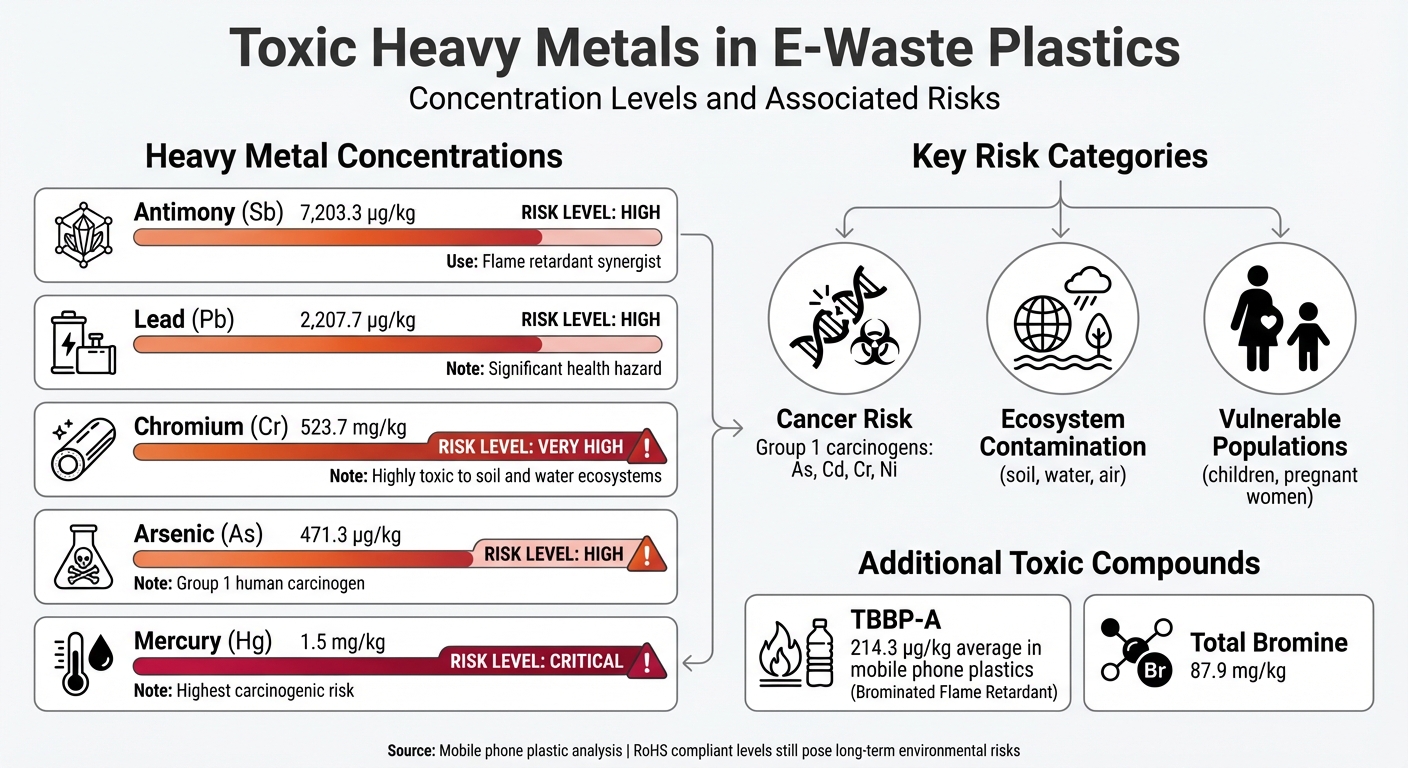
Toxic Heavy Metals in E-Waste Plastics: Concentration Levels and Health Risks
Let’s dive into the specific additives that make e-waste plastics a toxic challenge.
E-waste plastics often include various chemical additives designed to enhance performance and safety. However, these same additives contribute significantly to toxicity concerns, which makes understanding them critical for proper recycling and disposal.
Brominated Flame Retardants (BFRs)
Brominated flame retardants are widely used in electronic plastics to reduce flammability and meet fire safety standards. Some common examples include polybrominated biphenyls (PBBs), polybrominated diphenyl ethers (PBDEs), hexabromocyclododecane (HBCD), and tetrabromobisphenol A (TBBP-A). For instance, in mobile phone plastics, TBBP-A has been found at an average concentration of 214.3 μg/kg, with total bromine levels reaching about 87.9 mg/kg. While these levels comply with RoHS regulations, the long-term persistence of these chemicals becomes a major concern, especially when e-waste is improperly discarded.
These flame retardants are only part of the story. Let’s look at the heavy metals that add another layer of toxicity.
Heavy Metals in Plastics
Heavy metals like lead (Pb), mercury (Hg), cadmium (Cd), and chromium (Cr) are commonly used in e-waste plastics as stabilizers, pigments, or performance enhancers. Among these, mercury poses the highest carcinogenic risk, while lead - found in concentrations around 2,200 μg/kg - presents significant health hazards. Chromium, on the other hand, is highly toxic to soil and water ecosystems, and cadmium contributes to both cancer and other health risks. Open burning of e-waste dramatically amplifies these dangers, releasing concentrated levels of these metals into the environment.
But heavy metals aren’t the only concern. There’s more to uncover with other toxic additives.
Antimony and Other Additives
Antimony (Sb) is often used as a synergist with flame retardants, while trace elements like beryllium (Be) and arsenic (As) further complicate the toxicity profile. For example, arsenic is typically present at about 471.3 μg/kg. Even though these trace elements are found in smaller amounts compared to primary additives, they still require careful attention during recycling processes.
Understanding these toxic components is vital for shaping effective testing, regulatory measures, and safer recycling practices, which we’ll explore further in the discussion ahead.
Health and Environmental Risks
Toxic additives in e-waste plastics don't just stay put - they seep out of discarded electronics, infiltrating the environment and even human bodies. The result? Serious health problems and ecological damage that demand attention.
Chemicals like PBDEs and heavy metals wreak havoc by causing oxidative stress, inflammation, and DNA damage. These disruptions can mess with endocrine functions and metabolic systems. Mercury stands out as a major culprit, linked to both cancer and non-cancer diseases, while lead adds its own toxic effects. On top of that, arsenic, cadmium, chromium, and nickel - found in e-waste plastics - are classified as Group 1 human carcinogens, meaning they are confirmed to cause cancer in humans.
Some groups are especially at risk. Children and pregnant women face heightened vulnerability. For example, a study in Bangkok revealed that children living near informal e-waste recycling sites had elevated levels of PBDEs and toxic metals in their systems. These exposures were tied to oxidative DNA damage and early signs of mutagenic harm - essentially, cellular changes that could lead to serious health issues down the line.
The environment doesn't escape unscathed either. Open burning of e-waste releases toxic fumes and heavy metals, polluting the air, soil, and water. Near e-waste sites, PBDE levels in the air are over twice as high as in unaffected areas (2.30 ng/m³ compared to 0.87 ng/m³). Chromium, in particular, contaminates soil and water, posing eco-toxicity risks. These pollutants don't just stay in the ground - they enter the food chain through contaminated soil and water, accumulating in plants and animals we rely on for food. With e-waste generation growing by 2.6 million tons each year and expected to hit 82 million tons by 2030, the problem is only getting bigger.
This toxic cycle of direct exposure and environmental contamination hits communities hardest where informal recycling is common. Breaking this cycle calls for more rigorous toxicity testing and stricter regulations, which we’ll explore next.
Testing Methods for Toxicity
Understanding the toxicity of e-waste plastics is crucial for managing their risks. Toxicity testing typically involves two main strategies: chemical extraction and analysis, which identifies and measures harmful compounds, and biological toxicity assays, which assess the potential health and environmental effects of those compounds. These methods are particularly useful for addressing the dangers posed by additives like brominated flame retardants (BFRs) and heavy metals.
Chemical Extraction and Analysis
Chemical testing focuses on identifying specific hazardous substances such as heavy metals (e.g., lead and mercury), brominated flame retardants, and phthalic acid esters (PAEs). Techniques like gas chromatography–mass spectrometry (GC-MS) and liquid chromatography–mass spectrometry (LC-MS) are key players here. For instance, LC-MS is ideal for detecting additives like TCEP in plastics processed below 446°F (230°C), as TCEP begins to break down at higher temperatures.
Another advanced method, Pyrolysis GC-MS (Py-GC-MS), uses heat to break down the plastic matrix and immediately analyzes the resulting vapors, significantly reducing contamination risks. In a study conducted in July 2025, researchers Amoluck Eluri and Ivan Kourtchev used Py-GC-MS to analyze emissions from three electronic components - a thermocouple cable, an electrolytic capacitor, and a film capacitor. They successfully measured DEHP and DOP emissions ranging from 3 to 30 mg/kg. The technique achieved impressive detection limits of 0.56 to 0.68 nanograms for phthalates, with high accuracy (R² > 0.990) across a range of 0.1 to 20 nanograms.
"Most current analytical methods have limitations for estimating airborne PAE emissions during e-waste pyrolysis as they either rely on offline sampling and preparation potentially introducing uncertainties and contamination."
- Eluri & Kourtchev, 2025
The strength of Py-GC-MS lies in its ability to reduce contamination from environmental phthalates, which can otherwise distort results. However, the complex nature of plastic matrices can interfere with accuracy, requiring careful adjustments.
While chemical analysis excels at pinpointing and quantifying toxins, biological assays go a step further by evaluating their broader risks.
Biological Toxicity Assays
Chemical tests reveal what toxins are present and in what amounts, but biological assays help determine how dangerous these substances actually are. The USEtox Life Cycle Impact Assessment (LCIA) model is one such tool. It translates chemical concentration data into estimates of potential human health risks - covering both cancer and non-cancer effects - as well as ecological impacts.
For example, researchers analyzed plastic components from 20 discarded mobile phones using a combination of chemical tests and the USEtox model. They discovered that while most substances complied with RoHS limits, mercury and lead significantly contributed to risks of cancer and other diseases. This approach highlights the real-world health implications of these toxins.
Comparing Testing Methods
Combining chemical and biological testing offers the most thorough toxicity evaluation. Chemical analysis is ideal for regulatory compliance, providing precise measurements of banned substances and ensuring contaminant levels meet legal standards. On the other hand, biological assays are better suited for assessing the safety of recycling and disposal practices by examining the cumulative health and environmental effects of detected toxins.
| Feature | Chemical Analysis (GC‑MS / Py‑GC‑MS) | Biological Impact Assessment (USEtox) |
|---|---|---|
| Primary Goal | Identify and measure specific compounds | Assess health and environmental risks |
| Sensitivity | Detects contaminants at nanogram levels (0.56–0.68 ng for PAEs) | Evaluates combined effects of multiple toxins |
| Best Used For | Regulatory compliance and banned additive screening | Recycling safety and disposal impact analysis |
| Time & Cost | Faster for targeted screening; equipment-heavy | Requires prior chemical data; modeling adds time |
The most reliable approach combines both methods. Chemical analysis identifies and quantifies toxins, while biological models provide a deeper understanding of their potential risks. Together, these methods ensure compliance and support safer recycling practices.
Regulatory Standards and Compliance
Handling toxic e-waste plastics requires strict compliance with a range of federal, state, and international regulations. These rules dictate how businesses must manage, test, and dispose of hazardous electronic waste. Below is an overview of key guidelines at different levels.
EPA and Federal Guidelines
The Resource Conservation and Recovery Act (RCRA) Subtitle C serves as the backbone of federal hazardous waste regulations in the U.S. A critical principle under RCRA is that hazardous materials remain dangerous even when recycled. As the EPA emphasizes:
"Hazardous wastes do not cease to be dangerous simply because they are being reused, recycled, or reclaimed".
To identify hazardous characteristics in waste, the EPA relies on its SW-846 compendium, last updated on January 15, 2026. This includes Method 8327, which uses liquid chromatography/tandem mass spectrometry for PFAS analysis.
Federal rules also include certain exclusions aimed at promoting proper recycling practices. For instance:
- Shredded circuit boards are excluded from hazardous waste classification if stored in secure containers and free of mercury switches, mercury relays, and nickel-cadmium or lithium batteries.
- Cathode ray tubes (CRTs) can also qualify for exclusions when handled under specific conditions.
Additionally, the Universal Waste Program (40 CFR Part 273) simplifies the process for managing common hazardous wastes like batteries and mercury-containing equipment.
California E-Waste Regulations
California enforces some of the strictest e-waste regulations in the U.S. Under California Health and Safety Code Section 25214.10, effective since January 1, 2007, the sale of electronic devices containing heavy metals banned by the European Union’s Directive 2002/95/EC is prohibited.
Certain products, such as video display devices with screens over four inches, are classified as "covered electronic devices" (CEDs) and are presumed hazardous when discarded. This classification comes with specific management requirements, including recycling fees. Manufacturers are required to:
- Annually notify retailers about devices subject to recycling fees.
- Work with the California Department of Toxic Substances Control (DTSC), which maintains a list of hazardous electronic devices. The DTSC also offers a "nonhazardous concurrence" process, allowing manufacturers to prove that a device does not meet hazardous waste criteria.
International Standards
Globally, regulations increasingly limit the export of waste plastics, particularly mixed resins and those containing certain flame retardants. These restrictions are encouraging U.S. recyclers to adopt domestic technologies for sorting and processing plastic resins and toxic additives.
The push toward a circular economy is also shaping policies, with a focus on addressing design challenges like disassembly issues and contamination from flame retardants. These efforts aim to extend the lifespan of electronics and reduce toxic exposures during recycling and disposal. Given that plastics account for about 20% of the materials in electronic systems, these measures are becoming increasingly important.
Rica Recycling operates in full compliance with California e-waste laws and federal RCRA standards. With a 100% landfill-free policy, they provide certified electronics recycling services throughout the San Francisco Bay Area, ensuring toxic plastics are handled responsibly. For more information, visit their website at Rica Recycling.
Safe Handling and Recycling Practices
The presence of toxic substances in electronic plastics, such as lead at 2,207.7 μg/kg and chromium at 523.7 mg/kg found in mobile phone plastics, underscores the importance of careful management during disposal. Proper safety protocols and certified recycling processes are essential to address these challenges effectively.
Best Practices for Safe Handling
To protect both workers and the environment, certified recycling practices are crucial. Understanding the specific hazards in e-waste plastics is the first step toward minimizing risks.
- Chemical hazards: Use local exhaust ventilation to capture hazardous fumes, wear appropriate respirators, and apply specialized decontamination agents.
- Physical hazards: Protect against sharp fragments and jagged metal by using cut-resistant gloves and safety goggles.
- Ergonomic risks: Reduce strain with lift tables, adjustable workstations, and mechanical aids.
- Fire hazards: Implement proper storage protocols for lithium-ion batteries and manage combustible dust effectively.
Facilities can also ease regulatory challenges by taking advantage of RCRA exclusions for shredded circuit boards, as long as they are stored securely and free of mercury switches, mercury relays, and batteries containing nickel-cadmium or lithium. However, strict compliance with handling protocols remains non-negotiable, even during recycling.
Recycling Services and Compliance
In addition to workplace safety measures, partnering with compliant recycling services is essential. For businesses and organizations in the San Francisco Bay Area, Rica Recycling offers certified electronics recycling that adheres to federal RCRA standards and California's stringent e-waste regulations. Their services include:
- Convenient pickup and drop-off options
- Secure data destruction with certificates
- IT asset recovery for retired equipment
Rica Recycling operates with a 100% landfill-free policy, ensuring toxic plastics are responsibly processed rather than dumped in landfills, where harmful substances like mercury could contaminate soil and groundwater. Free drop-off is available for items such as computers, servers, monitors, printers, and cell phones, while appliances can be recycled for $50 per item. Additional details can be found at Rica Recycling.
As international requirements evolve, the focus has shifted toward domestic processing of e-waste plastics. Recyclers now prioritize clean, single-resin waste instead of mixed resin shipments. With plastics making up about 20% of the materials in electronic products, this transition supports the growing push for circular electronics - designing products for easier disassembly and material recovery. This approach not only reduces environmental harm but also minimizes toxic exposures during recycling.
Conclusion
E-waste plastics are a troubling source of hazardous substances, including mercury (1.5 mg/kg), chromium (523.7 mg/kg), and lead (2,207.7 μg/kg). These toxins pose serious risks - mercury contributes to cancer and other health problems, while chromium contaminates soil and water ecosystems.
"The results of LCIA highlight the growing importance to avoid the open burning practices of e-waste plastics that contain Hg, Pb, Cr and Sb." - Environment International
This underscores the importance of conducting detailed toxicity assessments. Advanced testing methods are essential for generating data that aligns with safety standards like RoHS and EPA guidelines.
For businesses in the San Francisco Bay Area, Rica Recycling provides a practical solution. They offer certified electronics recycling with a 100% landfill-free policy, secure data destruction, IT asset recovery, and compliance with both federal and California e-waste regulations. Learn more at Rica Recycling.
Shifting toward domestic recycling processes and circular electronics design is a critical step in safeguarding workers, communities, and ecosystems from the dangers of toxic e-waste plastics.
FAQs
How can I tell if an electronic plastic part contains toxic additives?
To spot harmful additives in electronic plastics, you can turn to rapid screening techniques like AP-MALDI-qTOF-MS, which allows for direct detection. Another option is using non-targeted and suspect screening methods, such as GC-QTOF-MS. These approaches are effective for identifying toxic organic compounds, flame retardants, and other chemical additives typically present in e-waste plastics.
What’s the difference between GC-MS testing and USEtox risk modeling?
Gas Chromatography-Mass Spectrometry (GC-MS) plays a critical role in identifying and measuring toxic substances found in e-waste plastics. By delivering detailed chemical profiles, it pinpoints the exact compounds present, offering a precise breakdown of the material's composition.
On the other hand, USEtox takes a different approach. It models the potential risks these chemicals pose to humans and the environment. By analyzing exposure pathways and toxicity data, USEtox provides insights into how these substances might impact broader ecosystems and public health.
Together, these tools serve distinct yet complementary purposes. While GC-MS zeroes in on the chemical makeup, USEtox evaluates the larger implications of those chemicals, creating a more comprehensive picture of toxicity in e-waste plastics.
What do California e-waste rules require when recycling electronics?
California's e-waste regulations require electronic devices to be evaluated for hazardous waste characteristics and regulated materials. This process ensures these items are correctly identified and handled safely, safeguarding both public health and the environment while adhering to state laws and standards.