
Hard Drive Shredding Safety Standards
Hard drive shredding is not just about destroying data. It also has to meet safety, fire, health, and e-waste rules.
If I were checking a shredding process on September 5, 2026, I’d look for six things right away:
NIST SP 800-88 "Destroy" alignment so data can’t be recovered
NSA-style equipment safeguards like enclosed chambers, interlocks, and nearby emergency stops
OSHA and Cal/OSHA controls for guarding, lockout/tagout, noise, and PPE
Dust and fire controls for metal dust, heavy metals, and battery-related hazards
California DTSC and CalRecycle records for shredding, handling, and reporting
Proof on paper like destruction certificates, chain-of-custody logs, and downstream tracking
Here’s the short version: a shredder can meet data-destruction goals and still fail on worker safety or waste handling. That matters because shredding lines can hit 95–110 dBA, and NIOSH has reported lead and cadmium overexposures at weakly controlled e-scrap sites. So the standard isn’t just “Was the drive shredded?” It’s also: Was it done safely, documented, and sent through the right waste stream?
A good process usually includes:
Serial number tracking
Battery removal before shredding
Guarded feed openings
Lockout/tagout for jams and maintenance
HEPA vacuuming instead of dry sweeping
Annual and pre-start filings in California
Downstream records for shredded material
If you’re picking a provider, I’d keep it simple: ask for the paperwork, ask about dust control, and ask how they handle batteries and shred residue. If they can’t show records, I would not treat the process as complete.
That’s the core of the article: data destruction, worker safety, fire control, and California compliance all have to work together.
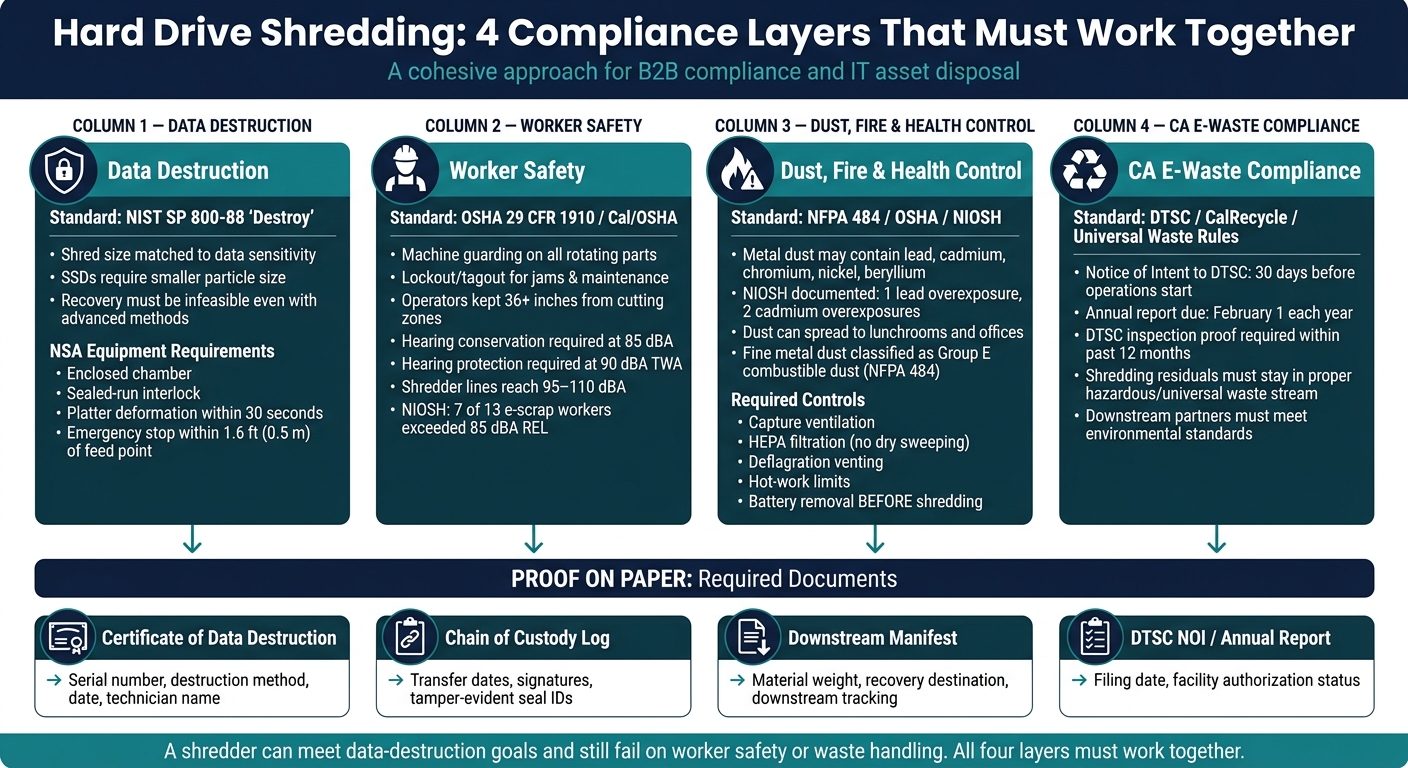
Hard Drive Shredding Compliance Checklist: Data, Safety & E-Waste Standards
Core Standards for Hard Drive Destruction and Equipment Safety
These standards cover two things at once: how the destruction has to work and how the machine has to be run safely.
NIST SP 800-88 and NSA Requirements for Physical Destruction
NIST SP 800-88 treats shredding as a Destroy method when data recovery must be infeasible even with advanced recovery methods.[10][4] In plain terms, the drive has to be destroyed so thoroughly that even high-end recovery efforts won't bring the data back.
Particle size matters here. NIST says the shred size should match the sensitivity of the data and the residual risk.[10][4] For SSDs and data with higher confidentiality needs, the particles must be smaller.[2][4]
NSA guidance gets more specific about the machine itself. It requires:
An enclosed chamber
A sealed-run interlock
Platter deformation within 30 seconds
An emergency stop within 1.6 feet (0.5 meters) of the feed point[3]
That last point is easy to picture: if something goes wrong, the operator shouldn't need to lunge across the room to stop the machine.
R2v3 and e-Stewards Rules That Affect Shredding Operations
R2v3 focuses on process control and documentation. It requires documented sanitization, serial-number traceability, equipment calibration, and destruction records.[19][20][22] So it’s not enough to say a drive was shredded. You need records that show which drive, when, and under what controls.
e-Stewards adds limits on how shredding is handled. It requires hard-drive shredders to be dedicated to hard drives and requires qualified downstream handling of the shredded output.[6][5][8][18][19][23] That means the job doesn’t stop once the drive goes through the machine. The shredded material still has to move through the right channels, such as electronics recycling services, afterward.
Machine Guarding, Lockout/Tagout, and Safety Controls
Under OSHA 29 CFR 1910.212, shredder operators must be protected from knives, pinch points, feed openings, and flying debris.[11][16] For shredders, rotating parts must stay enclosed except for a limited feed opening, and guards must be made of solid material or fine mesh.[12][17]
OSHA and ANSI guidance also recommend feed-system designs that keep operators at least 36 inches from in-running rolls or cutting zones during loading.[12] That buffer matters. A few feet can be the line between normal operation and a bad injury.
Lockout/tagout under 29 CFR 1910.147 applies when a worker clears a jam, replaces knives, cleans the chamber, or does maintenance where unexpected startup could cause injury.[13][14][15] Powering the machine off is not enough. The energy has to be isolated, locked, and verified before maintenance or jam clearing starts.
ANSI B11 and ISO 13849-1 set the bar for how safety controls such as emergency stops and interlocks must perform. They also require those controls to be tested and validated, not just assumed to work.[3][26]
These controls help cut mechanical injury risk. Dust, noise, and fire risks still remain.
Health and Environmental Risks in Hard Drive Shredding
Metal Dust, Air Quality, and Fire Risk
Once mechanical safeguards are in place, the next set of risks comes from dust, noise, and fire.
Hard drive shredding creates metal dust and fine dust that may contain lead, cadmium, chromium, nickel, and beryllium.[31] That’s not a small issue. NIOSH has found airborne metal exposure levels near or above OSHA limits when ventilation and cleanup practices are weak.[31] In one NIOSH review, one worker had lead overexposure and two workers had cadmium overexposure.[9][39]
Dust also doesn’t stay neatly around the shredder. It can travel into lunchrooms and offices, which turns a shop-floor problem into a site-wide one. For cleanup, HEPA vacuuming and wet cleaning are the safer options. Dry sweeping or using compressed air can push dust back into the air, right where workers can breathe it in.[37][38][39]
There’s also a fire and explosion angle here. Fine metal dust can ignite. NFPA 484 treats many of these materials as Group E metal dusts, so facilities should use:
Capture ventilation
HEPA filtration
Deflagration venting
Hot-work limits
Removal of lithium-ion batteries before shredding
Those steps matter because a shredder can turn a hard drive into more than scrap in seconds if dust control slips.[31][32][34][40]
Noise, Ergonomics, and Common Injury Patterns
Airborne exposure is only part of the picture. Noise and physical strain show up just as often.
Shredder lines are loud, often reaching 95–110 dBA near the equipment.[27][30] NIOSH found that seven of 13 e-scrap workers were above its 85 dBA REL, and one was above OSHA's 90 dBA PEL.[9][29][30] At 85 dBA, 29 CFR 1910.95 requires a hearing conservation program, along with testing, training, and recordkeeping.[9][29][30]
As noise levels move toward the 90 dBA PEL, acoustic enclosures and job rotation can help cut worker exposure.[28][33] That kind of control can make a big difference over a full shift.
The physical side of the job brings its own set of problems. Manual lifting, twisting, sharp edges, and conveyor loading often lead to back strain, shoulder injuries, cuts, and caught-in hazards.[9][35][36][38][41] Shops can lower that risk with carts, pallet jacks, lift tables, and adjustable-height workstations.[9][35][36][38][41]
These hazards explain why the federal, California, and certification rules in the next section are so strict.
Compliance Requirements for U.S. and California Facilities
Federal OSHA Rules and California E-Waste Requirements
The hazards covered in the previous sections don’t just create safety risks. They also trigger clear compliance duties under OSHA, DTSC, and CalRecycle.
OSHA requires machine guarding, lockout/tagout, hearing conservation, and dust-related respiratory protection when exposure levels call for it. Hearing protection is required when noise exposure reaches 90 dB TWA or higher.[13][46][47]
California adds stricter rules for e-waste handling and reporting. Covered electronic devices are managed as universal waste, which means they must move through compliant e-waste handling systems.[48][50] Facilities must submit a Notice of Intent to DTSC at least 30 days before starting operations. They also need to file annual reports by February 1 that describe handling and treatment activities, including shredding.[42][43] For recyclers in the Covered Electronic Waste program, CalRecycle also requires proof of a DTSC inspection completed within the past 12 months, along with current health, safety, and environmental compliance plans.[44]
Under California rules, shredding counts as a physical processing method, and shredding residuals must remain in the proper hazardous-waste or universal-waste stream.[7][49] In plain terms, facilities need a clear paper trail showing how each material stream is handled and where it goes next.
What to Look for in a Certified Shredding and ITAD Process
If you’re choosing a shredding or ITAD provider, don’t stop at sales claims. Ask for records and procedures that can stand up to an audit. The table below shows the main documents a compliant provider should be able to produce on request:
Document Type | Key Data Points | Compliance Relevance |
|---|---|---|
Certificate of Data Destruction | Serial number, destruction method, date, technician name | Audit readiness, data security standards |
Chain of Custody Log | Transfer dates, signatures, tamper-evident seal IDs | Audit readiness, liability protection |
Downstream Manifest | Material weight, recovery destination, downstream tracking | CalRecycle compliance, ESG reporting |
DTSC NOI / Annual Report | Filing date, facility authorization status | California e-waste handler compliance |
Paperwork matters, but the physical process matters just as much. A compliant operation should remove batteries and other hazardous parts before shredding, not after. Lithium-ion packs, capacitors, and CRT components must be taken out and sent to the proper waste streams under California universal waste rules before shredding starts.[7][45] A provider should be able to show written procedures for this step, not just talk through it on a call.
The clearest signal is documented downstream handling. CalRecycle requires CEW recyclers to show that downstream partners meet applicable environmental standards.[44] Providers that can document where shredded metals, plastics, and hazardous fractions go - and keep those materials out of general waste streams - fit California’s expectations.[44]
Conclusion: The Safety Standards That Matter Most
Hard drive shredding has to meet rules for data destruction, machine safety, worker health, fire control, and e-waste handling.[24][1][51] If a facility meets NIST SP 800-88 Destroy requirements but overlooks dust hazards or machine risks, it’s only doing part of the job and still leaving itself open to serious problems.
These rules fall into three layers. NIST SP 800-88 and NSA guidance set the bar for destruction performance. OSHA covers safe operation. R2v3 and e-Stewards add audit requirements, downstream controls, and worker-protection measures.[24][1][51][52][21]
For California facilities, federal OSHA rules still apply, along with state e-waste handling and recordkeeping requirements.
The main point is simple: what matters is documented, standards-based destruction, not just shredding by itself. The proof is in the paperwork. Ask for:
destruction certificates
chain-of-custody records
current certifications
dust-control procedures
battery screening
A certified, documented process helps protect data, reduce safety and e-waste risk, and back responsible recycling.
FAQs
What shred size is considered secure?
Professional shredding should break hard drives down into very small pieces so the data can't be recovered. In most cases, industry best practices and compliance standards treat 2 mm or less as secure.
For highly sensitive data, microshredding cuts drives into dust-like particles for the highest level of security. The destruction process should also be verified against your organization’s compliance requirements.
Why must batteries be removed first?
Batteries need to come out first because lithium-ion and other rechargeable batteries can trigger serious fire and explosion risks if they’re mishandled or shorted during shredding or cutting.
Taking them out also keeps batteries away from mixed e-waste loads, where sparks, combustible dust, or poor storage can set them off and put workers in danger.
What records should a shredding provider have?
A shredding provider should keep thorough, serialized records for every asset. That paper trail matters for compliance and makes audits far less painful.
This should include:
a detailed asset register with serial numbers, device types, makes, models, and data classifications
Certificates of Destruction showing the date, time, facility location, and method used
a clear chain of custody with signed transfer forms, timestamps, and, when needed, GPS-tracked transport records