
How AI Optimizes Reverse Logistics for Data Centers
AI can cut reverse-logistics waste in three places at once: tracking, routing, and grading. If you run a data center decommission, that means fewer missing assets, lower transport spend, faster intake, and cleaner audit records.
Here’s the short version:
Asset tracking: AI links serial numbers, scan events, wipe logs, and disposition records into one custody trail.
Transport planning: AI groups pickups, plans routes, and helps lower miles driven by 10%–25%.
Grading and resale: AI reviews condition and config data to help route gear to redeploy, resale, refurbish, or recycling.
Compliance support: It flags gaps like missing wipe events or broken custody records before an audit finds them.
Recovery results: Strong ITAD programs can recover 15%–35% of original asset value, while landfill diversion should stay at 95%+.
Risk control: Weak tracking is expensive when the average U.S. data breach costs $10.22 million.
A typical project still has the same core steps: inventory, removal, transport, data sanitization, grading, and final reporting. The problem is that manual tools - spreadsheets, paper manifests, and hand-entered serials - slow the process and make mistakes more likely.
My takeaway is simple: AI does not replace ITAD work. It helps you move retired hardware out of service with better records, lower cost per asset, and fewer delays from rack removal to final disposition.
Below, I break down where AI helps most, what data it needs, and which metrics matter if you want to measure results.
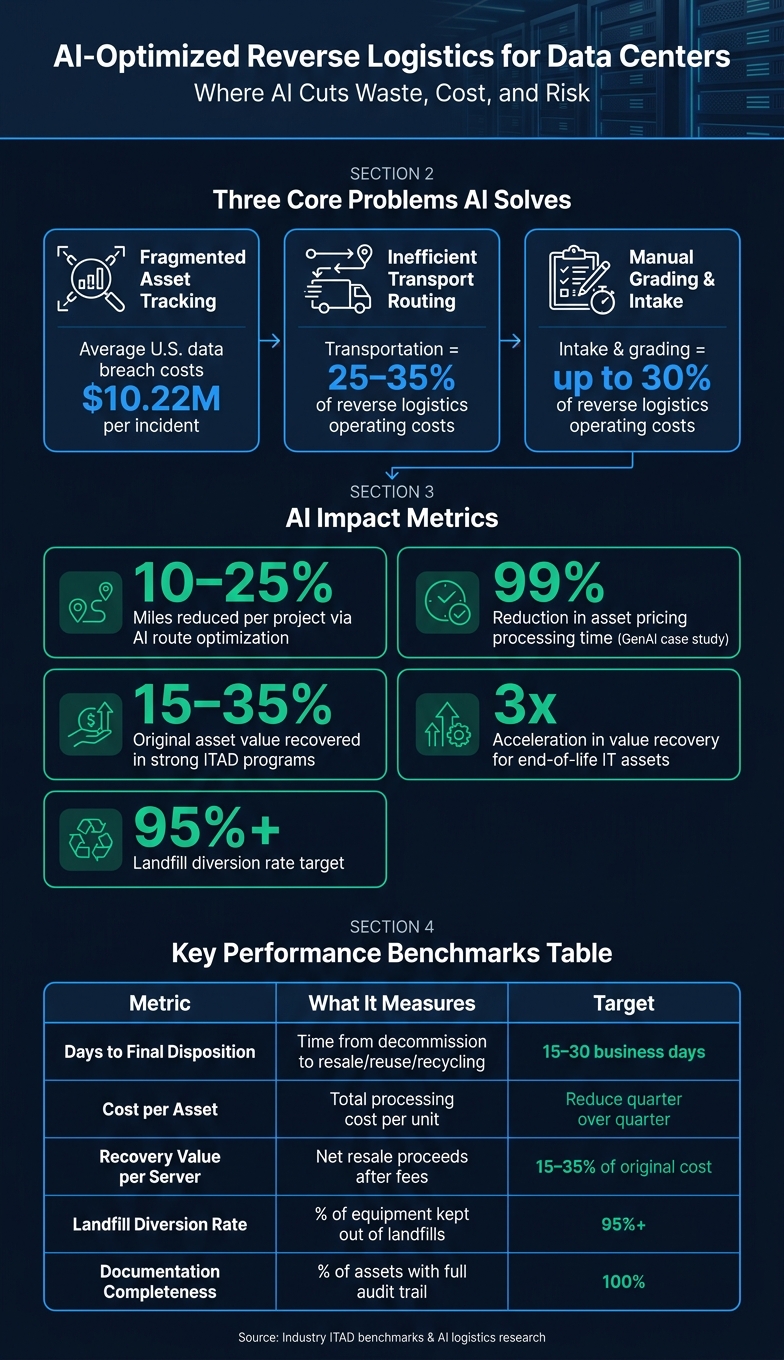
AI-Optimized Reverse Logistics: Key Metrics & ROI for Data Center Decommissioning
The End of Guesswork: How AI is Transforming Liquidation and Reverse Logistics.
The Core Reverse Logistics Problems AI Can Solve
Three recurring issues drive losses in reverse logistics: weak asset tracking, inefficient transport, and inconsistent grading. These are the spots where AI can make the fastest impact.
Fragmented Asset Tracking and Weak Chain-of-Custody
Many data center decommissions still run on spreadsheets, siloed IT asset management tools, paper manifests, and manual serial entry[5][7][8]. That might work on a small job. But when you're dealing with thousands of servers, drives, and network devices, the cracks show fast.
Serials get typed in wrong. Labels get skipped. Devices move, but the system never reflects it. And once that happens, chain-of-custody starts to fall apart.
If you can't match what left the rack to what arrived at the processing facility, you've got a compliance problem. Standards like HIPAA and SOC 2 expect clear control over data-bearing assets from removal through destruction[3][5][7][8]. Missing serial records and incomplete destruction logs leave audit gaps and increase compliance risk.
The financial downside is hard to ignore. The average U.S. data breach costs $10.22 million per incident[9]. So weak tracking isn't just messy. It can get expensive fast.
Inefficient Pickup Routing and High Transportation Costs
A lot of reverse-logistics pickups are still scheduled ad hoc. That usually means partial loads, poor stop sequencing, and higher transportation spend.
Transportation by itself can make up 25–35% of total reverse logistics operating expenses[1]. When trucks leave half full or take inefficient routes, the cost per asset goes up. Driver hours per trip increase. And the time from rack removal to facility arrival gets longer.
That lag hurts more than people think. Servers and storage don't hold their resale value forever. In fast-moving secondary markets, prices can drop quickly[2][4][6]. The longer equipment sits, the more value can slip away.
And here's the catch: lower transportation cost doesn't mean much if the asset then stalls at intake or disposition.
Slow Intake, Manual Grading, and Poor Disposition Decisions
Manual grading is often based on visual checks and basic testing. The process changes from site to site, and sometimes from one technician to the next. That's where money starts leaking out.
When people aren't sure, they tend to play it safe. So equipment that could have been refurbished and resold often gets pushed into electronics recycling instead.
Intake and grading can account for up to 30% of reverse-logistics operating costs[1]. AI-based grading and FMV analysis can help route each asset to the outcome with the best return, while also improving cycle time[2][4][6]. Manual workflows usually can't match that level of consistency.
The next section shows how AI fixes these problems in practice.
How AI Improves Data Center Equipment Recovery
AI for Serialized Tracking, Anomaly Detection, and Audit-Ready Records
AI-backed tracking systems pull in asset lists from CMDBs, decommissioning plans, and logistics manifests. Then they use machine learning to line up serial numbers, barcodes, and config data across those sources and across each event in the chain. Every scan event - whether it comes from a barcode, RFID, or handheld terminal - is time-stamped and linked to a single asset ID. The result is a machine-readable custody record that updates every time the asset is scanned.
This helps teams spot problems before they turn into audit headaches. If a server leaves a data center but there’s no matching data-wipe event inside the agreed SLA window, the system flags it. If a serial number shows up later in the process without a recorded pickup, that gets flagged too. Instead of finding those gaps during an audit, compliance teams can catch them early. In a large decommissioning project, the system can track tens of thousands of assets and destruction records in real time.[11]
AI can also generate exportable custody logs that show decommission date, pickup, arrival, destruction, and final disposition. Those records are ready to support SOC 2, ISO 27001, and environmental reports.
Once the asset record is clean, AI can help move the hardware side of the job faster and at lower cost.
AI Route Optimization and Volume Planning to Cut Logistics Costs
AI route optimization looks at route, load, and timing decisions all at once. It takes pickup locations, time windows, equipment weights and volumes, and truck capacity, then figures out the most efficient stop sequence. In data center recovery, that often means grouping pickups from multiple sites - on-site data centers, edge locations, and offices - so trucks move more equipment per run.
That matters for a simple reason: fuller trucks usually mean lower cost per pickup. Fewer miles can also mean assets arrive sooner and reach final disposition earlier.
AI-driven routing often cuts miles driven per project by 10–25%, which lowers fuel and carrier costs.[10][13] Predictive volume planning also helps teams lock in carrier capacity ahead of time and avoid premium freight.
When transportation gets tighter, intake tends to move faster too - and that sets up better downstream recovery results.
AI-Based Grading and Predictive Disposition for Better Recovery Value
Computer vision models trained on past grading decisions can review cosmetic damage, missing parts, and physical wear on servers, switches, and storage arrays at speed. When that’s paired with config data - CPU type, RAM, storage, and firmware version - AI can assign a standard grade and recommend what should happen next: redeploy, resell through a sustainable electronics store, refurbish, or recycle. Better grading decisions can push more assets into resale instead of recycling.
AI also makes grading more consistent across sites. That can cut resale disputes and improve resale forecasts. One GenAI-based pricing engine case study reported a 99% reduction in asset pricing processing time and a 3x acceleration in value recovery for end-of-life IT assets.[12]
Predictive disposition models can also apply policy rules. For example, a high-risk data-bearing asset may require destruction no matter what the resale market says. That keeps recommendations in line with compliance requirements, even when resale value looks tempting. Over time, feedback from sale prices and buyer rejection rates helps the model make better disposition calls.
What Implementation Looks Like for Bay Area Organizations
The Data and Workflow Inputs AI Needs to Work Well
AI works best when the underlying data is clean and easy to trace. For Bay Area organizations, that means building the same data foundation needed to fix tracking, routing, and grading in the first place.
It starts with a serialized asset inventory. Each record should include the asset tag, serial number, specs, age, location, and owner. After that, every step in the recovery process needs its own logged event.
That usually includes a transport manifest with pickup and drop-off timestamps, pallet IDs, and GPS route logs. It also includes a data wipe log that records the method used, such as NIST 800-88 Clear or Purge, the success or failure status, the technician or system ID, and the verification result. Teams should also record timestamps for intake, testing, wiping, grading, and final disposition.
Two more data sources complete the picture. First, resale outcome records should track days to sale, final sale price in U.S. dollars, the sales channel, and the condition grade. Second, recycling records should show materials recovered, weight in pounds, destination facilities, and downstream certifications.
When those inputs are in place, AI can connect events across the full chain, spot odd patterns, and improve its recommendations over time. Just as important, teams can finally check whether AI is making recovery faster, cheaper, and easier to audit.
How to Measure Efficiency, Cost Reduction, and Sustainability Results
Once the data feed is structured, the next step is simple: measure whether AI is cutting cycle time and lowering handling costs.
A standard ITAD engagement for about 500 assets usually takes 15–30 business days from pickup to final certification[16]. That makes days to final disposition a solid baseline metric.
For cost, two numbers matter most: cost per asset and cost per mile on pickup routes. Cost per asset looks at total handling, transport, and processing fees divided by the number of units processed. Cost per mile shows whether AI-based route planning is trimming transportation spend.
To track recovery value, use recovery value per server. This measures net resale proceeds after fees as a share of the original purchase price. Well-run ITAD programs can recover 15–35% of original asset value[15].
For sustainability, focus on landfill diversion and documentation completeness. Landfill diversion should be 95% or higher[15]. Documentation completeness should be 100%[16], with every asset tied to a full audit trail that includes chain-of-custody logs, wipe certificates, and final disposition records.
That last metric matters a lot in California. AI can flag missing documents and custody gaps before an audit does, which is especially useful for Bay Area organizations working under the state's e-waste rules in the Electronic Waste Recycling Act (SB 20/SB 50)[14].
Metric | What It Measures | Target Benchmark |
|---|---|---|
Days to Final Disposition | Time from decommission to resale, reuse, or recycling | 15–30 business days |
Cost per Asset | Total processing cost per unit | Reduce quarter over quarter |
Recovery Value per Server | Net resale proceeds after fees | 15–35% of original cost |
Landfill Diversion Rate | % of equipment kept out of landfills | 95%+ |
Documentation Completeness | % of assets with a full audit trail | 100% |
Where Rica Recycling Fits Into Secure and Responsible Recovery Workflows
Those metrics depend on steady pickup records, serial-linked certificates, and downstream processing data. For Bay Area organizations, Rica Recycling can handle pickup, secure data destruction, and compliant recycling records that feed AI tracking and reporting.
Its serialized certificates, landfill-free processing, and California e-waste compliance help support audit-ready documentation and sustainability reporting.
Conclusion: AI Makes Reverse Logistics Faster, Cheaper, and Easier to Manage
Reverse logistics for data center equipment gets slow, expensive, and messy to audit when teams rely on manual tracking, fixed routing, and inconsistent grading. AI helps clear those three bottlenecks.
When you put serialized tracking, route optimization, and AI-assisted grading together, the payoff is pretty clear: lower cost per asset, less time to reach final disposition, better audit trails, and stronger recovery value.
As equipment turnover keeps climbing, efficient reverse logistics matters more every year. That pressure shows up most when equipment needs to move fast from decommission to final disposition.
That said, AI only works well when the physical recovery process is documented from end to end. It can improve the workflow, but certified ITAD, secure data destruction, and compliant recycling still handle the hands-on work. For Bay Area organizations, Rica Recycling offers pickup, secure data destruction with certificates, and landfill-free processing that supports audit-ready tracking and reporting.
Organizations that move now on AI-supported tracking, routing, and grading will be in a better position to manage larger decommissions with lower risk, lower cost, and stronger sustainability reporting.
FAQs
How much data does AI need to work well?
There’s no stated minimum amount of data.
The main idea is simpler than it sounds: AI can work well by using visual recognition and predictive analytics to spot device models, configurations, and condition fast.
That helps teams automate complex tasks, improve accuracy, streamline compliance, and cut errors compared with manual methods.
Can AI improve reverse logistics without replacing ITAD teams?
Yes. AI can improve reverse logistics without replacing ITAD teams. Think of it as a force multiplier: it cuts down manual work, automates sorting, and helps teams make better calls.
When AI takes over repetitive jobs like device identification and inventory syncing, staff get more time for higher-value work. That shift matters. Instead of spending hours on manual sorting, teams can manage AI-driven tools that improve safety, accuracy, and speed.
Which reverse-logistics metric should we track first?
Start with recovery rate: the share of eligible data center assets that make it through your reverse logistics workflow.
It gives you a fast read on how well your equipment recovery process is working. It also sets a baseline, so you can track costs and other downstream metrics with more clarity.