We solve e-waste problems by making collection easier - and checking what happens after pickup. Before you load your vehicle, confirm accepted items, fees, hours, and unloading help. Then protect your data and set working devices aside for repair or reuse.
Here’s how we turn community collections into a system people can use:
Bring collection closer: Offer nearby drop-off sites, scheduled events, and pickup options.
Share the work: Give schools, local governments, nonprofits, businesses, and recyclers clear duties.
Protect data: Track each handoff and request sanitization or destruction records. <u>A pickup receipt is not proof of data destruction.</u>
Check results: Count people served, devices reused, material recycled, and items still awaiting processing. Use feedback to improve locations, hours, and instructions.
In the Bay Area, Rica Recycling lists free electronics drop-off in Hayward, Monday–Friday, 8 a.m.–4 p.m. We should confirm current terms, appliance fees, pickup options, certifications, and records before scheduling.
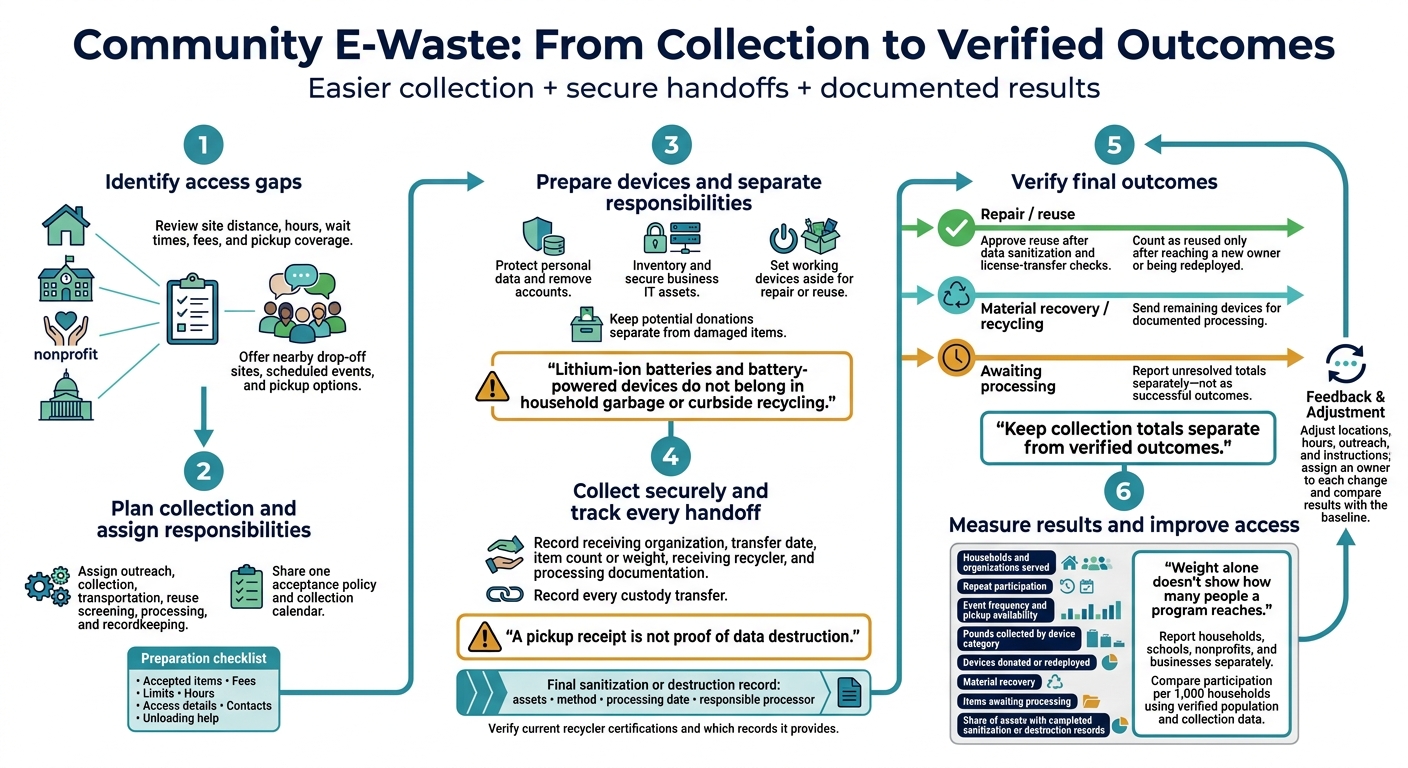
Community E-Waste: From Collection to Verified Outcomes
US Communities Adopt Electronic Waste Laws, Recycling Programs
Community Collections Make Recycling More Accessible
Community-hosted collections work best when the details are settled before dates are announced: staffing, secure storage, fire-safety procedures, transportation, and the material’s destination. Collection points at schools, community centers, and municipal sites bring access, rules, and secure handling together. Short surveys or public meetings can help residents identify gaps in access, while schools and neighborhood groups can share consistent event details.
Drop-Off Sites and Scheduled Collection Events
Publish one clear collection notice with accepted items, fees, limits, hours, access details, and contacts. Include prohibited items, preparation steps, the schedule, and whether businesses can participate. Cover parking, transit, an accessible unloading area, language assistance, and a contact number.
Explain how batteries and damaged devices will be handled. Lithium-ion batteries and battery-powered devices do not belong in household garbage or curbside recycling.[3]
Factor | Permanent drop-off site | Scheduled collection event |
|---|---|---|
Accessibility | Recurring access; travel and fixed hours may limit participation | Reaches underserved neighborhoods at selected times |
Capacity | Planned storage and regular transportation | Depends on vehicles, containers, staffing, and volume |
Staffing | Regular intake staff and security | Event volunteers, intake staff, and traffic control |
Frequency | Posted operating hours | Announced dates only |
Households | Best for smaller loads with transportation | Best for nearby collection or unloading help |
Businesses | Best for recurring deliveries if accepted | Best for coordinated loads within confirmed limits |
Access is only part of the job. Working devices need a separate route into reuse, so both models should have a dedicated intake area away from damaged items. EPA's electronics donation and recycling guidance supports reuse of working devices and recommends certified recyclers for unwanted electronics.[2]
Record the receiving organization, transfer date, item count or weight, receiving recycler, and processing documentation. Do not label an item reused until it leaves the site for reuse.
Rica Recycling Drop-Off and Pickup Services
Clear local collection details help residents and organizers plan for large or sensitive electronics.
Rica Recycling lists free drop-off at 27105 Industrial Blvd., Hayward, CA 94545, Monday through Friday, 8 a.m. to 4 p.m., for computers, laptops, servers, network equipment, monitors, TVs, printers, phones, cables, chargers, and related equipment.[8] For larger or sensitive loads, confirm pickup details, service area, accepted items, and any charges directly before scheduling.[6][8]
Appliances follow separate rules. Rica Recycling's appliance information lists separate categories and fees[7][8], so organizers should confirm current appliance pricing, accepted items, pickup availability, hours, and preparation requirements before publishing a notice.
Partnerships Keep E-Waste Programs Running
Once collection sites and events are in place, put each partner’s responsibilities in writing. The operating plan should assign outreach, collection, transportation, reuse screening, processing, and recordkeeping. Name a coordinator at each organization, set recurring collection schedules, and specify who pays transportation and processing costs.
Responsibilities for Schools, Governments, and Businesses
Schools can host recurring collections and identify equipment for reuse. Local governments can publish accepted-material rules, guide the public, approve suitable collection sites, and coordinate transportation or contracted handlers.
Nonprofits can recruit volunteers, offer multilingual outreach, inspect working equipment for reuse, and connect usable devices with schools or community organizations. Businesses should inventory retired equipment, identify or quarantine data-bearing assets, and schedule pickups. Direct reusable devices to donation and the rest to certified recycling.[2][9]
Partners should share one acceptance policy and collection calendar, with clear authority to approve transfers and resolve missed pickups. Assign a tester to check potential donations. Businesses and schools should approve reuse only after data sanitization and license-transfer checks.
Request separate cost estimates for transportation, processing, data destruction, certificates, and final disposition reports. This helps ensure funding covers the work that continues after collection ends.
Secure Processing and Documentation
Before contracting with Rica Recycling, verify its current certifications, what they cover, applicable authorization, and exactly which records it provides - including destruction certificates.
Use one shared workflow, with preparation and documentation requirements for each category.
Category | Preparation | Data-security needs | Collection method | Documentation |
|---|---|---|---|---|
Household electronics | Remove personal accounts; follow battery-handling instructions; identify damaged devices. | Sanitize data-bearing devices when possible; supervise unsanitized devices. | Staffed drop-off or approved pickup. | Collection receipt, count or weight, receiving handler, processing outcome. |
Business IT assets | Inventory serial numbers or asset tags; label and secure equipment. | Document sanitization or destruction for each asset. | Scheduled pickup with an authorized handoff. | Asset inventory, custody log, pickup receipt, sanitization or destruction certificate, disposition report. |
Large appliances | Confirm acceptance; empty contents; secure loose parts; disclose refrigerants or damage. | Reset smart appliances and remove accounts when applicable. | Scheduled pickup or staffed drop-off with suitable lifting equipment. | Appliance type, count or weight, receiving facility, recovery or recycling record. |
A pickup receipt is not proof of data destruction. Record every custody transfer. Require the final sanitization or destruction record to identify the assets, method, processing date, and responsible processor. Follow a media-sanitization procedure, such as NIST SP 800-88 Rev. 2.[10]
California requires certain regulated e-waste records to be kept for at least three years. Confirm which retention rule applies to each partner.[11][5]
Measure Results and Improve E-Waste Programs
Measure whether civic programs are reaching more people and leading to verified reuse and recycling. Once collections begin, check who they serve and where the process breaks down.
Track Participation, Reuse, and Recycling
Community reporting shows which outreach efforts work. Keep a regular dashboard that tracks participation, reuse, and recycling.
Track households and organizations served, repeat participation, event frequency, pickup availability, and pounds collected by device category. Report households, schools, nonprofits, and businesses separately. Weight alone doesn't show how many people a program reaches. Note whether reported weights include packaging or other non-electronic material.
Keep collection totals separate from verified outcomes. Track equipment screened for reuse, donated or redeployed, sent for material recovery, and still awaiting processing. Count equipment as reused only after it reaches its new owner or is redeployed - not when it passes screening. EPA identifies donation and reuse as ways to extend the life of functioning electronics.[2] Use participation data to adjust locations, hours, and outreach where turnout is lowest.
Also track the share of assets with completed sanitization or destruction records. Publish unresolved totals so processing delays remain visible rather than being counted as successful outcomes.
Use Community Feedback to Improve Access
Use the dashboard to spot participation patterns, then ask the community what's behind them. Compare participation per 1,000 households across neighborhoods using verified population and collection data. Review site distance in miles, hours, wait times, fees, and pickup coverage. Pair those numbers with surveys from schools, nonprofits, and people who haven't participated.
Use the findings to move collection sites, add evening or weekend hours, and explain item-specific acceptance rules and fees before people travel to recycle electronic waste. Check site accessibility and instructions in local languages. Assign one person to each change, compare results with the baseline, and use those measurements to guide the next round of changes.[12]
Conclusion: Easier Collection and Accountable Processing
The solution is a shared system, not a one-time cleanup. Civic engagement helps residents access collection services, while schools, businesses, governments, and processors coordinate secure handoffs and records of each device’s final disposition.
Put repair and reuse before recycling when devices still work. Protect data before donating or redeploying devices, and send the rest for documented processing.
Start by identifying gaps in access, confirming requirements, planning collection logistics, and tracking verified outcomes. Clear rules, coordinated logistics, and verified records turn e-waste collection into accountable processing. Bay Area organizers can contact Rica Recycling for pickup, drop-off, and secure data destruction. Confirm accepted items and documentation before scheduling.
FAQs
How can I start a neighborhood e-waste program?
Ask residents, businesses, and local organizations which devices they need to dispose of and what makes disposal difficult. Set measurable goals, work with certified recyclers and local groups, and clarify who handles each task.
Choose convenient drop-off locations or plan collection events 30–90 days ahead. Start promoting them 4–6 weeks in advance through social media and community channels. Provide education and on-site collection, make sure devices are securely prepared to protect their data, and request certificates of recycling and data destruction.
What if I can’t erase my device’s data?
If you can’t erase your device’s data yourself, use a professional data destruction service. Deleting files or formatting a drive often leaves data that can still be recovered.
Rica Recycling securely removes data by wiping, degaussing, or physically destroying the device through shredding or crushing. You’ll receive a Certificate of Data Destruction as legal proof that your sensitive information has been securely and permanently removed.
How can our community fund ongoing e-waste collections?
Apply for federal, state, private, or local government grants to help pay for collection costs, facility upgrades, and outreach [1]. Fee-for-service models and sponsorships from local businesses or organizations offer other funding options [2][1].
Working with certified recyclers like Rica Recycling may help nonprofits recover value from recycled materials [3][4]. Scheduling collections alongside existing community activities can also cut costs and bring in more participants [2].