
How E-Waste Contaminates Soil and Water
E-waste, or discarded electronics, is one of the fastest-growing waste streams globally, with over 62 million tons generated in 2022. Most e-waste ends up in landfills, where toxic materials like lead, mercury, cadmium, and PFAS pollute soil and water. Here's what you need to know:
- Soil Contamination: Toxic chemicals leach from e-waste into the soil, harming farmland and ecosystems. For example, lead levels in some areas exceed safety limits by 87.5 times.
- Water Pollution: Rainwater dissolves harmful substances from e-waste, contaminating groundwater and surface water. This affects drinking water and aquatic life.
- Health Risks: Exposure to these toxins can cause brain damage, developmental delays, kidney harm, and cancer.
- Solutions: Certified recycling programs prevent e-waste from reaching landfills and recover valuable materials like gold and copper.
There are many problems of electronic waste that have long-lasting effects on health and the environment. Recycling responsibly is key to reducing this growing problem.
How E-Waste Contaminates Soil
Chemical Leaching from Landfills
When old electronics are dumped in landfills, rainwater seeps through the waste, picking up harmful substances like lead, cadmium, mercury, and PFAS (often called "forever chemicals"). This toxic mix then infiltrates the surrounding soil. Acidic conditions make the problem even worse, as they allow heavy metals to move more freely. These pollutants tend to gather in the top layers of soil but can penetrate as deep as 12 to 39 inches (30 to 100 cm).
In addition to chemical leaching, even physical contact with discarded electronics can introduce toxins directly into the soil.
Direct Soil Contact from Discarded Electronics
Improper handling of e-waste, especially during dismantling, can release harmful metals directly into the ground. For example, informal recycling methods - like burning plastic coatings on wires to extract copper - emit dangerous dioxins and furans that settle into the soil.
One striking example is the Agbogbloshie scrapyard in Accra, Ghana, one of the largest informal e-waste hubs in the world. Soil in this area has been found to contain lead levels as high as 35,300 mg/kg - an alarming 87.5 times above international safety standards. Burning plastic alone has been linked to 86% of the organic pollutants found across the 31.3-acre site.
Effects on Farmland and Land Use
These contamination processes have devastating effects on agricultural land. Toxic substances like lead, cadmium, PCBs, and PFAS remain in the soil for years, making it unfit for farming. Cadmium, for instance, is particularly concerning because it moves easily through acidic soil and is absorbed by crops. Studies show that for people living near contaminated areas, vegetables can account for over 70% of their cadmium exposure. Once farmland is affected, it may remain unsafe for food production for decades.
| Toxic Substance | Common E-Waste Source | Impact on Soil and Farmland |
|---|---|---|
| Lead (Pb) | CRT glass, solder, batteries | Stays in soil for decades; toxic to plants and soil microbes |
| Cadmium (Cd) | Chip resistors, Ni-Cd batteries | Easily absorbed by crops, harming agricultural output |
| Mercury (Hg) | Relays, switches, flat-panel displays | Enters the food chain through plants grown in contaminated soil |
| PFAS | Wire coatings, insulators, flame retardants | Does not break down; remains in soil indefinitely |
| PCBs | Transformers, capacitors | Reduces soil fertility and harms soil ecosystems for years |
sbb-itb-855056e
How E-Waste Pollutes Water Systems
Landfill Seepage and Groundwater Pollution
When rainwater interacts with e-waste in landfills, it creates a toxic brew that seeps into the ground. This leachate, filled with harmful chemicals, slowly moves through the soil, eventually contaminating groundwater. Over time, toxic metals from e-waste accumulate in water systems, posing serious risks.
"Throwing e-waste into landfills leads to contaminated water bodies. This occurs when poisonous chemicals subsequently leak from the landfills and enter water sources underneath." - Springer Nature Review
The scale of this issue is alarming. For instance, a study in South Australia revealed that groundwater near landfills contained lead levels four times higher than what is considered safe for drinking water. In Rwanda, researchers found copper levels at 38.5 mg/L and iron levels at 43.025 mg/L in leachate from waste containing electronics. Landfills that are older or lack protective liners are particularly vulnerable to this kind of pollution.
In addition to metals, substances like PFAS - chemicals that don't break down - pose another threat. Components like phone plastics and screens are among the worst offenders, with PFAS concentrations reaching up to 2,197 ng/kg and 1,932 ng/kg, respectively. These pollutants often migrate from groundwater into surface water, worsening the contamination.
Surface Water Pollution from Runoff
Not all pollutants remain underground. Many are carried directly into surface water systems, such as rivers, lakes, and ponds, through runoff. This runoff spreads toxins like lead, mercury, cadmium, arsenic, PCBs, and PFAS, all of which can harm ecosystems and communities.
The impact on aquatic life can be devastating. Mercury, for example, builds up in fish and becomes more concentrated as it moves up the food chain, eventually affecting predators - including humans. Cadmium is toxic to fish and has been linked to kidney damage in people who drink contaminated water. PCBs, once in river sediments, can persist for years, continuing to harm aquatic organisms long after the original pollution source is gone.
Unregulated Recycling and Burning of E-Waste
Improper recycling practices add another layer to the problem. Methods like acid baths and open burning release dangerous toxins that find their way into water systems. Acid baths, used to extract metals from circuit boards, often result in toxic liquids being dumped directly onto the ground or into nearby waterways. Similarly, burning wires and plastic casings releases harmful particles, such as dioxins and furans, into the air. These particles eventually settle into rivers and ponds during rainfall.
"These harmful airborne particles are readily dispersed throughout the environment and eventually impact the ecosystem during the rainy season when they are washed into the water and soil." - Bhardwaj et al.
Efforts to regulate recycling can make a difference. Take Guiyu, China, for example. Once notorious for its e-waste pollution, the town saw significant improvements after the government established a centralized recycling park in 2015. This replaced thousands of backyard workshops that relied on acid baths and open burning. A study comparing water samples from the Lianjiang River in 2009 and 2020 showed marked reductions in manganese, nickel, lead, and cadmium levels. However, despite these improvements, researchers from Jinan University found that arsenic, chromium, and lead levels still posed carcinogenic risks to local children in 2020. This highlights how long-lasting the effects of contamination can be, even after major reforms.
Heavy Metals From E-Waste in Drinking Water Supplies | How Electronics Waste Can Impact Clean Water
The Effects of E-Waste Contamination on Health and Ecosystems
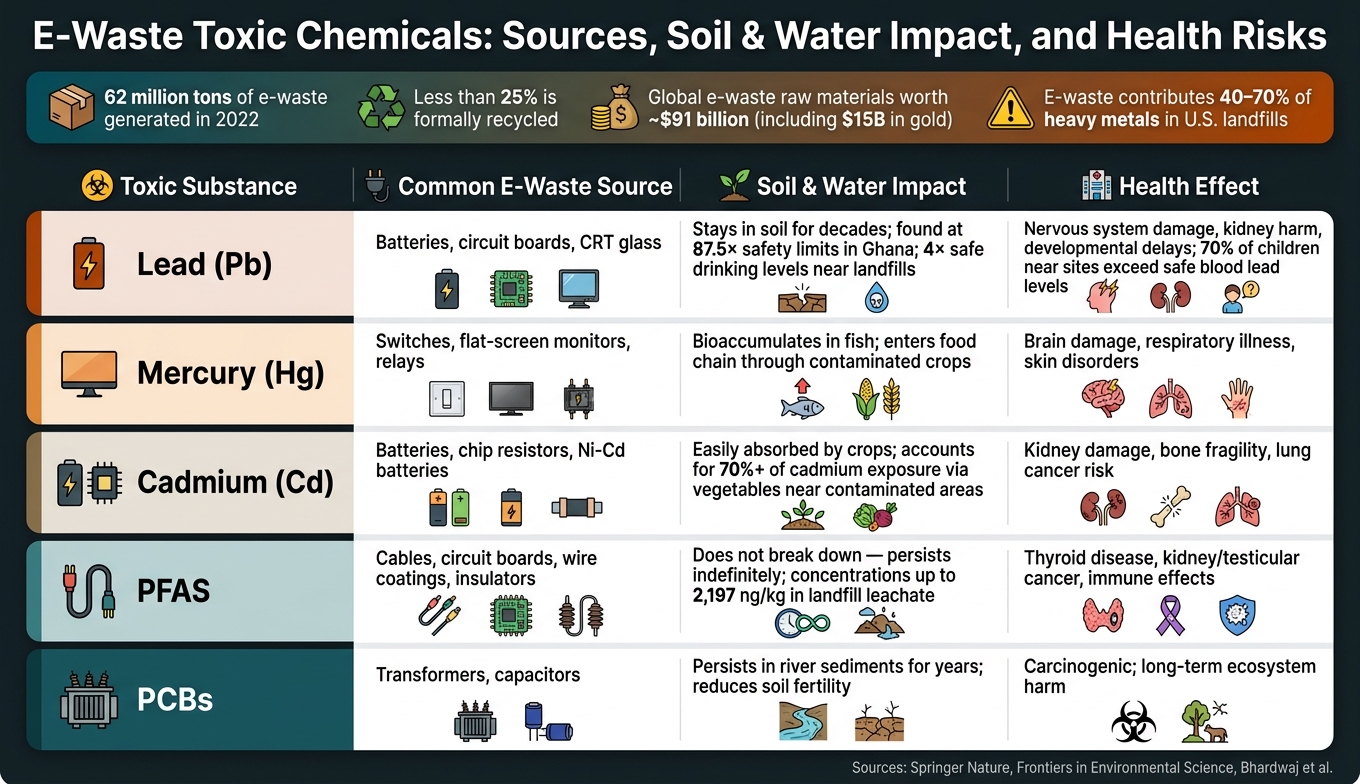
E-Waste Toxic Chemicals: Sources, Soil & Water Impact, and Health Risks
How Toxic Chemicals Degrade Soil and Ecosystems
E-waste doesn’t just pollute the surface - it digs deeper, literally and figuratively, into the environment. Heavy metals like lead, cadmium, and mercury seep into the soil, disrupting essential microbial communities. These microbes play a critical role in maintaining soil fertility and filtering water, so their destruction impacts the entire ecosystem.
At Accra's Agbogbloshie Scrapyard in Ghana, for instance, open burning of plastics has been linked to 86% of the organic pollutants found in the area.
"The improper handling of e-waste poses a considerable concern, given that pollutants can spread over long distances through dust, eventually contaminating the food chain and endangering the ecosystem." - Karoline Owusu-Sekyere, Institute for Sanitary Engineering
The toxins released during burning don’t stay put. Fine particles travel through the air, spreading contamination to ecosystems far removed from the original source.
This soil degradation doesn’t just harm plants and animals - it also compromises water quality, which has direct consequences for human health.
Health Risks from Contaminated Water
When e-waste toxins infiltrate drinking water, the results can be devastating. Communities near informal recycling or landfill sites often rely on groundwater that’s unknowingly tainted with heavy metals and persistent organic pollutants. Children and pregnant women are especially at risk. In some areas, about 70% of children tested have had blood lead levels exceeding safe limits. Even small amounts of lead exposure can lead to delayed development, hyperactivity, stunted growth, and brain damage.
Here’s a breakdown of the health effects linked to common e-waste toxins:
| Toxic Substance | Common E-Waste Source | Health Effect from Water Exposure |
|---|---|---|
| Lead (Pb) | Batteries, circuit boards, CRT glass | Nervous system damage, kidney harm, developmental delays |
| Mercury (Hg) | Switches, flat-screen monitors | Brain damage, respiratory illness, skin disorders |
| Cadmium (Cd) | Batteries, chip resistors | Kidney damage, bone fragility, lung cancer risk |
| Chromium (Cr) | Metal coatings, floppy disks | Bronchitis, liver/kidney damage, carcinogenic effects |
| PFAS | Cables, circuit boards, insulators | Thyroid disease, kidney/testicular cancer, immune effects |
A 2024 health risk assessment in Dhaka, Bangladesh, revealed alarming levels of toxins near e-waste sites: 587 mg/kg of lead and 25.57 mg/kg of mercury in soil and dust. These levels pose serious health risks, especially to children who may ingest contaminated particles.
The problem doesn’t stop at immediate health impacts. The long-lasting nature of these pollutants makes the issue even harder to tackle.
Why E-Waste Contamination Lasts So Long
E-waste pollutants don’t just go away. Heavy metals, for example, can’t be broken down naturally. They might change chemical forms, but their toxic effects persist indefinitely.
"Heavy metal(loid)s are non-biodegradable and can only be transferred from one chemical state to another. Furthermore, they are highly persistent in the soil, and can be accumulated in plants and animals." - Jianming Lu, et al., Wuhan Institute of Technology
Over time, these toxins migrate deeper into the soil, creating long-term reservoirs of pollution. Eventually, they seep into groundwater systems, spreading contamination even further. A 2022 study in Taizhou City, China, tracked metals like lead, copper, and zinc as they moved through soil and into crops like Chinese cabbage. This means these pollutants don’t just stay in the ground - they end up in the food supply.
"Once pollutants infiltrate the groundwater system, it can induce extensive and persistent environmental harm." - Karoline Owusu-Sekyere, et al., University of Stuttgart
How to Prevent E-Waste Contamination
Why Certified E-Waste Recycling Matters
Certified recycling plays a crucial role in preventing e-waste from polluting soil and water. By keeping toxic materials out of landfills, it directly addresses the chemical leaching issues mentioned earlier. Shockingly, e-waste is estimated to contribute between 40% and 70% of all heavy metals found in American landfills. Yet, despite global initiatives, less than 25% of e-waste is formally recycled, leaving most toxins to seep into the environment.
Certified recyclers adhere to rigorous standards throughout the entire recycling process. Certifications like R2v3 and e-Stewards ensure accountability, preventing your old electronics from ending up in unregulated facilities or being discarded in landfills. For instance, the e-Stewards certification explicitly bans the export of e-waste to developing countries, where informal recycling practices often lead to severe environmental harm, as discussed earlier.
"Every device dismantled through certified recycling means fewer heavy metals leaching into groundwater, fewer microplastics entering the Bay, and fewer fires releasing toxins into the air we breathe." - Samira Tasneem
Starting January 22, 2025, the EPA mandated its e-Manifest system for all Large and Small Quantity Generators of hazardous waste. This system requires real-time tracking of hazardous waste disposal, making it a legal obligation rather than just a best practice for organizations managing electronics disposal.
These regulated processes not only ensure compliance but also protect the environment from harmful toxins.
Keeping E-Waste Out of Landfills
Diverting e-waste from landfills is critical to avoiding issues like chemical leaching and toxic runoff. California, for example, enforces strict regulations prohibiting electronics from being disposed of with regular trash. The state's Universal Waste Rule specifically bans electronics from municipal landfills to mitigate the risks of toxic contamination.
To support proper disposal, municipal facilities in the state offer free e-waste drop-offs and even mobile pickup services. For businesses, choosing a recycling provider with the right certifications is key. Look for certifications such as:
- R2v3 for responsible recycling
- e-Stewards for ethical handling practices
- NAID AAA for secure data destruction
These certifications are more than just labels - they represent audited processes designed to protect both the environment and sensitive data.
Rica Recycling: Certified Electronics Recycling in the Bay Area
Rica Recycling offers a fully compliant, landfill-free solution for e-waste disposal in the San Francisco Bay Area. Operating under a 100% landfill-free policy, Rica Recycling ensures strict adherence to California’s e-waste regulations, including CA SB20 and SB50.
Their services are tailored to meet organizational needs, offering free electronics drop-off, scheduled pickups, secure data destruction with certificates, and IT asset recovery (ITAD) services that turn outdated equipment into recovered value. Data destruction follows stringent standards like NIST 800-88, HIPAA, and CCPA, making it a reliable option for organizations handling sensitive information.
Every item processed by Rica Recycling undergoes environmentally responsible handling. Valuable materials like gold, silver, and copper are recovered, ensuring these resources are reused rather than wasted. For businesses in the Bay Area aiming to manage their e-waste responsibly, Rica Recycling provides chain-of-custody documentation and compliance support to help them do it the right way.
Conclusion: Taking Action Against E-Waste Pollution
Key Takeaways
E-waste isn’t just about throwing away old gadgets - it’s a serious environmental threat. When electronics are dumped in landfills or handled improperly, toxic chemicals seep into the ground and water, potentially polluting ecosystems for decades. Certified recycling is a game-changer. By keeping electronics out of landfills, we reduce the flow of harmful substances into the environment, protect waterways, and recover valuable materials. In fact, the raw materials in global e-waste are estimated to be worth around $91 billion, including $15 billion in gold. Recycling responsibly not only prevents pollution but also helps recover these resources and supports healthier ecosystems.
"Advancing sustainable e-waste management requires coordinated, circular-economy-oriented interventions that simultaneously reduce environmental toxicity, enhance resource recovery and protect human health." - Frontiers in Environmental Science
Knowing this, we’re better equipped to make choices that matter.
What You Can Do Next
The first step is simple but powerful: don’t toss electronics in the trash. For individuals, this means dropping off old devices at certified recycling locations. For businesses, it’s about working with certified IT asset disposition (ITAD) providers that guarantee zero-landfill policies and offer proper documentation to ensure safe handling.
If you’re in the San Francisco Bay Area, Rica Recycling offers an easy solution. They provide free drop-off services, scheduled pickups, secure data destruction, and full compliance with California’s e-waste regulations. Every device recycled responsibly takes a step toward cleaner soil, safer water, and a healthier planet.
FAQs
Can soil or well water be tested for e-waste contamination?
Yes, it's possible to test soil and water for contamination caused by e-waste. Researchers typically collect samples from regions surrounding e-waste sites to check for heavy metals and harmful chemicals. Common methods used for this analysis include:
- Toxicity Characteristics Leaching Procedure (TCLP): A leaching test designed to determine the potential for hazardous substances to seep into groundwater.
- X-ray fluorescence (XRF): A technique used to identify and measure the concentration of heavy metals.
- Liquid chromatography: Useful for detecting specific chemicals in water samples.
To tackle contamination risks, companies like Rica Recycling provide certified e-waste disposal services that ensure no waste ends up in landfills. Their services are available in the San Francisco Bay Area, offering a responsible way to manage e-waste.
How can I tell if an e-waste recycler is actually certified?
To verify a recycler’s certification, visit the official R2 and e-Stewards websites, where you’ll find lists of certified providers. You can also check with the ANSI National Accreditation Board (ANAB) for accredited certifying bodies. Beyond that, request documentation such as data destruction certificates and assess the recycler’s openness about key practices like landfill diversion rates, final material destinations, and adherence to both California and federal regulations.
What should I do with old electronics so they don’t end up in a landfill?
To prevent old electronics from ending up in landfills, it's important to use a certified electronics recycler. This ensures proper and legal handling of these items. For example, in California, it's illegal to throw electronics in the trash because they often contain hazardous materials like lead and mercury, which can pollute soil and water.
Rica Recycling provides a solution with services like certified electronics recycling, secure data destruction, and IT asset recovery. They even offer convenient options for pickup or drop-off, all while adhering to a strict 100% landfill-free policy.