
Top 7 Certifications for E-Waste Recycling Vendors
When retiring old electronics, selecting a certified e-waste recycling vendor is crucial. Certifications ensure secure data destruction, compliance with regulations, and proper handling of hazardous materials. Improper disposal leads to significant problems of electronic waste like soil and water contamination. Without them, your business risks data breaches, fines, and environmental accountability.
Here are 7 key certifications to look for in a vendor:
- R2 Responsible Recycling Standard: Focuses on data security, worker safety, and full downstream accountability.
- e-Stewards Certification: Enforces strict recycling standards, bans hazardous waste exports, and requires NAID AAA and ISO certifications.
- RIOS Recycling Industry Operating Standard: Combines quality, environmental, and safety management into one framework.
- ISO 14001: Sets standards for managing hazardous waste and regulatory compliance.
- ISO 45001: Ensures workplace safety and addresses risks like toxic exposure.
- NAID AAA Certification: Guarantees secure data destruction with unannounced audits and strict protocols.
- WEEE Directive Compliance (EU): Mandates proper e-waste treatment and recovery for European markets.
Quick Tip: Always verify certifications through official directories and ensure they apply to the specific facility handling your equipment. Certified vendors reduce risks and support compliance with data and environmental laws.
All About the R2 Standard ♻️ Secure & Sustainable E-Waste! | Sustainability with Sia
sbb-itb-855056e
1. R2 Responsible Recycling Standard
The R2 (Responsible Recycling) standard, overseen by Sustainable Electronics Recycling International (SERI), has become a cornerstone certification for e-waste recycling vendors. Since its inception, it has grown significantly - from just 27 certified facilities in 2010 to an impressive 942 certified sites across 30 countries as of November 2020. This growth highlights its widespread adoption as a key industry benchmark.
The latest version, R2v3, was introduced in June 2020 and is ANSI-approved. It emphasizes three main pillars:
- Environmental and worker safety: Vendors must implement a documented Environmental, Health, and Safety Management System (EHSMS).
- Data security: Compliance with standards like NIST 800-88 and IEEE 2883-2022 ensures secure data handling.
- Downstream accountability: Vendors are required to track and audit every handler in their recycling chain, ensuring full traceability beyond their own operations.
"The downstream tracking requirement is what distinguishes R2v3 from less rigorous standards - your devices remain fully traceable." - Lo Terry, Human-I-T
R2v3 also features a modular structure, tailoring certification requirements to specific vendor activities. For instance:
- Appendix B (Data Sanitization): Required for vendors managing sensitive data.
- Appendix C (Test and Repair): Necessary for vendors involved in refurbishment.
When evaluating a vendor, take these steps to ensure compliance:
- Check their active R2v3 certification status on the SERI directory.
- Confirm the certification applies to the specific facility address (as certifications are site-specific).
- Request a serialized Certificate of Data Destruction, which should include the device’s manufacturer, model, and unique serial number.
Adopting this thorough vetting process ensures accountability and sets a high standard for e-waste management practices.
2. e-Stewards Certification
e-Stewards certification, managed by the Basel Action Network (BAN), holds companies to strict e-waste management standards. With about 180 certified facilities worldwide, it’s considered one of the toughest certifications in the industry.
What sets e-Stewards apart is its organization-wide requirement. Instead of certifying individual locations, this certification demands that every operational site within a company meets the same rigorous criteria. To even apply, vendors must already have NAID AAA certification for data destruction and either ISO 14001 or RIOS certification for environmental management. This ensures that both data protection and environmental practices are upheld across all locations.
Given that the average cost of a data breach could reach $10.2 million by 2026, e-Stewards takes data security seriously. It mandates NAID AAA compliance and requires a serialized Certificate of Data Destruction (CDD) for every device. This certificate includes details like the sanitization method used, the device’s unique serial number, and a timestamp for added transparency.
The certification also enforces full accountability for downstream processes. This includes GPS tracking for exported shipments through BAN’s e-Trash Transparency program. Additionally, e-Stewards prohibits the use of prison labor for handling hazardous e-waste and bans the export of such waste to developing countries, aligning with the Basel Convention's principles.
When selecting where to recycle your electronic waste, it’s essential to verify their e-Stewards certification. Check the official recycler registry maintained by BAN, and ask for downstream vendor lists and recent third-party audit reports. Ensuring the certification is up-to-date and specific to the facility you intend to use is just as important as confirming R2 certification for full e-waste compliance.
3. RIOS Recycling Industry Operating Standard
RIOS, created by the Institute of Scrap Recycling Industries (ISRI), combines quality, environmental, and safety standards into a single framework. Instead of pursuing individual certifications like ISO 9001, ISO 14001, and ISO 45001, recyclers can meet all these requirements through one streamlined audit. This approach simplifies compliance and can save both time and money for vendors.
This system is specifically designed to meet the needs of the recycling industry.
"Specifically designed for the recycling industry, RIOS™ integrates the key operational elements of a robust management system, bringing quality, environmental and health and safety together into one integrated system." - RIOS™ Recycling Industry Operating Standard
RIOS works seamlessly with R2 standards, making it especially useful for secure e-waste processing. The RIOS:2016 version is officially recognized by SERI as meeting the Environmental Management System (EMS), Health & Safety Management System (HSMS), and Quality Management System (QMS) requirements under the R2 certification framework. This means that a vendor with RIOS certification has already addressed a large portion of the R2 requirements in one step.
On the worker safety and data security front, RIOS mandates documented risk assessments, incident tracking, and monitoring of hazardous exposure. Its Quality Management System also ensures secure processes, including asset transport, data sanitization records, and a serialized chain of custody from intake to final disposition. Vendors are held accountable through annual internal and external audits, which provide a clear record of asset decommissioning.
Getting certified under RIOS is not a quick process - it typically takes 8 to 12 months. Most facilities work with consultants trained as R2/RIOS auditors to navigate the process. Certification involves two stages: a review of documented procedures (Stage 1) and on-site observation with record verification (Stage 2). To ensure a vendor's compliance, you can check their status in the RIOS database of certified recyclers. It's also a good idea to request proof of their Environmental and Health Safety Management System (EHSMS) to confirm active compliance. By aligning with R2 standards, RIOS certification strengthens vendor accountability in e-waste recycling.
4. ISO 14001 Environmental Management
ISO 14001 is a globally acknowledged standard for Environmental Management Systems (EMS). Katelyn Harrison, Marketing Specialist at HOBI International, Inc., describes it as:
"ISO 14001 is an internationally recognized standard for EMS (environmental management systems) that helps companies reduce their environmental footprint and ensure regulatory compliance."
This standard doesn't just focus on on-site operations - it ensures accountability throughout the entire waste management process.
For e-waste vendors, compliance means implementing documented and auditable processes for handling hazardous substances like lead, mercury, and cadmium. Specific clauses outline these responsibilities:
- Clause 8.1: Requires vendors to establish procedures for managing hazardous and non-hazardous waste.
- Clause 6.1.3: Involves identifying all legal requirements for each waste stream, such as EPA generator IDs or local permits.
- Clause 6.1.2: Extends vendor responsibility beyond their facility, mandating regular evaluations of downstream partners' licenses and disposal certifications. This ensures materials are handled responsibly throughout the entire process.
ISO 14001's "life cycle perspective" reinforces this extended accountability. Trenton Steadman, Lead ISO Consultant at Kaizen ISO Consulting, explains:
"Under the standard's life cycle perspective (Clause 6.1.2), your responsibility doesn't end when the waste leaves your property. You need to demonstrate that you've evaluated your waste contractors."
This standard is also a key requirement for e-Stewards certification, making it a cornerstone in the e-waste industry. For vendors already pursuing R2v3 certification, adding ISO 14001 typically increases costs by only 20% to 30% compared to obtaining it as a standalone certification. The initial investment for ISO 14001 certification generally ranges from $9,000 to $27,000, depending on the facility's size and complexity.
To ensure compliance, request Clause 9.1.2 records, which track waste volumes, recycling rates, and adherence to regulations. Like other certifications discussed earlier, ISO 14001 emphasizes thorough compliance, laying the groundwork for integrating environmental, safety, and data management standards.
5. ISO 45001 Occupational Health and Safety
Electronics recycling comes with its fair share of hazards - think heavy machinery, sharp-edged components, and exposure to toxic substances like lead, mercury, and lithium batteries. To tackle these risks, ISO 45001 was introduced as the first international standard specifically tailored for occupational health and safety (OH&S). It provides a structured, auditable framework to help organizations manage workplace safety effectively.
As DES Technologies puts it:
"A safe workplace is a stable workplace. By reducing injuries and downtime, ISO 45001 helps ITAD providers maintain consistent, compliant service delivery."
The ISO 45001 standard emphasizes active involvement from top management in safety initiatives while also engaging workers in creating practical safety protocols. A key feature of the standard is its use of the PDCA (Plan-Do-Check-Act) cycle, which helps organizations identify hazards, evaluate risks, and continuously improve safety measures. Notably, a 2024 amendment introduced a new requirement to address climate-related risks, such as mitigating heat stress in warehouses during hotter months.
For clients, ISO 45001 offers clear benefits, particularly in supporting the "Social" aspect of ESG strategies. It serves as proof that a recycling partner prioritizes ethical treatment of workers and maintains safe working conditions. These claims are validated through independent third-party audits, adding an extra layer of credibility.
For vendors already certified under ISO 14001, integrating ISO 45001 can simplify documentation and auditing processes. This alignment creates a cohesive approach to operational standards, blending health and safety measures with environmental accountability to ensure a well-rounded commitment to responsible practices.
6. NAID AAA Data Destruction Certification
When it comes to securely handling devices, ensuring proper data destruction is just as critical as meeting environmental standards. Recycling a device doesn’t automatically erase the data it contains. In fact, a study revealed that 40% of used devices bought online still had recoverable personal information - this included 44% of hard drives from sellers who claimed the data had been wiped. This is where the NAID AAA certification comes into play, addressing the crucial need for thorough data destruction.
Managed by i-SIGMA, NAID AAA certification is widely regarded as the highest standard for secure data destruction. What makes it stand out? Its use of unannounced, surprise audits. Inspectors can visit at any time to evaluate real-time operations, rather than relying on a predictable annual review. This approach ensures vendors maintain consistent accountability.
The certification enforces strict protocols at every stage of the data destruction process. These include:
- 24/7 video surveillance of facilities
- Restricted access to sensitive areas
- GPS-tracked transport vehicles
- Comprehensive three-level background checks for employees handling data
Looking ahead, i-SIGMA will introduce additional requirements by 2026, such as multi-factor authentication and centralized password management to safeguard digital audit trails.
From a compliance perspective, NAID AAA certification helps businesses meet the demands of critical regulations like HIPAA, FACTA, GLBA, and PCI-DSS. These regulations require detailed documentation of vendor practices. As part of this, vendors must issue a Certificate of Destruction (CDD), which includes detailed information like the device's manufacturer, model, serial number, sanitization method, and timestamp. Generalized descriptions, like "pallet-level" summaries, won’t pass muster during an audit.
To ensure a vendor's legitimacy, always check their current status in i-SIGMA’s official certification directory. Don’t rely solely on a logo on their website. Also, make sure they hold the "AAA" designation - not "AA", which has less rigorous standards.
7. WEEE Directive Compliance (EU)
Regulatory frameworks like the WEEE Directive play a key role in ensuring vendors handle e-waste responsibly. If your organization partners with global vendors or sells electronics to European customers, the WEEE Directive is a critical standard to understand. Short for Waste Electrical and Electronic Equipment, this EU legislation (Directive 2012/19/EU) outlines the rules for collecting, treating, and recycling electronic waste across Europe. With EU e-waste increasing from 9 million tons in 2005 to 13.5 million tons in 2021, the directive addresses a growing environmental challenge.
The directive is based on the principle of Extended Producer Responsibility (EPR), which holds manufacturers, importers, and distributors financially accountable for managing their products at the end of their lifecycle. For recycling vendors, compliance requires obtaining official treatment permits and meeting recovery targets - 80% for large domestic appliances and 75% for IT and telecom equipment. Vendors are also required to maintain detailed weight records of all e-waste entering and leaving their facilities. Non-EU entities interacting with the European market are also subject to specific obligations under this framework.
For U.S. companies selling electronics in the EU or UK, the directive may classify them as "producers", triggering registration and compliance requirements. Additionally, if a vendor processes e-waste outside the EU, the recovery efforts can only count toward official targets if the vendor can prove their operations meet equivalent environmental and health standards.
"Treatment outside the Community only count for the fulfilment of the targets of the Directive if the exporter can prove that treatment operations took place under conditions that are equivalent to the requirements of this Directive." - EUR-Lex
When evaluating a vendor for WEEE compliance, it's essential to request proof of equivalence documentation for any non-EU processing. Confirm that they follow selective treatment protocols, such as safely removing hazardous components like mercury, PCBs, and batteries. Additionally, verify that their equipment is marked with the crossed-out wheeled bin symbol. Compliance records must be retained for at least four years. Carefully verifying these requirements ensures you maintain the same high standard of vendor diligence emphasized throughout this guide.
Certification Comparison Table
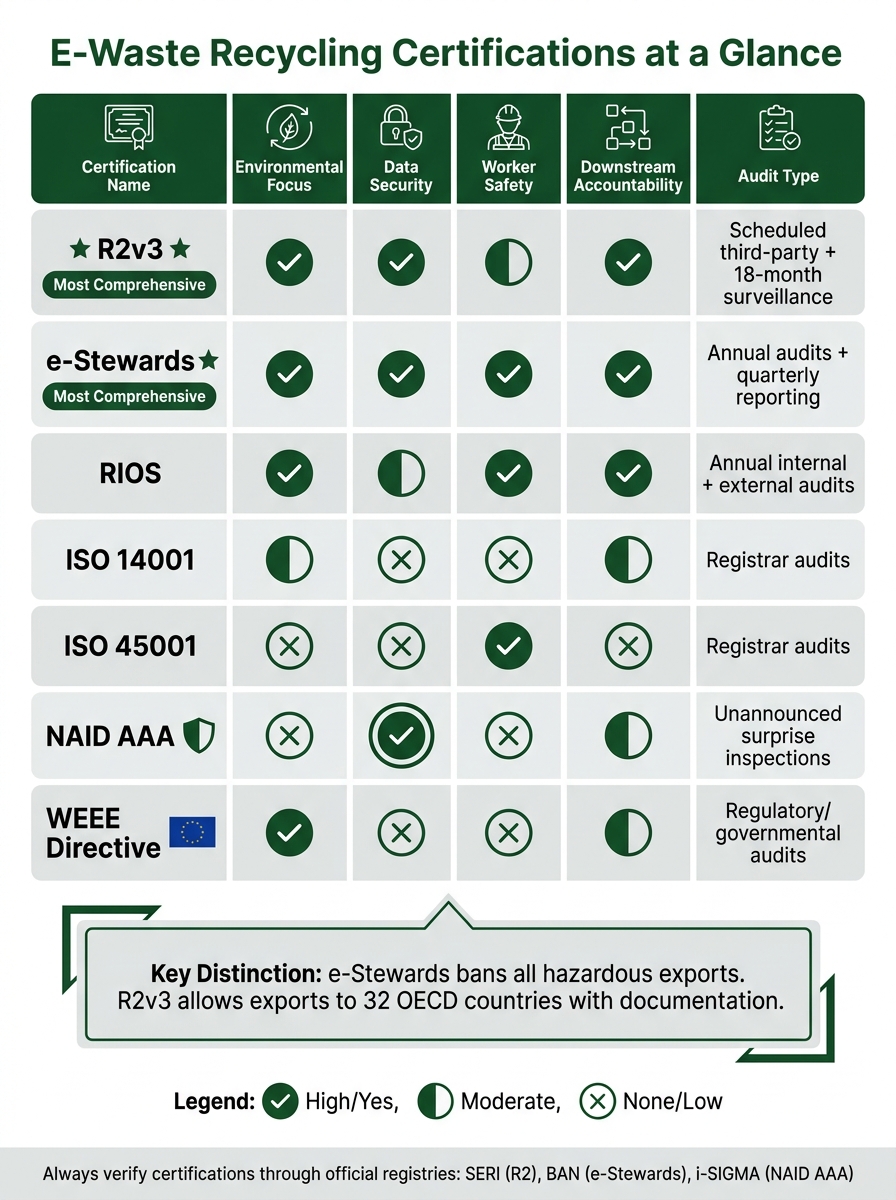
E-Waste Recycling Certifications Compared: Which One Does Your Vendor Need?
Here's a breakdown of seven certifications, each with its own set of priorities. The table below compares these certifications, helping you identify which one aligns best with your compliance goals.
| Certification | Environmental Focus | Data Security | Worker Safety | Downstream Accountability | Audit Type |
|---|---|---|---|---|---|
| R2v3 | High – prioritizes reuse and circular economy | High – includes Appendix B (NIST 800-88) | Moderate | High – Appendix A covers full downstream chain | Scheduled third-party + 18-month surveillance |
| e-Stewards | High – bans hazardous landfill use and export violations | High – requires NAID AAA certification | High – prohibits prison labor | High – includes quarterly reporting | Annual audits + quarterly reporting |
| ISO 14001 | Moderate – general environmental management, not specific to e-waste | None | None | Focuses on internal processes | Registrar audits |
| ISO 45001 | None – focuses solely on worker safety | None | High – primary focus is worker protection | None | Registrar audits |
| NAID AAA | Minimal – not focused on environmental standards | Very High – includes unannounced audits and employee screening | None | Limited to the destruction phase | Unannounced inspections |
| WEEE Directive | High – meets EU recovery and recycling targets | None | None | Moderate – requires treatment equivalence | Regulatory/governmental audits |
A closer look shows that R2v3 and e-Stewards provide the most comprehensive coverage for environmental and data security needs. The main distinction lies in their export policies:
- e-Stewards strictly bans exporting functional equipment to non-Basel Convention countries.
- R2v3 allows exports to 32 OECD countries, provided proper documentation is in place.
Additionally, e-Stewards incorporates NAID AAA certification, boosting its data security standards.
Meanwhile, NAID AAA focuses exclusively on forensic-level data destruction, filling a gap left by broader environmental certifications. For vendors handling equipment destined for European markets, compliance with the WEEE Directive ensures adherence to EU regulations and recovery targets.
Conclusion
Skipping vendor certification checks can leave your company vulnerable to serious legal and financial risks. Claims of data destruction that aren't verified may fail to meet legal requirements under regulations like HIPAA, GDPR, and FISMA. If something goes wrong later, your organization could end up shouldering the liability.
Each certification mentioned plays an important role in ensuring secure and compliant e-waste management. R2v3 and e-Stewards cover both environmental responsibility and data security comprehensively. NAID AAA specializes in forensic-level data destruction. ISO 14001 and ISO 45001 reflect a vendor's operational excellence. And compliance with the WEEE Directive is essential if your equipment interacts with European markets. To maximize these advantages, always confirm a vendor's certification status.
Before signing with any vendor, verify their certifications through official registries - SERI for R2, BAN for e-Stewards, and i-SIGMA for NAID AAA. Ensure the certification applies to the specific facility handling your equipment, not just the company as a whole. Certified vendors not only reduce your risks but also enhance ESG reporting efforts.
For Bay Area companies, Rica Recycling offers certified electronics recycling, secure data destruction, and IT asset recovery - all under a 100% landfill-free policy.
FAQs
Which certifications matter most for my organization?
To keep compliance and data security front and center, work with vendors that hold R2v3, e-Stewards, and NAID AAA certifications:
- R2v3: Emphasizes reuse, material traceability, and responsible recycling practices.
- e-Stewards: Guarantees high environmental and social standards, prohibiting the export of hazardous waste.
- NAID AAA: Confirms secure data destruction in line with NIST 800-88 guidelines, backed by unannounced audits.
Make sure to verify these certifications through official directories and always ask for a certificate of destruction for added peace of mind.
How can I confirm a vendor’s certifications are real and site-specific?
To confirm a recycler's certifications, it's best to use official sources rather than trusting the information on their website. Certifications apply to specific facilities, so verify that the processing location is listed in the R2 or e-Stewards directories. Double-check that the address matches, the certification is current, and the certificate number is legitimate. For extra clarity, you can also ask the vendor directly for their most recent audit documents and certificates.
What documents should I get to prove secure data destruction and chain of custody?
If you're serious about secure data destruction, you need audit-ready documentation from your recycling provider. These documents are essential for verifying compliance and maintaining a reliable chain of custody. Here are the key records to request:
- Certificate of Data Destruction: This tamper-proof document confirms that your data was destroyed following standards like NIST 800-88. It's your proof that the process was handled securely and correctly.
- Chain-of-Custody Records: These records provide detailed tracking of your assets, including their condition, destruction methods, and transfer dates. They ensure transparency at every step of the process.
- Serialized Asset Lists: These lists link each device to its final outcome, allowing you to cross-check your inventory against destruction reports for complete accountability.
Having these documents on hand not only protects your data but also ensures you're meeting compliance requirements.