
How ITAD Helps Nonprofits Secure Data
Nonprofits face serious risks when retiring outdated IT equipment. Improper disposal can lead to data breaches, environmental harm, and compliance issues. IT Asset Disposition (ITAD) offers a secure, structured way to manage old devices, ensuring data is erased, equipment is recycled responsibly, and sensitive information is protected.
Key takeaways:
- Data Security: ITAD prevents breaches by securely wiping or destroying data on old devices.
- Compliance: Certificates of Data Destruction (CoDs) provide legal proof of secure disposal.
- E-Waste Reduction: ITAD ensures electronic recycling, avoiding toxic waste and supporting sustainability.
- Cost Savings: Refurbished or resold devices can offset costs or be donated for community impact.
With the average data breach costing $10.22 million in 2026, nonprofits must prioritize ITAD to protect sensitive information, meet legal standards, and reduce risks. By partnering with certified ITAD providers like Rica Recycling, nonprofits can safely dispose of IT assets while supporting their mission and environmental goals.
ITAD and Data Risks for Nonprofits
What Is IT Asset Disposition (ITAD)?
IT asset disposition (ITAD) refers to the process of securely retiring outdated IT equipment - like laptops, desktops, servers, and mobile devices - while ensuring data protection and compliance with legal standards. This process includes everything from securely destroying data to refurbishing devices or recycling them responsibly. The main objective? Ensuring that no sensitive information remains on a device once it leaves your organization's possession.
For nonprofits, this system is especially important, as they often face unique challenges and risks when it comes to data security.
Why Nonprofits Are Common Targets for Data Breaches
Nonprofits are often viewed as easy targets for cybercriminals. They handle a wealth of sensitive information - such as donor payment details, healthcare records, client case files, and employee data - but typically operate with limited IT resources. Smaller budgets and lean teams often mean that robust security measures, which are standard for larger organizations, may be overlooked.
The financial impact of a data breach can be catastrophic for nonprofits. For organizations already working with tight margins, a breach doesn't just harm their reputation - it can threaten their very existence.
This vulnerability becomes even more pronounced during the disposal of IT assets, where lapses in security can lead to significant exposure.
Data Risks from Improper IT Asset Disposal
Improperly managed IT asset disposal is one of the most underestimated risks for nonprofits. Around 30% of IT assets go missing during the disposition process, leaving organizations exposed to potential breaches due to gaps in transit security or unsecured storage areas.
It’s important to note that simply performing a factory reset on a device isn’t enough to ensure data security.
"A factory reset does not eliminate the risk." - Lo Terry, May 21, 2026
Devices that are resold or donated without proper data wiping can still contain recoverable information. With basic forensic tools, sensitive data can be retrieved, creating compliance issues or exposing nonprofits to breaches. Additionally, most discarded electronics enter informal recycling streams, where data protection is nonexistent. This isn’t just an environmental issue - it’s a direct threat to nonprofit security.
"Every unwiped device sitting in a storage closet is an active liability - a potential data breach, a compliance gap, and a forfeited tax deduction." - Lo Terry, Human-I-T
To mitigate these risks, nonprofits need to implement strong ITAD processes that prioritize data security and compliance at every step. Without them, the cost of inaction could be far greater than many organizations realize.
sbb-itb-855056e
The Dangers of DIY ITAD
Core ITAD Services That Protect Nonprofit Data
A well-structured ITAD program isn’t just about disposing of old equipment - it’s about doing it in a way that safeguards your data and shields your organization from potential risks. Here’s how these services address the challenges nonprofits face.
Secure Data Destruction Methods
To counter data vulnerabilities, nonprofits need reliable data destruction techniques tailored to different media types and sensitivity levels:
- Software wiping: This method overwrites existing data with new patterns, making the original data impossible to recover. It’s ideal for devices intended for reuse or donation.
- Degaussing: Using a strong magnetic field, this process scrambles data on traditional hard drives. However, it renders the drive unusable.
- Physical destruction: For the most sensitive data, shredding or similar methods ensure complete data removal, especially when devices won’t be reused.
An important update: starting in 2026, standard industrial shredding will no longer meet compliance standards for solid-state drives (SSDs). Instead, SSDs must undergo micro-pulverization to specific particle sizes to ensure data cannot be recovered from flash memory chips.
Certificates of Data Destruction
A Certificate of Data Destruction (CoD) serves as legal proof that data has been securely erased. By 2026, a compliant CoD must include detailed records linking destruction results to individual hardware serial numbers, rather than summarizing destruction in bulk.
"Without chain-of-custody documentation, your organization may be unable to prove compliance, even if the data was destroyed." - Securis
To safeguard your nonprofit, retain all CoDs, chain-of-custody logs, and inventory records for at least seven years. This documentation is essential for audits or legal inquiries. With the average cost of a major data breach in the U.S. surpassing $10 million per incident, these records are more than just paperwork - they’re a critical layer of protection.
Responsible E-Waste Recycling
If a device isn’t suitable for reuse or refurbishment, recycling becomes the next step - but it must be done responsibly. Informal or unregulated recycling channels fail to protect data and often result in improper handling of e-waste. Certified ITAD providers ensure compliance with environmental regulations, safeguarding both data and the planet.
For nonprofits committed to sustainability, responsible recycling offers additional benefits. It supports a circular economy by reducing the need for new device production and minimizing environmental harm.
Asset Recovery and Redeployment
Many retired devices still hold value. Through asset recovery, ITAD providers can evaluate, refurbish, and resell equipment while maintaining strict data security protocols. In some cases, nonprofits may even receive a portion of the proceeds, helping to offset costs.
Refurbished devices also create opportunities to benefit communities. For instance, a 2025 study by Compudopt, a national nonprofit, surveyed 10,650 recipients of donated corporate computers. The findings? A staggering 92% of households lacked a functional computer before receiving one, and 97% reported that the donated device improved their quality of life. Redeploying technology in this way transforms old equipment into meaningful community support.
How to Set Up a Secure ITAD Program for Your Nonprofit
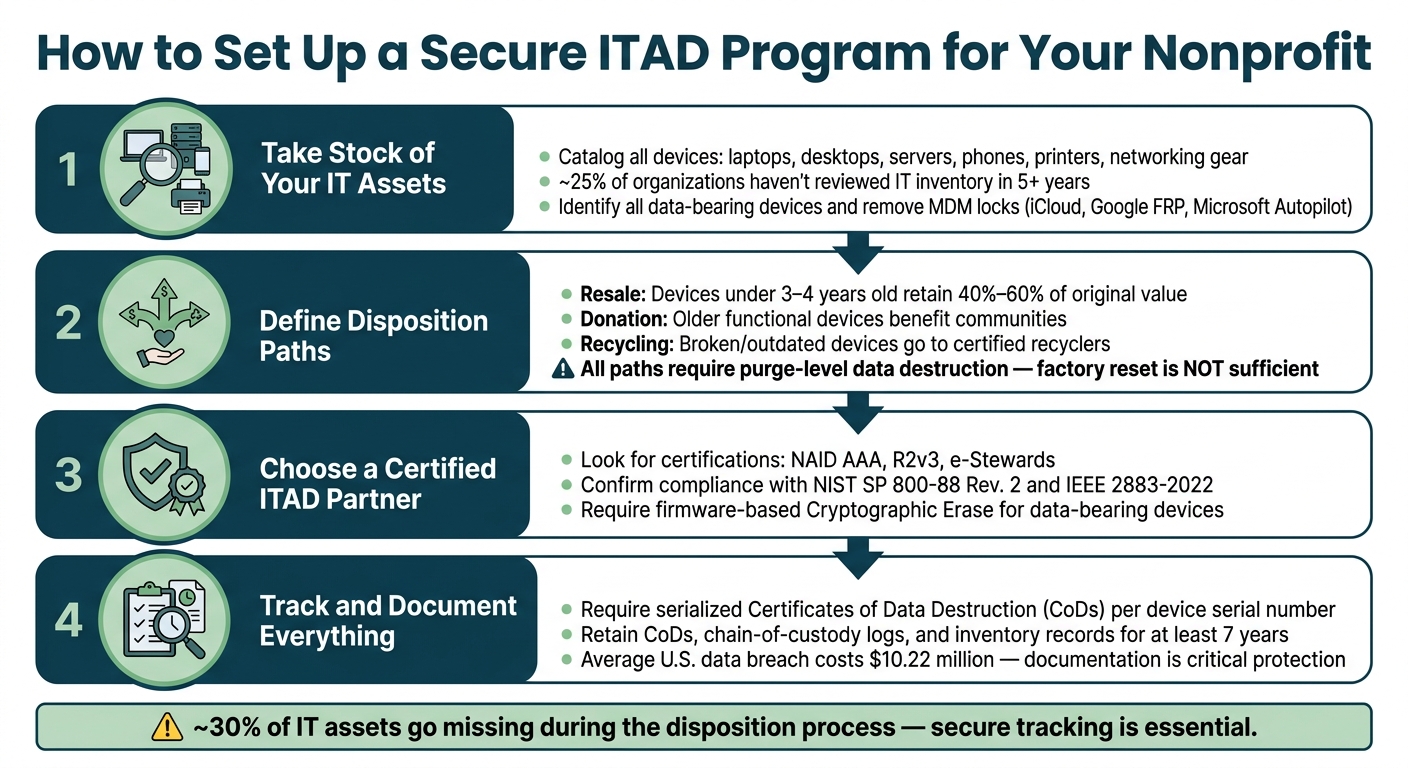
How to Set Up a Secure ITAD Program for Nonprofits
Establishing a secure IT Asset Disposition (ITAD) program involves four key steps: taking inventory, defining disposition paths, selecting the right partner, and documenting every stage.
Step 1: Take Stock of Your IT Assets
Start by cataloging all devices, including laptops, desktops, servers, mobile phones, networking equipment, and printers. Alarmingly, about 25% of organizations haven’t reviewed their IT inventory in the past five years, which can lead to unseen risks. Once inventoried, focus on identifying data-bearing devices. Use the table below for guidance:
| Asset Category | Data-Bearing? | Common Sensitive Data Stored |
|---|---|---|
| Laptops/Desktops | Yes | PII, financial records, login credentials |
| Servers/RAID Arrays | Yes | Large-scale databases, backup files |
| Networking Gear | Yes | Configuration files, security certificates, logs |
| Multi-function Printers | Yes | Cached document images, network credentials |
| Mobile Devices | Yes | Personal/business data, SIM/SD card info |
| Peripherals (Mice/Keyboards) | No | None (generally safe for direct recycling) |
Before moving forward, ensure that all Mobile Device Management (MDM) profiles - such as Apple iCloud locks, Google FRP, and Microsoft Autopilot activation locks - are removed. Devices with active locks hold zero resale value.
Once you have a complete inventory, you can determine the best way to handle each asset securely.
Step 2: Define Disposition Paths
Not all devices should follow the same route. Evaluate each item based on its age, condition, and market value to decide its next step:
- Resale: Devices under three to four years old, especially premium enterprise laptops, often retain 40% to 60% of their original value.
- Donation: Older but functional equipment can benefit other organizations or communities.
- Recycling: Broken or outdated devices should be responsibly recycled.
No matter the chosen path, ensure that all data is destroyed at a purge level. A simple factory reset doesn’t cut it, as it leaves data recoverable. Also, remove asset tags and stickers before transferring ownership.
Step 3: Choose an ITAD Partner
Once you’ve decided how to handle your devices, it’s time to find a trusted ITAD partner. Look for providers with certifications such as:
- NAID AAA: Verified data destruction.
- R2v3: Responsible recycling and reuse.
- e-Stewards: Ethical e-waste management.
These certifications indicate adherence to strict, audited processes. Additionally, confirm that the provider complies with NIST SP 800-88 Revision 2 and IEEE 2883-2022 standards. For data-bearing devices, ensure they use firmware-based Cryptographic Erase methods to meet purge-level requirements.
Step 4: Track and Document Asset Disposition
Proper documentation ensures secure disposal and regulatory compliance. Insist on serialized Certificates of Data Destruction (CoDs) from your ITAD partner. Each certificate should detail the destruction method, include the technician’s signature, and tie directly to a specific device serial number - not just a batch.
Keep all CoDs, chain-of-custody logs, and inventory records for at least seven years. This documentation can protect your nonprofit during audits or legal inquiries. Considering that the average U.S. data breach costs $10.22 million per incident, thorough record-keeping isn’t just a best practice - it’s a critical safeguard for your organization.
How Rica Recycling Supports Nonprofit ITAD Needs
When it comes to secure and compliant IT asset disposition (ITAD), nonprofits have unique needs. Rica Recycling, a trusted provider in the San Francisco Bay Area with over 20 years of experience, offers tailored solutions to help nonprofits safely dispose of IT assets while adhering to industry best practices. Their approach ensures both security and efficiency in data handling.
Certified Secure Data Destruction
Rica Recycling uses three distinct methods for data destruction, ensuring compliance with NIST 800-88 and DoD 5220.22-M (E) standards:
- 7-pass software-based overwriting for reusable devices.
- Industrial degaussing for magnetic media.
- Physical destruction for devices that cannot be wiped.
Each device is tracked with a serialized Certificate of Destruction (COD), provided within 48 hours. This documentation includes key asset data and logs every step in the chain of custody, from collection to final disposal. Such detailed records are invaluable for audits and regulatory compliance.
| Destruction Method | Security Level | Hardware Reuse Possible | Best For |
|---|---|---|---|
| Secure Data Wiping (7-pass) | High (NIST 800-88) | Yes | Functional devices for resale or donation |
| Physical Destruction | Highest (Irrecoverable) | No | Highly sensitive data or non-functional media |
| Degaussing | High (Magnetic only) | No | End-of-life hard drives and magnetic tapes |
100% Landfill-Free E-Waste Recycling and Sustainability
Rica Recycling operates under a strict 100% landfill-free policy, fully adhering to California's SB20 and SB50 e-waste regulations. This ensures that all processed devices stay out of landfills, a critical factor for nonprofits in California where improper disposal could result in fines.
Beyond compliance, Rica Recycling helps nonprofits meet their sustainability goals. Through their IT asset buyback program, remarketable hardware like laptops and servers can be resold, generating funds that can be reinvested into the organization’s mission. This makes responsible ITAD both an ethical and financially smart decision.
Pickup and Drop-Off Options
Rica Recycling provides flexible logistics options to accommodate organizations of varying sizes:
- Free drop-off: Nonprofits can drop off up to 9 items (e.g., computers, phones) at their Hayward, CA facility. However, data wiping must be done by the nonprofit beforehand.
- Scheduled on-site pickup: For 10 or more items, Rica Recycling offers pickup services ($50–$200), which include certified destruction.
For larger projects, such as decommissioning entire offices or data centers, Rica Recycling also handles on-site removal. This includes tasks like dismantling server racks and harvesting cables. Nonprofits managing sensitive data, such as donor or client information, are encouraged to choose the pickup service for added security and peace of mind. These logistics solutions not only ensure safe disposal but also emphasize a nonprofit's dedication to environmental stewardship.
Conclusion: Protect Data and Dispose Responsibly with ITAD
When it comes to ITAD (IT Asset Disposition), the stakes are high for nonprofits. Beyond safeguarding sensitive data, it’s also about staying compliant and making choices that align with environmental responsibility.
For nonprofits, retiring outdated IT equipment isn’t just a logistical task - it’s a vital step in protecting data and avoiding costly breaches. A single data breach can have severe financial repercussions, especially for organizations already working with limited budgets. That’s why a structured ITAD program matters. It ensures every step is covered: from tracking assets and selecting the best disposal method to certified data destruction and maintaining a secure chain of custody.
But ITAD isn’t just about security - it’s also a chance to make an environmental and social difference. For instance, donating usable hardware can have a meaningful impact. A 2025 study by Compudopt revealed that 92% of households receiving donated corporate computers previously lacked a functional device, and 97% reported an improved quality of life. Those numbers highlight the tangible benefits of responsible asset redeployment.
For nonprofits in the San Francisco Bay Area, Rica Recycling provides a reliable solution. They can help your organization meet its data security needs while adhering to sustainability goals. With ITAD, retiring IT assets doesn’t have to be a risk - it can be an opportunity to create value and secure a stronger future for your nonprofit. Start building a comprehensive ITAD program today.
FAQs
What devices in our nonprofit actually store sensitive data?
Many devices used in nonprofits hold sensitive information. These include laptops, desktops, servers, smartphones, tablets, and external hard drives. Even office equipment like printers, copiers, and scanners can store cached document images and network credentials. Networking hardware, such as routers, switches, and firewalls, often contains configuration files and security certificates. Before securely disposing of any equipment, it’s important to create an inventory of all devices that store data.
How do we verify data was destroyed before equipment leaves our control?
Maintaining control over data destruction requires a clear, documented chain of custody from the moment equipment is picked up until its final disposal. Insist that your ITAD provider tracks each device by its unique serial number, providing detailed inventory reports. While in transit, ensure security measures are in place, such as tamper-evident seals and GPS tracking, to safeguard against unauthorized access. To confirm compliance with standards like NIST 800-88, always obtain a Certificate of Data Destruction as legal proof that your data has been properly destroyed.
Should we wipe, donate, resell, or recycle each retired device?
Before taking any action, start by cataloging your devices by their serial numbers. As you do this, evaluate each item's condition and the sensitivity of the data it holds. Once this is done, you can decide the best course of action:
- Resell: If the device is functional, less than 3–4 years old, and still holds market value, selling it is a good option.
- Donate: Devices that work but have limited resale value can be donated to help communities in need. Plus, donations might come with tax benefits.
- Recycle: For devices that are broken, outdated, or pose a high risk due to sensitive data, recycling is the safest route.
No matter what you choose, make sure to properly sanitize the data. Use NIST 800-88-compliant software for secure data wiping, or physically destroy the storage components. Always request a certified Certificate of Data Destruction as proof of proper handling.