
How ITAD Supports Corporate Carbon Goals
Most IT carbon impact happens before a device is even turned on. A business laptop can carry about 400 kg CO₂e over its life, and roughly 84% of that can come from manufacturing. So if you replace working devices too soon or retire them without records, you make carbon reporting harder and push Scope 3 emissions higher.
Here’s the short version: ITAD helps you cut emissions by keeping devices in use longer, sending more equipment to reuse or refurbishment, and documenting what happens to every asset. That supports carbon tracking, waste reporting, and data security at the same time. For many companies, that matters because Scope 3 can account for more than 70% of total emissions.
If I had to boil the article down to the main points, they would be these:
Early refresh cycles waste embodied carbon
Reuse cuts more CO₂e than recycling alone
Asset-level records make ESG and waste reporting easier
Certified recycling helps with landfill diversion and material recovery
Local rules in California make proper e-waste handling a must
A few numbers stand out:
Extending 500 laptops from a 3-year to a 6-year refresh cycle can cut annualized embodied emissions from about 31 metric tons to 15.5 metric tons
Reusing 1 short ton of IT equipment can avoid about 29.83 metric tons of CO₂e
Recycling that same amount avoids about 1.07 metric tons of CO₂e
The core idea is simple: retired hardware should be part of your carbon plan, not a storage-room problem. When you track reuse, recycling, diversion, and data destruction, you turn old equipment into numbers your IT, finance, and ESG teams can use.
Below, I break down how that works and what to measure.
Circular Technology in IT Asset Disposition | The Future of Sustainable ITAD
The problem: how conventional IT retirement works against carbon goals
Building on the Scope 3 impact above, fixed device refresh schedules often throw away carbon that’s still “stored” in working hardware. The result is higher embodied emissions and weaker audit records.
Retiring devices too early wastes embodied carbon
Most laptop emissions come from manufacturing, so replacing a device too soon wastes the biggest share of its carbon footprint.[3][1]
When a working laptop gets swapped out ahead of schedule, the company effectively throws away most of the carbon already spent to make it. Then it sets off another round of manufacturing emissions for the replacement.
For 500 laptops, moving the refresh cycle from three years to six years cuts annualized embodied emissions from about 31 metric tons to 15.5 metric tons.[1] That’s a clear Scope 3 cut. And it doesn’t depend on new tech. It comes from a more deliberate refresh policy.
Poor end-of-life handling creates compliance and reporting gaps
Even when organizations retire devices on a sensible schedule, the next step is often a mess. Equipment may go to unverified recyclers, sit in storage for months or years, or end up in landfill with no records. None of those paths reliably produce the documentation ESG reporting calls for.
Without a structured ITAD process, most organizations can’t show device-level disposition data: what was reused, what was recycled, how much stayed out of landfill, or how data was destroyed. Those records connect retirement activity to accurate reporting. Frameworks like GRI 306: Waste 2020 require organizations to report waste generated, waste diverted from disposal, and waste directed to disposal with supporting evidence.[5]
Reuse can cut far more carbon than unmanaged end-of-life handling. Sending devices to an unqualified processor instead of a structured reuse program isn’t just a paperwork issue. It also means losing a carbon-cutting chance that won’t come back later.
The fix is a structured ITAD process that pushes reuse first and documents every disposition.
The solution: how ITAD reduces carbon impact
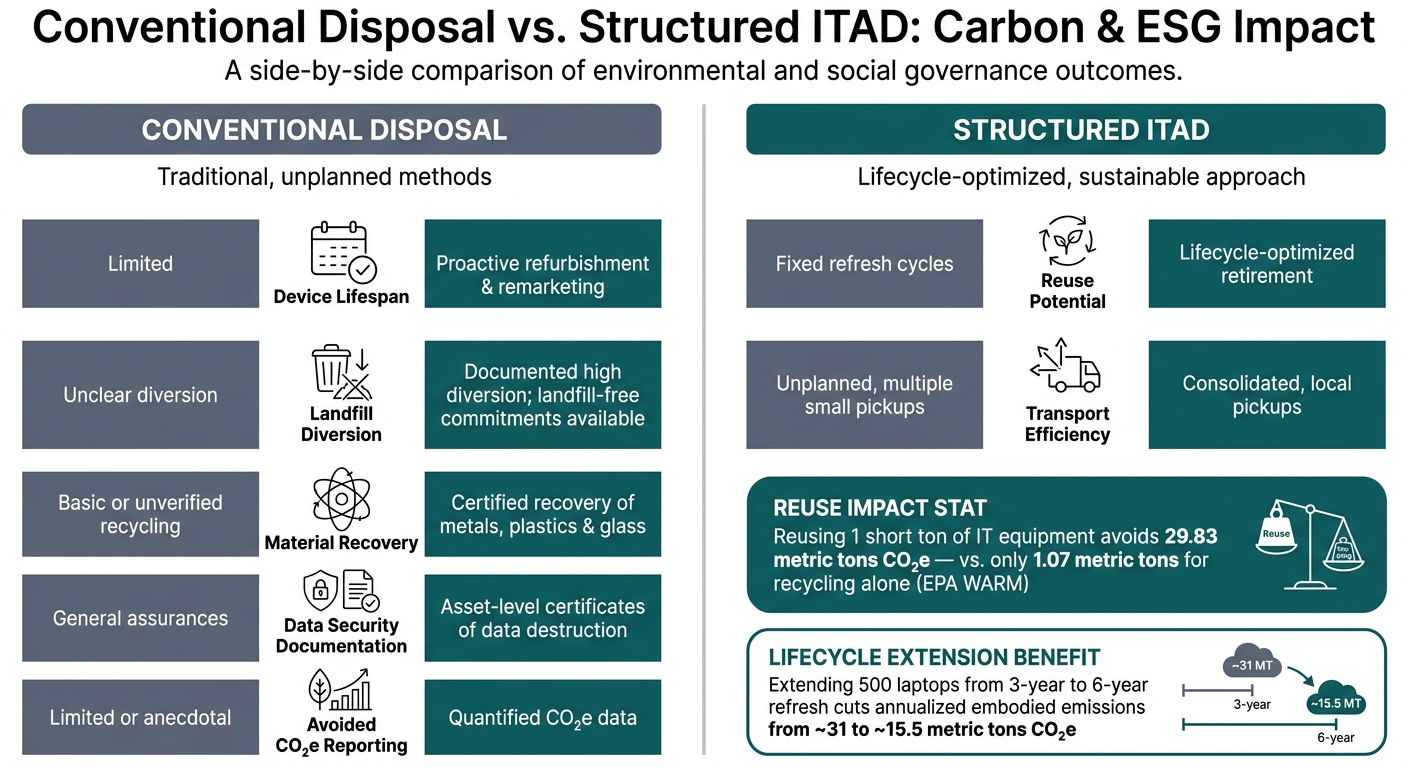
Conventional Disposal vs. Structured ITAD: Carbon & ESG Impact
A structured ITAD program turns device retirement into a carbon-cutting process built around reuse, refurbishment, and recycling. The main win is simple: keep equipment in use longer and track every retired asset from start to finish.
Reuse and refurbishment reduce demand for new hardware
Reuse is usually the lowest-carbon path. EPA WARM estimates that reusing one short ton of IT equipment avoids 29.83 metric tons of CO₂e, compared with 1.07 metric tons for recycling.[4][2][7]
The practical move is to redeploy devices that can still do the job, then refurbish and remarket the rest if they still have life left in them. Every time a device stays in service, its embodied carbon gets spread across more years of use. That matters. Longer refurbishment cycles can cut emissions to just over one-third of a standard three-year replacement cycle.[6]
Once reuse stops making sense, the next best carbon step is certified recycling.
Certified recycling supports material recovery and landfill diversion
If a device genuinely can’t be reused, certified recycling is the right next move. Certified recyclers recover metals, plastics, and glass so those materials can go back into manufacturing supply chains. That helps cut demand for virgin extraction and the energy needed to mine and refine raw materials.
The paperwork matters almost as much as the recycling itself. Providers working under standards like R2 or e-Stewards track material weights, downstream processors, and diversion rates. For ESG reporting, ask for:
Weight processed
Diversion rate
Material recovery data
For Bay Area organizations, Rica Recycling also offers local pickup and asset-level logs that can support sustainability disclosures.
The gap is easier to see when you compare structured ITAD with standard disposal side by side.
Conventional disposal vs. structured ITAD: side-by-side comparison
Dimension | Conventional Disposal | Structured ITAD |
|---|---|---|
Device lifespan | Fixed refresh cycles | Lifecycle-optimized retirement |
Reuse potential | Limited | Proactive refurbishment and remarketing |
Landfill diversion | Unclear diversion | Documented high diversion; landfill-free commitments available |
Transport efficiency | Unplanned, multiple small pickups | Consolidated, local pickups |
Material recovery | Basic or unverified recycling | Certified recovery of metals, plastics, and glass |
Data security documentation | General assurances | Asset-level certificates of data destruction |
Ability to report avoided CO₂e | Limited or anecdotal | Quantified CO₂e data |
Those differences give sustainability teams the metrics they need for carbon reporting.
How to build ITAD into sustainability and ESG operations
A repeatable ITAD program needs clear metrics, shared ownership, and written procedures. From there, the job is simple in theory but easy to fumble in practice: turn day-to-day ITAD work into numbers ESG teams can actually report.
Set KPIs that connect ITAD activity to carbon targets
Track ITAD metrics that tie straight to carbon and ESG reporting. Focus on these five KPIs: reuse rate, device lifespan, landfill diversion, avoided CO₂e, and secure data destruction success rate. The table below shows how each ITAD KPI links to a carbon or ESG metric.
ITAD KPI | Related carbon/ESG metric | Typical data source |
|---|---|---|
Reuse rate (%) | Scope 3 emissions - purchased goods and services; capital goods | ITAD partner disposition reports, asset inventory |
Average device lifespan (years) | Avoided manufacturing emissions; resource efficiency | IT asset records, purchase and retirement dates |
Pounds of e-waste diverted from landfill | Waste diversion rate; circular economy metrics | Recycler certificates, pickup manifests |
Avoided CO₂e (metric tons) | Scope 3 reduction claims; climate strategy KPIs | ITAD carbon impact reports, lifecycle emissions factors |
Secure data destruction success rate (%) | Governance, risk, and compliance metrics | Certificates of data destruction, IT security logs |
These KPIs help support Scope 3, GRI, and SASB reporting. Set a baseline year for retired devices, reuse rate, recycled weight, and avoided CO₂e.[11]
Build audit-ready reporting across IT, sustainability, and finance
Audit readiness starts long before an auditor sends an email. You need the right records in place ahead of time: asset inventories, chain-of-custody logs, recycling summaries, and data-destruction certificates.[8][10][12]
Store those records in one searchable repository tied to your carbon and ESG reporting systems. That makes life much easier when someone asks how avoided CO₂e was calculated. Instead of scrambling through folders, you can trace the number back to a recycler certificate or pickup manifest.
The paperwork matters, but the bigger issue is alignment. If IT, sustainability, and finance all work from different files, reporting gets messy fast. IT handles inventories and refresh timing. Sustainability handles carbon reporting. Finance reconciles resale value and fees. Quarterly reviews help keep all three teams on the same page and make sure ITAD data flows into annual ESG updates instead of disappearing after each pickup.[9]
Use a certified local process to simplify implementation
For Bay Area teams, a local certified process can make recordkeeping much easier. A certified local provider can simplify scheduled pickups, chain of custody, and compliance.
Rica Recycling offers certified electronics recycling and IT asset recovery for businesses, schools, and organizations across the San Francisco Bay Area. NIST 800-88–aligned sanitization supports security records, and California e-waste rules keep compliance tied to reporting.
Conclusion: ITAD turns retired equipment into measurable carbon progress
When ITAD is part of ESG operations, retired hardware stops being just old equipment. It becomes something you can track, document, and tie back to carbon goals.
Every retired laptop, server, or desktop creates a choice. Handle it well, and it can support documented progress. Handle it poorly, and it can turn into a liability in Scope 3 reporting, audit records, and compliance records.
Structured ITAD helps extend device life first, then recover materials when reuse is no longer possible. EPA WARM shows that reuse avoids far more emissions than recycling alone.[2][13][14] In plain English: reuse cuts the most carbon, and recycling comes after that. But the impact only carries weight when it’s properly documented.
That’s where records matter. Secure data destruction, chain-of-custody logs, and recycling documentation turn ITAD work into auditable carbon data. Those records support avoided-emissions claims across IT, sustainability, and finance teams. Without them, those claims are weaker, and Scope 3 gaps stay on the table.
For Bay Area organizations, loose disposal practices add compliance and reporting risk. Local climate action plans and stakeholder pressure make that risk hard to ignore. Rica Recycling supports Bay Area businesses with certified electronics recycling and ITAD services under a 100% landfill-free policy.
ITAD isn’t a back-office chore. It’s a direct way to turn retired equipment into measurable carbon progress.
FAQs
How do we know when a device should be reused or recycled?
After NIST 800-88-compliant data erasure, technicians check the device’s condition and inspect core parts like the motherboard, RAM, battery, and screen.
If the device still works, or if it can be fixed, it moves to refurbishment and reuse first. If it can’t be brought back into working order, it goes to recycling so materials like gold, silver, and copper can be recovered.
What ITAD records matter most for ESG audits?
The most important ITAD records are the ones that give you clear, verified proof on two fronts: environmental impact and data security compliance.
That usually includes:
Serialized inventory reports for every retired asset
Signed chain-of-custody records from pickup through final disposition
Certificates of data destruction, ideally with cryptographic proof
Impact reports that show landfill diversion rates, CO2 savings, and material recovery volumes
Think of these records as your paper trail. If someone asks what happened to a device, who handled it, whether the data was destroyed, or where the materials ended up, these documents should answer that without guesswork.
How can we measure avoided CO2e from retired IT assets?
Use a certified ITAD provider that offers third-party verified reporting and Lifecycle Assessment (LCA) methods for your specific hardware.
Ask for:
device-level tracking
ESG reports that calculate avoided CO2e
reuse-versus-recycling metrics
audit-ready records like Certificates of Destruction and data sanitization logs
These records help you measure Scope 3 impacts and show progress toward corporate carbon goals.