
How Startups Turn E-Waste Into New Products
Each year, millions of tons of electronics are discarded, with only a small fraction being properly recycled. In 2024, the U.S. alone generated 6.9 million tons of e-waste, yet just 15% of it was formally recycled. Startups are stepping in to address this issue by transforming old electronics into new, functional products. Here's how they do it:
- Sourcing Materials: E-waste comes from schools, corporate offices, data centers, and more. Partnerships with certified recyclers help secure pre-sorted materials.
- Sorting and Processing: Startups use manual dismantling, mechanical separation, and advanced recovery methods like AI-driven systems to extract valuable components.
- Upcycling Approaches: Options include refurbishing devices, harvesting components, and recovering raw materials like gold and copper.
- Eco-Friendly Methods: Techniques like cryogenic milling and reagent-free recycling avoid harmful chemicals while recovering high-value materials.
- Market Focus: Products made from e-waste appeal to eco-conscious buyers, with certifications and traceability boosting credibility.
This approach not only reduces waste but also taps into a market worth $91 billion in valuable metals embedded in discarded electronics. Startups are proving that e-waste is a resource, not a problem.
RoboLoop: Automating E-Waste Recycling with Robotics and AI
sbb-itb-855056e
Understanding E-Waste and Where to Source It
E-waste, officially referred to as Waste Electrical and Electronic Equipment (WEEE), includes any electronic device that has reached the end of its usable life. This can range from everyday items like smartphones and laptops to larger equipment like servers, printers, and refrigerators. On average, e-waste is made up of about 40% metals, 30% plastics, and 30% ceramics. Understanding this composition helps identify predictable, high-volume sources of e-waste, which can serve as a valuable resource for upcycling.
In the U.S., regulations - such as California's requirements for handler registrations and reporting - classify e-waste as either hazardous or universal waste. These classifications are essential not only for compliance but also for determining which materials are best suited for high-value upcycling. For instance, items like printed circuit boards (PCBs), often called "urban mines", hold greater potential for high-margin recovery compared to bulkier items like household appliances.
Common Sources of E-Waste
High-volume e-waste often comes from predictable sources like corporate IT upgrades, school technology refreshes, or data center decommissions. For example, when a company replaces its laptops or a school upgrades to newer Chromebooks, large quantities of uniform devices become available - perfect for startups seeking a steady supply.
| E-Waste Source | Typical Materials Available | Best For |
|---|---|---|
| Schools/Districts | Chromebooks, iPads, tablets, projectors | High-volume component harvesting |
| Data Centers | Servers, networking gear, enterprise storage | High-value precious metal recovery |
| Corporate Offices | Laptops, monitors, printers, docking stations | Refurbishment and resale |
| Retail/Logistics | POS systems, scanners, mobile terminals | Niche component sourcing |
Reaching out to K–12 districts or universities during their annual refresh cycles or 1:1 program rollovers can secure large, uniform batches of devices, simplifying sorting and processing downstream.
Building Supply Partnerships With Certified Recyclers
Sourcing e-waste piece by piece isn't practical for scaling. Instead, forming partnerships with certified recyclers, such as Rica Recycling, ensures access to pre-sorted materials and important documentation like Certificates of Data Destruction. To further safeguard operations and align with eco-friendly goals, verify that your recycling partner follows a landfill-free policy and complies with all relevant state and federal regulations. Once reliable sources are secured, startups can focus on implementing efficient sorting techniques.
Sorting and Triaging E-Waste for Upcycling
Efficient sorting is key to maximizing the value of e-waste materials. A three-step approach can help streamline this process:
- Level 1 - Manual Dismantling: Remove hazardous components (e.g., batteries or mercury-containing parts) and separate high-value items like PCBs.
- Level 2 - Mechanical Separation: Use physical or sensor-based methods to divide metals from plastics.
- Level 3 - Refined Recovery: Send materials rich in precious metals - like gold, palladium, and silver - to specialized refiners.
Sorting components by value immediately after dismantling ensures that high-margin materials remain separate from lower-value bulk items. For startups handling larger volumes, advanced tools like AI-driven vision systems are becoming increasingly viable. In September 2025, researchers from Texas A&M University and Sunnking Sustainable Solutions introduced the "RAISE" system, which used YOLOv8 deep learning to achieve a 98.9% success rate in disassembling over 120 phones per hour. This system even safely removed batteries by using thermal chilling to cool components below 0°F (-17.78°C).
Key Methods for Upcycling E-Waste
Once you've sorted and assessed the incoming devices, the next step is figuring out how to transform each item into something marketable. Startups typically rely on three main approaches, depending on the device's condition, the value of its components, and their production goals.
Refurbishment and Repair
Refurbishment involves cleaning, testing, and repairing devices by replacing parts like screens or ports, or updating firmware to restore functionality. This differs from remanufacturing, which goes further by completely disassembling a device and rebuilding it with new or certified components to meet "like-new" standards. While remanufactured products often enjoy longer lifespans and are ideal for industrial or warranty-replacement use, refurbished devices are more suited for budget-conscious resale or internal reuse.
Refurbishment also offers a major environmental benefit. For instance, refurbishing a smartphone can cut its greenhouse gas emissions by 77% to 91% compared to producing a new one. For startups, this eco-friendly angle can resonate strongly with environmentally conscious buyers.
Harvesting Components for New Products
When a device is too damaged to refurbish entirely, its individual parts may still hold value. Components like CPUs, RAM, graphics cards, screens, and motors can be extracted and either resold or repurposed in new products. The key to this process is non-destructive disassembly, which uses precision tools and localized heat to preserve the integrity of each component.
A great example is the San Francisco-based startup Tuurny, which introduced its "Nantul" robotic cell in April 2026. This system, powered by physical AI and computer vision, extracts RAM chips from e-waste at an impressive rate of 300 chips per hour. Tuurny even secured a six-figure deal with Areera, a UK-based TV recycler that processes 1,500 tons of televisions each month. As Tuurny founder Sina Ghashghaei explained:
"We're creating a new supply chain from old feedstock that didn't exist before."
However, as Texas A&M Associate Professor Minghui Zheng points out, precision is critical:
"The harder challenge... is removing chips without heat, mechanical, or electrical damage, and making sure it still works reliably afterward."
Recovering Raw Materials and Reusable Parts
For components that can’t be reused, startups focus on recovering valuable raw materials using innovative methods. Many prefer techniques that avoid harsh chemicals. Waste printed circuit boards (WPCBs) are especially lucrative - 1,000 lbs. (about 454 kg) of WPCBs can contain gold concentrations around 1,071 parts per million (ppm), compared to just 5.29 ppm in mined ore. The metal value in one ton of WPCBs is estimated at approximately $91,910.
One standout method is cryogenic milling, which uses liquid nitrogen to freeze PCBs, making the polymers brittle enough to separate cleanly from metal particles - no toxic solvents needed. This is often followed by electrostatic separation, which sorts conductive metal powders from insulating resins based on their surface charges, eliminating the need for water or chemical reagents. As researcher Natalya Kulenova from the Center of Excellence "VERITAS" explained:
"Reagent-free recycling represents a shift from chemistry-based extraction to physics-based recovery, offering a scalable, adaptable, and scientifically grounded path for sustainable management of electronic waste."
Even non-metallic leftovers can find new uses. For example, researchers at D. Serikbayev East Kazakhstan Technical University spent four years (2022–2026) processing 993 units of e-waste. They successfully upcycled WPCB plastic into construction-grade concrete (grades M300–M350) by replacing 10–50% of sand mass with crushed e-waste plastic.
Designing and Launching Products Made From E-Waste
Designing Around Available Materials
Creating products from e-waste flips the usual development process on its head. Instead of sourcing ideal materials, you work with what's available. Since reclaimed components can vary in both quantity and quality, product designs need to be adaptable.
For instance, if your e-waste supply consistently yields high-purity copper - achievable at 99.64–99.84% purity through hydrometallurgical methods - this material can become a key input for new electronics. Reclaimed plastics offer another option, capable of replacing 10–20% of fine aggregate in construction-grade concrete. The financial benefits are clear: recovering copper costs about 13 times less than raw extraction, with upcycled streams valued between $10,000 and $25,000 per ton. By designing products to incorporate these materials, companies not only reduce environmental impact but also lower production costs significantly.
Meeting U.S. Safety and Compliance Standards
Once the materials are identified, the next step is ensuring the product meets U.S. regulatory standards. Launching an e-waste-derived product involves navigating a complex set of rules. A key regulation is the EPA's Resource Conservation and Recovery Act (RCRA) Universal Waste Rules, which outline how hazardous materials - like lead-acid batteries, mercury thermostats, and fluorescent lamps - must be handled during upcycling.
Reclaimed materials also need to pass stringent tests, such as TCLP (Toxicity Characteristic Leaching Procedure), which ensures silver levels stay under 5 mg/L before integration into new products. Additionally, data-bearing components must be sanitized according to standards like NIST 800-88 or DoD 5220.22-M, especially for industries like healthcare or finance. Partnering with certified recyclers - those holding credentials such as R2v3, e-Stewards, or NAID AAA - can help startups navigate these overlapping requirements smoothly.
Marketing Upcycled Products to Eco-Conscious Buyers
Once the product is compliant, the focus shifts to marketing. For eco-conscious consumers, vague claims about being "green" won’t cut it. These buyers expect hard evidence of sustainability, including third-party audits, chain-of-custody documentation, and life cycle assessment (LCA) data that clearly outline the environmental benefits.
A standout example came in March 2026 when Mint Innovation teamed up with HP Inc. to create the first certified batch of closed-loop recycled copper. Using low-carbon biosorption technology, Mint recovered high-purity copper from HP’s end-of-life printed circuit boards. The process was independently audited by TÜV Rheinland under ISO 14021 and EN 15343 standards. This copper was then used in HP’s EliteBook X G2 Series laptops and EliteBoard G1a Next Gen AI PCs. As Mint Innovation’s President Matt Bedingfield and HP’s SVP of Design & Sustainability Stacy Wolff highlighted, independent certification and detailed traceability - from waste to finished product - helped validate the circular manufacturing process and instill buyer confidence.
For startups with smaller operations, achieving certifications like ISO 14021 for environmental claims or ISO 22095 for chain of custody can establish credibility with both B2B clients and eco-conscious consumers. When paired with robust LCA data - showing that upcycling reduces global warming potential by 50–63% and energy use by 30–70% compared to traditional recycling - these measures make a strong case for choosing upcycled products over conventional ones.
Setting Up a Scalable Upcycling Operation
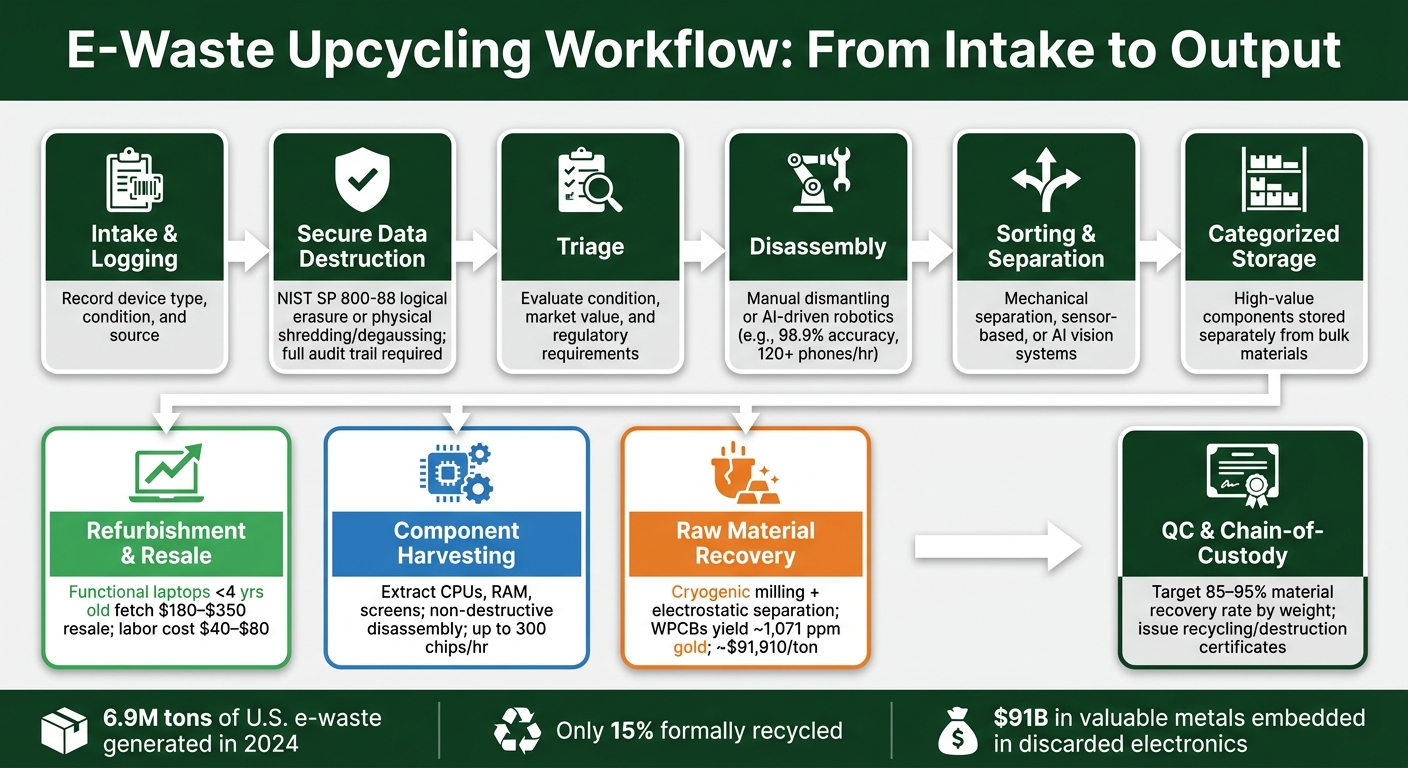
How Startups Turn E-Waste Into Valuable Products: Step-by-Step Workflow
Step-by-Step Upcycling Workflow
The process of upcycling e-waste typically follows a structured workflow: intake, logging, data destruction, triage, disassembly, sorting, storage, and finally, reassembly or material recovery.
When dealing with devices that contain sensitive data, certified methods like logical erasure, as outlined in NIST SP 800-88, or physical destruction (e.g., shredding or degaussing) are required. These methods must also include a complete audit trail. For devices without classified data, software-based erasure is often preferred, as it preserves the hardware for refurbishment - an approach that can yield higher profits compared to shredding. Once data is securely erased, each device goes through triage, where its condition, potential market value, regulatory requirements, and best next steps (refurbishment, component harvesting, or material recovery) are assessed.
A hybrid routing model - combining refurbishment and material recovery - can strike the right balance between profitability and environmental responsibility. For example, functional enterprise laptops less than four years old can fetch resale prices ranging from $180 to $350, even after factoring in labor and parts costs of about $40 to $80. Meanwhile, devices that don’t pass functional testing move on to material recovery. Advanced techniques like ultrasonic delamination for battery electrodes (which is 100x faster than traditional methods) and cryogenic milling for polymers help extract reusable materials efficiently.
Quality Control and Parts Traceability
Scaling operations requires a strong focus on both quality control and traceability. As the volume of e-waste grows, manual checks often give way to automated sorting systems. This shift mirrors broader adoption of AI and robotics in material recovery. Take Apple’s "Daisy" robot, for instance - it can disassemble 23 iPhone models at a speed of 200 units per hour, recovering 15 different materials like cobalt, tungsten, and rare earth elements with impressive purity.
Equally important is maintaining chain-of-custody records and issuing certificates of recycling or destruction for every batch. Aiming for a material recovery rate of 85–95% by weight not only ensures operational efficiency but also provides reliable data for sustainability reporting.
"Every dollar invested in design for circularity saved an estimated $4 to $7 in downstream collection, sorting, and processing costs." - Dell Technologies
Working With Certified E-Waste Partners
Collaborating with certified recyclers can streamline your upcycling efforts. Certified partners often pre-sort e-waste, allowing your operation to focus on high-value tasks like refurbishment and material recovery. For startups in the San Francisco Bay Area, Rica Recycling is a noteworthy option. They provide certified electronics recycling and IT asset recovery (ITAD) services, including secure data destruction with certificates and a 100% landfill-free policy, ensuring a responsible source of feedstock.
When selecting a partner, prioritize certifications like R2v3, e-Stewards, or NAID AAA. These credentials guarantee adherence to strict data security and environmental standards, reducing compliance risks while providing the documentation you’ll need to back up your sustainability claims.
Conclusion: Moving Forward With E-Waste Upcycling
E-waste upcycling offers a massive opportunity for both economic growth and environmental benefit. With global e-waste expected to hit 82 million tonnes by 2030 - and only 22.3% currently being formally recycled - there’s a $91 billion resource waiting to be tapped, including $15 billion in gold alone.
The most successful upcycling startups focus on three key strategies: smart design, strong supply partnerships, and scalable processes. By designing products with modular structures and standardized fasteners, companies make disassembly quicker and refurbishing more profitable. This approach to circular design not only cuts costs but also gives these businesses a competitive edge. It’s a clear path to boosting profitability.
"Upcycling presents a sustainable alternative by converting E-waste into high-value functional materials while reducing landfill dependency and pollutant release." - Pranav Prashant Dagwar, Department of Environmental Science and Engineering, SRM University-AP
Reliable supply partnerships are just as essential. Examples from the field show that working directly with OEMs and certified recyclers dramatically improves margins. A steady stream of pre-sorted materials allows startups to concentrate on adding value where it matters most.
Finally, scalable methods are shaping the next phase of e-waste upcycling. Techniques like reagent-free recovery, AI-driven sorting, and hybrid workflows that combine refurbishment with material recovery are already proving effective. The companies thriving in this space are those that see e-waste not as a problem to manage but as a valuable raw material with untapped potential. This forward-thinking approach turns what was once considered waste into a profitable and sustainable resource.
FAQs
How do startups decide between refurbishing, harvesting parts, or recovering raw materials?
Startups decide how to handle e-waste by evaluating the economic worth and condition of its components.
- Refurbishing: This is the go-to option for devices that are still functional. It helps maintain the original engineering and cuts down on energy consumption compared to creating new devices.
- Harvesting parts: For devices that no longer work, startups often salvage valuable components, especially if they’re rare or difficult to find, like legacy parts.
- Raw material recovery: When reuse isn’t an option, startups turn to mechanical or chemical processes to extract metals and polymers, ensuring nothing goes to waste.
Each method is chosen carefully to balance efficiency and sustainability.
What are the biggest data security steps when upcycling used computers and servers?
The first and most important step is certified data destruction to make sure sensitive information can't be recovered. This can be done through methods like NIST 800-88 compliant secure data wiping for devices that will be reused or physical shredding for hardware that's no longer functional. Keep in mind, simply deleting files or reformatting drives isn't sufficient. Always ask for a Certificate of Destruction as proof that the process followed regulations like HIPAA and FACTA, ensuring the secure handling of your data.
Which e-waste items usually have the highest resale or recovery value?
Items with the greatest recovery value often feature high-grade circuit boards. These include telecommunications equipment, enterprise routers, switches, and server components, which are rich in precious metals like gold, silver, palladium, and platinum. On the resale side, functional IT assets - such as modern laptops less than five years old - are particularly valuable when refurbished.
Rica Recycling plays a key role in responsibly recovering these materials, preventing electronics from ending up in landfills and channeling valuable resources back into manufacturing.