
NIST Standards for Real-Time Data Sanitization
Deleting a file doesn’t mean it’s gone forever. NIST’s updated SP 800-88 Rev. 2 guidelines, released in September 2025, provide a modern framework for ensuring data is permanently unreadable. This is especially critical with today’s advanced storage technologies like SSDs and NVMe drives, where traditional deletion methods often fail.
Here’s the core of what you need to know:
- Data Sanitization Methods: NIST outlines three levels - Clear (basic overwrite), Purge (e.g., Cryptographic Erase), and Destroy (e.g., shredding).
- Real-Time Sanitization: Automating processes with tools like Mobile Device Management (MDM) ensures fast, secure data removal, even remotely.
- Verification: Post-sanitization checks are mandatory, with sampling rates (10%-30%) based on risk levels.
- Compliance: Proper sanitization aligns with regulations like HIPAA, PCI DSS, and CMMC 2.0, reducing risks of data breaches and penalties.
Modern storage devices require advanced sanitization techniques, such as Cryptographic Erasure, which destroys encryption keys instead of data. Following NIST standards ensures secure data disposal, reduces breach risks, and supports compliance with U.S. regulations.
NIST SP 800 88 Revision 2: Media Sanitization Guidelines
sbb-itb-855056e
Core NIST Guidelines for Media Sanitization
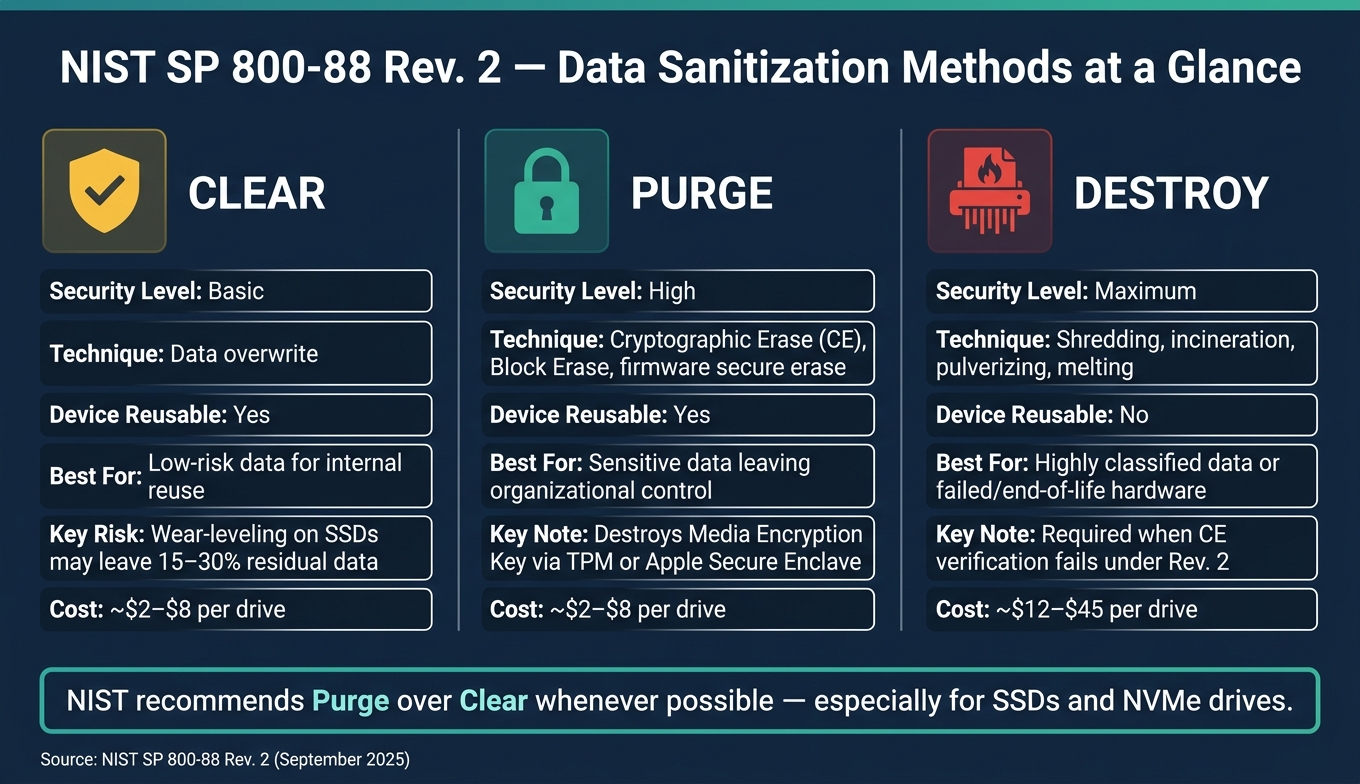
NIST SP 800-88 Rev. 2: Data Sanitization Methods Compared
Key Concepts in NIST SP 800-88
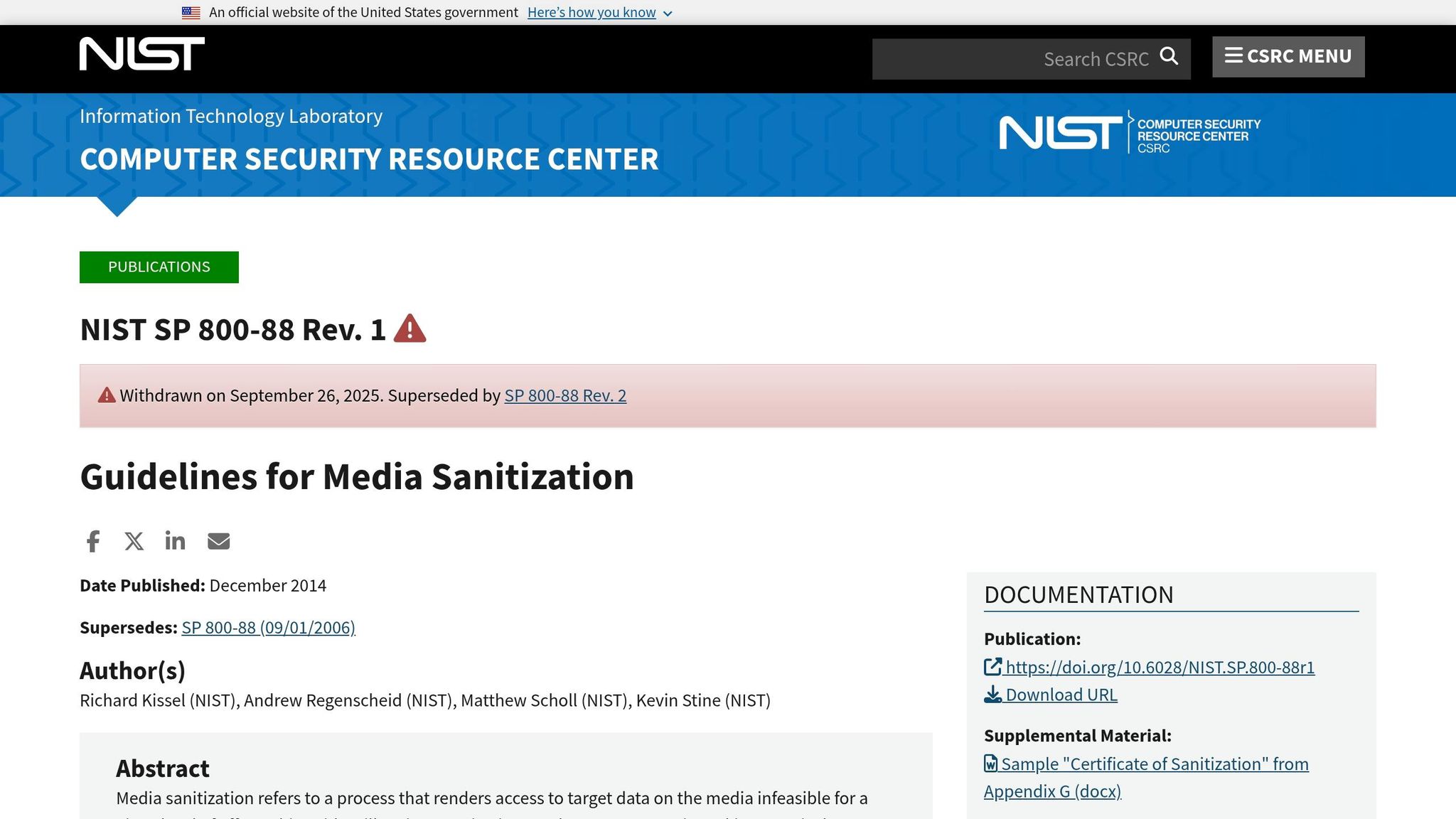
NIST SP 800-88 breaks down media sanitization into three main methods, each tailored to different levels of data sensitivity:
- Clear: This method overwrites data to prevent basic recovery, making it suitable for devices intended for internal reuse.
- Purge: Techniques like Cryptographic Erase (CE) or Block Erase are used to prevent data recovery, even with advanced tools, while keeping the device reusable.
- Destroy: Physical destruction methods, such as incineration or melting, render the media permanently unusable.
Interestingly, NIST SP 800-88 Rev. 2 emphasizes the use of purge over clear whenever possible:
"When possible, the purge sanitization method should be used instead of the clear sanitization method." - NIST SP 800-88 Rev. 2
This recommendation is particularly critical for SSDs. Due to wear-leveling - a process that spreads write operations across storage cells to prolong device life - overwritten data may leave 15%–30% of residual data intact. As a result, firmware-based purge methods are crucial for flash storage. Additionally, Rev. 2 has downgraded degaussing, which is no longer considered a "Destroy" technique and is ineffective for flash-based media.
| Method | Security Level | Device Reusable? | Best For |
|---|---|---|---|
| Clear | Basic | Yes | Low-risk data intended for internal reuse |
| Purge | High | Yes | Sensitive data leaving organizational control |
| Destroy | Maximum | No | Highly classified data or failed hardware |
These methods form the foundation for secure media sanitization, with additional guidance available for compliance and real-time monitoring.
NIST Publications Relevant to Real-Time Monitoring
Other NIST publications provide frameworks for real-time monitoring of sanitization processes. NIST SP 800-53 outlines a comprehensive set of security and privacy controls, ensuring that every sanitization event - whether performed remotely or on-site - is logged and can be verified. Meanwhile, NIST SP 800-209 focuses on storage security controls, offering strategies for managing and monitoring storage devices throughout their lifecycle.
Because Rev. 2 of SP 800-88 removed device-specific technical instructions, organizations are encouraged to consult IEEE 2883-2022. This standard provides detailed erasure techniques for 47 types of storage devices, including SSDs and NVMe drives. With the federal transition period for Rev. 2 ending in March 2027, organizations still adhering to Rev. 1 must update their policies. The focus has shifted from rigid technical steps to broader, outcome-based governance at the program level.
Together, these publications ensure that every sanitization action is meticulously tracked and integrated into a robust, real-time data sanitization framework.
How to Implement Real-Time Data Sanitization
Automating and Monitoring Clear, Purge, and Destroy Methods
To align with NIST's recommendations, organizations can use real-time systems to automate data sanitization processes. For the Purge method, tools like Unified Endpoint Management (UEM) or Mobile Device Management (MDM) platforms can issue Cryptographic Erase (CE) commands to devices such as SSDs, NVMe drives, and mobile devices. This process eliminates the Media Encryption Key stored within the device's hardware security chip (like TPM or Apple Secure Enclave), ensuring the data becomes irretrievable.
Sanitization events should be tracked across three key stages: Request, Acknowledgment, and Disappearance. To enhance security, implement an Auto-Wipe on Inactivity policy. For example, if a device remains offline for 15 days, the system should automatically execute the sanitization command when the device reconnects.
In cases of physical destruction, monitoring shifts to documenting the chain of custody. This includes using GPS-tracked transport, tamper-evident packaging, and serialized certificates that detail each device's serial number alongside its destruction method, date, and location. Automating these processes helps meet NIST's logging and verification requirements, ensuring compliance.
Verification and Logging for Compliance
Verification is a critical step after issuing a wipe command. According to NIST SP 800-88 Rev. 2, there are two approaches: validation (testing every device individually) and verification (sampling 10%–30% of a batch). For low-risk batches, a 10% sample is sufficient, but high-risk batches require a 30% sample to achieve a 95% confidence level.
When using Cryptographic Erase, it’s essential to confirm that the cryptographic module successfully destroyed the key - not just that the command was issued. Follow-up verification using forensic tools like R-Studio or PhotoRec on a random 10% sample can detect any residual data. This approach has shown to reduce sanitization failures from 23% to under 2% in enterprise environments.
Under Rev. 2 guidelines, every sanitization event must be logged and retained for at least 36 months. These logs should include the asset's serial number, its data sensitivity classification (per FIPS 199), the sanitization method used, the responsible technician, and the verification results. Certified ITAD providers, such as Rica Recycling, offer real-time client portals where organizations can track assets, view updates, and access certificates, simplifying audit preparation.
Common Challenges and How to Address Them
Operational challenges can disrupt effective sanitization, but proactive measures can minimize risks.
One frequent issue is silent firmware failures. Sometimes, firmware-level "Secure Erase" commands report success without completing the erasure. To address this, enforce mandatory sector-level verification.
Another hurdle involves device lock states. For instance, automating wipes for Android or iOS devices without clearing "Factory Reset Protection" (FRP) or "Activation Lock" can render devices unusable for redeployment or recycling. Always include these steps in your automated workflows to avoid such problems.
Lastly, organizations often overlook the cost differences between methods. Software-based sanitization typically costs $2–$8 per drive, while physical destruction ranges from $12–$45 per drive. When CE verification fails, physical destruction becomes mandatory under Rev. 2 guidelines. A written escalation protocol is essential, and 73% of enterprise policies already include this requirement.
Compliance and Best Practices for U.S. Organizations
Documenting and Auditing Sanitization Processes
Thorough documentation is the backbone of compliance efforts and can make the difference between defensibility and liability. According to NIST SP 800-88 Revision 2, released in September 2025, organizations must provide detailed, verifiable records of drive sanitization.
To prepare for audits, maintain meticulous records for each sanitization event. These should include device identifiers, the method used, timestamps, verification results, and a Certificate of Destruction. Retain these records for at least seven years to meet the requirements of regulations like HIPAA and SOX.
It's also crucial to implement an escalation protocol based on verification sampling. For instance, if a spot-check of 10%–30% of devices reveals a failure rate above 2%, expand the sampling to 50%. If the failure rate exceeds 5%, move to 100% validation of the entire batch. This structured approach demonstrates that your program is actively managed and not just a theoretical plan.
"In those environments, 'we wipe drives' is not a program. It is a claim that has to be backed by process and evidence." - Richie Steffens, CEO, TechWaste Recycling
To further strengthen your documentation, require digital signatures and tamper-evident storage for sanitization logs. This ensures that records remain unaltered, providing a trustworthy trail for audits.
These rigorous documentation practices also help establish reliable partnerships with certified ITAD providers.
How Certified ITAD Services Support NIST Compliance
While robust internal documentation is essential, achieving full NIST compliance often requires external expertise. Keeping up with modern storage technologies like NVMe SSDs, eMMC, and self-encrypting drives (SEDs) is no small feat. These devices demand firmware-level commands and specialized tools for proper sanitization and verification. NIST SP 800-88 Rev. 2 introduces the concept of "vendor trust as a control", where organizations must document why they trust a vendor's methods, how exceptions are managed, and how results are validated. A qualified ITAD partner can provide this level of documentation and assurance.
For example, Rica Recycling offers secure data destruction services, including Certificates of Destruction. These certificates provide the necessary evidence trail for NIST compliance, particularly for Bay Area businesses. When choosing an ITAD provider, ensure their Certificate of Destruction specifies the relevant NIST SP 800-88 r2 category and section for audit readiness. Typically, processing takes 1–3 business days, with certificates issued within 48 hours.
Security and Disposal Benefits of Following NIST Standards
Adhering to NIST standards doesn’t just ensure compliance - it also significantly reduces the risk of data breaches. Improper sanitization can have severe consequences. A study revealed that 42% of used drives sold on eBay still contained residual data, including sensitive personal and corporate information. In one notable case, a HIPAA violation involving disposal failures led to a $5.55 million settlement. Compare that to the relatively low cost of sanitization, which ranges from $2 to $45 per drive.
Following NIST guidelines also ensures responsible e-waste disposal. For highly sensitive data or end-of-life devices where a Purge method isn’t reliable, physical destruction methods like shredding or pulverizing are required. Certified providers, such as Rica Recycling, that operate under a 100% landfill-free policy, ensure secure data destruction while keeping hazardous materials out of landfills in line with EPA regulations.
Here’s how major U.S. regulations align with NIST 800-88 r2:
| Regulation | How NIST 800-88 r2 Applies |
|---|---|
| HIPAA | HHS OCR guidance recognizes NIST Destroy-level methods as "reasonable and appropriate" for disposal |
| PCI DSS v4.0.1 | Requires destruction methods that align with industry standards, including NIST 800-88 r2 |
| CMMC 2.0 | Mandates media sanitization per NIST SP 800-88 r2 for all Controlled Unclassified Information (CUI) |
| FACTA | NIST Destroy-level shredding satisfies "reasonable measures" for consumer report disposal |
Key Takeaways for Real-Time Data Sanitization
Real-time data sanitization plays a critical role in safeguarding sensitive information and meeting U.S. regulatory standards. The updated guidelines in NIST SP 800-88 Rev. 2 (effective September 2025) emphasize that organizations must go beyond simply wiping drives. They are now required to establish comprehensive, enterprise-wide programs with documented vendor reliability and defensible evidence.
A key technical challenge lies in the limitations of standard overwriting (Clear) on modern SSDs and NVMe drives. These drives often retain residual data even after overwriting, due to wear-leveling algorithms. To address this, NIST specifies Purge methods such as firmware secure erase, cryptographic erasure, or physical destruction for devices at the end of their lifecycle. Compliance mandates using the correct method for effective data sanitization.
Equally important is the verification process. Post-wipe validation significantly reduces failure rates - from 23% to under 2% - with just a 5% sample size achieving over 95% confidence. This meticulous approach is essential, given the financial risks associated with inadequate data sanitization.
The cost of data breaches underscores the importance of proper sanitization. By 2025, the average global cost of a data breach is projected to reach $4.44 million. Additionally, 80% of consumers report being less likely to trust a company after a breach. When compared to these staggering figures, the costs of secure sanitization are minimal: $2–$8 per drive for software-based methods and $12–$45 per drive for physical destruction.
For organizations aiming to meet NIST compliance while prioritizing environmental responsibility, partnering with a reputable ITAD provider like Rica Recycling is a smart choice. They offer secure data destruction backed by a Certificate of Destruction and a commitment to a 100% landfill-free policy, ensuring your organization achieves both data security and environmental goals.
FAQs
When should I use Clear vs. Purge vs. Destroy?
Selecting the appropriate NIST 800-88 sanitization method comes down to the sensitivity of the data and whether the device will remain under your control. Here's a quick breakdown:
- Clear: Ideal for non-sensitive data intended for internal use, especially when the device stays within your organization. This method relies on standard overwrite commands to remove data.
- Purge: Suitable for sensitive data if the device is leaving your control, such as when it's being recycled. This option uses advanced techniques like cryptographic erasure to ensure data is no longer accessible.
- Destroy: Best for classified information or media that has reached the end of its life. This involves physically destroying the device to make the data completely unrecoverable.
Each method ensures a specific level of data protection based on your needs.
How can we verify a remote cryptographic erase actually worked?
To ensure a remote cryptographic erase was successful, it's crucial to confirm that the encryption keys were completely destroyed - not just that the command was issued. Look for documented proof that the cryptographic module carried out the key destruction process. Carefully examine logs, completion codes, and error checks to verify that no plaintext data was present before the process. This approach helps ensure that any residual risk matches your data's classification level. Rica Recycling adheres to these rigorous protocols to guarantee secure data destruction.
What should sanitization logs include for a NIST audit?
Sanitization logs play a crucial role in meeting NIST audit requirements. They need to present a clear and defensible record of every device's lifecycle, ensuring all actions are traceable and verifiable.
Here’s what these logs should include:
- Unique Identifiers: Record details like serial numbers, model types, and asset tags to ensure each device is unmistakably identified.
- Sanitization Method: Specify whether the device underwent Clear, Purge, or Destroy processes. This clarity ensures compliance with NIST guidelines.
- Tools and Software Versions: Note the exact versions of tools or software used during sanitization. This adds an extra layer of precision and accountability.
To further strengthen the log:
- Personnel Accountability: Include names of responsible individuals, along with timestamps for each action. Verification results, such as certificates, validation screenshots, or raw data, should also be documented to confirm proper execution.
- Physical Destruction Evidence: If physical destruction is involved, photographic evidence is mandatory. This visual proof reinforces the integrity of the sanitization process.
By maintaining these detailed logs, organizations can ensure they meet NIST standards while providing a reliable trail of evidence during audits.