
Certified Data Wiping Tools for ITAD Providers
Certified data wiping tools are essential for ITAD providers to ensure secure and compliant data destruction. These tools go beyond simple file deletion or factory resets, addressing challenges posed by modern storage technologies like SSDs and NVMe drives. They also help meet strict regulatory requirements, such as HIPAA, GDPR, and NIST SP 800-88 standards, while producing verifiable Certificates of Destruction for auditing purposes.
Key Takeaways:
- Why They're Needed: Factory resets and standard overwrites leave data recoverable. Certified tools ensure complete erasure, even on SSDs and NVMe drives.
- Compliance: Tools must align with NIST SP 800-88 Rev. 2, finalized in 2025, and other regulations like HIPAA and GDPR.
- Features to Look For:
- Support for hardware-level erasure methods (e.g., Cryptographic Erasure).
- Detailed audit logs and tamper-proof Certificates of Destruction.
- Integration with ITAD workflows, such as PXE boot or ERP systems.
Top Tools:
- Blancco: Supports NIST Purge level, offers hardware-based validation, and integrates with platforms like ServiceNow.
- BitRaser: Scalable solution for high volumes, though it lacks full Purge certification.
| Feature | Blancco | BitRaser |
|---|---|---|
| NIST Purge Level Certified | Yes | No |
| Validation Method | Hardware-based | Software-based |
| Certificate Fields | 23 of 23 | 18 of 23 |
| Pricing (Per Device) | ~$45 | ~$28 |
Certified data wiping tools are a must for ITAD providers to ensure secure, compliant, and efficient data destruction processes.
Secure Data Wiping for ITAD: How Compucycle Uses BitRaser
sbb-itb-855056e
Key Features to Look for in Certified Data Wiping Tools
For IT asset disposition (ITAD) providers, certified data wiping tools stand out based on three primary features: adherence to industry standards, thorough audit documentation, and smooth integration into existing workflows.
Compliance with Industry Standards
Certified tools must align with the correct sanitization methods for different types of media. The federal standard to follow is NIST SP 800-88 Revision 2, finalized in September 2025. This document outlines three levels of sanitization: Clear, Purge, and Destroy. For traditional hard drives being prepared for reuse, a software-based overwrite (Clear) is sufficient. However, for SSDs and NVMe drives, only a hardware-level Purge method - such as Cryptographic Erasure - is appropriate.
"In the era of Flash Storage, you don't delete the data to sanitize the device. You destroy the key that unlocks the data." - Alanna River, Technical Content Writer, Hexnode
The older DoD 5220.22-M 3-pass overwrite method is no longer suitable for modern storage devices. Instead, look for tools that explicitly reference NIST SP 800-88 Rev. 2 and IEEE 2883-2022. Additionally, tools should comply with sector-specific regulations such as HIPAA, GDPR, PCI-DSS, and GLBA to ensure all legal requirements are met.
Apart from following these standards, secure and detailed documentation of every sanitized device is equally important.
Audit Reporting and Certificates of Destruction
Proper compliance relies heavily on accurate and detailed documentation. Certified tools must generate audit logs and verification records for every device, as outlined in NIST SP 800-88 §5.1. These tools should issue a unique, serial-numbered Certificate of Destruction (CoD) for each individual device, rather than a general summary for a batch.
"If you can't produce a record showing what happened to a specific drive, the wipe didn't happen as far as an auditor is concerned." - OEM Connect
Audit reports should include the sanitization method used, pass/fail results, timestamps, and the operator responsible. Additionally, there should be an escalation process to flag failed wipes for physical destruction, with records documenting this action. To enhance security, tamper-proof records signed with SHA-256 hashes provide extra assurance during regulatory reviews.
Integration with ITAD Workflows
Beyond compliance and documentation, seamless integration into ITAD workflows is critical for large-scale operations. Key features include PXE network boot, enabling the simultaneous wiping of thousands of drives. For instance, BitRaser supports up to 65,000 drives over a network. In environments where network access is restricted, bootable USB options ensure operations can continue offline.
Advanced tools also incorporate hardware-aware automation, which identifies the type of drive (HDD, SSD, or NVMe) and applies the correct sanitization method automatically. On the management side, features like REST API integration with ITAD ERP platforms and centralized cloud consoles are invaluable. These systems often include role-based access control (RBAC), ensuring secure management across multiple facilities. Such integration ensures the chain of custody is maintained from the initial scan of a device to its final disposition.
Top Certified Data Wiping Tools for ITAD Providers
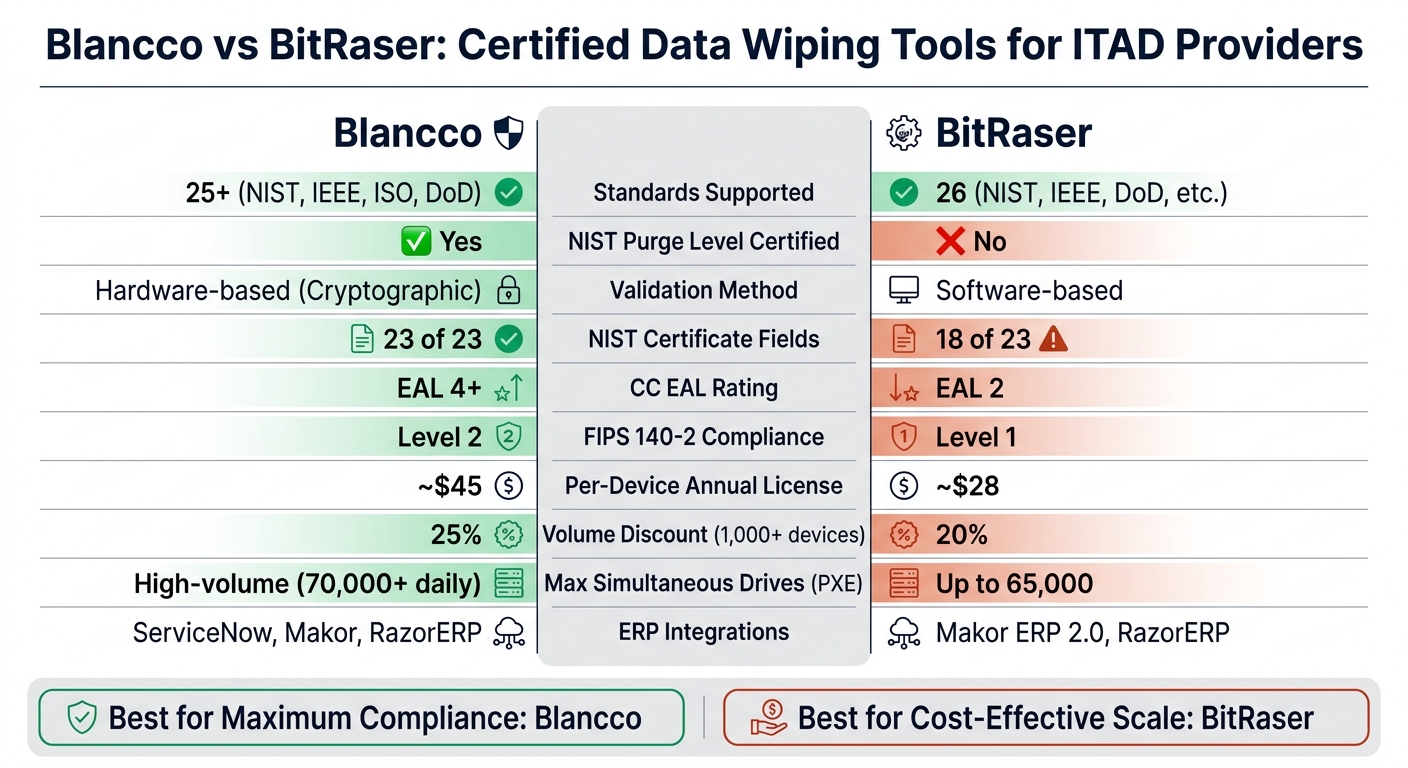
Blancco vs BitRaser: Certified Data Wiping Tools Compared
When evaluating ITAD tools, it’s crucial to focus on compliance, audit capabilities, and how well they integrate into workflows. Two standout solutions in this space are Blancco and BitRaser, each offering distinct features for certified data erasure and streamlined operations.
Blancco
Blancco is a powerhouse in the data wiping industry, adhering to over 25 recognized standards, including NIST SP 800-88 Rev. 2 and IEEE 2883-2022. What sets Blancco apart is its ability to handle both NIST Clear and Purge levels, leveraging hardware-based cryptographic validation for added security.
Its reporting capabilities are equally robust. Blancco's audit trail includes all 23 data fields required for a Certificate of Destruction, safeguarded with SHA-256 hashes to ensure records remain tamper-proof. Approved by more than 15 governing bodies, Blancco processes over 70,000 devices daily, with a spotless record of zero data breaches over its 29-year history.
For high-volume ITAD operations, Blancco simplifies workflows by combining erasure, diagnostics, grading, reimaging, and certification into a single pass. This efficiency reduces labor costs and minimizes manual handling. Seamless API integrations with platforms like ServiceNow, Makor, and RazorERP ensure the chain of custody is maintained without manual data entry.
"Blancco Drive Eraser and our asset management system provided the control and oversight…to adequately mitigate against the risk of data loss…" - Matthew Hill, CIO, Industry Trading (Lifecycle+)
In 2024, Industry Trading (now Lifecycle+) leveraged Blancco Drive Eraser to process over 30,000 assets monthly, deploying more than 100,000 units in a year. Another success story comes from IT Supply Solutions, which boosted production by 25% and shaved four minutes off processing time per machine by adopting Blancco's PXE boot solution.
BitRaser
Developed by Stellar, BitRaser is designed for scalability. It supports 26 international standards, including NIST 800-88, DoD 5220.22-M, and IEEE 2883-2022, and can simultaneously wipe up to 65,000 drives via PXE network boot. For environments without network access, it can handle up to 254 devices at once using USB boot.
While BitRaser’s software-based verification meets NIST Clear requirements, it does not offer full Purge certification. Its Certificates of Destruction include 18 of the 23 required fields and are digitally signed for security in a cloud repository. Optional verification reports are available for $5 per device.
BitRaser integrates seamlessly with Makor ERP 2.0 and RazorERP, while its Admin Console enables automated reporting across multiple facilities. CompuCycle, a Texas-based ITAD provider, achieved full integration between its data erasure facility and ERP system after deploying BitRaser Drive Eraser Admin Console.
"The Mac erasure solution was a game-changer for us - the ability to execute a simple command made remote and large-scale wiping dramatically more efficient." - Brayden Campbell, Global ITAD Operations, allwhere Inc.
BitRaser operates on a pay-per-use model, with licenses that remain valid until used, providing flexibility for ITAD providers. As of December 2025, it boasts an NPS score exceeding 80.
Here’s a side-by-side comparison of these tools:
| Feature | Blancco | BitRaser |
|---|---|---|
| Standards Supported | 25+ (NIST, IEEE, ISO, DoD) | 26 (NIST, IEEE, DoD, etc.) |
| NIST Purge Level Certified | Yes | No |
| Validation Method | Hardware-based (cryptographic) | Software-based |
| NIST Certificate Fields | 23 of 23 | 18 of 23 |
| CC EAL Rating | EAL 4+ | EAL 2 |
| FIPS 140-2 Compliance | Level 2 | Level 1 |
| Per-Device Annual License | ~$45 | ~$28 |
| Volume Discount (1,000+) | 25% | 20% |
Standards-Driven Data Wiping Methods
Both Blancco and BitRaser rely on proven sanitization methods tailored to the type of media being processed. These methods align with NIST SP 800-88 Rev. 2 standards:
- Overwriting (NIST "Clear"): Sequentially writes over all addressable storage locations, commonly used for HDDs.
- Cryptographic Erasure (NIST "Purge"): Destroys the encryption key protecting data on flash-based storage, making the data irretrievable.
- Degaussing: Disrupts the magnetic domains on spinning drives, rendering them permanently unusable - a method often used for physical destruction.
For R2v3 compliance, independent verification is essential. Tools like Blancco Drive Verifier and BitRaser Drive Verifier can validate erasure effectiveness on a sample of 5% of processed assets.
Rica Recycling: Certified Data Destruction in the San Francisco Bay Area

Rica Recycling adapts its certified data destruction services to meet the specific IT asset disposition (ITAD) needs of businesses in the Bay Area. Their solutions are designed to comply with the highest standards of data security and environmental responsibility.
Bay Area companies can depend on Rica Recycling for a range of certified data destruction methods, including software-based wiping, physical destruction, and component dismantling. For devices intended for resale or reuse, the software wiping process employs a 7-pass overwrite in line with DoD 5220.22-M (E) standards. This method also meets compliance requirements for NIST 800-88 Rev. 2, HIPAA, PCI-DSS, GLBA, SOX, and FACTA. On the other hand, physical destruction, such as shredding or crushing, is recommended for media that has reached the end of its life and demands the highest level of data security.
Every data destruction service includes a serialized Certificate of Destruction (COD) provided within 48 hours. Additionally, clients receive a detailed inventory report listing the make, model, and serial number of each item, ensuring full chain-of-custody tracking. For projects requiring extra security, Rica Recycling offers video or photo documentation of the destruction process.
Services are typically completed within 1–3 business days, with flexible options for pickups and drop-offs throughout the Bay Area. The company complies with California SB20/SB50 e-waste regulations and partners exclusively with EPA-registered, R2v3-certified facilities to maintain a 100% landfill-free policy.
Pricing depends on factors such as the volume of devices, the chosen destruction method, and logistical needs. For businesses with remarketable assets like laptops, servers, or networking equipment, Rica Recycling offers an IT asset buyback program, which can help offset service costs.
How to Choose the Right Certified Data Wiping Tool for Your ITAD Operation
Picking the right certified data wiping tool is a critical step to ensure both regulatory compliance and smooth operational performance.
Start by focusing on your compliance requirements. The standards your clients adhere to - like HIPAA for healthcare, GLBA for finance, or CMMC 2.0 for defense contractors - should guide your decision. Not all tools are built to support every standard, so it's vital to align your compliance needs with the standards each tool supports. These benchmarks act as your starting point for evaluation. As Securis explains: "NIST 800-88 is not a certification - it's a standard. Only third-party audits like NAID AAA can confirm it's being followed correctly."
Consider the media types you process. For solid-state drives (SSDs), ensure the tool supports cryptographic erasure and device-specific commands outlined in IEEE 2883-2022. Standard overwriting methods often fall short for SSDs and NVMe drives, as over-provisioned sectors can still retain data.
Reporting quality is another key factor. Certificates should include critical details like serial numbers, erasure methods, and verification outcomes to meet audit standards. For example, HIPAA requires destruction records to be kept for at least six years.
Also, think about how the tool integrates with your workflow. If you're handling high volumes, look for features like PXE Boot support, ERP integration with platforms such as Makor or RazorERP, and API compatibility with ITSM tools like ServiceNow. These features help automate processes, reducing manual data entry and ensuring erasure reports are seamlessly added to your asset management systems - a crucial benefit as your operation grows.
Finally, confirm certifications through trusted registries like SERI and i-SIGMA. Make sure audits verify compliance for the specific facility managing your assets. By balancing compliance needs with operational efficiency, you can choose a tool that supports the long-term success of your ITAD operation.
FAQs
How do I know if a wipe tool truly meets NIST SP 800-88 Rev. 2?
Compliance with NIST SP 800-88 Rev. 2 is more about having a well-documented and defensible process than relying on specific software tools. To ensure you're meeting the standard, your process should include detailed, asset-specific documentation. This means recording information like the serial number, the sanitization method used, the date of sanitization, and the verification process.
Additionally, it's critical to maintain tamper-proof certificates, a clear and documented chain of custody, and comprehensive audit trails. These elements are key for proving compliance and ensuring consistent results during audits.
What’s the safest way to erase SSDs and NVMe drives?
The best way to securely erase SSDs and NVMe drives is by using Purge-level methods designed to handle the unique challenges of flash storage. According to NIST 800-88 Rev. 2, effective options include firmware-based secure erase, the NVMe Sanitize command, or cryptographic erasure for self-encrypting drives. If the data is extremely sensitive, physical destruction - such as shredding - is the safest route. No matter the method, it's crucial to validate the process and obtain a Certificate of Sanitization to ensure compliance.
What should a Certificate of Destruction include for audits?
A Certificate of Destruction serves as proof that data-bearing devices were handled according to industry standards. It should list key details like device serial numbers, asset tags, or batch identifiers. The document must also specify the method used for data removal or destruction - whether it was wiping, purging, or shredding - and include the exact date and time of the process. To ensure accountability, it should confirm the results and provide the name or credentials of the service provider responsible for the procedure.