
OSHA Standards for Ventilation in Recycling
OSHA has no single ventilation rule or air-change rate for electronics recycling. I recommend starting with your tasks and materials, measuring worker exposure, and matching source exhaust to the hazards - not relying on fans or open doors.
The limits depend on where you work. California’s 8-hour lead limit is 10 µg/m³, compared with the federal limit of 50 µg/m³.
Here’s what I would check:
Hazards and exposure: Identify dust, fumes, and vapors, then use personal breathing-zone sampling to check applicable limits.
Ventilation: Test local exhaust, maintain filters and ducts, and check restrictions before returning process air indoors.
Worker protection: Add required respirators, safe cleaning, hygiene, training, and emergency procedures.
Records: Keep exposure results, ventilation tests, repairs, and required employee notices. Recheck controls when materials or tasks change.
Intake safety: Disclose damaged batteries and mercury-containing devices before pickup or drop-off.
My bottom line: air movement alone is not proof. <u>Compliance depends on measured exposure, tested controls, and the required records.</u>
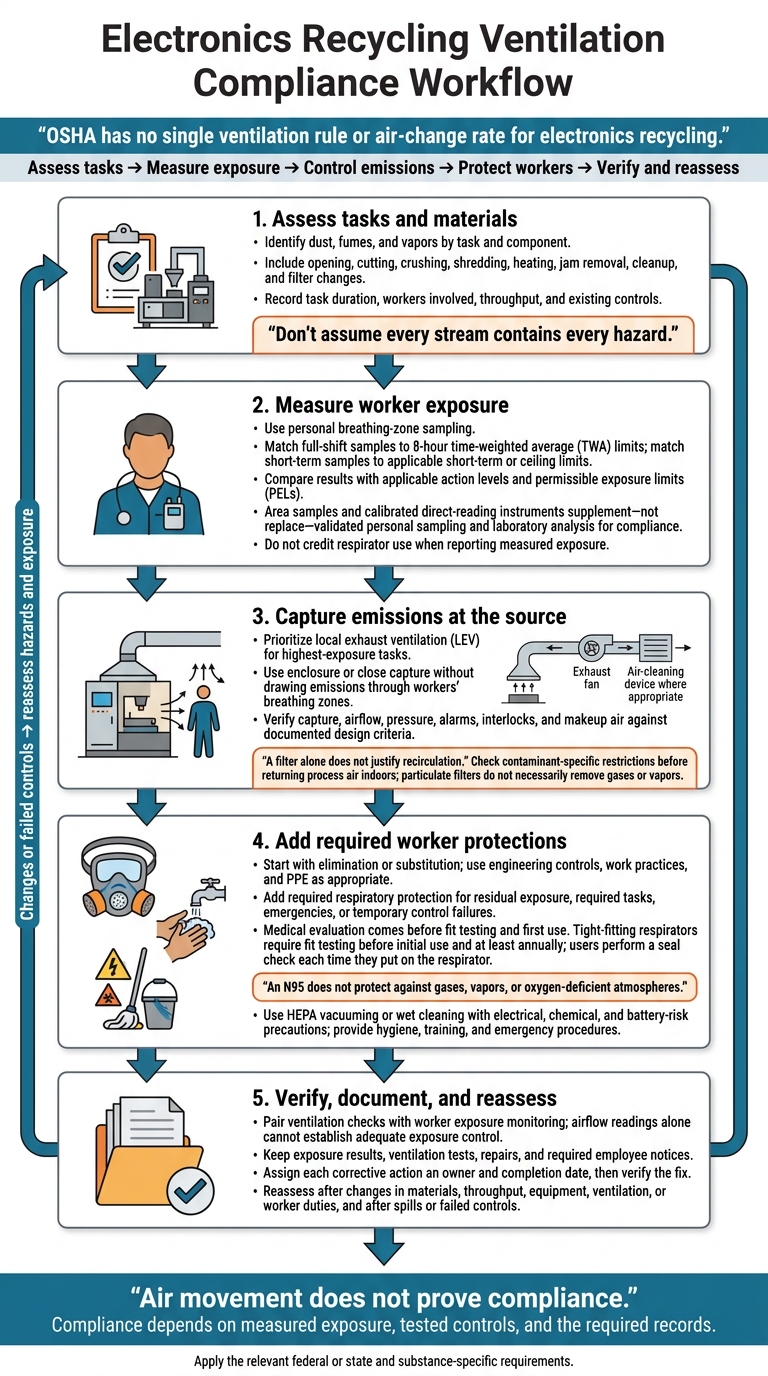
Electronics Recycling Ventilation Compliance Workflow
Airborne hazards and exposure monitoring
Contaminants released during processing
Assess what each task releases - not just what arrives. Receiving intact equipment generally creates less airborne contamination than opening, cutting, crushing, or shredding it. Dismantling can disturb internal dust, mechanical processing creates fine particles, and heating can produce fumes, vapors, and decomposition products. Document the highest-exposure tasks, their duration, the workers involved, throughput, and controls. Include jam removal, cleanup, and filter changes.
Match likely contaminants to the components being processed. Lead-containing dust may come from solder, cathode-ray-tube glass, painted components, or some batteries. Cadmium may come from certain batteries, pigments, coatings, and electronic components. Broken mercury-containing lamps, switches, and displays may release vapor or contaminated dust.
Processing boards and housings can also release metal and plastic dust. Damaged or overheated batteries can release particulates, corrosive mist, or decomposition products. Use component inventories, available Safety Data Sheets (SDSs), and laboratory analysis where needed. Don’t assume every stream contains every hazard. Use the task assessment to set exposure-monitoring priorities.
Worker exposure measurement
Use personal breathing-zone sampling to measure workers’ exposure, placing the sampler in the breathing zone. Match full-shift samples to 8-hour time-weighted average (TWA) limits and short-term samples to the applicable short-term or ceiling limits. When needed, sample high-emission tasks separately to check whether local exhaust and room ventilation control exposure.
Area samples help locate sources, evaluate ventilation, and compare locations. Appropriate, calibrated direct-reading instruments can identify changing concentrations, ventilation failures, leaks, or short-term peaks. But they supplement - not replace - validated personal sampling and laboratory analysis for compliance.
Compare results with applicable action levels as well as permissible exposure limits (PELs). Cadmium’s action level is 2.5 µg/m³ as an 8-hour TWA.[7][3] Do not credit respirator use when reporting measured exposure. Use the results to identify tasks that need stronger source control, set the next monitoring date, and track control performance.
Monitoring schedules and record updates
Once sampling identifies the main exposures, base follow-up monitoring on the applicable substance-specific rule and current results - not a fixed annual schedule. Federal cadmium monitoring is required at least every six months when exposure is at or above its action level.[7]
Reassess after changes in materials, throughput, equipment, ventilation, or worker duties, and after spills or failed controls. California lead monitoring may be discontinued only under the rule’s conditions, including two consecutive measurements at least seven days apart below the action level.[6]
Keep results with sampling methods, durations, workers represented, process conditions, and respiratory protection used. These records should document that ventilation and other controls were evaluated after changes in work or equipment.
California’s cadmium rule requires monitoring records to be kept for at least 30 years and written employee notification within 15 working days.[2] California’s lead rule requires written notification within five working days of the exposure assessment, plus corrective actions when exposure reaches or exceeds the PEL.[4] Provide employees and designated representatives access to applicable exposure records.[5]
Recycling & Reuse Operations - Potential Occupational Exposure Risks
Local exhaust ventilation and source controls
Use monitoring results to prioritize LEV for tasks with the highest exposures.
Capture emissions before they reach workers. Local exhaust ventilation (LEV) collects contaminants at the source, before they enter the breathing zone. A complete system usually includes a hood or enclosure, ductwork, an exhaust fan, and, where appropriate, an air-cleaning device.
Source controls by task and hazard
Match controls to the process, material, and likely contaminant. Enclose equipment when practical. If enclosure isn't feasible, place capture hoods close enough to collect emissions without drawing them through workers' breathing zones or nearby work areas. Separating production areas from offices, break rooms, and other clean spaces can also reduce contaminant migration, a key consideration when planning electronics recycling services.
These are task-based examples, not blanket requirements.
Task
Hazard
Control
Verification
Dust-collector or filter change-out
Accumulated lead, cadmium, or other hazardous dust
Sealed change-out, enclosure or negative-pressure containment, and HEPA or other suitable collection
High exposures during filter change-out: personal sampling during highest-risk steps; containment and cleanup checks
Soldering, heating, or thermal processing
Process fumes, metal fumes, and possible vapors
Close-capture hood, enclosed chamber, or dedicated exhaust
Task-based and full-shift sampling where warranted; hood airflow verification; substance-specific fume limits
Battery dismantling or damaged-battery handling
Dust, metal compounds, electrolyte mist, or irritating vapors
Isolation or enclosure, dedicated exhaust, filtration or treatment matched to the hazard, and emergency controls
Monitor based on battery chemistry and upset conditions, including spills; chemical and emergency requirements
Shredding, crushing, or sorting circuit boards
Metal-containing dust and other particulate
Enclosure or partial enclosure with LEV and dust collection; controlled cleanup access
Personal and area particulate or metal sampling; capture verification; lead/cadmium rule where applicable
Solvent or chemical cleaning
Organic or other chemical vapors
Closed containers, ventilated enclosure, local capture, and vapor-appropriate treatment
Chemical-specific sampling; treatment-media and breakthrough checks; Hazard Communication and chemical rules where applicable
Once source capture is in place, check whether the applicable rule allows treated air to return indoors.
Process-air recirculation limits
A filter alone does not justify recirculation. Particulate filters don't necessarily remove gases or vapors. Check the contaminant-specific standard before recirculating process air.
OSHA guidance calls for effective air cleaning, regular inspection and maintenance, performance monitoring, and fail-safe features, such as a fail-safe bypass or backup exhaust. California rules require that returned air not create harmful worker exposure. Position outdoor exhaust to minimize re-entry through doors, windows, or air intakes.
Ventilation testing and maintenance
Have a qualified ventilation professional document the design basis: hood placement, airflow targets, duct sizing, treatment method, makeup air, and exhaust location. During commissioning, check capture, airflow, pressure, alarms, and interlocks.
Adequate makeup air matters. Too little supply can weaken capture or cause backdrafting. Judge performance against the system's documented design criteria - not a generic air-change rate.
Inspect hoods, ducts, fans, seals, and filters. Replace treatment media before breakthrough, and verify performance after repairs. Pair these checks with worker exposure monitoring; airflow readings alone cannot establish adequate exposure control.
Record inspection dates, readings, defects, repairs, and follow-up checks. Keep inspection, repair, exposure, and required ventilation records under the applicable standard.
If LEV doesn't keep exposures below limits, add respirators and work-practice controls.
Worker protection beyond ventilation
When source capture falls short, add protections for hazards that ventilation cannot address. In electronics recycling, dust on hands, contaminated clothing, damaged batteries, and chemical handling can cause ingestion, skin contact, fires, and electrical injuries.
Start with elimination or substitution, then use engineering controls, work practices, and PPE. Ventilation does not prevent hand-to-mouth exposure, battery fires, or electrical hazards.
Respiratory protection requirements
Respirators add a layer of protection against airborne exposure that remains after other controls. Under 29 CFR 1910.134, substance-specific standards, and Cal/OSHA rules, use respirators when engineering controls cannot keep exposure below limits, for tasks that require them, or during emergencies.
Choose the respirator based on the contaminant, concentration, oxygen level, and task - not whether dust is visible. An N95 does not protect against gases, vapors, or oxygen-deficient atmospheres.
Maintain a written program that covers a designated administrator, respirator selection, medical evaluations, fit testing, training, inspection, cleaning, storage, and cartridge-change procedures. Review the program periodically and provide required protection at no cost to workers.
Medical evaluation comes before fit testing and first use. Tight-fitting respirators require fit testing before initial use, at least annually, after facepiece changes, and whenever physical changes could affect the fit. Users must perform a seal check each time they put on the respirator. Facial hair must not interfere with the seal.
Train users on hazards, respirator limits, donning, seal checks, emergencies, care, and equipment problems.
Workers who voluntarily use filtering-facepiece respirators must receive Appendix D information. Voluntary use of any other respirator also requires medical suitability, cleaning, storage, and maintenance under the applicable written-program provisions. Confirm that voluntary use adds no hazard.
Housekeeping, hygiene, and worker training
Use HEPA vacuuming or wet cleaning. Avoid dry sweeping, brushing, and compressed-air cleaning that spread hazardous dust, and follow any stricter substance-specific restrictions. Before wet cleaning, make equipment electrically safe and assess chemical and battery-reaction risks.
Restrict access to contaminated areas, provide handwashing, and keep food and drinks out. Contaminated clothing and footwear must stay out of clean spaces. Cleaning records should identify the area, method, date, person who cleaned it, and corrective action.
Train workers on labels, safety data sheets, inhalation, skin and eye contact, hand-to-mouth ingestion, puncture injuries, protective measures, PPE limits, and spill and emergency procedures. Update training whenever hazards, tasks, or procedures change.
Report and evaluate coughing, headache, dizziness, nausea, or breathing difficulty. Symptoms do not replace exposure monitoring.
Control methods and their limits
Match each control to the hazard, and keep the documentation needed to check that it works.
Control type | Appropriate use | Limitations | Verification |
|---|---|---|---|
Engineering controls | Enclosures, isolation, guards, closed systems, local exhaust | Poor capture, leaks, blocked ducts, inadequate maintenance, bypassed guards, unexpected releases | Hazard assessment, design specs, commissioning, airflow tests, maintenance, corrective actions |
Administrative and work-practice controls | Restricted access, procedures, scheduling, labeling, training, safe battery handling, spill response, controlled cleaning | Dependence on worker behavior; insufficient protection for high or variable exposures | Procedures, training records, access logs, inspections, exposure results, incident reports, periodic review |
Respiratory protection | Residual exposure, required tasks, emergencies, temporary control failures; atmosphere-specific protection for unknown concentrations | Leakage, communication barriers, heat burden, selection or fit failures; no protection for other body areas; no replacement for feasible engineering controls | Written program, medical evaluations, fit tests, training, inspection and cleaning records, cartridge-change schedule, periodic program evaluation |
Conclusion: Reviewing ventilation compliance
Air movement does not prove compliance. Judge compliance using hazard assessments, exposure data, verified controls, and required records. Use this checklist to check that those controls are in place.
Ventilation compliance checklist
Verify hazards: Review the hazard assessment for lead, cadmium, battery chemicals, and other hazards from incoming materials. Match each task to the applicable standard.
Verify controls: Review exposure data and LEV tests to confirm source capture. Check that workroom air stays separate from offices and break rooms where appropriate. Assess whether recirculated air could carry contaminants into occupied spaces.
Verify records: Document LEV tests, exposure results, maintenance, and recirculation controls. California requires testing after installation, alteration, and maintenance, and at least annually. Keep test records for five years.[8] Keep training, housekeeping, and respirator records on file. Give each corrective action an owner and completion date, then verify the fix. Reassess exposure when materials, processes, or controls change.
Handling details for Rica Recycling customers
Before pickup or drop-off intake at Rica Recycling, disclose swollen or punctured batteries, broken screens, and mercury-containing devices. Request handling instructions before service.
Service claims do not prove workplace ventilation compliance. Request ventilation and exposure documentation before accepting compliance claims.
FAQs
Which OSHA rules apply to my recycling facility?
OSHA doesn’t have a single “e-waste recycling” ventilation standard. Depending on the work, applicable rules may include Hazard Communication (29 CFR 1910.1200), PPE (29 CFR 1910 Subpart I), respiratory protection when exposure levels require it, and lockout/tagout (29 CFR 1910.147) to control hazardous energy.
HAZWOPER applies if workers could respond to hazardous substance releases. In California, Cal/OSHA may impose stricter requirements alongside these federal rules. [1]
Who should test my facility’s ventilation?
Qualified professionals should test your facility’s ventilation as part of preventive health monitoring and exposure monitoring. This includes sampling the air near shredders and dismantling lines to check that local exhaust ventilation (LEV) systems are working properly.
These tests help spot problems early and guide adjustments when ventilation isn’t collecting dust and fumes at the source.
What should I do if exposure exceeds OSHA limits?
Act now to protect workers and meet OSHA requirements. Adjust work tasks to prevent further overexposure, strengthen engineering controls such as local exhaust ventilation, and make sure workers consistently use appropriate personal protective equipment.
Set up medical surveillance, including baseline and periodic blood tests for substances such as lead, mercury, and cadmium. Continue monitoring exposure and use written hazard assessments to spot and address problems before they cause serious health issues.