
R2v3 vs. ISO: Comparing Recycling Standards
If you hire an electronics recycler in the U.S., I’d put it this way: R2v3 covers the electronics work itself, while ISO covers the system used to run that work.
Here’s the short answer:
R2v3 is for electronics recycling and ITAD
ISO 9001 covers quality and process control
ISO 14001 covers impact, waste, and compliance systems
ISO 45001 covers worker health and safety systems
R2v3 goes deeper on data security, focus materials, and downstream tracking
ISO goes deeper on audits, corrective action, and management review
If you’re choosing a vendor, I’d check these points first:
Can they track devices by serial number?
Do they follow NIST SP 800-88 for data sanitization?
Can they show downstream records to final disposition?
Do they have ISO-certified systems for quality, waste, and worker safety?
Quick Comparison
Standard | What it does | Best use |
|---|---|---|
R2v3 | Sets rules for e-waste, data destruction, reuse, and downstream due diligence | Picking an electronics recycler or ITAD provider |
ISO 9001 | Sets a quality management system | Keeping intake, grading, and records consistent |
ISO 14001 | Sets a management system for waste and compliance duties | Managing site impacts and waste controls |
ISO 45001 | Sets a worker safety management system | Managing job hazards, training, and incident response |
My takeaway is simple: if you handle computers, servers, laptops, or storage devices, R2v3 should come first. ISO still matters, but it does a different job. It helps show that the recycler runs documented processes, audits them, and fixes problems when they come up.
That’s the core difference this article explains.
What R2v3 Covers in Recycling Operations
R2v3 is built for electronics recycling and ITAD. It covers the full chain: intake, reuse, refurbishment, recovery, and disposal of electronics. And it sets clear controls for each step.
In day-to-day work, that means facilities can't just jump to shredding or materials recovery. R2v3 puts reuse first. Teams need to check whether a device or component can be reused or refurbished before moving to destruction.
E-Waste Handling Controls and Downstream Accountability
R2v3 defines Focus Materials (FMs), including batteries, circuit boards, CRT glass, mercury-containing devices, and PCBs.[2][11] These material streams need to be separated, tracked, and managed with downstream controls.
That doesn't stop at the loading dock. If a facility sends material to another vendor, it has to qualify that downstream partner first. The vendor must be checked for legal, environmental, and data-security compliance before any transfer takes place. Facilities also need records that show both vendor qualification and material traceability.
Data Security and Documentation Requirements
R2v3 also requires a written data security program. That program covers intake, physical control, sanitization, and disposition records for every data-bearing device.
Sanitization should line up with NIST SP 800-88, which uses the Clear, Purge, and Destroy framework based on device type and reuse potential.[3][4][7] In plain English, reuse drives may be purged, while media that can't be recovered is destroyed.
Documentation matters here too. Facilities record:
Serial numbers
The method used
The technician
The date
Verification results
After that, they issue a Certificate of Destruction or Sanitization.[5][6][8][9]
These data controls work hand in hand with physical handling and worker protection.
Worker Safety and Environmental Controls Under R2v3
R2v3 Core Requirement 3 deals with the environmental, health, and safety hazards tied to dismantling electronics.[1][10] Electronics can contain some nasty stuff. Lead is found in batteries, printed circuit boards, power cords, and CRTs. Cadmium can show up in batteries, pigments, plastics, coatings, and CRT phosphors. Mercury is present in fluorescent lights and some flat-panel displays.[1]
If those risks aren't controlled, workers can pay the price. Electronics recycling workers may face lead dust exposures above OSHA's permissible exposure limit of 50 µg/m³.[10]
R2v3 requires hazard identification, monitoring, storage controls, incident response, training, and corrective actions. For example, damaged lithium-ion batteries should be stored separately in clearly labeled, fire-safe containment.
That level of detail is where ISO adds more structure, documentation, and repeatability.
What ISO Standards Add to Recycling Process Quality
ISO builds the documented system around day-to-day recycling work: procedures, checks, audits, corrective actions, and management review. That system wraps around the operational controls covered by R2v3.
Put simply, R2v3 tells you what to control in electronics recycling. ISO standards help you build a repeatable system to control it the same way day after day, across teams and shifts.
ISO 9001 for Intake, Grading, and Process Control
ISO 9001 is a quality management standard used across industries worldwide. In recycling, its main value is repeatability. It asks organizations to document workflows, define responsibilities, and check whether those steps are working.
For an electronics recycler or ITAD provider, that shows up at every stage. Intake procedures are written down and followed the same way each time. Grading criteria - whether a device goes to reuse, refurbishment, parts recovery, or scrap - are defined so different technicians can reach the same conclusion on the same device. Data destruction verification steps are recorded, not left to assumption.
When something goes wrong, ISO 9001 requires a structured response. A mislabeled serial number, a skipped test step, or a documentation gap gets logged as a nonconformance. The team then investigates the root cause, puts a corrective action in place, and checks that it solved the problem.
ISO 9001 also extends to downstream partners. Recyclers need criteria for selecting and evaluating vendors, including smelters, transport firms, and downstream processors. They also need records of those evaluations. That adds a documented, audited process for how partners are chosen and monitored, which works alongside R2v3's downstream accountability requirements.
ISO 14001 and ISO 45001 for Environmental and Worker Protection
ISO 14001 structures how a facility identifies and manages its key environmental risks and obligations. For an electronics recycler, that means mapping risks such as air emissions from shredders, hazardous waste from batteries or CRTs, energy use in testing labs, and the chance of soil or water contamination from storage areas. From there, the facility sets measurable objectives around those issues. It may track its reuse rate, monitor landfill diversion, or document compliance with state hazardous waste rules.
ISO 45001 does the same kind of work for worker safety. It requires formal hazard identification for disassembly lines, warehouse storage, forklift operations, and materials processing. Then it builds risk controls, training, incident investigation, and corrective action around those hazards.
Where ISO 14001 and ISO 45001 go past R2v3 is the management-system layer. They require formal planning cycles, documented objectives, internal audits, and leadership reviews that support continual improvement instead of one-time compliance. That gap becomes clearer in the next section, where scope and audit expectations are compared directly.
R2v3 vs. ISO: Scope, Quality Control, and Audit Differences
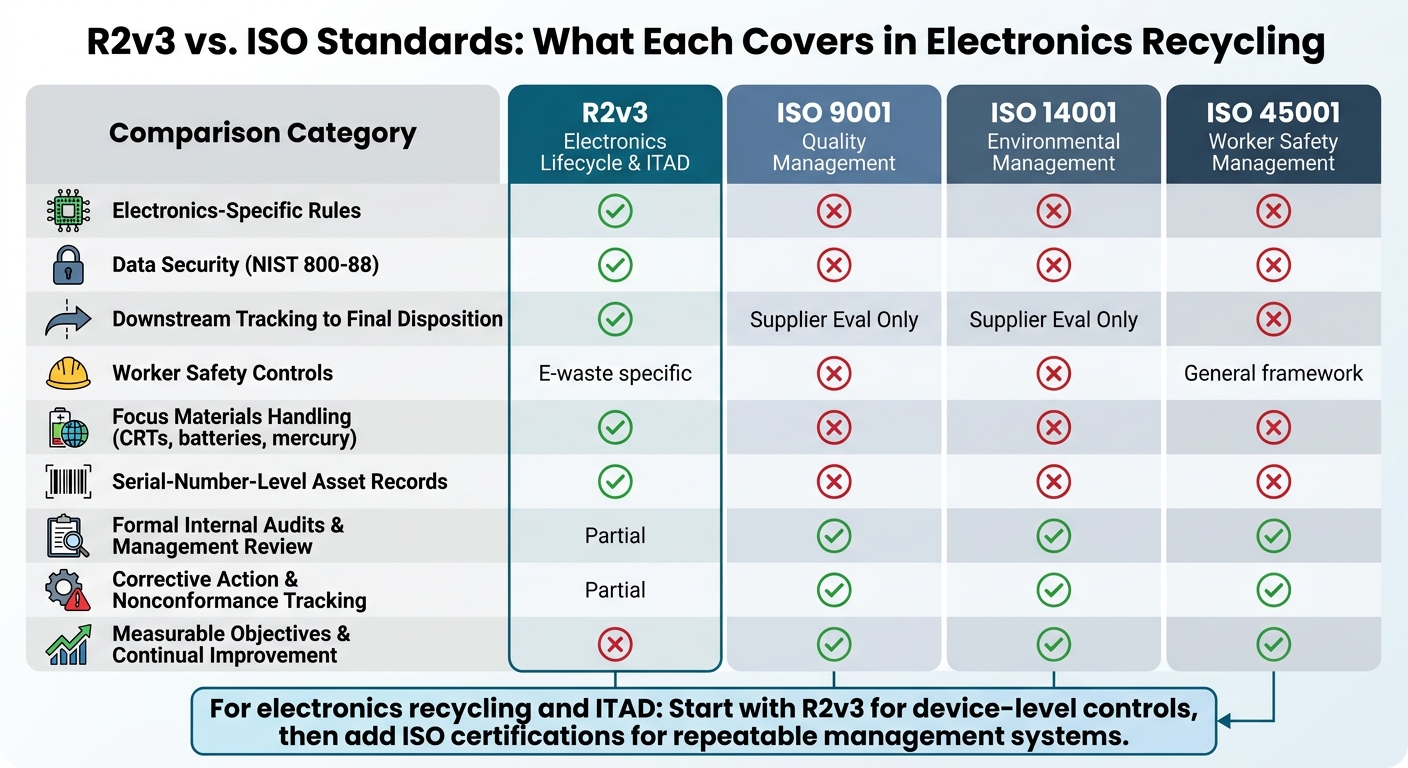
R2v3 vs. ISO Standards: Electronics Recycling Certification Comparison
The main difference comes down to scope: R2v3 sets controls built for electronics, while ISO standards set up the management systems that help teams apply those controls in a steady way. You see the split most clearly when you line up scope, recordkeeping, and audit depth side by side.
The table below shows where the standards overlap - and where R2v3 goes further.
Category | R2v3 | ISO 9001 | ISO 14001 | ISO 45001 |
|---|---|---|---|---|
Primary scope | Electronics lifecycle, from intake to final recovery | Quality management across any industry | Environmental management across any industry | Worker health and safety across any industry |
Electronics-specific rules | Yes - focus materials, reuse criteria, export controls | No | No | No |
Data security requirements | Yes - NIST 800-88 aligned, serial-number-level logs | No | No | No |
Downstream tracking | Yes - to final disposition for all R2 Controlled Streams | Supplier evaluation | Supplier evaluation | Not addressed |
Worker safety | Yes - tied to e-waste-specific hazards | Not addressed | Not addressed | Yes - general safety framework |
Documentation focus | Asset-level traceability, destruction records, downstream audits | Process consistency, nonconformance records | Environmental aspects, compliance obligations | Hazard assessments, incident logs |
Where R2v3 Is More Specific Than ISO
R2v3 spells out duties that ISO certifications simply do not cover. Focus Materials - such as CRTs, mercury lamps, batteries, and lead-containing components - need clear identification and handling controls. ISO 9001, ISO 14001, and ISO 45001 do not set those electronics-only rules.
The same pattern shows up in data destruction. R2v3 requires serial-number-level sanitization or destruction records aligned with NIST 800-88. ISO 9001, by contrast, asks for a documented process, but not that level of item-by-item proof.
Downstream tracking is another big gap. Under R2v3, recyclers must check vendors in the downstream chain and document material flows through to final disposition. ISO standards call for general supplier evaluation, but they do not require material-level traceability.
Where ISO Strengthens Management Systems Across Operations
ISO brings in the management structure that R2v3 does not fully spell out by itself. ISO 9001 pushes organizations to set measurable quality objectives, track customer requirements, log nonconformances, and run formal corrective action processes across all operations.
ISO 14001 and ISO 45001 add formal internal audit programs and management review cycles. That creates recurring accountability across intake, grading, storage, and vendor review, instead of relying only on one-time compliance.
Those differences shape which framework matters most for a given organization.
How to Choose the Right Framework for Your Organization
R2v3 deals with electronics-specific risk. ISO adds process discipline. A practical way to look at it is simple: use R2v3 for electronics-specific controls, then add ISO when you need repeatable management systems.
When to Prioritize R2v3 for Businesses, Schools, and Nonprofits
If your organization is disposing of computers, laptops, servers, or storage devices, put R2v3 first. That applies across the Bay Area. A school district retiring classroom Chromebooks, a nonprofit updating donated equipment, and a company shutting down a server room all run into the same issue: Can the recycler document each device's chain of custody?
R2v3 speaks to that issue more directly than ISO certifications alone.
ISO makes more sense as the next layer when your program needs repeatable workflows, corrective actions, and internal audits. If you want formal intake procedures, nonconformance tracking, and structured management reviews, adding ISO 9001, ISO 14001, or ISO 45001 on top of R2v3 is a smart move.
How Rica Recycling Fits This Decision Process
For Bay Area organizations, the right provider should be able to document chain of custody, data destruction, and downstream handling. Rica Recycling offers pickup and drop-off options for computers, laptops, servers, and other electronics, along with data destruction certificates.
Rica Recycling complies with California e-waste regulations and operates under a landfill-free policy.
FAQs
Do I need both R2v3 and ISO certifications?
Not necessarily. R2v3 and ISO do different jobs.
R2v3 focuses on e-waste handling, with attention to both data security and environmental responsibility. ISO standards, such as ISO 14001, set a broader management framework.
Some organizations keep both to show they take specialized e-waste practices and general management systems seriously. But the right fit comes down to your compliance goals and the level of oversight you need.
Is ISO enough for electronics recycling?
Not on its own. Standards like ISO 14001 deal with environmental management systems, not the full set of demands tied to electronics recycling.
It helps with hazardous materials and e-waste handling, but it doesn’t cover secure data destruction or downstream vendor accountability. If you want tighter oversight, certifications like R2v3 or e-Stewards are also needed.
How can I verify a recycler’s chain of custody?
Request documentation that tracks each asset from collection to final disposition. Review records like serial numbers, condition assessments, and certificates of data destruction.
Also check certifications such as R2v3 or e-Stewards with the certifying organization. On top of that, look for regular independent third-party audits and a clear audit trail for each device.