
Server Recycling: Energy-Efficient Hardware
Data centers retire thousands of servers and hardware annually, generating millions of tons of e-waste. Most of this waste ends up in landfills, releasing harmful toxins and wasting valuable materials. Energy-efficient recycling offers a smarter solution by focusing on secure data erasure, component reuse, and material recovery.
Key Takeaways:
- E-Waste Problem: The U.S. generates 6.9 million tons of e-waste annually, but only 17.4% is recycled.
- Energy Savings: Recycling aluminum uses 95% less energy, while steel recycling saves 70%.
- Carbon Emissions: Cloud computing accounts for 3% of global energy use, with emissions projected to hit 20% by 2030.
- Cost Savings: Decommissioning one server can save up to $2,500 annually in energy, licenses, and maintenance.
- Recycling Process: Steps include secure data destruction, disassembly, and material sorting.
Energy-efficient recycling not only reduces waste but also cuts costs and emissions, making it a practical choice for businesses and the environment.
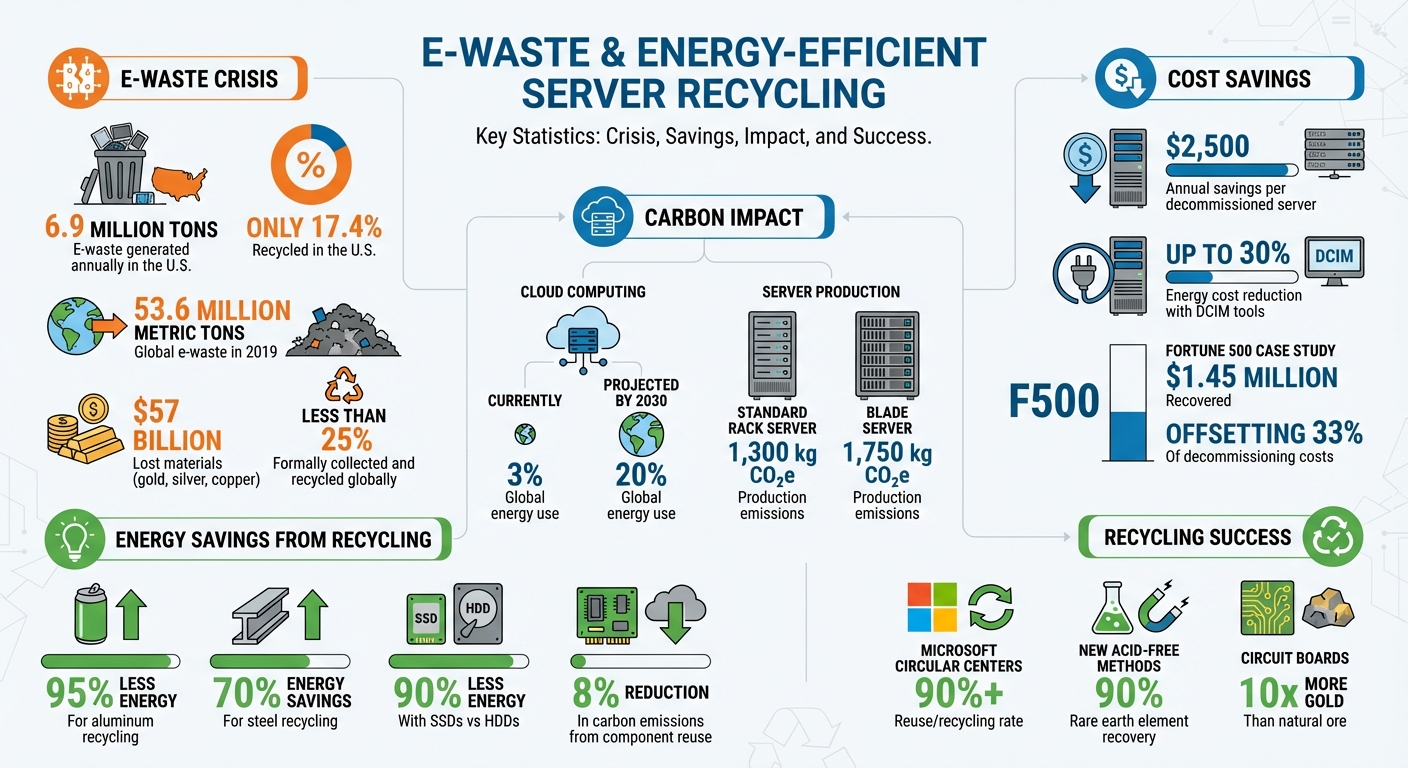
E-Waste and Energy-Efficient Server Recycling Statistics
Why Data Centers Need Energy-Efficient Recycling
The Environmental Cost of E-Waste
When data center hardware gets discarded, it doesn't just vanish - it leaves behind a toxic trail. Materials like lead, mercury, cadmium, and chromium seep into the soil and groundwater, posing serious risks to ecosystems and human health. These pollutants don't stay put; they travel through water systems, spreading harm far beyond their origin.
Take mercury poisoning, for example. It disrupts marine ecosystems, reduces bird populations, and even damages plant cells, which can accelerate deforestation. In 2019 alone, the world generated 53.6 million metric tons of e-waste, resulting in an estimated $57 billion in lost materials like gold, silver, and copper. To put it into perspective, circuit boards can hold gold concentrations up to 10 times higher than what’s typically found in natural ore.
But it’s not just about the materials - it’s about the energy. Manufacturing servers and other hardware requires significant energy. When these items are improperly discarded instead of recycled, manufacturers have to mine and refine new raw materials, which consumes even more energy. This cycle of waste and inefficiency piles onto the already substantial environmental impact of data centers.
How Data Centers Contribute to E-Waste
The rapid pace of hardware upgrades in data centers only makes the problem worse. Across the U.S., over 3,000 data centers - including roughly 500 hyperscale facilities - are constantly cycling through equipment. In 2020, 42% of organizations reported replacing their servers every two to three years. Such frequent refreshes generate a steady stream of discarded hardware.
The issue doesn’t end with disposal. Many data centers fail to decommission equipment responsibly, adding to their carbon footprint. Without proper recycling, valuable components like memory modules and power supplies are wasted. And globally, the numbers are staggering: over 60 million metric tons of e-waste are produced annually, yet less than 25% is formally collected and recycled through regulated systems.
Thankfully, advancements in recycling technology offer a glimmer of hope. New methods, such as acid-free dissolution, can recover up to 90% of rare earth elements from items like decommissioned hard drives. Companies like Microsoft are setting an example with their "Circular Centers", achieving reuse and recycling rates of over 90% for server components by focusing on refurbishment and harvesting parts. These energy-efficient recycling initiatives are essential to mitigating the environmental damage caused by data centers.
sbb-itb-855056e
Data Center Sustainability & Decommisioning The Ugly Truth
Key Steps in Energy-Efficient Server and Hardware Recycling
Recycling servers and hardware efficiently involves a structured process that prioritizes data security and reduces environmental harm. The first step is conducting a detailed IT asset inventory. This helps establish a clear chain of custody, ensuring accountability at every stage. This inventory also sets the groundwork for secure data destruction and effective material sorting.
Secure Data Destruction
Before recycling can begin, data must be thoroughly erased - deleting files alone isn’t enough. Standard deletion only marks storage space as available without actually removing the data. Professional data sanitization uses certified software to overwrite storage media multiple times, making recovery impossible. Organizations should adhere to NIST SP 800-88 standards, which recommend methods such as cryptographic erasure or single-pass overwriting for secure data destruction.
The stakes couldn’t be higher. Servers often store sensitive information, and improper disposal could lead to data breaches, legal consequences, and damage to reputations. To avoid this, back up any necessary data first, then use certified tools to ensure complete sanitization. Verification after erasure is critical, especially for encrypted drives, which may still be vulnerable to decryption over time. Partnering with facilities certified under R2 (Responsible Recycling) or e-Stewards standards ensures compliance with both environmental and data protection guidelines.
Once data is irretrievable, the focus shifts to dismantling the hardware for reuse and material recovery.
Disassembly and Material Sorting
After data destruction, the next step is disassembling the hardware to separate and repurpose its components. Servers are powered down and dismantled following anti-static protocols to protect reusable parts. Key components like CPUs, RAM modules, motherboards, SSDs, and power supplies are identified, removed, and categorized. The aim isn’t to destroy everything but to salvage functional parts that can be refurbished or resold, extending their usefulness and conserving the energy originally invested in their production.
"Very frequently, if one component goes bad or is not efficient, the entire server goes waste." - Ashkitha Sriraman, Computer Science Professor, Carnegie Mellon University
Next, materials are sorted into distinct categories: precious metals such as gold and silver, base metals like copper and aluminum, plastics from casings and internal components, and hazardous elements including lead, mercury, and cadmium. Each material type requires specialized processing. Sorted materials are then ground, smelted, or otherwise treated to re-enter the manufacturing cycle. This process uses far less energy than sourcing raw materials. Despite its advantages, only 22.3% of the 62 billion kilograms of electronic waste generated globally in 2022 was formally collected and recycled.
Energy-Saving Techniques in Hardware Recycling
When servers and other hardware reach the end of their service life, the way they’re processed can have a big impact on energy consumption. Two key strategies stand out: refurbishment and reuse, which extend the life of equipment, and material recovery, which retrieves valuable metals, requiring far less energy than mining new resources.
Refurbishment and Reuse
Refurbishing hardware is one of the most effective ways to reduce energy use. A server’s embodied energy - the energy consumed during manufacturing - makes refurbishment a smart choice. For instance, the GreenSKUs project showed that using salvaged RAM modules and SSDs in Azure cloud servers led to an 8% reduction in combined embodied and operational carbon emissions.
Modular server designs make refurbishment even easier. Instead of scrapping an entire server when one part fails, components like RAM or SSDs can be swapped out. Emerging technologies, such as Compute Express Link (CXL) controllers, allow newer processors to work with older memory systems, simplifying upgrades. Additionally, servers that are no longer cutting-edge can still be repurposed for lighter tasks, like file storage or acting as network firewalls. By doing so, businesses can delay the need for energy-intensive recycling.
However, when extending the life of hardware is no longer an option, attention turns to recovering valuable materials.
Material Recovery and Recycling
Material recovery complements refurbishment by capturing energy savings through the reuse of metals. When refurbishment isn’t viable, metals like gold, silver, palladium, copper, and aluminum can be extracted from old servers. Recycling these materials uses much less energy than mining and refining new ones. Yet, despite its benefits, less than 20% of IT waste is recycled globally, presenting both environmental and economic challenges.
The manufacturing phase of IT equipment is a significant source of emissions. For example, producing a standard rack server generates about 1,300 kg of CO₂e, while a blade server can generate roughly 1,750 kg of CO₂e. Material recovery helps offset these emissions by reducing the demand for new production. Additionally, transitioning from traditional HDDs to SSDs improves energy efficiency - SSDs use up to 90% less energy and avoid hazardous materials like lead and mercury.
To ensure proper recycling, businesses can work with certified ITAD providers that hold e-Stewards or NAID AAA certifications. These certifications guarantee strict environmental and data security practices, along with a commitment to 100% landfill-free disposal.
Benefits of Energy-Efficient Recycling for Organizations
By incorporating energy-efficient recycling methods, organizations can achieve both financial savings and a reduced environmental impact. When paired with well-implemented recycling processes, these practices not only lower costs but also align with sustainability goals.
Cost and Energy Savings
Decommissioning a single server can save an organization approximately $2,500 annually in energy, licensing, and maintenance costs. For companies managing hundreds or even thousands of servers, these savings quickly add up.
Tools like Data Center Infrastructure Management (DCIM) play a key role in identifying underused or outdated equipment. DCIM provides insights into server utilization and energy efficiency, enabling organizations to cut energy costs by up to 30%. These audits often uncover "zombie" servers - machines that consume electricity without delivering meaningful output. By consolidating or decommissioning these servers, companies can significantly reduce energy consumption and prepare the hardware for recycling or refurbishment.
Refurbishment and asset recovery offer additional financial advantages. Instead of discarding old equipment, organizations can resell functional parts or partner with certified recyclers who pay for recoverable materials. These strategies not only save money but also lessen the need for new equipment purchases, further reducing costs and waste.
Carbon Footprint Reduction
Recycling and reusing hardware components tackle the significant emissions generated during the manufacturing process - emissions that occur even before a server is operational. Studies show that reusing components like RAM and SSDs in cloud servers can cut combined embodied and operational carbon emissions by 8% without sacrificing performance.
On a global scale, adopting hardware reuse practices could lower carbon emissions by 0.1% to 0.2% - a reduction comparable to the emissions from all smartphone usage in the United States. With cloud computing projected to account for 20% of global emissions by 2030, energy-efficient recycling is becoming a critical strategy for organizations striving to meet environmental goals and comply with regulatory standards.
Rica Recycling's Approach to Energy-Efficient IT Asset Management
Rica Recycling provides certified IT disposal services to the San Francisco Bay Area, combining environmental responsibility with strict data security measures. Operating out of Hayward, CA, their facility focuses on maximizing resource recovery while minimizing environmental harm. By adopting energy-efficient recycling methods, the company ensures secure data handling alongside sustainable recovery processes.
100% Landfill-Free Recycling
Rica Recycling operates under a 100% landfill-free policy, ensuring that every piece of hardware - whether it’s servers, computers, monitors, or cables - is processed responsibly. Instead of contributing to landfill waste, these items are handled through environmentally sound channels, preventing harmful materials from contaminating ecosystems.
The company’s mission underscores this commitment: "To encourage the world to raise their standards of reduction, recycling, and reuse through providing economic and efficient ways for individuals and companies to safely and responsibly recycle electronics".
For businesses managing significant amounts of outdated equipment, Rica Recycling offers quick and convenient pickup services tailored to offices and commercial spaces. This service also helps businesses stay compliant with California's stringent e-waste regulations.
Secure IT Asset Recovery
Rica Recycling’s IT Asset Recovery services take their commitment a step further by focusing on both security and value recovery. Before any hardware is recycled, the company performs secure data wiping and provides Certificates of Data Destruction. These certificates ensure businesses meet compliance requirements while maintaining a clear audit trail.
This dual emphasis on data security and sustainability gives businesses peace of mind when decommissioning IT assets. Sensitive data remains protected, while functional components are evaluated for potential reuse or resale. By recovering value from retired equipment, Rica Recycling reduces reliance on energy-heavy manufacturing processes. Extending the lifecycle of IT equipment through refurbishment supports a circular economy, cutting down the demand for new device production and conserving resources.
Conclusion
Recycling servers and hardware with energy efficiency in mind has become a crucial part of corporate sustainability efforts and regulatory compliance. The numbers tell a stark story: in 2019, only 17.4% of the 53.6 million metric tons of global e-waste was recycled. Companies that fail to prioritize proper recycling not only harm the planet but also miss out on billions of dollars' worth of recoverable resources every year.
The financial incentives are hard to ignore. Take the example of a Fortune 500 company, which decommissioned a 5,000-square-foot data center in 2025. Through asset recovery, they recouped $1.45 million, offsetting 33% of their total decommissioning costs. This case highlights how energy-efficient recycling can deliver real financial returns while protecting the environment. By focusing on refurbishment, companies can recover value while reducing ecological damage.
"E-waste is just as serious a scourge as carbon when it comes to harming the environment." - Christopher Tozzi, Technology Analyst
Adopting such forward-looking practices is a step toward a more sustainable future. Companies should evaluate hardware performance regularly to extend its lifecycle, saving both money and resources. When recycling is unavoidable, working with certified providers ensures data security and compliance with environmental standards.
In the San Francisco Bay Area, Rica Recycling sets an example with its secure, 100% landfill-free IT asset recovery services. Their approach showcases how sustainability and data protection can go hand in hand, proving that responsible IT asset management benefits businesses of all sizes.
FAQs
How do I securely erase data before recycling servers?
To safely erase data before recycling servers, it's essential to follow the NIST 800-88 standards for data sanitization. These guidelines outline three key methods:
- Destroy: Physically destroy the device, especially when handling highly sensitive data.
- Purge: Employ techniques like cryptographic erasure to eliminate data before releasing the device.
- Clear: Overwrite data, suitable for non-sensitive information.
Always verify and document the entire process to ensure compliance and maintain data security. If needed, certified providers can help with secure destruction and proper documentation.
What server parts are worth reusing or reselling?
Server components such as memory modules, storage drives, network interface cards, and power supplies often hold considerable resale or reuse potential. When refurbished to a condition that closely matches their original performance, these parts can maintain much of their value. This makes them a smart choice for extending the life of hardware while also helping to cut down on electronic waste.
What certifications should an e-waste recycler have?
When choosing an e-waste recycler, it's important to check for certifications like the EPA-recognized Responsible Recycling (R2) Standard and the e-Stewards® Standard. These certifications indicate that the recycler adheres to strict protocols for environmental protection, health, and data security. Always take the time to confirm a recycler’s compliance to guarantee your e-waste is handled responsibly and securely.