
Study: Lithium-Ion Battery Chemicals in E-Waste
Lithium-ion batteries power our devices and vehicles but come with serious risks when improperly discarded. Fires, soil contamination, and toxic emissions are just some of the dangers tied to mishandling these batteries. Recycling rates remain low - only 2% to 47% globally - despite their growing presence in e-waste.
Key takeaways:
- Lithium-ion batteries contain critical materials like lithium, cobalt, and nickel, which can pollute soil and water when discarded.
- Fires caused by damaged batteries release harmful gases (e.g., hydrogen fluoride) and heavy metals into the environment.
- New recycling methods, such as hydrometallurgy and bioleaching, recover over 90% of valuable materials while reducing energy use and emissions.
- California leads with strict e-waste laws, requiring certified recycling and safe disposal practices.
Recycling lithium-ion batteries isn’t just about waste management - it’s about mitigating risks and reclaiming resources.
Chemical Makeup of Lithium-Ion Batteries and Their Risks
Primary Battery Chemicals
Lithium-ion batteries are built with a sophisticated combination of metals and chemicals, designed to store and release energy efficiently. The cathode, or positive electrode, plays a key role in determining the battery's energy capacity. Common cathode materials include Lithium Cobalt Oxide (LCO), which contains about 60.2% cobalt by weight, and Nickel Manganese Cobalt (NMC), with high-performance types like NMC811 containing up to 48.3% nickel. Another option, Lithium Iron Phosphate (LFP), uses iron and phosphorus, offering improved safety but with lower energy density.
The anode, or negative electrode, is typically made of graphite coated onto copper foil. Aluminum foil is used as the cathode's current collector, while copper serves the same role for the anode. Between these electrodes lies a polymer separator, soaked in an electrolyte made of fluorinated salts dissolved in organic solvents. This setup enables lithium ions to move during charging and discharging cycles.
Key materials like lithium, cobalt, nickel, and manganese are considered critical due to their high economic importance and supply chain challenges. Aluminum and copper, which together make up about 25% of an EV battery pack's weight, are also integral. However, when batteries are improperly discarded, this valuable mix becomes a source of environmental and safety hazards, highlighting the need for professional electronics recycling services.
Environmental Dangers of Improper Disposal
The chemical complexity of lithium-ion batteries makes their improper disposal a serious environmental concern. When these batteries end up in landfills or are mishandled, their components can seep into the soil and water, causing widespread contamination. Heavy metals like copper, cobalt, and nickel can disrupt soil stability on a microscopic level, altering the electrostatic interactions that maintain its structure.
Research shows that contamination from these metals can significantly affect soil properties:
- Copper reduces soil shear strength by 34% and increases permeability by 84%.
- Nickel lowers shear strength by 27% and raises permeability by 68%.
- Cobalt decreases shear strength by 11% and boosts permeability by 46%.
These changes not only accelerate the spread of pollutants but can also destabilize the ground, affecting infrastructure and ecosystems in the area.
"Spent LIBs are considered hazardous wastes (especially those from EVs) due to the potential environmental and human health risks associated with heavy metals." - Sustainable Environment Research
The risks extend beyond soil contamination. For instance, a fire in January 2025 at the Vistra Corporation Battery Energy Storage System in Moss Landing, California, caused extensive environmental damage. This facility, the largest of its kind at the time, lost 75% of its capacity in the fire. Nickel, manganese, and cobalt from the batteries were deposited across the nearby Hester Marsh wetlands, part of the Elkhorn Slough National Estuarine Research Reserve. Soil tests showed nickel levels increasing tenfold and cobalt levels rising fivefold, with contamination detected nearly 2 miles away. The distinct 2:1 ratio of nickel to cobalt confirmed the presence of NMC cathode materials.
Leachate from discarded batteries acts as a carrier for hazardous substances, spreading them into groundwater and sensitive ecosystems like wetlands. This can lead to far-reaching damage. For example, soil with nickel concentrations exceeding 50 parts per million poses toxicity risks to plants and aquatic life.
sbb-itb-855056e
Lithium-Ion Battery Fires in Waste Streams
What Causes Fires in E-Waste
Lithium-ion battery fires in waste facilities are often the result of poor handling practices when these batteries reach the end of their life. Many discarded batteries still hold up to 100% of their charge, which can lead to thermal runaway if the battery is damaged. This residual energy becomes a serious hazard when batteries are improperly disposed of in regular waste streams instead of using professional electronics waste pick-up services.
Mechanical damage during processes like shredding, crushing, or compacting can puncture the internal separator, causing a short circuit and immediate ignition. For instance, in Toronto, waste facility fires increased by nearly 40% year-over-year as of 2025, with lithium-ion batteries identified as the primary cause.
As batteries age, they can develop defects such as dendrite formation, which significantly raises the risk of thermal runaway when exposed to heat or overcharging. This triggers rapid chemical reactions. In some instances, gases vented from the batteries form vapor clouds that don’t ignite right away but later explode with overpressures of 6 to 8 atmospheres. These incidents not only cause fires but also release harmful emissions into the environment.
Toxic Emissions and Their Environmental Effects
When lithium-ion batteries catch fire, they emit a mix of toxic gases and particles that threaten both human health and the environment. The smoke contains hydrogen fluoride (HF), carbon monoxide (CO), methane (CH4), nitrogen dioxide (NO2), sulfur dioxide (SO2), hydrogen chloride (HCl), and benzene. Among these, hydrogen fluoride is particularly dangerous - it’s highly corrosive and can cause severe harm through inhalation or skin contact.
These fires also release fine particulate matter (PM2.5 and PM10) that carries heavy metals like nickel, cobalt, manganese, and lithium. These particles can travel far; for example, after an e-bike battery fire, contamination was detected up to 330 feet away, with levels 34 times higher than the NIOSH working limit. Fluoride alone can account for 5% of the mass of smoke particles and soot.
Another concern is the release of PFAS (per- and polyfluoroalkyl substances), which are persistent chemicals that don’t naturally break down. Fires involving batteries can release between 10 to 60 micrograms of PFAS per kilogram of battery cells, with soot containing concentrations ranging from 20 to 130 nanograms per gram. PFAS exposure has been linked to health issues like reduced immune response, thyroid problems, and liver damage.
"The fire is one piece. The structure collapse is another. The biggest concern for me is the actual chemical release; identifying what's been exposed, cleaning it up, and mitigating that risk." - Randy Narine, CEO, Clean Core Research
The environmental impact doesn’t stop once the fire is out. Corrosive gases like hydrogen fluoride and hydrogen chloride can damage electrical systems for weeks after the incident. Additionally, water used to extinguish these fires often becomes contaminated with metals and PFAS, with levels reaching up to 4,700 nanograms per liter. This polluted runoff can infiltrate soil and groundwater, leading to long-term environmental harm far beyond the immediate fire site.
Lithium-ion Battery Hazards – Impact of State-of-Charge (SOC)
New Methods for Lithium-Ion Battery Recycling
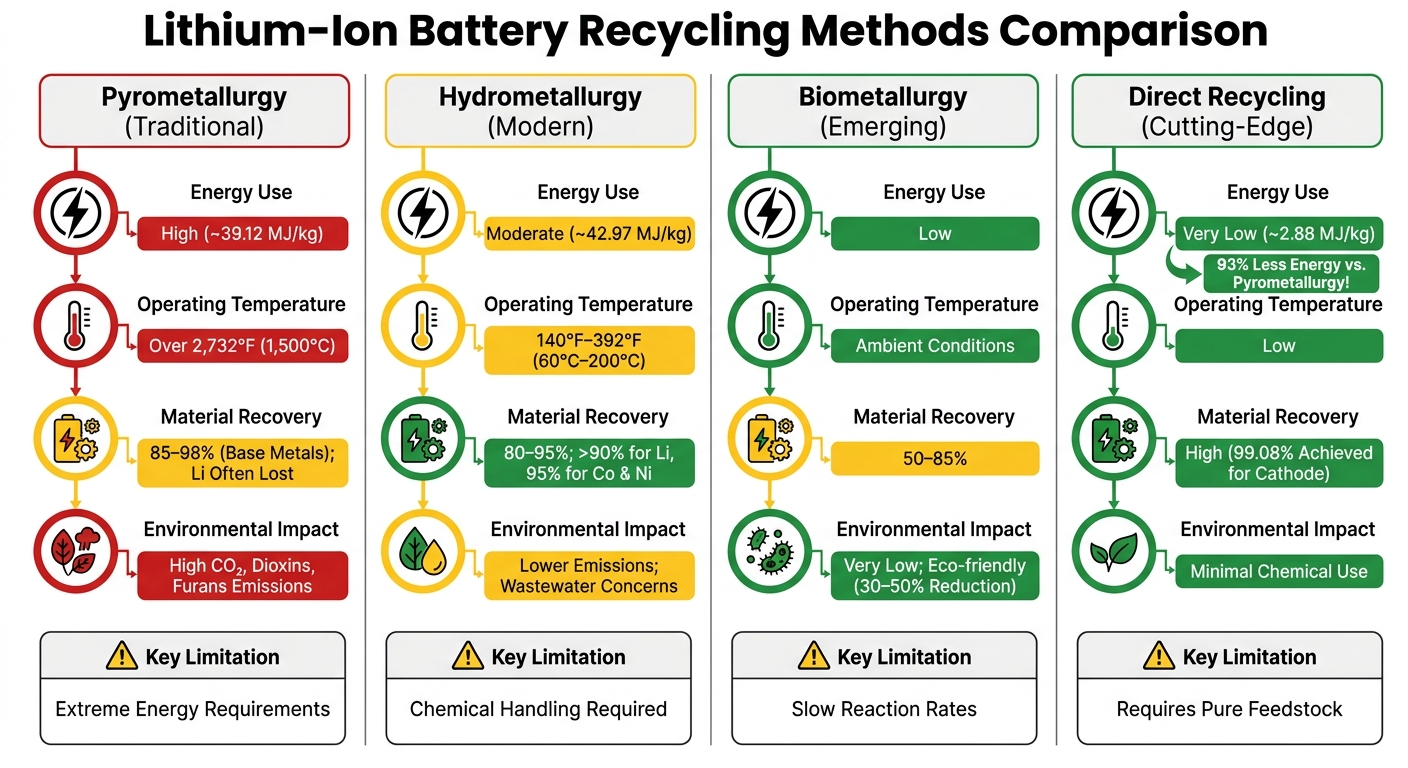
Lithium-Ion Battery Recycling Methods: Energy Use and Recovery Rates Comparison
New Chemical Recovery Methods
The recycling industry is rolling out innovative ways to address the chemical risks associated with lithium-ion batteries. One promising approach is hydrometallurgy, which uses aqueous solutions below 212°F (100°C) to selectively recover metals like lithium, cobalt, nickel, and manganese. This method boasts recovery rates of over 90% for lithium and 95% for cobalt and nickel, all while consuming significantly less energy than traditional smelting. For instance, researchers in Ecuador demonstrated in February 2026 that using sulfuric acid at 158°F (70°C) could recover 97.5% of manganese and lithium from discarded smartphone and laptop batteries.
Another method, bioleaching, employs microorganisms that produce organic acids to dissolve metals under ambient conditions. This approach eliminates the need for hazardous chemicals and reduces environmental impact by 30%–50% compared to standard chemical processes.
A game-changing method introduced in February 2026 is redox-mediated recycling, which utilizes flow cells to process various types of batteries. This system not only recovers over 95% of critical metals but also generates electricity and captures carbon dioxide. For every 10,000 tons of battery material processed, it can theoretically produce 246 megawatt-hours of electricity and sequester about 1,066 tons of CO₂ annually.
"Spent cathode materials are not only valuable source of critical metals, they also contain significant amounts of free energy... leading to energy waste [in traditional methods]." - Nature Communications
Comparing Old and New Recycling Methods
Traditional recycling methods, like pyrometallurgy, rely on smelting at temperatures over 2,732°F (1,500°C), consuming about 39.12 MJ/kg. While effective at recovering base metals (85–98%), this process often loses lithium to slag and emits large quantities of carbon dioxide, dioxins, and sulfur oxides.
In contrast, modern hydrometallurgy operates at much lower temperatures - between 140°F and 392°F (60°C to 200°C) - and uses approximately 42.97 MJ/kg. Though it requires significant energy, it produces fewer greenhouse gas emissions and is more efficient at recovering lithium. However, it does generate wastewater that must be treated carefully.
| Recovery Method | Energy Use | Material Recovery | Environmental Impact | Key Limitation |
|---|---|---|---|---|
| Pyrometallurgy | High (~39.12 MJ/kg) | 85–98% for base metals; lithium often lost | High CO₂, dioxins, furans | Extreme energy requirements |
| Hydrometallurgy | Moderate (~42.97 MJ/kg) | 80–95%; >90% for lithium | Lower emissions; wastewater concerns | Chemical handling required |
| Biometallurgy | Low | 50–85% | Very low; eco-friendly | Slow reaction rates |
| Direct Recycling | Very Low (~2.88 MJ/kg) | High (restores materials) | Minimal chemical use | Requires pure feedstock |
Among these methods, direct recycling stands out as the most energy-efficient, consuming just 2.88 MJ/kg - an impressive 93% less energy than pyrometallurgy. This technique restores degraded cathode materials without breaking them into individual elements, preserving their original crystal structure. In December 2025, researchers at Central South University achieved a 99.08% recovery rate for cathode materials while also capturing hazardous fluoride pollutants during processing. Companies like Li-Cycle and Northvolt have already commercialized hydrometallurgical processes, creating closed-loop systems where recovered materials are directly reused in new batteries.
These cutting-edge methods not only enhance material recovery but also offer a pathway toward more sustainable e-waste management, setting the stage for better practices in the industry.
E-Waste Management Guidelines
Why Certified E-Waste Recycling Matters
Certified e-waste recyclers follow strict protocols designed to minimize environmental harm. Here's a striking example: processing mixed-stream lithium-ion batteries (LIBs) through certified methods reduces greenhouse gas emissions and water use by at least 58% compared to extracting new materials from mining. Despite this, the global recycling rate for lithium-ion batteries ranges from just 2% to 47%, while in the U.S., 99% of lead-acid batteries are successfully recycled.
Improper handling of batteries can lead to dangerous fires, which release heavy metals into nearby ecosystems. Certified facilities mitigate these risks by fully discharging batteries before processing. This step is essential to prevent short-circuiting and thermal runaway during mechanical handling.
"If batteries are not well discharged, the residual charge could result in short circuiting, leakage, or even thermal runaway during the subsequent mechanical and hydrometallurgical processing stages." - Metallurgical and Materials Transactions B
California’s stringent e-waste laws further emphasize the importance of certified recycling practices.
California E-Waste Laws and Landfill-Free Policies
California has some of the toughest e-waste regulations in the U.S., designed to treat lithium-ion batteries as hazardous materials. These rules aim to reduce risks like thermal runaway and toxic emissions. Under the Resource Conservation and Recovery Act (RCRA), businesses must determine if their discarded batteries qualify as hazardous waste - most lithium-ion batteries fall under the ignitable (D001) and reactive (D003) categories. To simplify compliance, the EPA encourages managing these batteries under "universal waste" rules (40 CFR part 273), which streamline labeling, storage, and accumulation timeframes.
"Lithium-ion batteries and devices containing these batteries should NOT go in household garbage or recycling bins." - US EPA
New legislation has expanded these efforts. Starting January 1, 2026, SB 1215 extends the Electronic Waste Recycling Act to include "covered battery-embedded" (CBE) devices - products like tablets and smartphones with non-removable batteries. Businesses purchasing these items must pay a recycling fee of 1.5% of the retail price, capped at $15.00 per product, unless the fee is collected at the time of purchase. Meanwhile, the Responsible Battery Act of 2022 (AB 2440) requires battery manufacturers to fund collection and recycling programs, ensuring accessible drop-off locations - one site per 15,000 residents for small batteries.
Before transporting batteries for recycling, businesses must comply with DOT Hazardous Materials Regulations. This includes taping terminals with non-conductive tape or placing each battery in a separate plastic bag to prevent short circuits that could lead to thermal runaway. Businesses generating less than 220 pounds of hazardous waste monthly may qualify as "very small quantity generators" (VSQG), which come with reduced federal requirements, though state regulations may be stricter.
Rica Recycling: Certified E-Waste Services in the Bay Area
Operating under California's strict e-waste laws and landfill-free mandates, Rica Recycling provides certified recycling and IT asset recovery services throughout the San Francisco Bay Area. Their 100% landfill-free policy ensures responsible handling of electronics such as computers, laptops, servers, monitors, printers, cell phones, and more. They offer both pickup and drop-off options to make recycling easy and accessible.
Services include secure data destruction with certificates of completion - critical for devices like tablets and smartphones that store sensitive information - appliance recycling ($50 per item, drop-off only), and IT asset recovery to help businesses, schools, and organizations turn outdated equipment into value while adhering to California e-waste and EPA standards. Rica Recycling also hosts free electronics drop-off events, providing small businesses and organizations with a convenient way to dispose of e-waste responsibly without triggering complex hazardous waste management rules for smaller quantities.
Conclusion
Lithium-ion battery e-waste comes with serious risks. When these batteries end up in landfills, heavy metals like copper, cobalt, and nickel can seep into the soil and groundwater. This contamination can weaken soil structure by as much as 34% and increase its permeability by 84% - a troubling combination for ecosystems and infrastructure alike. Fires caused by batteries only add to the problem, releasing harmful substances such as hydrogen fluoride and metal-bearing aerosols that can damage nearby environments.
Thankfully, modern recycling methods offer a safer alternative. Unlike older high-temperature pyrometallurgical processes - which operate at over 2,700°F and produce significant greenhouse gas emissions - new hydrometallurgical techniques recover more than 90% of lithium and 95% of cobalt and nickel at much lower temperatures. These advancements not only minimize environmental harm but also reclaim valuable materials, reducing the need for mining.
As the lithium-ion battery market approaches $102.4 billion by 2030, the importance of effective recycling continues to grow. Certified recyclers are essential for managing these risks, preventing fires, and ensuring compliance with hazardous waste laws. They also play a key role in recovering materials that can be reused, helping to reduce the demand for mining. For businesses in the Bay Area, Rica Recycling offers a comprehensive solution with secure data destruction, convenient pickups, and a commitment to 100% landfill-free processing - all in line with California's strict e-waste regulations.
FAQs
How can I tell if a device uses an LCO, NMC, or LFP battery?
You can figure out whether a device uses an LCO, NMC, or LFP battery by looking at its specifications or inspecting the labeling. This information is usually found in the product documentation or printed directly on the battery itself.
What should I do if I find a swollen or damaged lithium-ion battery?
If you come across a swollen or damaged lithium-ion battery, handle it with extreme caution to prevent any risks. Never dispose of it in household trash or regular recycling bins. Instead, place the battery in a fireproof, non-conductive container for safe storage. Then, take it to a certified recycling facility for proper disposal.
Avoid actions like puncturing, crushing, or exposing the battery to heat, as these can increase the danger. If the battery is leaking, steer clear of any contact with the material and seek help from professional disposal services. Safety should always come first when dealing with compromised batteries.
How should I store and transport lithium-ion batteries for recycling safely?
To ensure the safe storage and transportation of lithium-ion batteries for recycling, follow these guidelines:
- Keep them in a cool, dry, and ventilated space - far from heat sources, sparks, or anything flammable.
- Use containers made of non-conductive materials to avoid short circuits or chemical reactions.
- Partially discharge the batteries to minimize risks during transportation.
- Clearly label the packages with hazard warnings, and handle them gently to prevent damage or exposure to moisture.
These steps are crucial for reducing the chances of fires, leaks, or other accidents.