
AI-Powered Robotics for E-Waste Sorting
AI-powered robotics are reshaping e-waste recycling, making it faster, safer, and more efficient. With the U.S. generating up to 7.6 million metric tons of e-waste annually, and global production expected to reach 82 million tons by 2030, traditional recycling methods can't keep up. The problems of electronic waste make manual sorting slow, hazardous, and prone to errors, leading to lost materials and risks for workers. Here's how AI and robotics are stepping in:
- Precision Sorting: AI systems like roboLoop and A.R.I.S. use computer vision and machine learning to identify and separate materials like metals, plastics, and batteries with high accuracy.
- Safer Workplaces: Robots remove hazardous items, such as lithium-ion batteries, reducing risks of fires and worker exposure to toxins.
- Higher Efficiency: Robots process up to 20 times more items per hour than humans, cutting labor costs by as much as 59%.
- Economic Impact: AI-driven systems help recover valuable materials, like copper and gold, worth $95 billion annually.
From advanced disassembly robots like Apple's Daisy to high-speed sorting systems, these technologies are transforming recycling facilities. With AI adoption growing, businesses can reduce costs, recover critical materials, and improve safety, all while meeting stricter regulations.
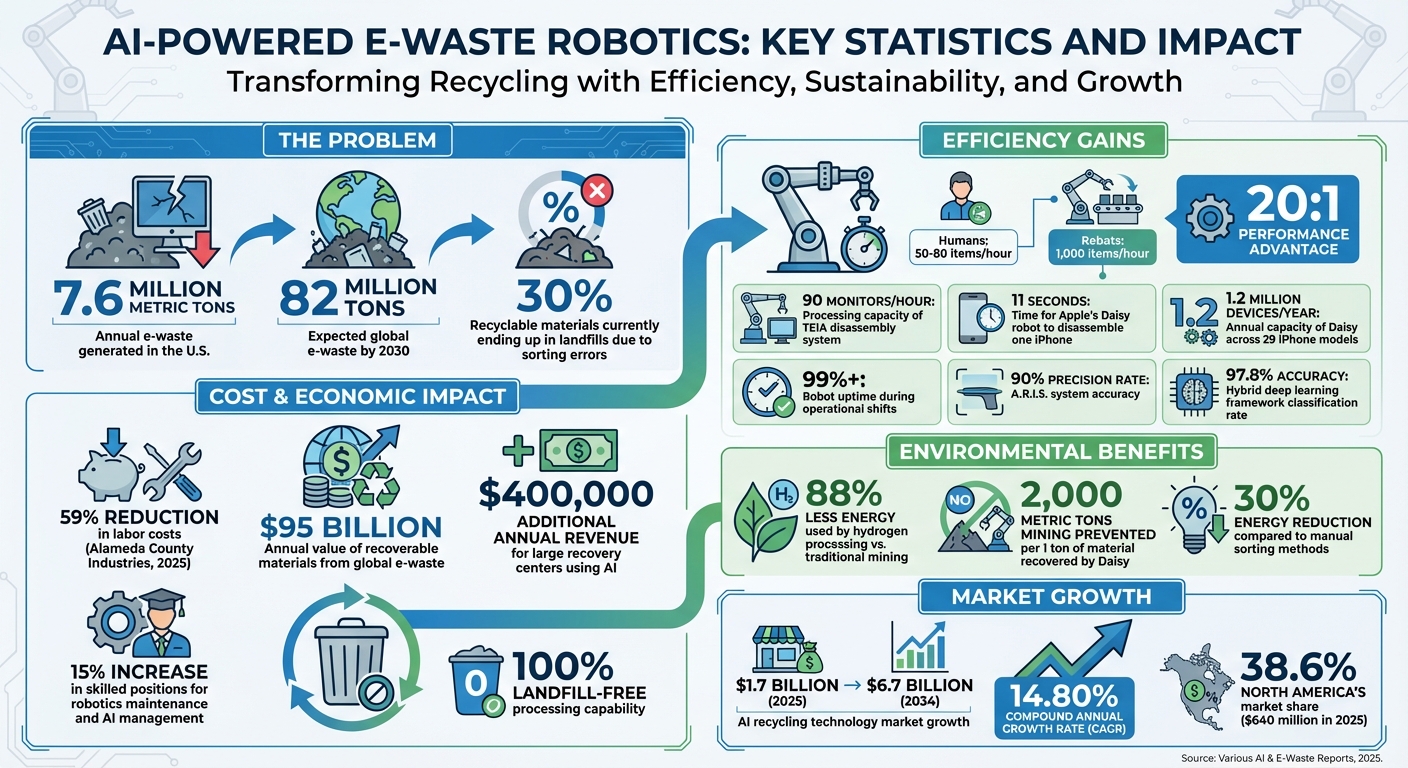
AI-Powered E-Waste Robotics: Key Statistics and Impact
AI Technologies Used in E-Waste Sorting
Computer Vision and Machine Learning
E-waste sorting systems use computer vision to quickly identify materials. At the heart of this technology are Convolutional Neural Networks (CNNs), deep learning models that analyze visual data much like how humans recognize patterns. Popular architectures like YOLOx and U-Net are widely used for real-time material detection.
In February 2026, researchers Dhruv Talwar and his team introduced A.R.I.S. (Automated Recycling Identification System), a portable device for sorting shredded e-waste. Powered by a YOLOx model, A.R.I.S. achieved a precision rate of 90% and an 82.2% mean average precision (mAP) when classifying materials like metals, plastics, and circuit boards. The system works on conveyor belts, making rapid decisions on material routing in real time.
But visual cameras alone aren’t enough for every situation. For example, dark plastics can be tricky for optical sensors. This is where DEXRT and XRF step in - these technologies analyze density and atomic composition, essentially "looking through" surface contamination. One notable system, X-SORT, validated in 2024, achieved over 85% efficiency in detecting glass fragments while maintaining less than 5% contamination in recovered materials. As a waste strategy advisor for the European Commission aptly put it:
"It's not just about separation anymore. It's about recognition."
In December 2025, another research team showcased a system combining X-ray imaging with YOLO and U-Net models, specifically designed to detect and isolate battery-containing items. This is critical for safety since damaged lithium-ion batteries can cause fires during processing. Using this system, a Delta robot with a suction gripper removes hazardous batteries before they reach the shredding phase. For consumers, knowing where to recycle your electronic waste is the first step in ensuring these materials reach such advanced facilities.
Once materials are identified, AI algorithms take over to optimize the disassembly process, maximizing recovery and efficiency.
AI Algorithms for Material Optimization
After identifying materials, AI algorithms determine the most efficient way to process them. Reinforcement Learning (RL) and Deep Q-learning (DQL) teach robots to optimize disassembly sequences through trial and error, similar to how one might strategize moves in a chess game. These algorithms enable robots to perform precision tasks, such as removing screws with less than 1 millimeter of clearance - tasks that are either too tedious or unsafe for humans.
A 2024 study demonstrated the power of a hybrid deep learning framework combining EfficientNetB0 and MobileNetV2, achieving 97.8% accuracy and 98.1% precision in classifying 12 different e-waste categories. What’s more impressive is that this framework required far less computational power compared to older models like ResNet50.
Optimization algorithms, including Ant Colony Optimization (ACO) and Genetic Algorithms (GA), tackle the challenge of balancing disassembly lines. These tools determine the most efficient dismantling sequence, ensuring maximum recovery of valuable materials while minimizing time. Such systems can handle throughputs of up to 20 tons per hour with conveyor speeds of 3 meters per second, all while cutting energy usage by roughly 30% compared to manual sorting methods. The combination of visual recognition and algorithmic efficiency is what drives modern e-waste sorting systems forward.
sbb-itb-855056e
Robotic Systems for E-Waste Dismantling and Sorting
Automated Dismantling Robots
Today's dismantling robots are designed to carefully take apart electronics, recovering materials that can be reused. Take Apple's Daisy robot, for example. Daisy can disassemble an iPhone in as little as 11 seconds, handling up to 1.2 million devices annually across 29 iPhone models. It uses techniques like freezing, unscrewing, and applying controlled force to extract key components such as motherboards, cameras, and batteries.
"One metric ton of material recovered from Daisy prevents 2,000 metric tons of mining."
– Sarah Chandler, VP of Environment and Supply Chain Innovation, Apple
Apple has also introduced other specialized robots for targeted material recovery. Dave focuses on extracting tungsten and rare earth magnets from Taptic Engines, while Taz is designed to separate magnets from audio modules using shredding and magnetic separation. Impressively, by 2026, 99% of the rare earth elements in Apple's magnets will come from recycled sources.
Another example of innovation in this space is the iDEAR (Intelligent Disassembly for E‑waste Recycling) project by Fraunhofer IFF. This system uses AI-powered 3D cameras and optical sensors to identify fasteners like screws, rivets, and clips in real time. It can autonomously remove complex components, such as motherboards, from devices like computers.
"We intend to revolutionize the disassembly of e‑waste... so that as the widest variety of products, from computers to microwaves to home appliances, can be disassembled in real time with little engineering."
– Dr. José Saenz, Manager of Assistive, Service and Industrial Robots Group, Fraunhofer IFF
These advanced dismantling robots work seamlessly with sorting systems to ensure efficient material recovery.
High-Speed Sorting Robots
Once dismantling is complete, high-speed sorting robots step in to separate materials with precision. These systems operate on conveyor belts, using Delta robots equipped with suction grippers or mechanical arms. Powered by AI models like YOLO, U-Net, and advanced X-ray imaging, they can identify and remove hazardous items like batteries or valuable components such as circuit boards in real time, before the materials move on to shredding.
This focus on speed and efficiency is critical as e-waste continues to grow. With global e-waste expected to hit 74 million metric tons by 2030, recycling facilities are increasingly relying on these robotic systems to process materials quickly while maintaining high recovery rates.
Benefits of AI-Powered Robotics in E-Waste Recycling
Improved Efficiency and Accuracy
AI-driven robots have revolutionized the speed and precision of e-waste sorting. While human workers typically manage 50–80 items per hour, robots can process up to 1,000 items in the same timeframe, delivering a 20:1 performance advantage. For example, in January 2026, Hiro Robotics implemented its TEIA disassembly system at the Bollate Correctional Facility recycling plant near Milan, Italy. Using ABB IRB 2600 and IRB 460 robots, the system handles up to 90 monitors per hour, slashing both processing time and operating costs compared to manual methods.
Accuracy is another game-changer. Advanced computer vision algorithms allow robots to identify and sort materials with precision, reducing recycling stream contamination. This is vital, as roughly 30% of recyclable materials currently end up in landfills due to sorting errors. By improving sorting accuracy, these systems help recover critical minerals and rare earth elements that might otherwise be wasted.
"Computer vision algorithms and robotic sortation equipment are capable of seeing better than humans while sorting orders of magnitude more material at far lower costs than existing equipment."
– Joe Castagneri, Director of Software Engineering, AMP
Unlike human workers, robots maintain consistent performance, operating more than 99% of the time during their shifts. This reliability is essential as global e-waste volumes are projected to hit 74 million metric tons by 2030. With their speed, precision, and stamina, robots not only increase efficiency but also create safer work environments by reducing human exposure to hazardous tasks.
Better Worker Safety
E-waste recycling involves handling dangerous materials, but AI-powered systems are stepping in to mitigate these risks. Using X-ray imaging and computer vision, robots can identify and safely remove hazardous components like lithium batteries, mercury-containing parts, and toxic capacitors before shredding begins. This prevents facility fires and shields workers from exposure to harmful substances such as lead, mercury, and battery chemicals.
A standout example is the EU-funded ReconCycle project, led by Dr. Aleš Ude at the Jožef Stefan Institute. This initiative developed a self-reconfigurable robotic cell capable of automating the removal of hazardous components from electronic devices. Equipped with specialized grippers, these robots safely handle dangerous tasks, allowing human workers to focus on monitoring the system.
"We believe that ReconCycle showed that AI-driven, reconfigurable robotics can make e-waste recycling safer, more efficient and economically viable."
– Aleš Ude, Professor and Project Coordinator, Jožef Stefan Institute
By taking over high-risk tasks, AI-powered robotics not only enhance worker safety but also contribute to broader economic and environmental benefits.
Environmental and Economic Impact
The financial upside of AI in e-waste recycling is hard to ignore. In September 2025, Alameda County Industries near San Francisco reported a 59% reduction in labor costs after implementing AI-powered systems. Before automation, the facility faced staffing challenges despite offering workers salaries of around $85,000 annually. Beyond cost savings, the recovery of valuable materials from e-waste is a major economic driver, with potential resource yields estimated at $95 billion.
AI-powered systems also bring energy efficiency to the table. For instance, hydrogen processing of magnetic scrap (HPMS) uses up to 88% less energy than traditional methods of mining and refining. In 2025, Mint Innovation announced plans for U.S.-based facilities capable of recovering 1,000 tons of copper and 600 kg of gold annually from domestic e-waste, leveraging proprietary biotechnology and AI-optimized processes.
"The e-waste facility of the future will look more like a high-tech manufacturing plant than a scrapyard, with robotics, cleaner chemistry, and connected systems forming the backbone of the next-generation resource recovery network."
– David Daoud, Principal Analyst, Compliance Standards LLC
Interestingly, AI integration is also reshaping the workforce. It has led to a 15% increase in skilled positions for robotics maintenance and AI management. This shift transforms e-waste recycling from labor-intensive work to technical roles, supporting a more sustainable and resource-efficient economy.
Future Trends and Market Potential for AI in E-Waste Recycling
Advancements in AI and Robotics
In December 2025, the EU-funded ReconCycle project, led by Dr. Aleš Ude, unveiled a groundbreaking self-reconfigurable robotic cell. This system uses vision-language models to predict disassembly steps for complex electronics like smoke detectors and heat-cost allocators, showcasing the potential of AI-driven automation in tackling intricate recycling challenges.
Emerging sensing technologies are also transforming the field. Tools like hyperspectral imaging, X-ray fluorescence (XRF), and infrared systems can now detect chemical compositions and specific metals that standard cameras - and even human eyes - cannot identify. On another front, soft robotics innovations such as the qb SoftHand 2 are making strides in handling delicate components with precision. By employing tactile sensing and adaptive stiffness, these robots minimize damage during disassembly.
At CES 2026, Oshkosh Corporation introduced an upgraded version of HARR-E (Hailable Autonomous Refuse Robot, Electric). This modular, autonomous robot uses AI-optimized routing to efficiently serve planned communities and corporate parks on demand. These developments underline a significant shift toward fully autonomous systems that can adapt to the increasing complexity of modern electronics. Such advancements not only refine recycling processes but also drive the overall market forward.
Market Growth and Adoption
The global market for AI-powered recycling technology is expected to grow dramatically, jumping from $1.7 billion in 2025 to approximately $6.7 billion by 2034. This reflects a compound annual growth rate of 14.80%. North America currently leads the market, holding a 38.6% share valued at $640 million as of 2025.
Several factors are fueling this growth. Severe labor shortages, stricter environmental regulations, and the relentless rise in global e-waste volumes are pushing facilities to adopt AI-driven solutions. Facilities that integrate AI robotics report impressive results, including a 60% boost in operational efficiency and material identification accuracy rates of up to 99%. Additionally, large recovery centers can generate up to $400,000 in extra annual revenue by capturing recyclables that manual sorting often misses.
In 2025, Machinex Industries Inc. launched the SamurAI sorting robot with MACH Vision 3.0. This innovation reduced sorting times by 30% for fiber recovery applications, highlighting the efficiency gains AI can deliver. With copper demand projected to outpace supply by 2025 - leading to an estimated 6.6 million-ton deficit by 2030 - domestic recycling is becoming an essential strategy for U.S. businesses to secure critical materials.
Opportunities for Local Businesses
The rapid adoption of AI in recycling opens up valuable opportunities for local businesses, particularly in regions like the San Francisco Bay Area. With the shift toward cyber-physical recycling facilities, partnering with certified recyclers provides access to advanced recovery methods while ensuring compliance with California's stringent e-waste regulations.
For companies looking to adopt AI-driven recycling, a phased approach can help manage the initial investment. While AI automates repetitive tasks, it also creates demand for skilled roles in robotics maintenance and system management. Businesses can benefit from investing in upskilling programs to transition workers from manual sorting to these technical positions.
Rica Recycling (https://ricarecycling.com) offers a practical gateway into this advanced recycling ecosystem for businesses in the Bay Area. Their services include certified electronics recycling, secure data destruction, and a 100% landfill-free policy. Rica Recycling provides convenient pickup and drop-off options, helping organizations safely dispose of electronics like computers, laptops, and servers while adhering to California's e-waste regulations and contributing to the circular economy.
Inside RoboLoop: How Robots Are improving E-Waste Recycling | Covestro
Conclusion
AI-powered robotics are revolutionizing how electronic waste is managed. The shift from basic "crush-and-separate" methods to precise, automated disassembly is turning recycling facilities into advanced hubs. These systems now rely on real-time monitoring and automated adjustments to recover valuable materials while safely isolating hazardous components.
With throughput rates nearly 20 times higher than manual sorting and accuracy levels reaching 99%, AI systems are not just about speed - they're also cutting labor costs by as much as 59%. The global recycling robotics market is projected to hit $673.21 million by 2032, further highlighting the economic impact of these technologies. Beyond efficiency, it’s estimated that $95 billion worth of reusable resources could be reclaimed from the global e-waste stream.
The environmental advantages are equally striking. For example, hydrogen-based magnet recycling consumes 88% less energy compared to traditional mining. Meanwhile, advanced metallurgical techniques and digital tracking systems are reducing emissions and ensuring responsible sourcing practices.
These advancements are also fostering local adoption. In the San Francisco Bay Area, businesses and organizations can tap into this ecosystem by working with certified recyclers. Rica Recycling (https://ricarecycling.com) provides secure electronics recycling, certified data destruction, and a commitment to a 100% landfill-free policy. This makes safe e-waste disposal straightforward while aligning with California's stringent e-waste regulations.
The technologies emerging today are making recycling faster, safer, and more cost-effective. As AI and robotics continue to evolve, the potential to recover critical materials domestically while protecting the environment will only grow. This progress embodies a future where advanced robotics drive secure and sustainable e-waste recycling.
FAQs
How do AI robots tell metals from plastics in e-waste?
AI robots rely on cutting-edge computer vision, sensors, and machine learning to separate metals from plastics in electronic waste. By examining physical traits, they can identify materials instantly. Deep learning models, such as YOLOx, achieve around 90% accuracy in classifying components. Over time, these systems get better at their tasks, making recycling faster, recovering metals like gold and silver, and minimizing contamination and the need for manual labor.
Can robots reliably spot and remove lithium batteries before shredding?
Yes, robots are now capable of detecting lithium batteries in e-waste streams with impressive reliability before the shredding process begins. Thanks to advancements in AI-driven systems, including sophisticated robotics and purpose-built platforms, these technologies can accurately identify and extract hazardous materials. This not only boosts safety during recycling but also makes the process more efficient.
What does it cost to add AI sorting robots to a recycling line?
Adding AI-powered sorting robots to a recycling line usually comes with a price tag ranging from $200,000 to $400,000 per unit. These advanced systems can handle impressive workloads, sorting as many as 33,000 items during a 10-hour shift. This level of automation can greatly boost efficiency, especially in processing electronic waste.