
Want to dispose of electronics responsibly in the Bay Area? Here's everything you need to know about e-waste events in 2025. These government-approved events cover San Mateo, Sonoma, Alameda, and Marin counties, offering free opportunities for residents to recycle items like laptops, TVs, and phones. Proper recycling prevents harmful substances like lead and mercury from polluting the environment and ensures data security through certified recyclers.
Key Takeaways:
- Event Dates & Locations: Notable events include Foster City on July 19, 2025, and Rohnert Park’s 3-day event from September 12–14, 2025.
- Eligibility: Bring proof of residency (e.g., driver’s license or utility bill).
- Accepted Items: TVs, computers, phones, and small electronics. Items like batteries, fluorescent bulbs, and large appliances are excluded.
- Year-Round Options: Facilities like Shoreway Environmental Center and Blue Line Transfer Station provide drop-off services outside event dates.
Whether you're attending a one-off event or using year-round facilities, recycling electronics supports safer disposal practices and resource recovery. Businesses with larger volumes can turn to services like Rica Recycling for certified data destruction and IT asset recovery.
How to Use This Calendar
This calendar provides a schedule of confirmed 2025 events happening across San Mateo, Sonoma, Alameda, and Marin counties. Each listing includes the event date, location, and the hosting organization. Since event details can change, always double-check with your city or county website. In San Mateo County, public notices for e-waste events are legally required to include the date, location, and the name of the certified electronics recycler. Below are checklists to help you participate in or organize these events efficiently.
Checklist for Participating in E-Waste Events
- Verify your eligibility: Bring proof of residency, such as a driver’s license, utility bill, or garbage collection bill. For instance, at the Foster City event on July 19, 2025, attendees needed to confirm they lived in San Mateo County before dropping off items.
- Check accepted items: Each event has specific guidelines. Most will take computers, monitors, and cell phones, but items like batteries, fluorescent bulbs, and large appliances (e.g., stoves or air conditioners) are often not allowed.
- Appointment or walk-in?: Find out where to recycle your electronic waste and if you need to book ahead. Some events, like the Sonoma Community Center event on April 4, 2025, operate on a walk-in basis to make drop-offs easier.
- Erase personal data: Even certified recyclers recommend wiping all personal data from devices like hard drives, phones, and copiers. These can retain recoverable information.
- Sort your items: Separate working electronics from broken ones. Functional items might be donated to organizations like Goodwill, while non-functional ones are sent for recycling.
For those managing larger volumes of e-waste, the next section offers tailored tips.
Tips for Organizations
Organizations with substantial e-waste or specific disposal needs can benefit from services like Rica Recycling, which offers secure data destruction and IT asset recovery. Keep in mind that most one-day events are intended for households, so schools, businesses, or government agencies may need alternative solutions. Rica Recycling ensures compliance with California’s e-waste regulations and adheres to a 100% landfill-free policy.
-
Set up a collection point: Prevent e-waste from ending up in regular trash bins by designating a formal drop-off area. As Crystal Clean warns:
A retired computer that leaves your facility without secure data destruction creates exposure that no privacy policy can address after the fact.
- Develop a clear policy: Create a written procedure for retiring IT equipment. This should include steps for secure data destruction and removing items from asset tracking systems.
sbb-itb-855056e
2025 Bay Area E-Waste Events Calendar
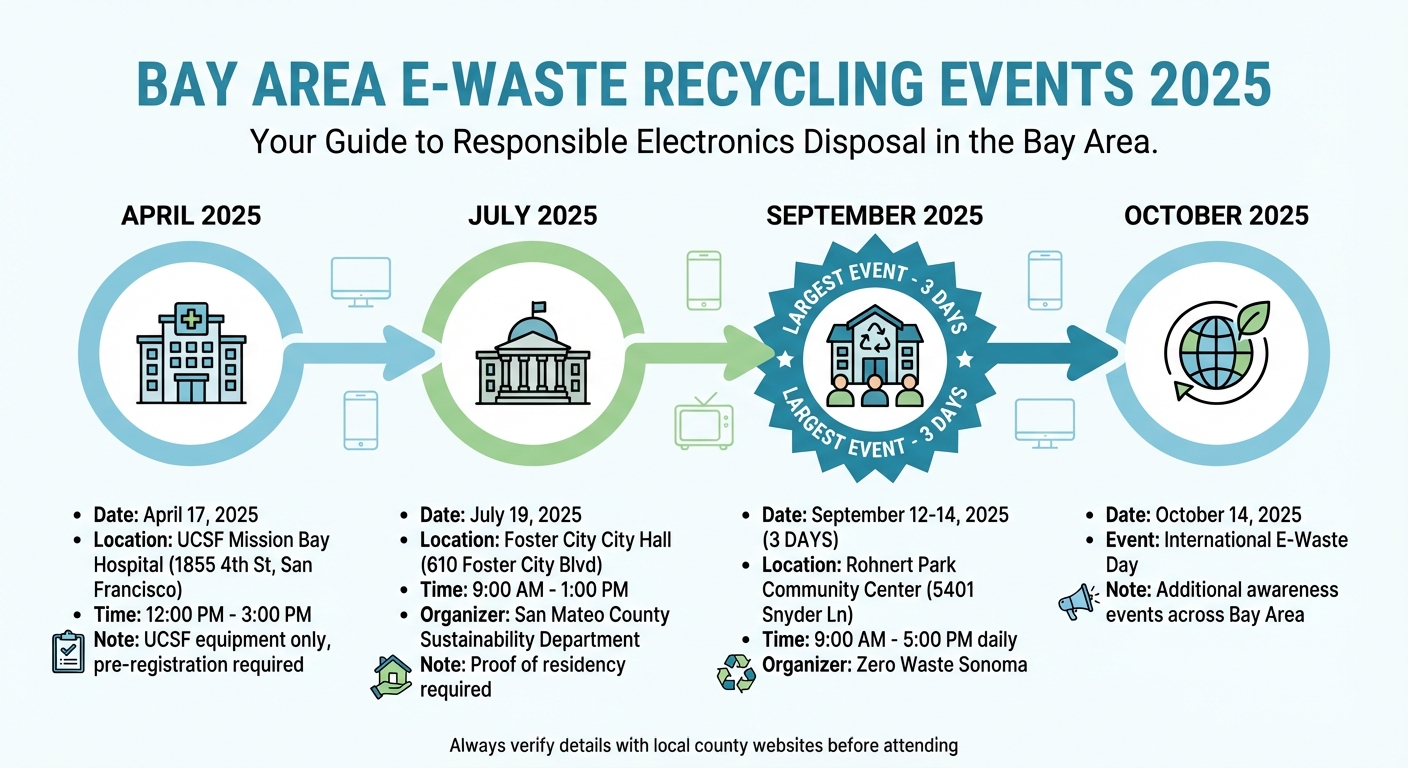
2025 Bay Area E-Waste Recycling Events Calendar
Monthly Event Breakdown
The Bay Area hosts several government-sponsored e-waste recycling events in 2025, ensuring residents have access to safe and legal disposal options that align with local regulations.
- April 17, 2025: UCSF Mission Bay Hospital (1855 4th St, San Francisco) will hold an event exclusively for UCSF-owned equipment. This event runs from 12:00 PM to 3:00 PM and requires pre-registration. Note: Household items are not accepted.
- July 19, 2025: Foster City City Hall (610 Foster City Blvd) will host a residential event from 9:00 AM to 1:00 PM. Organized by the San Mateo County Sustainability Department, attendees must present proof of residency, such as a driver’s license or utility bill.
- September 12–14, 2025: The largest event of the year will take place at the Rohnert Park Community Center (5401 Snyder Ln) from 9:00 AM to 5:00 PM, spanning three days. This event is organized by Zero Waste Sonoma.
- October 14, 2025: International E-Waste Day may include additional awareness events across the Bay Area, offering more opportunities to recycle responsibly.
Each event has specific guidelines for accepted items. For example, working electronics brought to San Mateo County events are often redirected to Goodwill stores for reuse rather than being recycled immediately.
If you can’t make it to one of these events, don’t worry - there are alternative drop-off locations or e-waste pick-up services available year-round.
Year-Round Drop-Off Options
For those unable to attend scheduled events, several drop-off facilities operate throughout the year, providing convenient options for e-waste recycling:
- Shoreway Environmental Center (333 Shoreway Rd, San Carlos): Offers free drop-off for items like TVs, appliances, and printers. However, fees apply for larger items such as refrigerators or commercial copy machines.
- Blue Line Transfer Station (500 E. Jamie Ct, South San Francisco): Accepts cell phones, monitors, and TVs for free, though fees are charged for other types of electronics.
- Recology of the Coast (1046 Palmetto Ave, Pacifica): Serves residents only and accepts computers, TVs, and small appliances at no charge.
Private facilities also expand recycling options:
- Crown Computer Recycling (110 Glenn Way, Unit 19, San Carlos): Accepts a variety of electronics, including CDs/DVDs and cables.
- Zarc Recycling (26 S Linden Ave, South San Francisco): Handles TVs, monitors, cables, and ballasts.
Most of these facilities operate Monday through Friday, with some offering Saturday hours, making them a reliable choice for those with packed weekend schedules.
Accepted Items and Restrictions
Accepted E-Waste Items
At most Bay Area e-waste events, you can drop off a range of Covered Electronic Waste (CEW) items. This includes TVs, computer monitors (both CRT and flat panel), laptops, tablets, computers, printers, scanners, fax machines, and cell phones. Smaller household electronics like microwaves, vacuum cleaners, hairdryers, lamps (without bulbs), stereos, VCRs, DVD players, and even electronic toys are also accepted. If you're bringing a lamp, make sure to remove the bulb first - lamps are accepted, but the bulbs require separate handling. Be aware that nonfunctioning CRTs and mercury bulbs are classified as hazardous waste and must go through specialized disposal channels.
Prohibited Items
While many electronics are accepted, some items require special attention. Large appliances - like refrigerators, stoves, washers, dryers, and air conditioners - are not accepted at these events, though appliance recycling drop-off locations are available throughout the region. Similarly, items such as smoke detectors, solar panels, thermostats, and fluorescent tubes must be handled as hazardous waste due to their toxic components. Loose batteries, whether lithium or alkaline, are also prohibited. However, devices with embedded batteries are generally allowed. If you need to dispose of standalone batteries, take them to designated battery collection sites or Household Hazardous Waste (HHW) facilities.
Looking ahead, Senate Bill 1215, effective January 1, 2026, will expand the Covered Electronic Waste Recycling Program to include products with embedded batteries. This could change how these items are managed in the future.
Data Security Reminder
Before recycling your devices, ensure all sensitive data is securely erased. To guarantee safe data destruction, choose certified recyclers under programs like e-Stewards® or R2. In San Mateo County, collectors are required to work with processors certified under these programs, ensuring compliance with strict data security standards. For businesses or organizations handling sensitive information, Rica Recycling offers certified data destruction services that meet California's regulatory requirements.
Planning Checklist for Businesses and Organizations
Preparing for E-Waste Disposal
If your business generates a significant amount of e-waste, a planned approach to disposal is essential. Start by creating an inventory of your electronics, grouping them into categories like computers, peripherals, and telecommunications devices. Keep in mind that most government-run e-waste events are designed for residential use and do not accept items from schools or businesses. Similarly, community collection events typically focus on household electronics, making them unsuitable for organizations that need to dispose of larger volumes or require secure handling of sensitive data.
It's critical to address data security early in the planning process. While some community events may accept hard drives, they rarely provide the formal Certificates of Data Destruction required for compliance with regulations such as HIPAA or FACTA. If your organization deals with sensitive data - whether related to students, employees, or clients - you should prioritize certified data destruction services. These services not only ensure regulatory compliance but also provide a clear audit trail. For businesses and institutions managing large-scale e-waste disposal, specialized services offer the security and efficiency needed to handle the task properly.
When to Use Rica Recycling
Rica Recycling is an excellent solution when community events can't meet your organization’s volume or security requirements. With over 20 years of experience, Rica Recycling specializes in certified e-waste services tailored to the needs of businesses in areas like San Francisco, Oakland, and San Mateo. They offer scheduled on-site pickups, IT asset recovery, and secure data destruction services to ensure compliance with California's e-waste regulations.
Rica Recycling accepts a wide range of electronics, including computers, servers, monitors, printers, cell phones, cables, and appliances. Organizations can drop off standard electronics for free at Rica's Hayward facility, while appliances incur a $50 recycling fee per item. Their commitment to a 100% landfill-free policy and certified data destruction ensures your organization not only meets California’s strict disposal regulations but also maintains the highest standards of data security.
Conclusion
Government-sponsored e-waste events in the Bay Area make it easy and free for residents to dispose of electronics responsibly throughout 2025. Participating in these events not only aligns with California's law - which bans tossing electronics in regular trash - but also helps protect the environment from harmful substances like lead and mercury. Tackling e-waste is a shared responsibility, and these events are a step toward managing it effectively as a community.
Before heading to an event, double-check details like proof of residency requirements and the list of accepted items to ensure a smooth experience.
For businesses or organizations handling larger quantities or needing specific services, certified recycling options are key. Rica Recycling serves areas like San Francisco, Oakland, and San Mateo, offering tailored solutions such as on-site pickups, IT asset recovery, and secure data destruction. Their Hayward facility accepts standard electronics for free, while appliances are recycled for $50 per item - all under a 100% landfill-free policy.
Whether you're an individual or part of an organization, taking action in 2025 contributes to protecting public health, conserving resources, and supporting sustainable practices. Choosing to recycle responsibly reflects a commitment to the Bay Area's environmental goals.
FAQs
How do I wipe my data before recycling a device?
Before recycling your device, make sure your personal data is completely and securely erased. A simple factory reset might not do the trick, as some data could still be retrieved. To safeguard your information:
- Back up any important files you want to keep.
- Log out of all accounts and deactivate any software licenses tied to the device.
- Use a trusted data-wiping tool to overwrite your data securely.
If you're looking for an extra layer of protection, consider physically destroying your hard drive.
What should I do with batteries or fluorescent bulbs?
Batteries and fluorescent bulbs fall under hazardous waste and shouldn't be tossed in with regular trash. Instead, take them to household hazardous waste collection events or specific drop-off sites for proper disposal. These items need special handling to ensure environmental safety and meet legal requirements.
Can a business schedule secure e-waste pickup and data destruction with Rica Recycling?
Businesses can easily arrange secure e-waste pickup and data destruction services through Rica Recycling. These services include secure hard drive wiping and the issuance of certificates of data destruction for peace of mind. To ensure safe and compliant disposal of your electronics, get in touch with Rica Recycling today.