
Basel Convention and E-Waste: What to Know
If your old electronics cross a border, the pickup is only the start. I’d boil this article down to one point: the big legal question is whether your devices are still reusable or are now waste. That single call affects consent rules, export limits, and what records you need.
Here’s the short version:
The Basel Convention is a global treaty that controls cross-border shipments of hazardous waste, including many discarded electronics.
The U.S. signed but did not ratify the treaty, but many receiving countries follow it.
U.S. e-scrap exports are about $1.45 billion per year, so the downstream risk is not small.
If equipment is working, complete, tested, and meant for reuse, it may fall outside Basel waste controls.
If it is non-working, damaged, incomplete, or sent for recycling/disposal, it is much more likely to be treated as e-waste.
Many e-waste shipments now need written approval before export under Prior Informed Consent (PIC) rules.
Hazardous e-waste exports from developed countries to many developing countries can be blocked under the Basel Ban Amendment.
For U.S. groups, compliance often means checking Basel rules, RCRA rules, state rules, destination-country rules, and transit-country rules.
Good records matter: functionality tests, inventory logs, chain-of-custody forms, consent papers, and data-destruction records can help if a shipment is questioned.
If you want fewer cross-border issues, I’d keep processing domestic and use a certified recycler with clear downstream reporting.
A few plain-English takeaways stand out:
Classification drives everything.
Reuse claims need proof.
Bad paperwork can turn a legal shipment into a problem.
Data security should happen before devices leave your site.
This article then walks through the rules, the waste-vs.-reuse test, export checks, and the handling steps businesses and schools should follow.
Understanding the Latest Basel Convention Amendments and Their Impact on Electronics Processors
Basel Convention basics and how they apply to e-waste
E-Waste vs. Reusable Equipment: Basel Convention Classification Guide
Adopted in 1992, the Basel Convention limits cross-border shipments of hazardous waste to protect human health and the environment. It has 186 parties [2]. For U.S. organizations, the practical issue is pretty simple: can retired equipment be exported, and if so, under what rules?
What the Basel Convention covers
With e-waste, everything starts with classification. Under Basel, the main issue is whether the electronics are actually waste. The treaty applies to waste electrical and electronic equipment (WEEE), along with components and assemblies.
A device is generally treated as waste if it is missing key parts, fails a functionality test, or has defects that affect core functions [2]. For electronics, Basel hinges on one line: is the item still usable, or has it become waste [2]? If it still works and is meant for repair or reuse, it may be treated as non-waste and is generally not subject to Basel export controls.
Recent e-waste amendments and Prior Informed Consent
Recent Basel e-waste amendments expanded controls, so most e-waste shipments - including some non-hazardous materials - now need notification and written consent before export [2]. That single classification decision - waste or reusable - decides whether the Prior Informed Consent process applies.
Under Prior Informed Consent (PIC), exporters must get written approval from the countries of export, transit, and import before shipment [2]. In plain English, that's the main compliance hurdle before any cross-border shipment can move.
Many countries also apply stricter national rules than Basel requires. So before shipping, it’s important to check the destination country’s rules, not just the treaty itself. Those consent rules decide whether an export can move forward legally.
Key export rules businesses should understand
The next step is classification. Under Basel, annex status decides whether a shipment falls under full controls. That comes first because it shapes everything that follows: whether the shipment is hazardous, restricted, or mostly outside Basel controls.
Annex VIII vs Annex IX: How e-waste is classified
Annex VIII covers hazardous e-waste, such as non-functional CRTs, leaded glass, and circuit boards with heavy metals. These shipments require Prior Informed Consent. Annex IX generally covers non-hazardous scrap, such as clean metal scrap and certain reusable assemblies, and generally faces fewer Basel export restrictions.
Feature | Annex VIII (Hazardous) | Annex IX (Non-Hazardous) |
|---|---|---|
Hazard Status | Hazardous | No hazardous characteristics |
Typical Items | Non-functional CRTs, leaded glass, circuit boards with heavy metals | Clean metal scrap, certain electronic assemblies |
Control Level | Full Basel controls; Prior Informed Consent required | Generally faces fewer Basel export restrictions |
Business Impact | Full export controls; prohibited to many developing countries under the Ban Amendment | Lower export restrictions |
That classification sets the export rules that come next. In plain terms, it can decide whether a shipment moves at all or whether it must get written consent before export.
The Basel Ban Amendment and illegal traffic risk
The Basel Ban Amendment prohibits hazardous waste exports from developed countries to developing countries, including for recycling [1]. If a company labels non-functional hazardous equipment as reusable, that false reuse claim can trigger illegal traffic findings, return obligations, and liability [1].
For U.S. exporters, the next issue is whether domestic hazardous-waste rules meet or go beyond that restriction.
Waste vs reusable equipment: Why the distinction matters
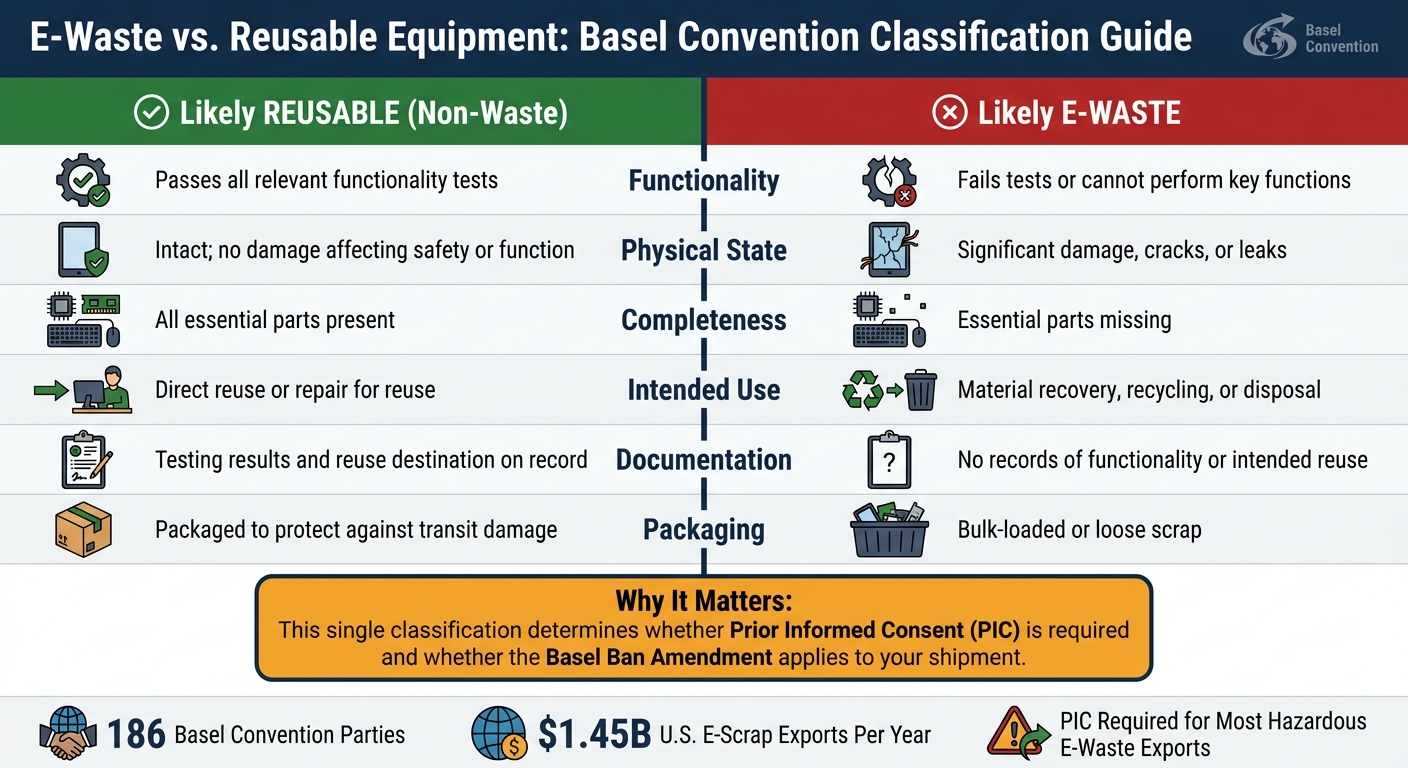
The line between waste and reusable equipment often comes down to a few concrete checks: functionality tests, condition, completeness, intended use, records, and packaging. That's the stuff customs and regulators look at when a shipment gets a second look.
Indicator | Likely Non-Waste (Reusable) | Likely E-Waste |
|---|---|---|
Functionality | Passes all relevant functionality tests | Fails tests or cannot perform key functions |
Physical State | Intact; no damage affecting safety or function | Significant damage, cracks, or leaks |
Completeness | All essential parts present | Essential parts missing |
Intended Use | Direct reuse or repair for reuse | Material recovery, recycling, or disposal |
Documentation | Testing results and reuse destination on record | No records of functionality or intended reuse |
Packaging | Packaged to protect against transit damage | Bulk-loaded or loose scrap |
Documentation is the proof behind the classification. Without records showing functionality testing and intended reuse, even working equipment can be hard to defend as non-waste if border officials question the shipment.
For U.S. organizations, that classification shapes the checklist before any shipment leaves the country.
What U.S. organizations need to do before moving e-waste across borders
The U.S. signed Basel but never ratified it. That means foreign destination rules often end up driving the rules for hazardous e-waste exports. Once electronics are treated as waste, exporters have to line up Basel requirements with U.S. hazardous-waste rules.
How Basel interacts with U.S. hazardous waste rules
U.S. exporters still need to follow the Resource Conservation and Recovery Act (RCRA) and any state laws that apply, while Basel is aimed at limiting the international movement of hazardous waste. The catch is simple: these two systems don't always match.
Feature | U.S. Export Requirements (RCRA/Domestic) | Basel Prior Informed Consent (PIC) |
|---|---|---|
Legal Basis | RCRA and state laws (e.g., CA SB 20) | International Basel Convention Treaty |
Consent Requirement | EPA notification for hazardous exports, with EPA coordinating foreign consent | Explicit written consent from export, transit, and import countries before shipment |
Non-Party Trade | Subject to U.S. domestic law, but still limited by whether the importing country is a Basel party | Prohibits trade with non-parties unless a separate Article 11 agreement exists |
Who Grants Approval | EPA, in coordination with the importing country's government | Competent authorities of export, transit, and import countries |
The U.S. currently has Article 11 agreements for hazardous waste exports to Canada and Mexico [1]. If you're shipping outside those deals, you need to confirm whether another separate agreement applies before sending hazardous e-waste abroad.
A practical checklist before export
This overlap turns paperwork into the next big compliance task. Before any shipment leaves the U.S., organizations should work through a short but strict checklist:
Characterize the material using the waste/reuse test above.
Check for hazardous characteristics. If the material is waste, confirm whether it shows hazardous properties such as toxicity or flammability under U.S. rules and the destination country's rules.
Verify destination and transit country rules. Confirm whether the destination country is a Basel party, whether an Article 11 agreement applies, and whether each transit country has granted consent.
Assemble a defensible evidence file. Keep waste characterization records, functionality test results, consent documents, and shipment manifests together. If a shipment gets stopped or questioned at the border, this file is your best line of defense.
Those same records also help support secure downstream handling and data security. For local support, businesses can also utilize electronics recycling for Bay Area organizations to ensure compliant disposal.
How to manage e-waste responsibly and what to take away
After classification and export checks, the next step is simple: store items safely, keep clean records, and control every handoff.
Best practices for storage, records, and data security
Good e-waste management starts before pickup. Set aside a marked storage area for retired electronics with a clear label like "Electronic Waste – For Recycling." Keep that area protected from weather, unauthorized access, and accidental damage. Lithium batteries, CRT monitors, and mercury lamps should go in closed containers away from heat.
That may sound basic, but it does a lot of heavy lifting. It cuts the chance of loss, mix-ups, and data leaks before a recycler ever touches the equipment.
Here’s a quick look at the main practices and the risks they help control:
Best practice | Risk addressed | How it helps |
|---|---|---|
Labeled, secure storage areas | Environmental liability; misclassification | Prevents mixing with trash or hazardous chemicals |
Detailed inventory logs (device type, quantity, date, final disposition) | Audit exposure | Maintains traceability from generation to disposition |
Chain-of-custody forms with sign-offs at each handoff | Contractual risk | Controls handoff points and keeps vendors vetted |
NIST SP 800-88-aligned data wiping or physical destruction | Data exposure; privacy violations | Protects information before devices leave your control |
Certified recycler/ITAD provider with a written no-illegal-export commitment | Reputational damage; noncompliant exports | Reduces downstream risk through documented downstream flows |
Staff training on waste vs. reusable equipment classification | Misclassification; operational errors | Keeps frontline decisions aligned with internal process |
Don’t let materials sit longer than your policy and local law allow. Limit access to authorized staff only. Keep records for the full required retention period. That includes certificates of data destruction, serial number logs, and recycler certifications. If your internal policy or sector rules require a longer timeline, follow that instead.
Working with a certified Bay Area recycler
If your goal is to avoid cross-border risk, domestic processing keeps things simpler. A certified local provider can help with classification, downstream vetting, and paperwork, which matters a lot for businesses, schools, and organizations that don’t have in-house Basel expertise.
Rica Recycling offers electronics recycling, IT asset recovery (ITAD), and secure data destruction with certificates, plus pickup and drop-off options for businesses, schools, and organizations across the San Francisco Bay Area. Rica Recycling is fully compliant with California e-waste regulations, which helps keep materials in approved channels.
When you evaluate any certified recycler, look for:
Third-party certifications such as R2 or e-Stewards
Written confirmation that no illegal exports will occur
Detailed reporting on asset disposition
Key takeaways for businesses and schools
Responsible handling starts with safe storage, solid records, and secure transfer. Classification and documentation shape compliance: they decide which rules apply, what paperwork is needed, and whether a shipment could be flagged as illegal traffic.
Inventories, chain-of-custody records, destruction certificates, and recycler certifications give you a paper trail you can stand on. Good local handling, clear internal procedures, and cross-border movement only for documented reuse shipments help keep the process clean and defensible.
FAQs
How do I prove equipment is reusable and not e-waste?
To show equipment is meant for reuse rather than e-waste, you need to prove two things: it still works and it’s being kept for further use, not thrown away.
A clear inventory helps a lot here. Record the make, model, serial number, purchase date, and current condition for each item. That paper trail makes it much easier to show the equipment has a next life instead of heading to disposal.
Before anything is reused, wipe all data in a secure way so it can't be recovered while the device stays functional. Rica Recycling can help confirm the equipment’s status, handle proper data sanitization, and provide documentation for compliance.
What happens if my e-waste shipment is misclassified?
Misclassifying an e-waste shipment can trigger serious legal and financial trouble. Under federal law, fines can hit $37,500 per day. In California, penalties may reach $70,000 per violation.
The damage doesn’t stop with fines. A bad classification can lead to contamination, data security issues, and harm to your company’s reputation.
To stay compliant, businesses need to keep clear, accurate records and work with certified recyclers like Rica Recycling.
Do I need consent from transit countries too?
Yes. The Basel Convention generally requires prior informed consent from all countries involved in the transboundary movement of hazardous waste, including transit countries.
For businesses and organizations in the San Francisco Bay Area, Rica Recycling helps simplify these requirements by handling e-waste in line with strict standards and a 100% landfill-free policy.