
Ultimate Guide to Rural Recycling Logistics
Rural recycling works when I match service to distance, volume, and road access - not when I copy a city program. In many rural areas, access is the first problem: 55% of rural respondents recycle vs. 70% in suburban areas, and 29% say service is not available. The fix is usually simple in concept: map where material comes from, use drop-off or hub systems where curbside costs too much, combine loads before long hauls, and track a few numbers every month.
If I had to boil the whole article down, it would be this:
Start with the map: homes, schools, farms, small businesses, roads, bridges, and seasonal closures
Pick the right setup: curbside for clustered homes, drop-off for spread-out areas, hubs for small loads that need consolidation
Separate material streams: paper and cans can move one way; appliances and e-waste need their own handling
Control hauling costs: watch miles per ton, truck hours per ton, fuel per route, and average payload
Lock in partner rules: accepted items, pickup timing, cost sharing, contamination limits, and chain-of-custody for electronics
A few numbers show why this matters. Rural routes can run 120+ miles compared with about 30 miles in suburban areas. Some drop-off sites sit more than 20 miles from the homes they serve. And collection costs can range from $89.38 to $278 per ton, with rural service often near the high end.
Here’s the short version of what I’d keep in mind before building or fixing a rural program:
Topic | What matters most | What I’d do |
|---|---|---|
Service coverage | Low density and long travel | Put sites near material clusters, not just where land is available |
Collection model | Curbside gets costly fast | Use curbside only where homes are close together |
Site type | Volume and staffing drive the choice | Start with drop-off, then add transfer or hub capacity if tonnage grows |
Special materials | e-waste and appliances need separate handling | Use locked storage, clear signs, and certified downstream vendors |
Hauling | Long trips can wipe out material value | Consolidate loads and avoid half-full trucks |
Performance | Small issues become cost problems fast | Review KPIs monthly and fix weak routes early |
In short: if you want rural recycling to last, keep the system simple, local, and data-based - then scale only when the numbers support it.
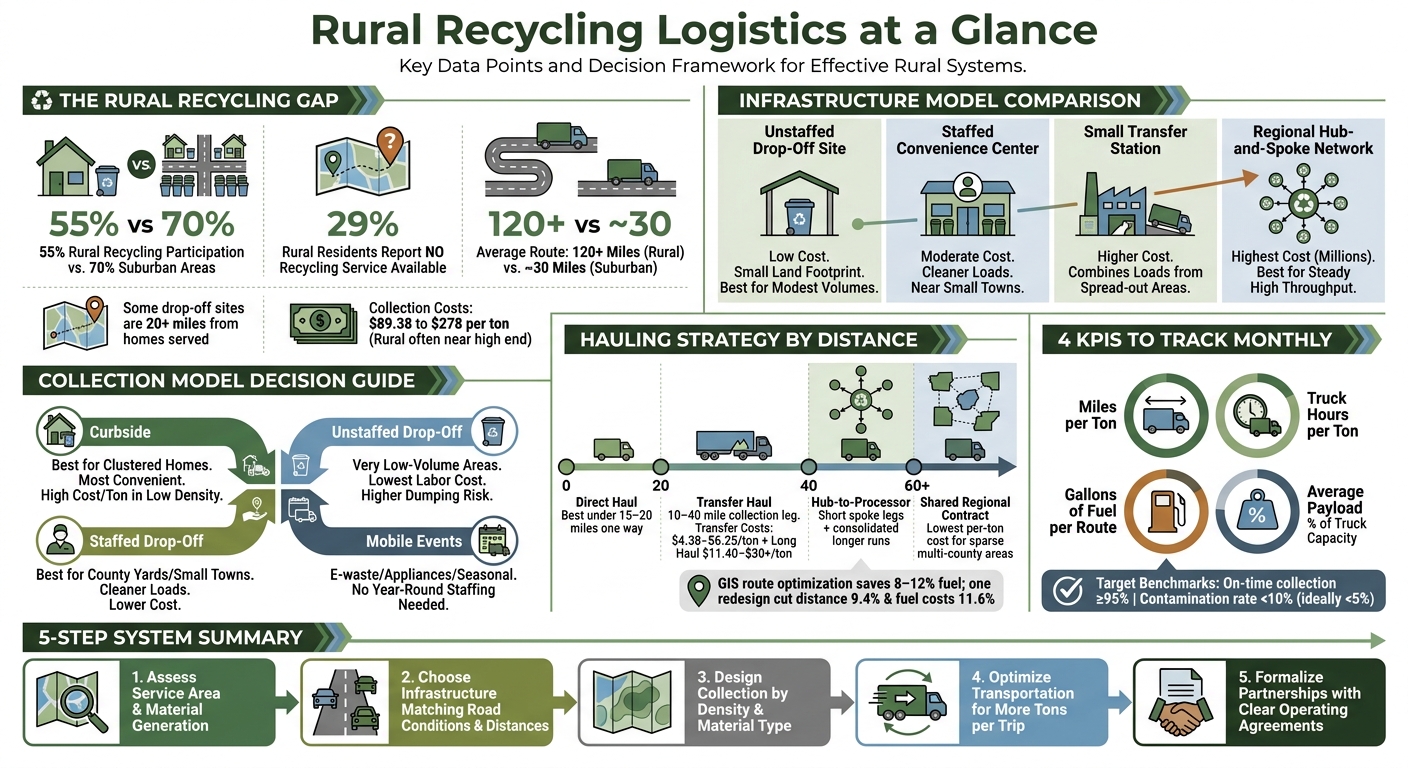
Rural vs. Suburban Recycling: Costs, Coverage & Collection Models
Planning Infrastructure and Service Coverage
Assess Generation Points, Roads, and Seasonal Access Before Choosing Sites
Before you place a single container, figure out where recyclables are actually coming from. Map your generation points first: households, farms, schools, small businesses, and public facilities. Then add rough estimates for how many tons each cluster produces each year. County billing records, school lists, and utility data can help fill in the blanks. GIS heat maps of generation density are especially useful for spotting clusters that deserve attention first.[6][11][4][13]
After that, look at the roads. This is where many plans start to look good on paper and fall apart in practice. Classify routes by surface type, weight limits, and seasonal closures, including mud season, snow, flooding, and bridge limits for loaded transfer trailers. Planning guidance calls for at least 30 ft. of clear distance from the roadway to containers and 4,000 sq. ft. for safe vehicle movement.[3][5][7][9][14]
Seasonal access should be built straight into your cost-per-ton estimates. If a road becomes unreliable for part of the year, that can drive up hauling costs fast and throw off the whole system later.[3][5][7][9][14]
Site access determines what can be built; collection design determines what can actually be served.
Choose the Right Setup: Drop-Off Sites, Transfer Stations, or Hub-and-Spoke Networks
The right site type comes down to volume, staffing, and haul distance.[2][3][6][7][12]
Infrastructure Model | Approx. Capital Cost (USD) | Land Needed | Best Fit for Low-Density Areas |
|---|---|---|---|
Unstaffed drop-off site | Low (tens of thousands) | Small pad near an existing facility | Yes - where volumes are modest and staffing budgets are tight |
Staffed convenience center | Moderate | Space for traffic, multiple containers, small building | Yes - near small towns or existing landfills with resident foot traffic; moderate day-to-day demand |
Small transfer station | Higher | Enough for truck maneuvering and temporary storage | Yes - when combining loads from spread-out communities to cut haul cost; needs more coordination |
Regional hub-and-spoke network | Highest (can reach several million) | Large site for multi-material storage, truck traffic | Recommended when steady throughput and revenue can support the added complexity |
A phased approach usually makes the most sense. Start with drop-off sites, then move toward hub-based systems as volume grows.[3][8][11][2][4][13]
Plan for California Compliance and Safe E-Waste Handling
Electronics collection sites need more than extra space. They need controlled storage and compliant downstream pickup. In California, rural e-waste collection sites have specific duties under the state's e-waste rules. Storage areas should be protected from weather and kept separate from municipal recyclables. Drop zones should be fenced or locked, with supervised drop-off. Signage should clearly list accepted items, banned materials, and any fees. Staff also need training to spot and isolate problem items like CRTs or batteries before those items mix with general material streams.[10]
Recordkeeping and certified downstream processing are also required. Certified providers such as Rica Recycling offer certified electronics recycling and IT asset recovery (ITAD) services, including pickup and drop-off options, secure data destruction, and compliant downstream handling. That gives rural counties and school districts a workable setup: use local sites as safe aggregation points, rely on locked containers and clear signage, and schedule periodic pickups for compliant processing under California e-waste rules. This lets rural programs avoid buying complex on-site processing equipment while still maintaining strong data security and environmental performance.[10]
With sites in place, the next step is choosing how material reaches them.
Designing Collection Systems for Rural Communities
When Curbside Works and When Drop-Off Makes More Sense
Curbside recycling can get expensive in a hurry when homes are far apart. Trucks travel longer distances, crews spend more time between stops, and fuel and maintenance add up. EPA-referenced data shows collection costs from $89.38 to $278 per ton, based on service frequency, vehicle size, and set-out rates.[15] In rural areas, costs often land near the top of that range.
Drop-off programs cut route costs because residents bring materials in themselves. That setup also tends to produce cleaner loads since people usually sort items before dropping them off.
Collection Model | Best Fit | Main Advantages | Key Drawbacks |
|---|---|---|---|
Curbside | Clustered rural towns, semi-rural subdivisions | Most convenient for residents; familiar service | High cost per ton in low-density areas; contamination risk if education is weak |
Staffed drop-off | County yards, small towns, convenience centers | Cleaner loads, lower collection cost, staff can screen materials | Requires site hours, staffing budget, and resident self-haul |
Unstaffed drop-off | Very low-volume areas with tight budgets | Lowest labor cost; simple to deploy | Higher risk of illegal dumping and contamination |
Mobile events | E-waste, appliances, seasonal or special collections | Temporary access without year-round staffing | Low frequency; participation depends heavily on outreach |
The basic rule is pretty simple: use curbside where enough homes are close together to make routes efficient. Use drop-off where they aren't.
When local volumes are too small for direct hauling to work well, the next move is to combine material through a hub.
Using Hub-and-Spoke Collection to Consolidate Small Volumes
After sites and routes are mapped, a hub-and-spoke system can turn that map into something that works day to day. Smaller communities, schools, and county yards act as spokes. They gather and store material close to where it is generated, then send it on scheduled runs to a central hub.
That hub handles the heavier lifting: sorting, baling, storage, and transfer to downstream processors. The point is to turn small local loads into full shipments. Without that step, hauling can feel like driving half-empty trucks across long distances and hoping the math works out.
Spoke communities should also put written agreements in place with the hub. Those agreements should spell out accepted materials, contamination standards, and pickup cadence.
Electronics and appliances need their own setup because they don't move through the system like standard recyclables.
Collection Options for Electronics, IT Assets, and Appliances
Special materials need dedicated channels, not standard bins. E-waste and appliances usually need a mix of collection options so residents, schools, and businesses all have a clear path to use.
That can include:
School and community collection events where residents bring computers, monitors, and small electronics on a set day
Municipal yard or transfer station drop-offs with clearly marked e-waste areas using roll-off containers or secure cages
Direct pickups from businesses, schools, and organizations by certified ITAD providers that handle secure data destruction and asset reporting
Ongoing drop-off at regional hubs during regular hours
For rural programs, certified providers such as Rica Recycling can handle pickup, secure data destruction, appliance recycling, and compliant downstream processing.
Transportation, Routing, and Cost Control
Cut Cost Per Ton with Route Planning and Right-Sized Vehicles
Once sites and collection points are set, routing decides whether the program stays affordable. In rural recycling, transportation is usually the biggest cost driver. When processing facilities sit 100 to 200 miles away one way, fuel, truck time, and driver hours can eat up the value of the material fast. That puts every program in front of the same choice: haul material straight to the processor, combine loads first, or share transport with nearby jurisdictions.
Route design works at two levels. System routing is the big-picture layout: where hubs, transfer stations, and drop-off sites should go, and which processor each site should use so average haul distances don’t get out of hand. Day-to-day routing is the field-level plan: stop order, travel direction, and which vehicle handles each run.
That split matters. A decent map alone won’t fix a weak hauling setup. GIS-based route optimization studies have shown fuel savings of 8% to 12% compared with shortest-path planning alone [19]. One computational study also found a 9.4% reduction in distance traveled and about 11.6% lower total fuel costs after a route redesign [20].
Vehicle size matters just as much as route design. Smaller, easier-to-handle trucks make sense for local pickup. Larger tractor-trailers or walking-floor trailers fit longer hub-to-processor runs, where fuller loads can pay for the equipment. In many rural areas, though, road conditions make that choice for you. Narrow gravel roads, low-clearance bridges, and tight farm driveways often rule out oversized trucks.
A simple metric can flag waste fast: track average payload as a percentage of truck capacity by route. If a route keeps sending out half-full trucks, you’ve found a cost problem.
Direct Haul, Transfer Haul, Hub-to-Processor Runs, and Shared Regional Transport Compared
The right hauling setup comes down to three things: distance, volume, and the number of jurisdictions involved. EPA guidance puts transfer-station break-even at 15 to 20 miles, with one example near 35 miles round-trip [17]. Under that range, direct haul is often the simpler and lower-cost move. Go beyond it, and load consolidation starts to make more sense.
The table below compares the main hauling options for rural programs:
Strategy | One-Way Miles (Typical) | Truck Hours per Ton | Relative Fuel Use per Ton | Cost Signal | Best Fit |
|---|---|---|---|---|---|
Direct haul to processor | Shorter routes; often most practical when processors are nearby | Lower when routes are short and loads are steady | Lower on short routes, but rises quickly as distance increases | Simpler and often cheaper when a transfer station is not justified | Rural counties near a regional MRF or processor |
Haul to nearby transfer point | 10–40 miles on the collection leg | Lower on the collection leg; more efficient on the long-haul segment | Lower per ton on the long-haul leg because loads are fuller | In one county study, transfer station operating costs were about $4.38 to $6.25 per ton, plus long-haul transport of $11.40 to over $30 per ton [18] | Longer-distance disposal or processing with available transfer infrastructure |
Hub-to-processor runs | Short spoke legs; periodic longer hub-to-processor runs | Lower than direct haul because small loads are consolidated before long trips | Lower per ton with consolidated loads | Often competitive in very low-density regions | Many small rural communities feeding one hub |
Shared regional hauling contract | Optimized across jurisdictions | Lower through cross-boundary routing | Lower through fuller payloads | Lowest per-ton potential when routes are underfilled | Sparse, low-tonnage areas across multiple counties |
If a single county can’t produce enough tonnage on its own, shared regional contracts can help fill trucks and cut empty return miles. That’s often the difference between a route that works on paper and one that works in practice. But these agreements need clear rules up front, including cost-sharing formulas, performance targets, and scheduling commitments.
No matter which hauling model a program picks, the same four metrics should stay on the dashboard:
Miles per ton
Truck hours per ton
Gallons of fuel per route
Average payload
Those numbers show pretty fast whether the current setup is doing its job or whether it’s time to add a transfer point, join a regional hauling deal, or redraw the routes.
Once the hauling model is set, the next step is formal agreements and simple performance tracking.
Operations, Partnerships, and Long-Term Performance
Build Regional Partnerships and Clear Operating Agreements
Once the physical network is mapped, formal partners are what keep it moving.
Many rural counties can't run a full recycling system well on their own. The programs that last usually bring together counties, municipalities, tribal governments, school districts, private haulers, MRFs, and specialized recyclers under formal agreements. Those agreements should spell out who handles each task, who covers each cost, and what happens if service breaks down.
Regional agreements can help rural systems grow fast. West Tennessee more than doubled tonnage in two years, and Emmet County expanded service from 35,000 to over 100,000 residents while lowering per-ton costs [16][1].
A good agreement should set clear rules for:
accepted materials
contamination limits
pickup schedules
cost-sharing
insurance
reporting
For electronics and IT assets, add chain-of-custody documentation, serial tracking, and data-destruction certificates.
Track Performance with Simple Logistics Metrics
Use the agreement terms as the starting point for monthly review.
Once partnerships are set up, a small group of KPIs can tell you pretty fast if the system is doing its job. For rural programs, the most useful ones are tons collected per capita, tons per trip, contamination rate, on-time pickup rate, and equipment utilization. Industry benchmarks suggest aiming for an on-time collection rate of 95% or higher and keeping contamination below 10% - ideally under 5% - to avoid rejected loads and processing penalties [21][6].
If you're managing retired electronics and IT assets, tonnage by itself doesn't tell the full story. You also need to track chain-of-custody records, asset inventories by serial number, data destruction certificates aligned with NIST SP 800-88, downstream vendor certifications, and any asset recovery value returned to your organization. A certified ITAD provider such as Rica Recycling can supply these records directly.
Review these metrics every month so problems show up before costs climb. Write clear triggers for formal changes into every agreement, including sustained container overflow, repeat contractor underperformance, or new state regulations. That way, partners revisit assumptions on a set schedule instead of waiting for a service failure.
Conclusion: Core Steps to Build a Rural Recycling Logistics System
A working rural recycling logistics system comes down to five core steps: assess your service area and material generation, choose practical infrastructure that fits road conditions and travel distances, design collection methods by density and material type, optimize transportation to get more tons per trip, and formalize partnerships with clear operating rules.
Each step depends on the one before it. Skip the service area assessment, and sites can end up in the wrong places. Weak operating agreements can turn into cost disputes and missed pickups. Poor route design can eat through budget before material ever reaches a processor. The goal is to match sites, routes, partnerships, and reporting to local volume and road conditions.
North Country Reflections: Helping Rural Communities Recycle Right
FAQs
How do I choose between curbside and drop-off recycling?
Choose based on volume, convenience, and the type of items you need to get rid of.
Curbside pickup is a good fit when you want an easy handoff. It works well for larger loads or planned cleanouts, but it can require scheduling ahead and may come with limits on item types or how much you can set out.
Drop-off often makes more sense for smaller loads or when you need access right away. The tradeoff is simple: you have to transport the materials yourself.
Rica Recycling offers both options in the San Francisco Bay Area.
When does a rural program need a transfer station or hub?
A rural program needs a transfer station or hub when pickup points are spread out and direct shipping costs too much.
Transportation can make up as much as 60% of reverse logistics costs, so a central hub can make a big difference. It lets you combine equipment from offices, schools, and warehouses in one place, fill vehicles more efficiently, cut the number of trips, lower the cost per unit, and keep the program moving while supporting compliance.
Which metrics matter most for rural recycling costs?
Transportation efficiency is the biggest cost driver in rural recycling. In many cases, it can account for up to 60% of total costs. That’s why it pays to track transportation and logistics performance closely, especially when you’re dealing with the high fuel costs and bulky loads that come with e-waste.
It also helps to watch asset recovery rates, waste diversion, and material recovery. These metrics give you a clearer view of what’s working and what’s not. They can help improve route planning, weigh disposal fees against recovered value, and support sustainability and compliance reporting.