
Battery Recycling Toolkit: Resources for Campaigns
I’d sum it up like this: a battery recycling campaign works when I keep four things connected - goals, safety messages, collection setup, and results tracking. In California, that matters because batteries cause waste-facility fires, and about 822 million batteries are used each year while roughly 7,294 tons go to landfills. If I skip planning, people may toss batteries in the trash, collection sites may get messy, and rule issues can show up fast.
Here’s the short version of what this article covers:
- Set clear targets for pounds collected, site access, staff training, and safety incidents
- Focus on higher-risk battery types like lithium-ion, nickel-cadmium, button-cell, and household batteries
- Match the message to the audience so schools, offices, HOAs, seniors, and local agencies each get the right info
- Use EPA, DOT, and California rules to guide storage, shipping, and collection
- Tell people exactly what to do: don’t put batteries in trash or curbside recycling, tape certain terminals, and separate damaged batteries
- Use ready-made outreach materials from groups like the EPA and Call2Recycle instead of building every flyer or post from scratch
- Set up collection points in places people already visit and give one person site ownership
- Keep loose batteries separate from battery-powered electronics such as laptops, phones, and servers
- Track results every quarter with data like attendance, pounds collected, device counts, outreach reach, and incident totals
- Review each event so I can fix weak spots before the next one
A quick way to think about the toolkit is this:
| Area | What I need to do |
|---|---|
| Planning | Pick goals, battery types, audiences, and rule basics |
| Outreach | Use short safety messages and local service info |
| Collection | Set bins, staffing, storage, transport, and electronics intake |
| Reporting | Track volume, turnout, and safety, then update the plan |
If I want a battery campaign that is safe, easy to follow, and easier to run again next quarter, this toolkit gives me the checklist to do it.
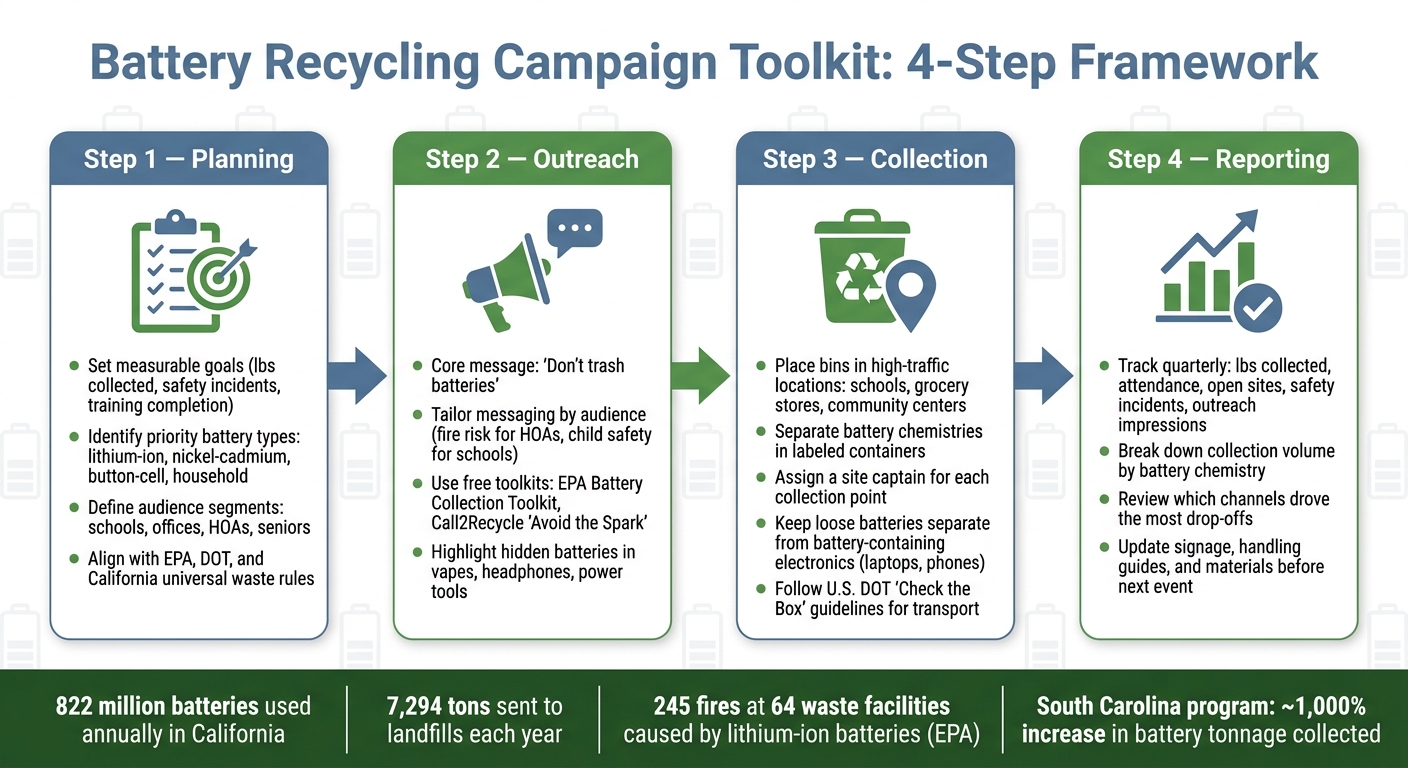
Battery Recycling Campaign Toolkit: 4-Step Framework
Call2Rcycle Video with Fire Chief Volpe PSA 1920X1080 FINAL ENG
Checklist 1: Set Campaign Goals, Audiences, and Compliance Basics
Use this checklist to define goals, audiences, and compliance requirements before outreach.
Define Measurable Goals and Priority Battery Types
Set clear targets for pounds collected, site access, safety incidents, and training completion. Then review performance every quarter.
Put collection targets around the battery types that carry the most risk: lithium-ion, rechargeable nickel-cadmium, button-cell, and household batteries. Track quarterly pounds collected and contamination rates with vendor reports and spot waste audits.
After that, shape the message for the people most likely to respond.
Match Messages to Each Audience Segment
Different groups respond to different angles. A school may care most about child safety and classroom learning. A property manager may care more about fire risk and easy resident access.
| Audience | Core Message Focus | Suggested Channel |
|---|---|---|
| Schools | Button battery safety and science curriculum | Classroom posters, teacher training |
| Offices and Businesses | Workplace safety, safe storage procedures, written collection policies | Internal policy docs, staff training |
| Property Managers and HOAs | Fire risk in multi-unit dwellings, convenient resident access | Building notices, resident access information |
| Seniors | Button battery safety and safe storage | Webinars, podcasts |
Start with U.S. EPA and California Guidance
Begin with EPA recycling metrics and DOT battery shipping guidance. The EPA's "Measuring Recycling: A Guide for State and Local Governments" gives standardized worksheets to calculate recycling rates and track diversion progress. The U.S. DOT PHMSA "Check the Box" initiative covers safe shipping practices for batteries classified as hazardous materials.
If you're working in California, universal waste rules apply to rechargeable batteries, and e-waste rules apply to battery-containing electronics. Build those requirements into collection, storage, and shipping from day one.
With goals, audiences, and rules lined up, the next checklist moves into outreach materials.
Checklist 2: Build Core Safety Messages and Outreach Materials
With goals and compliance rules set, the next step is simple: build the messages and materials people will actually notice. This checklist covers what to say, where to get ready-made assets, and how to direct Bay Area residents and groups to local help.
Write Simple Safety Messages People Can Act On Right Away
The best battery safety messages are short, plain, and easy to act on. Start with the action you want people to take. Skip the long setup.
"Lithium-ion batteries and devices containing these batteries should NOT go in household garbage or recycling bins." - U.S. EPA
Every campaign should center on a small set of must-follow actions. Batteries should never go in the trash or curbside recycling. They can get crushed or damaged during collection, and that can start a fire. For lithium-ion, lithium metal, and nickel-cadmium and nickel-metal hydride batteries over 9V, tape the terminals with non-conductive electrical tape or put each battery in its own plastic bag before taking them to a collection point. If a battery is swollen, damaged, or leaking, keep it away from other batteries and place it in a separate damaged-battery container.
Another problem shows up in plain sight: hidden batteries. Vapes, wireless headphones, remotes, and handheld power tools all contain batteries, yet people toss them out without a second thought. That’s why your visuals and copy should call these items out early and often.
Use one short slogan across every channel. "Don't trash batteries" works because it fits on a sticker, a social post, or a building notice. Just as important, people can remember it. Once you land on the message, repeat it across flyers, signs, and posts.
Pull Materials from National Battery Safety and EPA Toolkits
You don’t have to make every asset from scratch. A few national groups already offer free campaign materials you can use right away.
The U.S. EPA Battery Collection Best Practices Toolkit includes social media posts, flyers, infographics, and how-to guides for state and local governments. Call2Recycle’s "Avoid the Spark" and "Protect What Matters. Be Battery Safe." toolkits include pre-written social captions, videos, and graphics that can be adapted fast. Redwood Materials also offers an advocate toolkit with community outreach templates and lithium-ion safety basics.
These ready-made materials tend to work best when you keep them plain and repeatable. Larimer County showed that simple bilingual visuals and low-cost local outreach can increase collection.
Add Local Service Information for Battery-Containing Electronics
Loose batteries are only part of the story. Many devices, including laptops, phones, and servers, have embedded batteries and need a separate disposal route.
For Bay Area campaigns, direct groups to Rica Recycling for pickup or drop-off of electronics with embedded batteries, along with secure data destruction and California-compliant handling.
Add Rica Recycling service options right into your campaign materials. Put them on drop-off location lists, event signs, and digital resources you share.
These materials should also help people handle the practical side of the program, including collection setup, staffing, and transport procedures.
sbb-itb-855056e
Checklist 3: Plan Collection Setup, Staffing, and Recycling Logistics
Good messaging helps. But by itself, it won’t move batteries safely from people’s hands into the right recycling stream. You also need bins, people who know what they’re doing, and a pickup plan that doesn’t fall apart on event day.
Once the message is set, turn it into a clear collection plan.
Choose Collection Points and Event Formats That Fit Your Audience
"Convenience is key to encouraging battery recycling participation." - Redwood Materials
Put collection points where people already go. High-traffic, familiar places tend to get better turnout: schools, churches, grocery stores, community centers, and downtown plazas.
The format should match the setting. In schools, a labeled collection box in the front office or near the main entrance is often the easiest option. In offices, a central area near the kitchen or printer station makes sense because people pass by it every day. For public events, a pop-up collection table can work well when it’s tied to something people are already attending, like a farmers' market or a neighborhood cleanup day.
Set Safe Handling Procedures for Storage and Transport
Before you open a collection point, write a one-page handling guide. Keep it short, plain, and easy for staff and volunteers to use in the moment. Use labeled containers for each battery chemistry, and keep those chemistries separated at all times. Damaged batteries should go into a separate bin.
This isn’t busywork. An EPA study found that 245 fires at 64 waste facilities were caused, or likely caused, by lithium-ion or lithium-metal batteries. That number makes it pretty clear: storage has to be handled with care.
It also helps to give one person clear ownership. Assign a site captain to check containers, guide volunteers, and handle incidents if something goes wrong. Share incident-response contacts ahead of time, and make sure storage practices line up with local fire-code rules for lithium-ion batteries. For transport, follow the U.S. DOT "Check the Box" initiative guidelines so batteries are shipped safely and labeled the right way.
Coordinate Electronics Recycling and IT Asset Recovery Support
Battery-containing electronics need their own intake stream. Don’t lump them in with loose household batteries. Laptops, phones, servers, and other devices with embedded batteries should move through a separate logistics track.
For larger Bay Area cleanouts, Rica Recycling offers pickup or drop-off for battery-containing electronics, secure data destruction, and IT asset recovery under California e-waste rules.
When you work with an electronics recycler, check that they hold recognized certifications such as R2v3 or e-Stewards. Before you close out the event, ask for both a Certificate of Recycling and a Certificate of Data Destruction. For IT assets, make an inventory of each device by brand, model, and serial number before anything leaves your site. That simple step helps maintain a clean chain of custody.
Checklist 4: Track Results, Report Progress, and Improve the Next Campaign
After each event, record the results and update the toolkit.
Measure Participation, Volume, and Safety Outcomes
Track pounds collected, participation, open sites, and safety incidents. It also helps to break collection volume down by chemistry so storage and pickup planning gets easier over time.
Use the same metrics at every event so you can compare results apples to apples.
| Metric | Q1 | Q2 | Q3 | Q4 | Notes |
|---|---|---|---|---|---|
| Collection Sites (#) | Track growth in accessibility | ||||
| Event Attendance (#) | Measure community engagement | ||||
| Batteries Collected (lbs/tons) | Break down by chemistry if possible | ||||
| Battery-containing devices diverted (#) | Battery-containing electronics only | ||||
| Safety Incidents (#) | Fires, spills, or handling injuries | ||||
| Outreach Reach (Impressions) | Flyers distributed, social media reach |
In South Carolina, the "Take Charge! Be Battery Smart" program launched in November 2023 and offers a solid point of comparison. The South Carolina Department of Environmental Services reported that the program used $15,000 in staff time and a $25,000 EPA grant, trained 2,000 teachers, and helped drive an approximately 1,000-percent increase in statewide battery tonnage collected.
Review What Worked and Update the Toolkit
Once the numbers are in, use them to make the next campaign run more smoothly.
After each campaign, look at which channels brought in the most drop-offs. Did social media posts beat flyers? Did a school event draw better attendance than a weekend pop-up? Talk with site captains and volunteers about what confused participants most. Those pain points are often the simplest things to fix.
A few review questions are worth adding to your post-campaign checklist:
- Which outreach channel generated the most inquiries or drop-offs?
- Which collection points underperformed?
- Where did staff or volunteer handling break down?
- What were the most common questions from the public, and were they answered in your materials?
"The program's greatest challenge is informing residents about the environmental, health, and safety impacts of batteries." - South Carolina Department of Environmental Services
Use that feedback to update signage, the handling guide, and outreach materials before the next event. Small changes can make a big difference. Moving a bin to a busier spot, simplifying a safety flyer, or shifting an event to a Saturday morning can improve turnout and safety outcomes.
Conclusion: The Battery Recycling Campaign Toolkit at a Glance
A strong campaign gets better when goals, outreach, logistics, and reporting stay connected. Set measurable goals and define your audience. Build clear safety messages backed by EPA and national battery safety resources. Run collection logistics safely with trained staff and proper handling procedures. Then track results each quarter so every campaign is better than the one before it.
FAQs
Which batteries should we prioritize first?
Prioritize lithium-ion batteries first because they create major fire and safety risks during collection, transportation, and processing. That includes both loose batteries and batteries still inside consumer electronics.
Also put damaged, defective, or recalled batteries at the top of the list, since they carry an even higher risk of combustion.
After that, include all household battery types.
How should we safely handle damaged batteries?
Damaged batteries can be a serious fire hazard, so handle them with extreme caution and use the right personal protective equipment.
If a battery is swelling, leaking, smoking, or overheating, move it to a container filled with absorbent, non-flammable material. Keep that container in a cool, dry, well-ventilated area - ideally outdoors and away from buildings or vehicles.
Keep damaged batteries separate from undamaged ones. Then contact the device or battery manufacturer for exact handling guidance.
What metrics should we track each quarter?
Track the types and total volume of materials collected each quarter. Ask your recycling provider for regular reports so you can measure impact, show cost savings, and point to the environmental upside.
When you share those results with stakeholders, it helps people see the value of community participation and builds trust in your recycling system over time.