
Top E-Waste Recycling Services for Nonprofits in SF Bay Area
If your nonprofit needs e-waste pickup in the Bay Area, the right choice comes down to four things: data destruction, pickup rules, reuse options, and proof of recycling.
I went through 7 local services and the takeaway is simple:
- Rica Recycling fits groups that want pickup, data destruction, and IT asset recovery
- Tech Exchange and Human-I-T fit nonprofits that want working devices reused
- GreenCitizen fits teams that want drop-off, pickup, and clear pricing
- Goodwill of the San Francisco Bay fits donation-focused loads
- Recology San Francisco matters if you’re in San Francisco and need the city’s approved disposal channel
- Sims Lifecycle Services fits larger IT retirements where records and chain of custody matter
This matters because e-waste is only 2% of the U.S. waste stream but makes up 70% of its toxic waste. And in California, many electronics can’t go into landfills.
So if I were picking a provider, I’d check these first:
- Does it cover my location?
- Is pickup free, and is there a minimum?
- Do they wipe or shred drives?
- Do they issue Certificates of Destruction or Recycling?
- Will they reuse working devices instead of just recycling them?
Quick Comparison
| Service | Best for | Pickup / drop-off | Data handling | Notes |
|---|---|---|---|---|
| Rica Recycling | Mixed loads, ITAD, data destruction | Both | Certificates available | Free drop-off for most electronics; appliances cost $50 each |
| Tech Exchange | Reuse-first donations | Both | DoD wipe on request | Free pickup for 20+ devices |
| Recology San Francisco | SF disposal channel | Drop-off | Check before use | For San Francisco nonprofits |
| Sims Lifecycle Services | Large IT retirements | Both | NIST-based records | Better fit for audit-heavy jobs |
| GreenCitizen | Public drop-off and item-based pricing | Both | Wipe, shredding, certificates | Free pickup for 5+ items within range |
| Human-I-T | Refurbishment and community reuse | Both | NIST-based process; certificate within one week | Free pickup for larger donations; shipping option for smaller loads |
| Goodwill of the San Francisco Bay | Donation-first electronics recycling | Both | Data destruction guaranteed | Free pickup for 20+ units; $20 fee below that |
Bottom line: if you have data-bearing devices, ask about wipe standards and paperwork before you book. If the devices still work, reuse usually makes more sense than sending them straight to recycling.
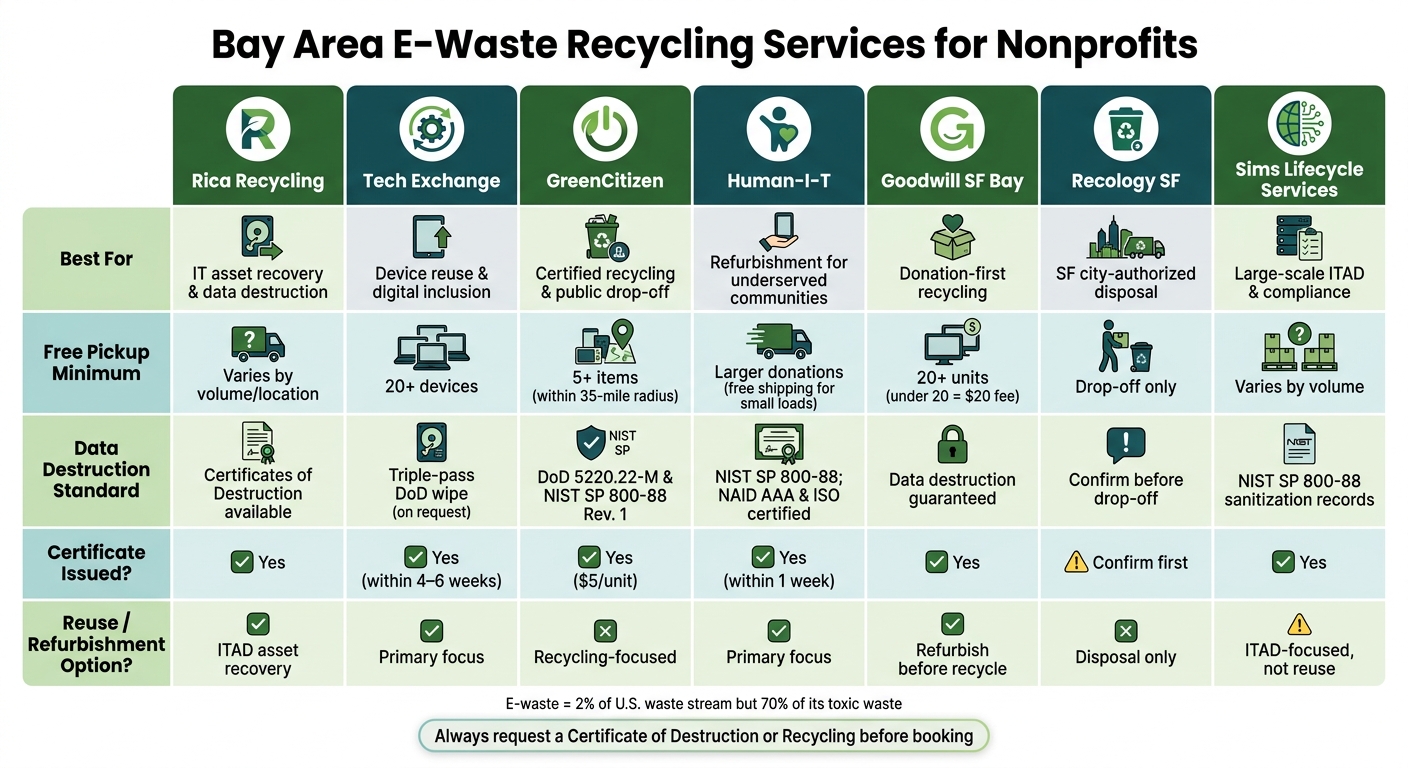
Bay Area E-Waste Recycling Services for Nonprofits: Side-by-Side Comparison
What Nonprofits Should Look for in an E-Waste Recycling Partner
For nonprofits, the main filters are service area, data security, paperwork, and certifications. If you're comparing vendors, focus on four things first.
Start with the basics: service area, pickup minimums, drop-off options, and lead times. If a provider can't handle your location or timeline, the rest doesn't matter much.
Data security comes first. Ask each provider which data-wipe or destruction standard they follow. NIST SP 800-88 Rev. 1 and DoD 5220.22-M are the key benchmarks. Also ask whether they offer on-site hard-drive shredding. That one detail can make a big difference if you're handling donor, staff, student, or patient data.
Always ask for documentation. A solid partner should issue serial-number-specific Certificates of Destruction and Recycling for every device processed. Those records shift liability from your organization to the recycler and create the audit trail you may need for HIPAA, FERPA, or SOX audit requirements.
After that, check third-party certifications. Look for:
If you're in California, state compliance matters too. Your recycler should be CalRecycle- and DTSC-compliant and operate under the Electronic Waste Recycling Act (SB 20/SB 50). And if your nonprofit is retiring devices that still work, ask whether the provider can refurbish and donate usable equipment.
sbb-itb-855056e
1. Rica Recycling
For nonprofits in the Bay Area, Rica keeps things simple: free drop-off, pickup, and secure data destruction through one local service. The drop-off site is in Hayward, CA, and pickup is available across San Francisco, Oakland, San Mateo, and nearby Bay Area communities. Free drop-off covers computers, servers, monitors, printers, cell phones, and cables. Appliance recycling costs $50 per item and is drop-off only. Pickup pricing varies based on volume and location.
If your team handles old devices with stored files, Rica also offers secure hard-drive destruction and provides Certificates of Data Destruction. That paper trail matters when you need proof that data was destroyed. Rica also runs a 100% landfill-free program and works with EPA-registered, R2-certified processors for material recovery.
Some retired devices still have resale value. In those cases, Rica offers IT asset recovery (ITAD) to help nonprofits recover value from old equipment while keeping the process secure.
| Feature | Details |
|---|---|
| Drop-off location | Hayward, CA |
| Pickup area | San Francisco, Oakland, San Mateo, and surrounding Bay Area communities |
| Free drop-off | Yes |
| Appliance recycling | $50 per item (drop-off only) |
| Data destruction certificates | Yes |
| Landfill-free program | 100% |
| Certifications | Works with EPA-registered and R2-certified processors |
2. Tech Exchange
Tech Exchange is an Oakland-based nonprofit that refurbishes donated devices for reuse and recycles whatever can't be reused in a responsible way. If your nonprofit wants working equipment to stay in use before it gets recycled, this is a strong option.
They offer free pickup for donations of 20 or more devices across the Bay Area, including San Francisco, Oakland, San Jose, and nearby counties. If you have a smaller donation, you can drop it off in Oakland Monday through Friday, 10 a.m. to 5 p.m. Most pickups need 1–2 weeks' notice.
Tech Exchange accepts:
- Laptops
- Desktops
- Monitors
- Tablets
- Chromebooks
- Peripherals
They prefer laptops from 2018 or newer and desktops under five years old.
For nonprofit and other organizational donors, Tech Exchange can handle data removal in a few ways. On request, they offer a triple-pass DoD wipe. They also provide magnetic degaussing for hard drives and physical destruction for devices that can't be wiped. If you need records for compliance, certificates of destruction and serial-number logs are available on request and usually arrive by email within 4 to 6 weeks. If you don't request a wipe, devices get a randomized 1-pass wipe and no certificate.
There's another angle here too. If your nonprofit also needs to buy equipment, Tech Exchange's Partner Solutions program offers 10 to 500 refurbished devices at 15% to 50% below retail. Most refurbished laptops come with a one-year warranty.
That mix matters. You're not just clearing out old gear. You may also be solving the next problem: getting replacement devices without paying full retail.
Tech Exchange has distributed more than 250,000 refurbished computers and kept over 3,050 tons of e-waste out of landfills.
| Feature | Details |
|---|---|
| Pickup minimum | 20+ devices |
| Service area | SF, Oakland, San Jose, Santa Clara, San Mateo, Alameda, Contra Costa, Solano |
| Drop-off location | 1716 Telegraph Ave, Oakland, CA 94612 |
| Data wipe | Triple-pass DoD (must be requested) |
| Destruction certificate | Yes, typically delivered within 4–6 weeks |
| Bulk device orders | 10–500 devices via Partner Solutions |
| Zero-landfill policy | Yes |
For nonprofits that need a service built more around recycling than reuse, the next provider takes a different path.
3. Recology San Francisco
In San Francisco, local disposal rules affect how nonprofits recycle your electronic waste. Recology San Francisco is the city’s waste hauler, which means nonprofits need to send electronics through the proper e-waste channel, not the regular trash pickup.
That part matters for compliance. But there’s another issue that matters just as much: data security. If a device stores files, account details, donor records, or staff information, confirm how Recology or its approved partner handles and destroys that data before you drop anything off.
For data-bearing devices, secure handling matters as much as disposal access.
4. Sims Lifecycle Services
For nonprofits that need documented ITAD, Sims Lifecycle Services focuses on secure data destruction and compliance records. That paper trail matters. If your team may need to show exactly how retired devices were handled, clear records can save a lot of stress later.
Before committing to any ITAD partner, nonprofits should verify both secure data destruction and compliance documentation. If you’re talking with Sims, ask for NIST SP 800-88 sanitization records and disposal documentation to support your audit trail.
This becomes even more important for organizations retiring larger volumes of devices, where missing records can turn into a headache fast.
5. GreenCitizen
For nonprofits that need a public drop-off option and clear records for data handling, GreenCitizen stands out in the Bay Area. Since 2005, the company has recycled more than 33.9 million pounds of electronics for business customers.
If you have a small load, the Burlingame EcoCenter has a drive-through drop-off open Monday through Friday, 10:00 AM–6:00 PM. If you have 5 or more items - like laptops, desktops, servers, or monitors - you can book a free on-site pickup within a 35-mile radius. That service covers San Francisco, Oakland, San Jose, and the Peninsula.
Pricing is pretty simple. Laptops, desktops, servers, and monitors are recycled at no charge. Items like printers, keyboards, and cables cost about $1.00 per lb.
On the data side, GreenCitizen offers destruction services that follow DoD 5220.22-M and NIST SP 800-88 Rev. 1 standards. Software erasure costs $5 per drive, physical shredding costs $20 per drive, and Certificates of Destruction cost $5 per unit.
GreenCitizen also gives each major item a unique asset ID through its GTAMS tracking system. Downstream processing stays in the U.S. through R2- and e-Stewards-certified vendors that follow California EPA and DTSC guidelines.
The company is also a Certified B Corporation, which may matter if your nonprofit wants its recycling partner to line up with its sustainability goals.
If your nonprofit needs more involved asset recovery, the next provider leans more toward an ITAD model.
6. Human-I-T
For nonprofits that want usable equipment to keep doing its job, Human-I-T puts refurbishment first. It’s a strong fit for groups that want retired devices fixed up and passed on to underserved communities. That means working tech can go to students, job seekers, and low-income households that need device access and internet service.
In 2025, Human-I-T diverted 3.3 million pounds of e-waste, distributed 72,530 computers, and helped 120,000 households get internet access. So if your nonprofit would rather see reusable devices go back into people’s hands instead of straight into the recycling stream, this option makes sense.
They accept most electronics except appliances, including laptops, desktops, hard drives, and servers. For Bay Area nonprofits with larger donations, free on-site pickup is available and is usually scheduled within two weeks. If the donation is smaller, you can ask for free shipping boxes and return labels.
On data security, Human-I-T follows NIST SP 800-88 sanitization procedures at NAID AAA- and ISO-certified facilities. If a drive can’t be wiped, it’s destroyed by default. Nonprofits get a Certificate of Data Destruction within one week of pickup, plus itemized reporting for data-bearing and high-value assets. Donations are also tax-deductible.
One thing to handle before donating: unlock any device-enrollment locks. Locked devices may be rejected for refurbishment.
If your nonprofit mostly has end-of-life equipment, the next provider is a better match for strict recycling and compliance.
7. Goodwill of the San Francisco Bay
If your nonprofit has devices it can donate, Goodwill tries to keep them in use before sending anything to recycling. Usable electronics are refurbished first, and the rest are recycled.
They take computers, laptops, monitors, phones, network equipment, televisions, and small electronics in either working or nonworking condition. Printers and scanners must be from 2000 or newer.
Here’s how pickup and drop-off work:
- 20 units or more: free pickup
- Fewer than 20 units: $20 pickup fee
- Drop-off: free at Goodwill donation centers in San Francisco, San Mateo, and Marin counties
Goodwill also guarantees data destruction on donated electronics.
They’re a CalRecycle-approved collector, listed under CEWID: 102312, through March 2028.
To schedule a business pickup, call 575-2150. It’s smart to confirm accepted items and quantity limits before you drop anything off or book a pickup.
Quick Comparison Table
Use this quick snapshot to trim your shortlist based on access, data handling, and how well each option lines up with nonprofit needs.
| Organization | Best fit | Service area | Pickup and drop-off | Data Destruction | Nonprofit benefits | Pricing Notes | Certifications / Policies |
|---|---|---|---|---|---|---|---|
| Rica Recycling | IT asset recovery and certified e-waste recycling | SF, Oakland, San Mateo, Hayward | Both | Secure destruction; certificates available | Reuse and recovery value | Free drop-off for most electronics; $50 per appliance | EPA-registered; R2-certified processors |
| Tech Exchange | Digital inclusion and device refurbishing | SF, Oakland, San Jose, Santa Clara, San Mateo, Alameda, Contra Costa, Solano | Both | Triple-pass DoD wipe; certificates available | Refurbishes donated devices for reuse | Free pickup for tech donations | Zero-landfill policy |
| Recology San Francisco | City-authorized e-waste disposal | San Francisco | Drop-off only | Confirm data handling before drop-off | Compliant disposal channel for SF nonprofits | Included in city waste services | CalRecycle-compliant |
| Sims Lifecycle Services | Secure ITAD and compliance documentation | Bay Area | Both | NIST SP 800-88 sanitization; full disposal records | Detailed audit trail for retiring large device volumes | Varies by volume and service | ITAD-focused compliance documentation |
| GreenCitizen | Certified recycling with public drop-off access | SF, Oakland, San Jose, Peninsula; 35-mile pickup radius | Both | DoD 5220.22-M and NIST SP 800-88 Rev. 1; certificates available | B Corp; R2- and e-Stewards-certified vendors | Free for laptops, desktops, servers, monitors; about $1.00/lb for peripherals; $5/drive wipe; $20/drive shredding | R2, e-Stewards, Certified B Corp, DTSC-compliant |
| Human-I-T | Device reuse for underserved communities | Bay Area; free shipping option available | Both | NIST SP 800-88; NAID AAA- and ISO-certified facilities; certificates within one week | Tax-deductible donations; devices go to low-income households | Free pickup for larger donations; free shipping boxes for smaller loads | NAID AAA, ISO-certified |
| Goodwill of the San Francisco Bay | Reuse-first donation and recycling | SF, San Mateo, Marin counties | Both | Data destruction guaranteed | Free drop-off at donation centers; supports community programs | Free drop-off; free pickup for 20+ units; $20 pickup fee for fewer than 20 | CalRecycle-approved collector; CEWID: 102312 |
How to Choose the Right Service for Your Nonprofit
The comparison table above is a good starting point. But the best option comes down to what your nonprofit needs right now. These quick filters can help you narrow the list without wasting time.
If compliance and chain-of-custody records matter most, Rica Recycling is the strongest fit. Rica accepts end-of-life and broken equipment, so device condition doesn't get in the way.
If your devices still have life left in them, reuse should come before recycling. Working laptops and desktops are usually better sent for reuse, refurbishment, or donation. In that case, Tech Exchange and Human-I-T are the better matches.
If you're trying to cut pickup and handling costs, pay close attention to minimum volume rules. Free pickup often starts only after you meet a certain threshold. Common electronics like laptops, desktops, servers, and networking gear are often free to recycle or donate.
Appliances are a different story. They often come with separate charges. Rica Recycling charges $50 per item, so it's smart to factor that in if you're clearing out a break room at the same time as your IT equipment.
| Your situation | Best fit |
|---|---|
| Need audit trail and destruction records | Rica Recycling |
| Have working devices for reuse | Tech Exchange, Human-I-T |
| Need free pickup at qualifying volume | Check provider minimums |
| Recycling appliances alongside electronics | Rica Recycling |
Use this snapshot to double-check volume, data handling, and pickup terms before you book.
Conclusion
No service works for every nonprofit. The best fit comes down to what you need handled, not just who’s available to pick it up. Match the provider to your data risk, device volume, budget, and whether reuse or recycling matters more.
Use the table to trim your shortlist. Then confirm accepted items and service area before you book. Also ask for a Certificate of Destruction or Certificate of Recycling to shift liability.
A complete paper trail helps protect your organization and the people it serves.
If you're planning a reuse-first pickup, expect to give 1–2 weeks' notice.
And if you're booking a mixed pickup, check appliance fees before you lock anything in.
The right partner makes compliance simpler and helps protect your data, budget, and mission.
FAQs
How do I choose the right e-waste service for my nonprofit?
Prioritize providers that offer certified data destruction and can show compliance with state and federal rules. They should issue formal Certificates of Destruction and Certificates of Recycling to support audits and transfer liability.
It also helps when a provider can handle the logistics for you, whether that means bulk pickups or on-site collection events. Just as important, they should maintain a documented chain of custody and follow a strict landfill-free policy.
What proof should I ask for after recycling devices?
Ask for a Certificate of Data Destruction to confirm that sensitive information was permanently removed with secure methods.
It also helps to request chain-of-custody documentation. That gives you a clear record of how assets were handled from pickup to final processing.
If you need device-level tracking, ask for serial-number-specific reporting so you can see the status of each item.
When should working devices be reused instead of recycled?
Working devices should come first for reuse when refurbishment can help meet community needs like education, employment, or digital access programs.
Reuse gives devices a longer life, helps narrow the digital divide, and cuts down on environmental harm. When a device is no longer a good fit for reuse, Rica Recycling can take over with secure, certified electronics recycling and IT asset recovery services.