
How E-Waste Becomes Luxury Jewelry
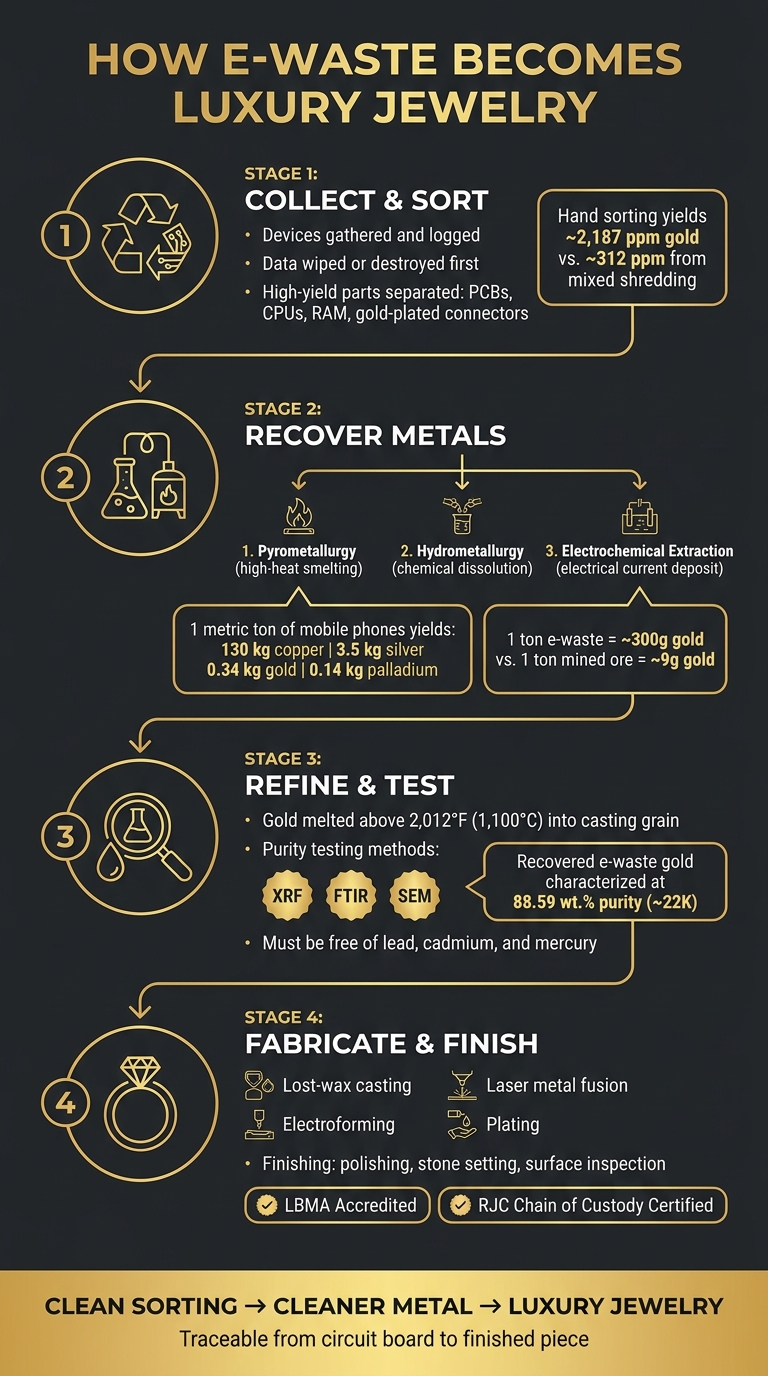
Old electronics can hold more gold per ton than mined ore. In plain terms: e-waste jewelry starts with secure collection, moves through sorting and metal recovery, then goes through refining, testing, and bench work before it becomes a ring, necklace, or plated piece.
If I had to boil the process down, it looks like this:
- Collect devices safely
- Destroy stored data first
- Sort high-metal parts like PCBs, CPUs, RAM, and gold-plated connectors
- Recover gold, silver, copper, and palladium
- Refine and test the metal
- Cast, form, plate, or electroform the final piece
- Track the chain of custody from scrap to finished jewelry
A few numbers make the point fast:
- 1 metric ton of mined ore may yield about 9 grams of gold
- 1 metric ton of e-waste can yield about 300 grams of gold
- PCBs are about 30% metal by weight
- Hand sorting can reach about 2,187 ppm gold, versus about 312 ppm from mixed shredding
- 1 metric ton of mobile phones can contain about 130 kg of copper, 3.5 kg of silver, 0.34 kg of gold, and 0.14 kg of palladium
What matters most is simple: clean sorting leads to cleaner recovered metal. That helps cut waste, lowers chemical load, supports worker safety, and gives jewelers metal that is fit for casting, plating, or electroforming.
| Stage | What happens | Why it matters |
|---|---|---|
| Collection | Devices are gathered and logged | Protects material flow and records |
| Data destruction | Drives are wiped or destroyed | Protects private business and school data |
| Sorting | High-yield parts are separated | Improves metal recovery |
| Recovery | Metals are pulled out by heat, chemistry, or current | Produces crude metal stock |
| Refining and testing | Metal is cleaned and checked | Makes it fit for jewelry use |
| Fabrication | Metal becomes finished pieces | Turns scrap into sale-ready jewelry |
So when you see luxury jewelry made from e-waste, you’re not looking at a gimmick. You’re looking at a step-by-step process that turns discarded electronics into polished metal through sorting, recovery, refining, and traceable fabrication.
How E-Waste Becomes Luxury Jewelry: From Circuit Board to Finished Piece
Making jewelry from the gold in computers
sbb-itb-855056e
Step 1: Source and sort the right e-waste
Start with high-yield e-waste and keep low-value material out of the precious-metal stream.
Electronics and components used for metal recovery
Not all e-waste belongs in precious-metal recovery. The best approach is simple: go after the parts with the most metal first.
PCBs alone contain nearly 30% metal content by weight, including gold, silver, palladium, and copper. That’s why the first items to sort are PCBs, motherboards, CPUs, RAM, and gold-plated connectors, pins, and edge fingers.
| Component | Primary Metals | Why It Matters |
|---|---|---|
| PCBs / Motherboards | Gold, Silver, Copper, Palladium | Major source of recoverable precious metals |
| CPU / IC Chips | Gold, Silver | Good target for gold recovery |
| Gold-Plated Fingers | Gold | Direct leaching target |
| RAM / Memory | Gold, Silver | Steady source for precious-metal recovery |
Batteries, power supplies, and plastic housings should go into separate streams. They don’t add precious metals, and they can contaminate the material you want to process.
Manual dismantling and material separation
Once you’ve picked the right devices, the hands-on work starts.
Batteries come out first, and they need special handling. After that, boards are removed from plastic housings, and parts are sorted by type: chips in one group, connectors in another, wiring in a third.
This early sorting step matters more than it may seem. Cleaner input means better purity, lower reagent use, and more recovery value. Hand disassembly can yield about 2,187 ppm gold, compared with about 312 ppm when whole devices are shredded together.
Put bluntly: cleaner feed means less chemical use and better refining yield. Once that sorting is done, the material is ready for metal recovery.
Step 2: Recover precious metals from electronic scrap
The industry relies on three main recovery paths, and each one produces a different type of material for the next stage. For jewelry, the target is clean, high-purity metal stock. At this point, though, the output is still crude metal stock - not jewelry-grade metal yet.
Hydrometallurgy, pyrometallurgy, and electrochemical extraction
Pyrometallurgy uses high-heat furnaces to smelt circuit boards and pull copper and precious metals from the melt. It works well for bulk e-waste loads and moves fast. The tradeoff is simple: it needs industrial-scale equipment, burns a lot of energy, and creates emissions. That’s why you rarely see it used on a small scale.
Hydrometallurgy takes a different route. It uses liquid chemical reagents to dissolve specific metals on purpose. Older formulas often depend on aqua regia, a highly corrosive mix of nitric and hydrochloric acids. Newer solvents have made this path safer and more efficient. One room-temperature solvent can recover gold from PCB fragments fast and with far less energy than smelting. The gold then precipitates as a fine powder, which is filtered and melted into small ingots or casting grain ready for use. The aim here is metal that’s clean enough for refining, casting, or plating.
Electrochemical extraction uses electrical current to deposit metal. The Wohlwill process, for example, dissolves gold into a chemical solution and then redeposits it onto electrodes as high-purity metal. In jewelry-focused work, recovered copper sulfate solution can also be used for electroforming, where current deposits metal onto a conductive surface.
Here’s what the yield can look like: one metric ton of mobile phones can produce about 130 kg of copper, 3.5 kg of silver, 0.34 kg of gold, and 0.14 kg of palladium. Each method leaves you with a different kind of recoverable stock - gold powder or small ingots, copper sulfate solution, or solid copper - that can move into refining.
Safety, compliance, and handling of non-precious residues
This isn’t a casual process. These systems need closed-loop handling, toxic-gas controls, and regulated treatment from start to finish. Non-precious residues also need tracked reuse or disposal. Copper and tin go to specialist recyclers, fiberglass goes into cement production, and plastics go to other industrial uses.
Document each batch from incoming scrap to recovered metal. That paper trail supports compliance and sustainability claims. That controlled output is ready for refining.
That recovered stock moves into refining in Step 3.
Step 3: Refine recovered metals into jewelry-ready material
Recovered metal isn't ready for the bench the moment it comes out of e-waste. It can still hold trace impurities, mixed alloys, and chemical residue. Refining turns that material into stock that can be used for casting, forming, or plating. The process starts with purity testing.
Purity testing and conversion into usable stock
The refining route depends on what form the metal is in after recovery.
Gold precipitate is first washed, dried, and then melted above 2,012°F (1,100°C) into casting grain or small ingots. After refining, the gold goes through annealing, which is a controlled heating and cooling cycle that brings back malleability before fabrication.
Before that stock moves into jewelry production, it needs to be checked for purity and cleanliness. Different tests handle different jobs:
Recovered e-waste gold has been characterized at 88.59 wt.% purity, or about 22K, with minor silver and copper content that can improve mechanical properties. Jewelry stock also needs to be free of lead, cadmium, and mercury.
Once the stock passes testing, it can move into casting, forming, plating, or electroforming.
Recovered copper sulfate solution takes a different path. Instead of being reduced to solid metal first, small-scale workshops can feed it straight into electroforming baths, where electrical current deposits copper onto a conductive surface. That's a good fit for intricate pieces, especially when a shop doesn't have high-heat smelting equipment.
Comparing recovery methods for jewelry material
Each recovery method leads to a different kind of jewelry input. Hydrometallurgy usually gives the cleanest small-batch stock. Pyrometallurgy still calls for more refining. Electrochemical methods make the most sense when the goal is direct plating or electroforming.
For now, purity testing and chain-of-custody records are the main practical standards. Once stock passes both, it's ready for Step 4.
Step 4: Design and fabricate the finished jewelry
Once the refined stock passes purity testing, it heads to the bench. Now the metal is ready to be turned into sheet, wire, grain, or plated form. From there, it can be worked much like standard jewelry stock, and the jeweler picks the method that fits both the metal form and the shape of the piece.
Casting, forming, electroforming, and plating
Lost-wax casting is a strong fit for solid gold pieces. It also gives designers room to embed recovered electronics right into the form.
For more detailed shapes, laser metal fusion can build intricate solid-gold pieces from refined recovered metal powder.
If the recovered metal is copper-rich, electroforming is often the most direct route. It deposits copper from a solution onto a conductive form, which makes it useful for lightweight pieces with fine detail.
Finishing, traceability, and quality standards
After shaping, the piece moves into final finishing and inspection. Each one goes through polishing, stone setting, and surface inspection before it's treated as finished. The result blends precise fabrication with hand craftsmanship.
Traceability matters just as much as the finish. Reputable e-waste jewelry brands work with refining partners that hold LBMA (London Bullion Market Association) accreditation and Responsible Jewellery Council (RJC) Chain of Custody certification. That helps document the metal's path from the e-waste source to the finished piece.
For business electronics entering the recovery stream, that also includes secure data destruction records. If laptops or servers are dismantled for metal recovery, documented data destruction helps protect the original owner and supports corporate compliance requirements.
Conclusion: What the e-waste-to-jewelry process shows
Turning a circuit board into a gold ring isn't magic. It's a chain of steps: collection, recovery, refining, and fabrication. The value in that chain comes from careful collection, clean separation, and precise refining.
The main takeaway is simple: sorting quality shapes recovery quality. When materials are separated cleanly at the dismantling stage, refining yields purer output. And that means the jeweler has less cleanup work to handle later. Skip steps - or cut corners on compliance - and the whole process starts to fall apart.
That chain also depends on doing the first things first. For organizations retiring electronics, certified collection and secure data destruction need to happen before any recovery work begins.
E-waste-to-jewelry does more than produce beautiful objects. It changes how we think about "waste." That's what turns discarded electronics into luxury: clean sourcing, careful recovery, and traceable craftsmanship.
FAQs
Is e-waste gold safe for jewelry?
Yes. Extracting and refining gold from salvaged metals removes harmful toxins and contaminants.
When the process is done properly, gold from e-waste is free of toxic elements like lead, mercury, and cadmium. It can also reach high purity levels, making it safe to wear in fine jewelry.
Why is hand sorting better than shredding?
Hand sorting and pre-processing improve recovery by separating gold-bearing parts from non-gold materials before chemical processing.
That means only the gold-rich pieces go into treatment. The result is less wasted work, cleaner yield, and better value retention. Breaking circuit boards into smaller, easier-to-handle pieces and removing non-gold material also makes the process more efficient.
How do brands prove the metal is traceable?
Brands show traceability through formal provenance systems, often using a chain-of-custody mark similar to a jewelry assay mark. That mark gives buyers a clear way to check where the metal came from and how it was sourced.
When companies work with specialized recyclers and keep the supply chain open to review, they can follow recovered precious metals from device collection to extraction and refining. That paper trail gives consumers documentation that confirms the gold came from a recycled, responsibly sourced stream.