
ITAD Vendor Selection: Key Questions to Ask
Pick the ITAD vendor that can prove three things: secure data destruction, clear chain of custody, and a clean payout model. That is the short version.
If I were reviewing vendors today, I’d focus on these 7 checks right away:
- Value recovery: How the vendor tests, grades, sells, and pays for retired gear
- Data destruction: Which NIST 800-88 methods they use for HDDs, SSDs, servers, and network gear
- Certifications: Whether their current certs and downstream processors line up with your risk limits
- Scale and logistics: Whether they can de-rack, pack, track, and move gear across one or many sites
- Pricing and liability: What you pay, what you get back, and who pays if something goes wrong
- Audit records: Whether they provide serial-level reports, destruction records, and custody logs
- Track record: Whether they’ve handled data center projects like yours without security failures
A few numbers from the article stand out:
- ITAD can recover up to 95% of resources, versus about 70% for standard e-waste recycling
- Specialized ITAD firms often return 60% to 70% of resale revenue for used data center gear
- In October 2020, Morgan Stanley was fined $60 million after retired hardware with customer data was sold as scrap
Before I compare vendors, I’d first line up my own rules for:
- asset inventory
- data sensitivity
- destruction vs. resale
- minimum rebate floor
- required reports and certificates
That way, I’m scoring vendors on proof, not sales talk.
| Area | What I’d check first |
|---|---|
| Data security | NIST 800-88 method by device type, plus serial-level proof |
| Money | Revenue share, buyback terms, fees, and settlement timing |
| Compliance | Current certifications and downstream controls |
| Logistics | De-racking, transport, multi-site coverage, and tracking |
| Audit trail | Certificates of Destruction, chain-of-custody logs, and resale reports |
If a vendor can’t show me what happened to each serial number, I’d treat that as a warning sign from the start.
What is R2v3? An ITAD Buyer's Guide to the Certification
sbb-itb-855056e
What to Align on Internally Before Evaluating ITAD Vendors
Before you start grilling vendors, get your own house in order. That means agreeing on the standards a vendor has to meet around approval authority, data security, chain of custody, compliance, and value recovery. Those points become the yardstick for every question you ask later.
This step matters because ITAD decisions don’t sit with one team. Several groups usually have a say, and each one is looking at the project from a different angle. IT and data center operations care about inventory, timing, and testing. Information security is focused on sanitization. Procurement looks at pricing and rebates. Legal and compliance wants to limit risk. ESG teams need reporting. Facilities has to deal with the on-site move.
| Stakeholder | Primary Focus in ITAD Selection |
|---|---|
| IT / Data Center Ops | Asset inventory, decommissioning timelines, and functional testing |
| InfoSec | Data sanitization standards (NIST 800-88 Rev. 2) and destruction method verification |
| Procurement | Value recovery rebates, pricing structures, and vendor contracts |
| Legal / Compliance | CCPA, GDPR, HIPAA, and liability for data breaches |
| ESG / Sustainability | Landfill diversion and emissions reporting |
| Facilities | On-site logistics, dock access, and physical security during asset removal |
Scope should be clear early on. Pin down the number of sites, the serial-level inventory, and the decommission timeline. Then classify assets by sensitivity so you can assign Clear, Purge, or Destroy under NIST 800-88 Rev. 2. Without that input, it’s hard to tell whether a vendor fits your decommission plan or just sounds good on a sales call.
It also helps to draw a hard line on value recovery before vendor talks begin. Set a minimum rebate floor. At the same time, flag any assets that must be destroyed even if they still have resale value. Organizations can typically recover 60% to 70% of revenues from the sale of used data center equipment when using a specialized ITAD partner. That range gives you a solid baseline when comparing vendor offers.
You’ll also want to agree on the paperwork up front. For many teams, that means things like:
- Certificates of Destruction
- Signed chain-of-custody records
- ESG impact reports
When those requirements are set internally, every vendor gets measured against the same standard. That makes the next round of vendor questions much easier to compare.
1. What is your approach to IT asset recovery and value optimization for data center equipment?
This question goes straight to the vendor’s main process. A good answer should do more than promise resale. It should show, step by step, how the vendor handles your equipment from pickup through final settlement.
Once you’ve set your recovery floor, ask how the vendor turns retired hardware into net return.
Value recovery model
Start with the basics: how they inventory, test, grade, and route assets. Some equipment should go to resale. Some should be used for parts. Some should be recycled. That call should follow clear rules based on age, configuration, cosmetic condition, and current demand in the secondary market. In plain terms, newer blade servers and high-port-count switches usually sell for more than legacy hardware.
You’ll also want to know how pricing works. Do they rely on model-level price databases, recent sales history, or guaranteed buyback rates? Just as important, ask how that value gets passed back to you. A clear settlement report should show the gross sale price, fees, and net return for each asset.
Next, make sure their process protects data without cutting into recoverable value.
Data destruction controls
Value recovery and data security don’t have to compete. But that only works if the vendor treats both with the same level of care. Ask how they separate data-bearing devices from the rest of the equipment and what chain-of-custody controls they use during transport.
For example, a vendor may recover full value from servers and networking gear while physically destroying all retired SSDs and HDDs that hold sensitive data. That lets you keep return on assets that still qualify for resale while meeting security rules for the devices that don’t.
Certifications and downstream compliance
Certifications matter because they show the vendor’s recovery process can stand up to review. They also show whether materials are tracked through every downstream channel, which helps protect you from compliance gaps during an audit.
Operational capacity
Capacity matters more than many teams expect. Ask if the vendor can handle de-racking, packing, secure removal, and custody transfers at your scale. That includes phased decommissions, multi-site rollouts, and after-hours work.
If there’s a weak spot here, it can slow everything down. And when assets take longer to reach the market, recoverable value can drop.
2. How do you guarantee secure data destruction and prove compliance?
After you confirm how a vendor recovers value, the next step is data security. This is where vague answers aren't good enough. You want specifics: how each device is sanitized, how that process is tracked, and what paperwork proves it happened.
Once value recovery is in place, check that every device type has a matching sanitization method.
Data destruction controls
Ask for the exact sanitization method used for each device type. Different hardware needs different treatment, and those methods should line up with NIST SP 800-88.
Here’s how the three sanitization levels break down:
| Method | Technical Approach | Typical Use | Reusability |
|---|---|---|---|
| Clear | Software-based overwriting using standard IT tools | Non-sensitive data | Fully reusable |
| Purge | Cryptographic erasure or degaussing | Sensitive or regulated data | Fully reusable |
| Destroy | Physical shredding, melting, or pulverizing | Highly confidential data | Completely unusable |
That method should be logged against each serial number and final disposition. In plain terms, you should be able to look at a device and see what happened to it, how it was sanitized, and where it ended up.
Ask for device-specific sanitization methods for:
- Servers
- HDDs
- SSDs
- Network gear
Logistics and reporting capability
Require serial-number-level reporting for every asset, including final disposition.
Certifications and downstream compliance
Ask for certificates of destruction, chain-of-custody records, and downstream recycling or remarketing records. Those records should be backed by the certifications and audit documents you ask for next.
3. What certifications do you hold and how do you ensure responsible recycling?
Once sanitization and chain-of-custody controls are in place, the next step is to check the vendor’s certifications and recycling chain.
Certifications and downstream compliance
Ask which certifications the vendor currently holds, and request current copies of every active certificate. That sounds basic, but it matters. A certificate on paper doesn’t mean much if the same controls stop at the vendor’s front door.
You’ll also want to ask how downstream processors and recyclers are screened to that same bar. Think of this as a risk check. The recycling path should support compliance, auditability, and responsible disposition at every step.
For California sites, confirm compliance with state e-waste rules and landfill-free handling.
4. Can you handle our data center's scale, timelines, and logistics?
Once the security and recycling checks are done, the next step is simple: can the vendor actually handle the job at your scale?
This is where a lot of projects either run smoothly or go sideways. After compliance and data destruction controls, you need to know whether the vendor can move fast without hurting asset value.
Logistics and reporting capability
Ask if the vendor can staff the project and finish the work inside your maintenance windows. A vendor set up for a full data center decommission should be able to manage:
- Rack teardown
- Cable removal
- Palletizing
- Secure transport across one or more sites
If you're dealing with multi-site work, ask for one point of contact and regular status updates. That sounds small, but it saves a lot of confusion when timelines get tight.
You should also require serial-level tracking for every asset. That means make, model, serial number, asset type, and final disposition. If assets are coming from more than one site, that tracking needs to stay intact across all locations, with final reconciliation delivered in a single report.
Value recovery model
Scale has a direct effect on resale value, so ask how the vendor keeps hardware moving without delay or damage. In plain terms: if equipment sits too long, gets mishandled, or leaves the site in a messy process, value drops fast.
Ask how the vendor protects resale value during high-volume removals. Also ask whether buyback applies to servers, storage, and networking gear.
Slow or poorly coordinated logistics can cut recovery value and add operational risk. That’s why execution speed and chain-of-custody discipline matter just as much as the vendor’s technical capabilities.
5. How do you structure pricing, rebates, and risk protection?
Once logistics are set, the next step is simple: make sure the deal makes financial sense.
Ask for a clear breakdown of price, rebate, and liability. A good way to look at pricing is in three buckets:
- What you’ll pay
- What you might recover
- Who’s on the hook if something goes wrong
That split helps you see the deal for what it is, instead of getting lost in one big quote.
Value recovery model
Start with the rebate. Ask how it’s calculated, when payment is issued, and whether the quote includes deductions, minimums, or holdbacks. That part matters more than it may seem. A quote can look strong at first glance, then shrink once fees and holdbacks show up.
Also, keep rebate pricing separate from destruction charges. If those numbers are bundled together, it gets much harder to tell what you’re gaining and what you’re simply paying for.
Data destruction controls
For data destruction, ask how pricing works. Is it billed per device, per drive, or per project? Those models can lead to very different costs, especially if your asset mix is uneven.
You’ll also want to confirm whether reporting is included in the quoted price. If it isn’t, that line item can show up later and change the math.
Risk protection and downstream compliance
Price is only part of the picture. The last financial guardrail is contract liability.
Spell out who is liable for transit loss, data incidents, downstream failures, and missing chain-of-custody records. Don’t leave those points implied or buried in general terms. Put them directly in the contract.
| Pricing Component | Type | Main Driver |
|---|---|---|
| Deinstallation | Variable | Labor hours, rack complexity |
| Transportation | Variable | Volume, number of sites |
| Data destruction | Variable | Method and billing unit (per device, per drive, or per project) |
| Compliance reporting | Often fixed | Included or itemized in quote |
6. What reporting and documentation do you provide for audits?
After security, certifications, and logistics, ask a simple follow-up: What audit evidence will you give us for each asset?
That question matters because these records support IT, security, legal, procurement, and ESG reviews. They’re not just paperwork sitting in a folder. They’re the proof you’ll use to score vendors and check whether the process happened the way the vendor said it did.
Ask for asset inventory reports that link serial numbers to the final resale or recycling outcome, along with net proceeds. Ask for serial-level destruction records that show the method, timestamp, location, and certificate of destruction. And don’t stop at final destruction. You also want documentation for intake, refurbishment, and downstream material handling.
It also helps to confirm that the vendor can export chain-of-custody records in formats your team can actually use, such as CSV, PDF, and portal exports. If your team can’t import the data, it’s a headache waiting to happen.
Use the records below to verify each step of the disposition process.
| Report Type | Key Data Included | Compliance Support |
|---|---|---|
| Serialized Inventory | Serial number, asset tag, condition, final disposition | IT audits, inventory reconciliation |
| Certificate of Destruction | Method, timestamp, location, technician ID | HIPAA, GDPR, PCI-DSS, SOX |
| Chain-of-Custody | Signed handoffs, GPS transit logs, dual-custody verification | Data privacy laws, insurance claims |
| Environmental Impact | Landfill diversion %, CO2 reduction, material recovery | ESG reporting, sustainability goals |
Use these records as the evidence layer in your vendor scorecard. In plain English: your documentation should map straight to your vendor evaluation checklist.
7. What is your track record with data centers and how do you maintain a security-first culture?
Documentation shows what a vendor says it does. Track record shows what it has actually done.
Once you've reviewed the paper controls, the next step is simple: ask for proof from past data center work. The strongest signal isn't a broad claim like "we've done this before." It's evidence from projects that look like yours.
Ask for named references from similar data center clients. That could include cloud providers, colocation facilities, financial services firms, or healthcare organizations. Then get specific. How many data center decommissions has the vendor completed in the past year? What did typical asset volumes look like? What was its on-time completion rate? You should also ask for anonymized summaries of similar data center projects, including scope, asset count, timeline, recovery rate, and incident history.
A security-first culture shows up in day-to-day habits, not sales language. Look at hiring, access control, and training. Ask whether staff who handle assets go through background checks, use role-based access controls, and sign confidentiality agreements. Then look one layer deeper: how are temporary staff and subcontractors screened, trained, and monitored?
Value recovery model
Don't settle for a promise of return. Ask for proof of value recovered on similar data center projects, including asset mix, timeline, and net return.
Data destruction controls
Ask for one recent decommission walkthrough that shows who handled the assets, where handoffs happened, and how exceptions were resolved.
Certifications and downstream compliance
Ask how the vendor audits subcontractors, fixes findings, and stops repeat security failures.
Logistics and reporting capability
Control during logistics matters because security problems often happen at handoff points. Ask whether one team manages pickup, transport, storage, and processing under a single tracking system. If that chain breaks, risk goes up fast.
Once you have a clear view of the vendor's track record and day-to-day culture, you can turn those answers into a structured evaluation checklist.
Value Recovery Models for Retired Data Center Equipment
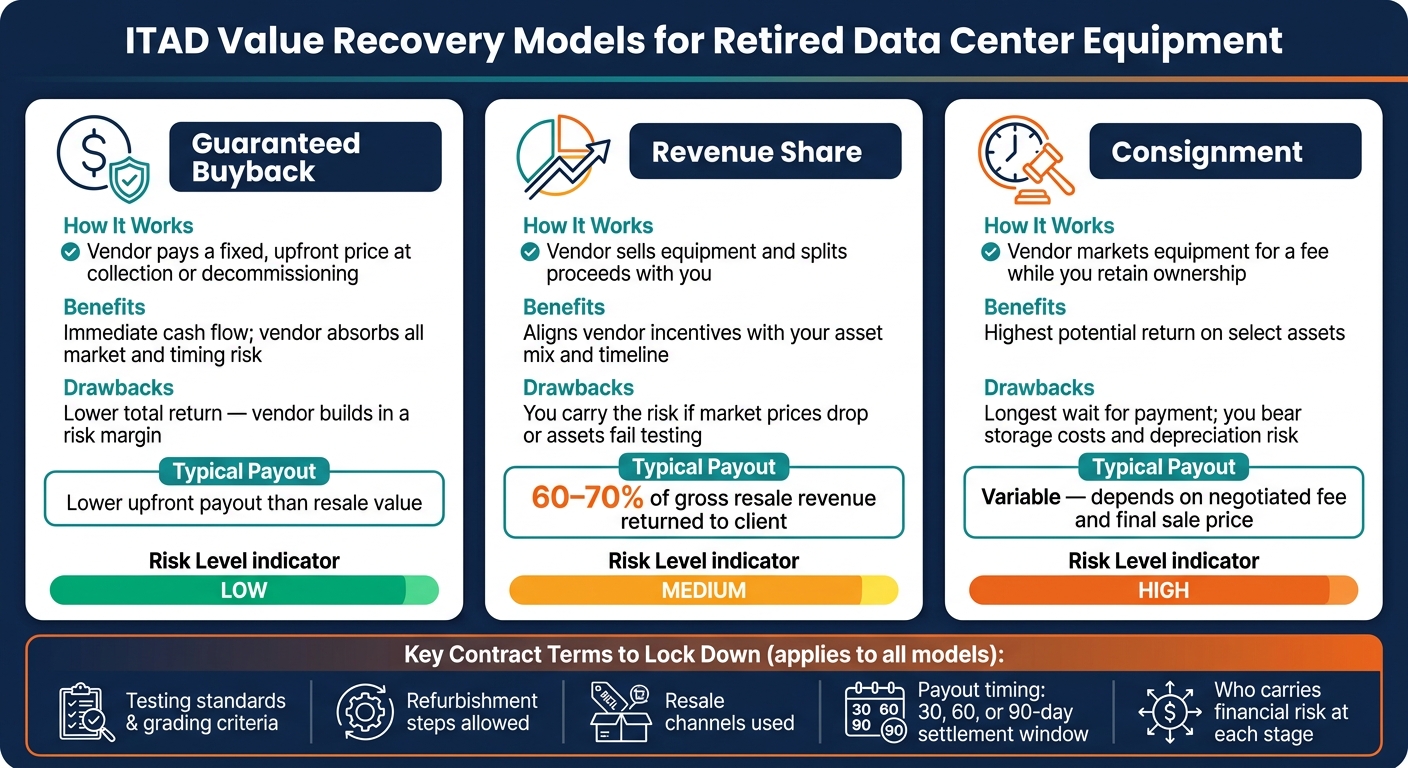
ITAD Value Recovery Models: Guaranteed Buyback vs Revenue Share vs Consignment
Once you’ve checked the vendor’s security practices and track record, the next step is simple: look hard at the payout model.
This part matters more than it may seem. The payout structure shapes your cash flow, your risk, and how much money you may get back. Put bluntly, two vendors can handle the same gear and still give you very different financial outcomes.
There are three common models, and each comes with its own risk-return tradeoff:
| Model | How It Works | Benefits for Data Centers | Potential Drawbacks | Typical Payout |
|---|---|---|---|---|
| Guaranteed Buyback | Vendor pays a fixed, upfront price for the equipment upon collection or decommissioning | Immediate cash flow; vendor absorbs all market and timing risk | Usually results in a lower total return as the vendor builds in a risk margin | Lower upfront payout than resale value |
| Revenue Share | Vendor sells the equipment and splits proceeds with you | Aligns vendor incentives with your asset mix and timeline | You carry the risk if market prices drop or assets fail testing | 60–70% of gross resale revenue returned to client |
| Consignment | Vendor markets the equipment for a fee while you retain ownership | Higher potential return on select assets | Longest wait for payment; you bear storage costs and depreciation risk | Variable; depends on the negotiated fee structure and final sale price |
A Guaranteed Buyback is the most predictable option. You get paid upfront, or at least at pickup or decommissioning, and the vendor takes on the market risk. That said, there’s no free lunch. Because the vendor is taking that risk, the offer is usually lower than what the equipment might earn in a later resale.
A Revenue Share deal can pay more, especially if your retired equipment is in good shape and still has demand. The catch is that you’re tied to market performance. If prices slip or units fail testing, your return drops too. In many cases, clients receive 60–70% of gross resale revenue.
Consignment can bring the highest return on the right assets, but it also asks for the most patience. You keep ownership while the vendor markets the gear for a fee. That means a longer wait for payment, plus more exposure to storage costs and depreciation. It can work well for select items, but it’s not the path for teams that need cash back fast.
Just as important as the model itself are the settlement terms. The contract should spell out a settlement window of 30, 60, or 90 days. If that window is vague, trouble tends to show up later.
You’ll also want a clear answer to a practical issue: what happens if assets fail testing or arrive with missing parts? The contract should state whether the result is an adjusted payout or return of the asset. If that point is fuzzy, disputes get a lot easier to start and a lot harder to fix.
Before signing, lock down these terms in writing:
- Testing standards and grading criteria
- Refurbishment steps the vendor is allowed to take
- Resale channels they use
- Payout timing
- Who carries the financial risk at each stage
Next, match each payout model to the right data-destruction method for each device type.
Data Destruction Methods by Device Type
Not every device should be sanitized the same way.
A method that works for magnetic media may be the wrong fit for SSDs or flash storage. And if you choose poorly, you can end up with leftover data or wipe out resale value for no good reason. The safest move is to match each device type to the NIST 800-88 Rev. 2 method that fits the media and the sensitivity of the data.
Data sensitivity should drive the method. Before any asset leaves your site, ask the vendor to spell out exactly which method they use for each device type. Then compare that plan against your asset list before you approve destruction.
| Destruction Method | Applicable Device Types | Security Level | Documentation Provided | Impact on Resale Value |
|---|---|---|---|---|
| Software Wiping (Clear) | HDDs, SSDs, Servers, Laptops | Basic | Serialized Asset Report, Serialized Certificate of Sanitization | High - Preserves full functional value for resale |
| Cryptographic Erasure (Purge) | SSDs, NVMe, Self-Encrypting Drives | High | Serialized Asset Report, Certificate of Destruction | High - Sanitizes data without wearing out flash memory |
| Degaussing (Purge) | HDDs, Magnetic Tapes | High | Certificate of Destruction, Asset Log | None - Renders magnetic media unusable by destroying servo tracks |
| Shredding / Crushing (Destroy) | HDDs, SSDs, Tapes, Optical Media, Flash Media | Maximum | Timestamped Certificate of Destruction | None - Value is limited to raw material/scrap recovery |
Use this device map as a gut check: does the vendor's process line up with your security needs and your recovery goals? The paperwork should also line up with the serial-level reports covered in the audit section.
A few points matter more than most:
- Degaussing does not work on SSDs or flash media.
- Wiping preserves resale value; shredding eliminates it.
- For highly confidential data, use on-site destruction and require a serialized Certificate of Destruction tied to each make, model, and serial number.
No serial number, no valid proof.
Next, verify that the vendor's certifications and downstream recyclers support the method used on each device.
Certifications and the Risks They Reduce
After you confirm downstream processors, the next step is simple: check the controls behind them. Certifications help you do that. They give you a way to review downstream controls, environmental handling, worker safety, and information security before retired assets leave your hands.
| Certification | Focus Area | Risk Reduced | Documentation to Request |
|---|---|---|---|
| R2v3 | Responsible reuse, data security, downstream accountability | Unvetted downstream vendors, data exposure during remarketing, improper disposal of e-waste | R2v3 certificate and downstream due-diligence records, data sanitization process documentation |
| e-Stewards | Hazardous e-waste controls, export restrictions, responsible recycling | Illegal export of hazardous e-waste, toxic material mishandling, non-compliant recycling | e-Stewards certificate and export-control policy, landfill-free policy |
| ISO 14001 | Environmental management systems | Environmental liability and improper disposal | ISO 14001 certificate, environmental management policy |
| ISO 45001 | Worker health and safety | Workplace injury liability and unsafe handling of hazardous components | ISO 45001 certificate, safety management plan |
| ISO 27001 | Information security management | Data breach during transit or processing, unauthorized access to storage media | ISO 27001 certificate, chain-of-custody records |
Here’s the quick read on what each one tells you. R2v3 deals with reuse and downstream accountability. e-Stewards is centered on hazardous e-waste exports and responsible recycling. ISO 27001 speaks to information security. ISO 14001 and ISO 45001 cover environmental and worker-safety risks.
Don’t just glance at a PDF and move on. Verify the certificate number and expiration date directly with the certifier. Certifications can lapse, and that small detail can turn into a big problem if you hand over retired assets to a vendor with inactive status.
Once the certifications check out, the next question is whether the vendor can handle decommissions at your scale.
Operational Capability Checklist for Large-Scale Decommissions
For large decommissions, you need to know if a vendor can staff the job and handle logistics within your maintenance window. Speed matters here for another reason too: it helps protect resale value.
This checklist helps you separate vendors that say they have capacity from vendors that can do the work when the clock is running. The table below focuses on the operational checks that matter most in a large data center decommission. Pay close attention to the red flags column. Those answers should make you stop and look closer.
| Capability | Why It Matters | Questions to Ask | Red Flags |
|---|---|---|---|
| On-site Packing & Palletizing | Prevents damage and keeps assets secured before leaving your control. | Do you provide on-site palletizing, tamper-evident packing, and serialized logging at the point of collection? | Your team is expected to pack sensitive assets unsupervised. |
| Rack Teardown & Cable Removal | Dismantling enterprise hardware requires specialized labor to safely break down racks and remove cables. | Can your team handle full rack breakdown and cable removal? | No specialized tools or live data center experience. |
| After-hours & Maintenance Windows | Protects uptime when work must happen outside normal hours. | Can you deploy a dedicated crew for weekend or after-hours work? | Limited availability or high surcharges for non-standard hours. |
| Crew Size & Labor Capacity | Large decommissions require sufficient labor to maintain security and meet deadlines. | What is your maximum technician deployment for a single-site project? | Vague answers about labor capacity or heavy reliance on temporary, unvetted staff. |
| Secure Transport | Chain of custody doesn't end when equipment leaves the rack. Sealed trucks and documented handoffs reduce loss and tampering risk in transit. | Do you use GPS tracking, tamper-evident seals, and signed driver handoffs? | No GPS tracking, no sealed transport, or no documented handoffs. |
| Multi-site U.S. Coverage | Prevents inconsistent workflows, handoff gaps, and audit mismatches across sites. | Can you provide the same security standards and reporting format across all our U.S. data center locations? | Fragmented service levels, different documentation formats by region, or reliance on unvetted local subcontractors. |
After a vendor passes these operational checks, move on to pricing, rebates, and liability terms.
ITAD Cost Components and Revenue Streams
Once you’ve set rebate and liability terms, the next step is simple: break the proposal into line items. That makes it much easier to compare vendors side by side instead of trying to judge two bundled quotes that hide the details.
Use the table below to see where the money goes, where it comes back, and what each provider should explain before you sign.
| Line Item | Cost or Revenue | What Drives the Charge / Payout | Questions to Clarify |
|---|---|---|---|
| Packing & Handling | Cost | Volume, security level (dual custody, tamper-evident seals) | Is packing labor included in the quote? |
| Transportation | Cost | Weight, pallet count, and fuel surcharges | Are there extra fees for inside pickup or liftgate service? |
| De-installation Labor | Cost | Rack count, cable harvesting complexity, and site access | Is the team trained for live data center environments? |
| Data Shredding | Cost | Number of drives, on-site vs. off-site, and drive type (SSD vs. HDD) | Do you provide a serialized Certificate of Destruction? |
| Recycling Fees | Cost | Weight of unrecoverable e-waste and presence of hazardous materials such as batteries | Are recycling, landfill, and hazardous-material fees itemized? |
| Resale Proceeds | Revenue | Market demand, equipment age, and refurbishment quality | What is the revenue-share percentage? |
| Parts Harvesting | Revenue | Component demand (CPUs, RAM) and labor to pull parts | How do you inventory and price harvested parts? |
| Reporting Fees | Cost | Depth of audit trail, portal access, and ESG metrics | Is there a fee for portal access? |
A quote can look solid at first glance and still hide costs in the fine print. Storage fees, legacy-hardware surcharges, and hazardous-material charges are common places where pricing starts to drift. That’s why line-by-line review matters.
Gartner estimates ITAD providers return 60% to 70% of used data center equipment revenue to the disposing organization. That payout can change a lot based on timing. If a provider sits on gear for weeks before listing it for resale, your return may take a hit. Ask how long it takes from pickup to resale listing, and get that timeline in writing.
It also helps to pressure-test each charge against the destruction method behind it. If you’re paying for data shredding, for example, make sure the vendor spells out whether that means on-site shredding, off-site processing, or another method entirely. The same goes for recycling fees: don’t settle for a lump sum when itemized charges tell you what you’re paying for.
Reports and Documents That Support Audit Readiness
Use the documents below to check a vendor’s claims around chain of custody, destruction, recycling, and recovery for every retired asset.
| Report Type | Purpose | Data Included | Audit/Compliance Support | Format |
|---|---|---|---|---|
| Serialized Inventory Report | Maps retired assets to internal inventory | Make, model, serial number, asset type, and condition | Confirms retirement of tracked inventory | CSV |
| Chain-of-Custody Log | Shows each handoff and transit point | Signed custody transfers, timestamps, location data, and vehicle IDs | Proves assets stayed accounted for from pickup to final disposition | |
| Certificate of Data Destruction (CoD) | Links sanitization method to each serial number | Serial number, destruction method (Clear/Purge/Destroy), and date/time | Supports HIPAA, GDPR, CCPA, and NIST 800-88 Rev. 2 compliance | |
| Recycling Certificate | Proves downstream recycling compliance | Total weight, downstream recycling path, and processor information | Confirms compliance with CA SB20/50 and federal RCRA requirements | |
| Resale/Settlement Summary | Financial reconciliation of recovered assets | Market value, refurbishment status, and net payout details | Supports internal financial audits and value recovery tracking | CSV |
| Environmental Impact (ESG) Report | Quantifies landfill diversion and emissions avoided | CO₂ emissions avoided, energy saved, and landfill diversion rates | Supports corporate ESG disclosures and sustainability audits |
Here’s the simple way to think about it: CSV files help you reconcile records. PDF files help you build the audit trail.
That means each report should tie back to:
- a serial number
- a final disposition
If a vendor can’t connect those two dots, the paper trail has a hole in it.
Treat these documents as the evidence column in your vendor scorecard.
How to Turn These Questions into a Vendor Evaluation Checklist
Take the documentation and controls above and turn vendor answers into a scorecard. These seven questions should anchor your weighted RFP and vendor scorecard.
The rule is simple: score vendors on proof, not promises. Serial-level documentation and chain-of-custody records should drive the scoring, not sales claims.
Map each question to an evaluation category, then set the weight for each category based on what matters most to your organization.
| Evaluation Category | What to Compare |
|---|---|
| Data Security & Destruction | Data sanitization methods and proof of destruction |
| Certifications & Compliance | Relevant certifications and regulatory alignment |
| Value Recovery | Remarketing approach, resale revenue share, and pricing transparency |
| Logistics & Scale | Ability to support large decommissions and tight timelines |
| Reporting & Audit Readiness | Inventory reports, destruction certificates, and audit documentation |
| Track Record & Culture | Experience with data centers and a security-first culture |
This part works best when it isn't handled by one team alone. Have IT, Security, Procurement, Facilities, Legal, and Sustainability review the RFP before it goes out.
It also helps to test the checklist before you bet the whole project on it. Start with a small sample. Then run a pilot decommission before full rollout to check tracking and reporting in practice. Those pilot records can then be used to score each vendor.
Conclusion
Choose the vendor that can show the work with serial-level records, chain of custody, and clear payout terms. Then compare vendors based on proof, not sales talk.
The right partner should give straight answers to three things: how it recovers value, how it destroys data, and how it records each step. Certifications can help you narrow the field, but they don't prove what happens with every asset or every project. That's why a small pilot makes sense. It lets you check tracking, reporting, and logistics before you move into a full rollout.
Those seven questions turn vendor selection into a simple test: who can prove secure recovery, compliant disposal, and a clear return on value?
FAQs
How do I choose between wiping, purging, and destroying drives?
It depends on how sensitive your data is, what kind of hardware you have, and whether you plan to reuse the asset.
- Clear: Best for non-sensitive data when you want the device to stay fully functional for reuse.
- Purge: A good fit for sensitive or regulated data when you still plan to resell or reuse the equipment.
- Destroy: Best for highly confidential data or damaged drives when maximum security matters most.
What reports should I require from an ITAD vendor?
Require audit-ready records for compliance and transparency, including:
- detailed asset lists by serial number and type
- Certificates of Destruction confirming secure data sanitization
- chain-of-custody reports from pickup to final disposition
Also ask for GPS transport logs, signed transfer records, and reports covering downstream vendor due diligence, material recovery rates, and environmental impact metrics.
Which ITAD pricing model is best for our data center?
The best ITAD pricing model comes down to your data center’s mix of risk control, compliance needs, and how much value you can get back from old equipment.
ITAD can cost more than basic recycling because the process is more involved and usually includes audits. But there’s a tradeoff: resale and remarketing can often recover 15% to 70% of an asset’s value.
That’s why it makes sense to look for a partner that offers flexible logistics and clear, certified processes. You want to know where your gear is going, how data is handled, and what kind of return you can expect.