
Checklist for Federal E-Waste Procurement Compliance
Federal agencies handle large amounts of sensitive data and IT equipment, making proper e-waste management critical. Compliance with federal regulations ensures data security, legal adherence, and environmental safety while maximizing taxpayer value. Here's what you need to know:
- Key Standards: Follow FAR Part 23, NIST 800-88 Rev. 1, and EPEAT, among others, for procurement and disposal.
- Vendor Requirements: Verify certifications like R2v3 and TAA compliance. Ensure vendors provide chain-of-custody documentation and meet recycling and sanitization standards.
- Internal Policies: Develop procurement policies aligned with federal rules. Use tools like GSA schedules and TCO modeling to optimize costs.
- Contracts: Include detailed terms for data destruction, recycling, and accountability. Require certificates of destruction and downstream tracking.
- Monitoring: Assign a Contracting Officer's Representative (COR) to oversee vendor compliance, conduct audits, and maintain organized records.
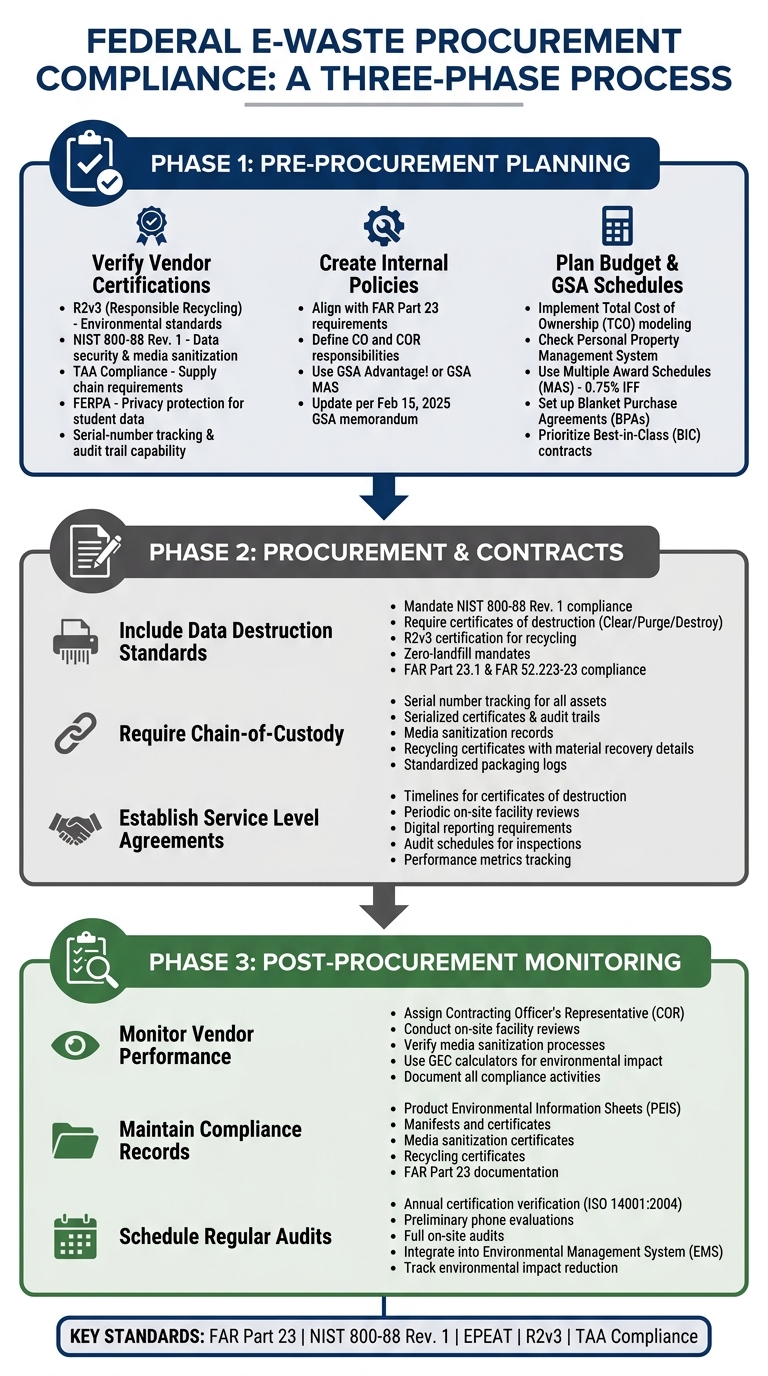
Federal E-Waste Procurement Compliance: 3-Phase Implementation Checklist
E-Waste Management: Standardization and Conformity Assessment, World Resources Forum (WRF)

sbb-itb-855056e
Pre-Procurement Planning Checklist
Before issuing contracts or purchase orders, federal agencies must complete several key planning steps. These steps ensure vendors meet federal standards and that internal processes comply with regulatory requirements. Skipping these steps can lead to compliance issues, security risks, and wasted taxpayer funds.
Verify Vendor Certifications and Compliance Status
It's critical to confirm that potential vendors hold the necessary certifications. For instance, R2v3 (Responsible Recycling) certification ensures adherence to environmental standards, zero-landfill policies, and proper tracking of electronic components. This certification helps prevent illegal export of hazardous e-waste and guarantees responsible recycling practices.
Vendors should also comply with NIST 800-88 Rev. 1 standards for media sanitization. They must provide documented methods - such as "Clear, Purge, or Destroy" - and verification certificates. Agencies dealing with student data must also require FERPA compliance documentation to ensure the protection of minors' information and secure destruction of education records.
Additionally, confirm Trade Agreements Act (TAA) compliance. Many Multiple Award Schedule contracts mandate that products be manufactured or "substantially transformed" in the U.S. or a designated TAA-compliant country. Vendors should also provide detailed tracking information, including serial-number-level tracking and a full audit trail from asset retirement to final disposition.
| Standard/Certification | Focus Area | Federal Relevance |
|---|---|---|
| NIST 800-88 Rev. 1 | Data Security | Required federal standard for media sanitization and data destruction |
| R2v3 | Environmental | Promotes responsible recycling and downstream accountability |
| TAA Compliance | Supply Chain | Ensures products originate from the U.S. or TAA-designated countries |
| FERPA | Privacy | Protects student data and ensures secure record destruction |
After verifying these certifications, integrate them into your agency's internal procurement policies.
Create Internal Procurement Policies
Use verified vendor standards to establish strong internal procurement policies. Incorporate FAR Part 23 requirements and energy efficiency standards outlined in the Energy Independence and Security Act of 2007, as well as the Energy Policy Acts of 1992 and 2005.
Update your policies to align with the February 15, 2025, GSA memorandum, which allows deviations to FAR Parts 11, 18, 23, and 37. Clearly define the responsibilities of Contracting Officers (COs) and Contracting Officer’s Representatives (CORs) to ensure vendors comply with sustainability mandates. Also, require vendors to be accessible through GSA Advantage! or GSA Multiple Award Schedules (MAS) to take advantage of pre-negotiated federal pricing and sustainability standards.
Plan Budget and Use GSA Schedules
Once vendor certifications and internal policies are in place, allocate your budget and maximize the use of GSA schedules for cost-effective compliance. Implement Total Cost of Ownership (TCO) modeling to evaluate both direct and indirect life cycle costs, including end-of-life asset management. The EPA's TCO Calculator Tool can help compare management options and their environmental impacts. Before finalizing your budget, check the Personal Property Management System for excess property from other agencies to cut costs.
Take advantage of Multiple Award Schedules (MAS) for access to commercial products and services at discounted prices. These governmentwide contracts are pre-vetted and include an Industrial Funding Fee (IFF) of 0.75% of reported sales, which supports GSA operations. For recurring e-waste services, consider setting up Blanket Purchase Agreements (BPAs) to streamline the process.
For smaller purchases, use GSA SmartPay government purchase cards, provided the costs fall within micro-purchase thresholds. This simplifies acquisitions for mission-critical supplies or services. Finally, prioritize Best-in-Class (BIC) contracts to secure the best pricing and terms.
Procurement and Contract Requirements
To ensure compliance from data destruction to final disposition, contracts should build on vendor certifications and internal policies. These provisions are essential for maintaining regulatory adherence, minimizing risks like FAR non-compliance, data breaches, and environmental violations. By formalizing vendor relationships through well-constructed contracts, agencies can maintain accountability at every stage.
Include Data Destruction and Recycling Standards in Contracts
Contracts must mandate compliance with NIST Special Publication 800-88 Revision 1, which outlines strict media sanitization standards. This federal guideline requires documented methods such as "Clear", "Purge", or "Destroy", with specific verification steps. The contract should specify the appropriate sanitization method based on device type and require vendors to issue certificates of destruction for each processed asset.
Environmental responsibility is equally important. Look for vendors with R2v3 (Responsible Recycling) certification to ensure proper recycling practices and downstream tracking. Include zero-landfill mandates in your contract to fulfill state and federal environmental requirements. As the EPA highlights:
Electronics also have hazardous materials which may pose a threat to the environment and human health, if not disposed of properly.
Additionally, contracts should comply with FAR Part 23.1 (Sustainable Procurement) and FAR 52.223-23 (Sustainable Products and Services). The EPA's model contract language for "Electronics and Associated Services" can help align solicitations with sustainable purchasing standards.
| Requirement Category | Specific Standard/Regulation | Contractual Deliverable |
|---|---|---|
| Data Sanitization | NIST 800-88 Rev. 1 | Certificate of Destruction (Clear/Purge/Destroy) |
| Environmental | R2v3 Certification | Downstream Tracking Report / Zero-Landfill Audit |
| Federal Procurement | FAR 23.1 / FAR 52.223-23 | Sustainable Products and Services Compliance |
| Privacy (Education) | FERPA | Documented Student Data Destruction |
| Accountability | Chain of Custody | Serialized Asset Audit Trail |
Require Chain-of-Custody and Documentation
Contracts should also mandate comprehensive chain-of-custody documentation, including serial number tracking. Vendors must provide serialized certificates and audit trails to confirm whether equipment was reused, donated, or recycled. This ensures assets are handled by eligible recipients or reputable recyclers.
Documentation requirements should cover media sanitization records, receipts for transfers or donations, recycling certificates detailing material recovery, and chain-of-custody logs from pickup to final disposition. To prevent loss or damage during transit, standardize packaging logs. For organizations requiring professional assistance, e-waste pickup services can streamline the logistics of secure transport. For vendor evaluation, the EPA's "Checklist for Selection of an Electronics Recycler" offers a reliable framework.
Establish Service Level Agreements
Service Level Agreements (SLAs) should outline clear timelines and performance expectations. Include deadlines for delivering serialized certificates of destruction and chain-of-custody documentation. SLAs should also require periodic on-site reviews of recycler facilities to confirm environmentally responsible practices.
Vendors must provide timely digital reports and logs for performance tracking. Additionally, audit schedules should allow for facility inspections at set intervals. SLAs should align with the Omnibus Clause in FAR 52.223-23, emphasizing sustainable products and services. Performance metrics should ensure vendors consistently meet their contractual obligations throughout the service period.
Post-Procurement Monitoring and Record-Keeping
Once you've partnered with an e-waste vendor, the work doesn't stop there. Ongoing oversight is crucial to ensure the vendor meets all contractual obligations. The Contracting Officer's Representative (COR) plays a key role in making sure contractors deliver on their promises, from the quality of services to compliance with federal standards.
Monitor Vendor Performance and Compliance
Assigning a COR to oversee vendor performance is essential. Their responsibilities include monitoring critical compliance tasks, like ensuring proper media sanitization processes that align with federal security standards. On-site facility reviews are another important step to confirm the vendor's operations match the agreed-upon contract terms. For these inspections, the EPA's "Guidelines for On-Site Reviews of Electronics Recyclers" can serve as a helpful framework, particularly for evaluating how materials are handled downstream.
Additionally, keep a close eye on media sanitization procedures and use GEC calculators to measure the environmental impact of the vendor's activities. By consistently documenting these efforts, you create a reliable record for future inspections.
Maintain Organized Compliance Records
Good record-keeping is non-negotiable. Set up a system to manage key documents such as Product Environmental Information Sheets (PEIS), manifests, media sanitization certificates, and recycling certificates that detail material recovery. These records are not just useful for internal tracking - they also demonstrate compliance during federal inspections and align with FAR Part 23 sustainable procurement requirements.
Schedule Regular Reviews and Audits
In addition to ongoing monitoring, schedule routine evaluations to ensure everything stays on track. These reviews should confirm that the vendor maintains certifications and continues to comply with federal standards. Conduct annual checks to verify that certifications, like those tied to ISO 14001:2004, are up to date. Before committing to full on-site audits, consider starting with a preliminary evaluation over the phone using tools like the "Checklist for Selection of an Electronics Recycler".
Finally, integrate electronics stewardship goals into your agency's Environmental Management System (EMS). This approach makes it easier to track compliance regularly and work toward reducing environmental impacts systematically.
Conclusion and Key Takeaways
Summary of Compliance Requirements
Meeting federal e-waste procurement compliance standards means following FAR Part 23 throughout the entire asset lifecycle. Start by focusing on statutory programs like ENERGY STAR® and EPEAT-registered products, and check the GSA Personal Property Management System for surplus equipment before buying new.
When procuring, ensure contracts outline specific requirements for media sanitization, chain-of-custody documentation, and certified recycling services that comply with FMR Bulletin B-34. Assign a Contracting Officer's Representative to oversee vendor performance and maintain well-organized compliance records.
Post-procurement, conduct regular audits to confirm vendors maintain certifications and adhere to compliance standards. Use tools like on-site review guidelines and benefits calculators (such as those from the Global Electronics Council) to measure environmental impact. Incorporate these practices into your agency's Environmental Management System to maintain high standards and ensure expert-level compliance.
How Rica Recycling Supports Federal Compliance
Rica Recycling provides certified services designed to meet federal compliance standards. With R2v3 certification, we guarantee responsible recycling practices, including complete downstream tracking to prevent illegal exports and enforce zero-landfill policies. Our media sanitization services comply with NIST 800-88 Rev. 1, offering Clear, Purge, or Destroy methods with thorough verification certificates.
We also fulfill federal record-keeping requirements by providing serial number tracking, detailed chain-of-custody documentation, and compliance reports, typically delivered within 7 to 10 business days. Our services safeguard sensitive data while optimizing taxpayer value through a transparent resale revenue model.
FAQs
How do I choose between Clear, Purge, and Destroy under NIST 800-88?
Under NIST 800-88, selecting the right method - Clear, Purge, or Destroy - depends on the sensitivity of the data and the security requirements for the device:
- Clear: This method involves overwriting data and works best for non-sensitive information on devices that will remain under your control.
- Purge: More advanced techniques, such as cryptographic erasure, are used here. It's ideal for sensitive data when devices are leaving your control.
- Destroy: This approach physically destroys the device, offering the highest level of security for highly sensitive or classified information.
What chain-of-custody documents should I require for every asset pickup?
When handling asset pickups, always obtain chain-of-custody documents. These should include:
- Verification of the media sanitization methods used, such as Clear, Purge, or Destroy.
- Detailed descriptions of the verification procedures performed.
- Certificates confirming compliance with federal data destruction standards.
These documents play a critical role in maintaining proper tracking, ensuring security, and staying compliant throughout the e-waste disposal process.
How often should we audit an R2v3-certified recycler after award?
An R2v3-certified recycler must undergo an audit at least once a year after certification. These regular audits are crucial for confirming that the recycler continues to meet compliance standards, particularly regarding environmental practices and data security protocols.