
Most e-waste does not stay in formal recycling systems. In 2022, the world generated 62 million tons of e-waste, but only 22.3% was formally collected and recycled. That gap helps explain why informal collectors, repairers, and dismantlers still handle a large share of old electronics.
If I had to sum up the article in plain English, I’d put it this way:
- Informal e-waste networks fill collection gaps that formal programs still miss.
- Some of this work keeps devices in use longer through repair, reuse, and parts recovery.
- Some of it causes serious harm through burning, acid use, and unsafe dismantling.
- Workers and nearby communities face health risks, including lead exposure, injuries, and breathing problems.
- Bans alone often fail because people still depend on this work for cash income.
- Policies work better when they connect informal collectors to formal systems through buy-back programs, EPR, PROs, cooperatives, and tracking tools.
- For U.S. organizations, the main issue is chain of custody: where retired electronics go after pickup, and whether that path is documented.
A few numbers stand out:
- 82 million tons of global e-waste is expected by 2030
- 80% of discarded electronics may move through informal channels in some places
- 100,000+ informal e-waste workers are reported in Lagos
- 150,000+ workers were tied to peak activity in Guiyu
- Nigeria’s public project reported 300 metric tons collected and recycled from 2019 to 2023
- Nigeria’s e-waste project budget was $15 million
Here’s the core takeaway: informal e-waste systems are both a source of repair and material recovery, and a source of pollution and worker harm. So the article argues for a simple position: bring informal actors into safer, tracked systems instead of pretending they do not exist.
For U.S. readers, that means one thing above all: don’t judge an e-waste vendor only by pickup service. Judge them by documented downstream handling.
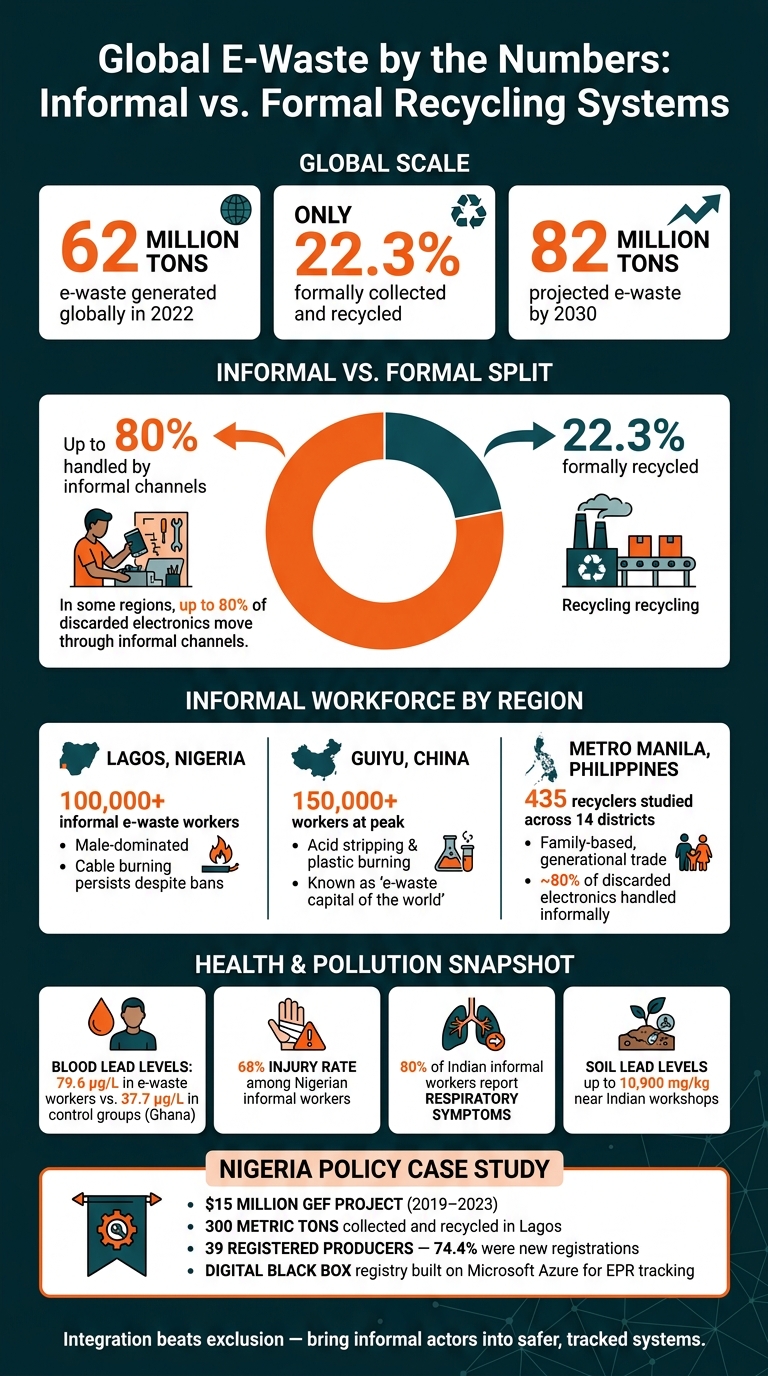
Global E-Waste by the Numbers: Informal vs. Formal Recycling Systems
The Electronic Waste Challenge: A Global Perspective
sbb-itb-855056e
Global E-Waste Flows and How the Informal Sector Works
The informal e-waste sector is a network of unregistered collectors, buyers, repairers, refurbishers, and dismantlers working outside formal safety and environmental systems. These systems stick around for a simple reason: formal collection still doesn’t reach everyone. In many places, that leaves big gaps in coverage. And that helps explain why informal e-waste flows matter so much for both material recovery and environmental harm.
What Counts as Informal Recycling
Informal recycling covers a wide range of activity. Some of it helps extend a device’s life through repair and refurbishment. Some of it relies on hazardous methods like open burning, acid leaching, and CRT smashing to pull out materials.
That difference matters. Repair keeps devices in use for longer. Hazardous extraction, by contrast, often recovers only small amounts of material while releasing toxic byproducts into the surrounding environment. In the Philippines, informal networks handle an estimated 80% of discarded electronics, but recovery can drop to 5% because processing methods are inefficient.
There’s also a plain economic reason households turn to informal buyers: they offer immediate cash for old devices.
Key Regions Covered in the Research
Research keeps pointing to a few major hubs that show how informal recycling steps in where formal systems fall short.
Guiyu, China, is known as the "e-waste capital of the world." At its peak, it employed over 150,000 informal workers. Common activities included acid stripping for gold and burning plastics to identify material types.
Lagos, Nigeria, is home to more than 100,000 informal e-waste workers. A longitudinal study covering 2017 to 2023 found that cable burning continued even after a ban by the Lagos Waste Management Authority (LAWMA), with workers shifting the practice to avoid enforcement.
In Metro Manila, a 2026 study of 435 informal recyclers across 14 administrative districts found that economic survival was a major driver of recycling behavior.
These collection patterns also shape the pollution and health risks discussed next.
What Research Finds on Pollution and Health Risks
The informal hubs described above leave clear pollution and health traces.
Pollution From Common Informal Processing Methods
Researchers have measured contamination in soil, air, and water around informal e-waste sites. The main sources are open burning, acid leaching, manual dismantling, mechanical processing, and mercury use.
To separate normal background metal levels from contamination tied to recycling, researchers use Enrichment Factors (EF). An EF above 5 points to human-caused pollution. Near informal sites, EF values for copper, lead, and cadmium often go past 40, which falls into the extremely high enrichment range.
Open burning creates the worst pollution load. In Wenling, China, soil PAH concentrations reached as high as 1,231 mg/kg. In India, lead levels in workshop dust were measured between 2,360 and 10,900 mg/kg, or 5 to 20 times above background levels.
| Informal Practice | Materials Targeted | Key Pollutants Released | Short-Term Impacts | Long-Term Impacts |
|---|---|---|---|---|
| Open Burning | Insulated wires, plastic casings | Lead, copper, dioxins (PCDD/Fs), PAHs | Respiratory irritation, skin lesions, acute inflammation | Cancer, cardiovascular disease, and DNA damage |
| Acid Leaching | Printed circuit boards, gold connectors | Arsenic, cadmium, strong acids | Chemical burns, acute inhalation toxicity | Kidney damage, soil and groundwater contamination, neurological impairment |
| Manual Dismantling | CRTs, batteries, LCDs | Lead, mercury, barium, brominated flame retardants | Physical injury, dust inhalation | Neurological disorders, developmental delays in children |
| Mercury Amalgamation | Gold-plated components | Mercury vapor | Acute mercury vapor inhalation | Permanent brain and kidney damage |
That contamination shows up again in worker and community health data.
Health Risks for Workers and Nearby Communities
The health toll is measured directly, not guessed at. In Agbogbloshie, Ghana, biomonitoring studies found blood lead levels of 79.6 µg/L in e-waste workers, compared with 37.7 µg/L in control groups. In Nigeria, one study reported a 68% injury rate among workers, with most injuries being cuts to hands and fingers from sharp materials.
In India, about 80% of informal e-waste workers report respiratory symptoms such as coughing, suffocation, and nasal discomfort, much of it tied to weak access to protective gear. Other studies found genetic damage and elevated liver markers in exposed workers.
Children living near these sites face even more risk. Lead and mercury can harm developing nervous systems, and contaminated dust adds another path of exposure.
Despite these harms, informal recycling continues because it still offers income and recoverable materials. Professional electronics recycling services provide a safer alternative by using controlled environments to capture these materials without the toxic byproduct.
Why Informal Recyclers Still Play a Central Role
Even with the health and pollution risks, informal recyclers still lead e-waste collection in many markets. The pollution numbers matter, but they don't show the whole picture.
Income, Repair, and Parts and Scrap Recovery
Informal networks stick around for a simple reason: they work. They pay cash, recover usable parts, and collect devices through flexible, low-cost, door-to-door systems that formal programs often can't match.
And they don't start with dismantling. In many cases, they first try to keep devices in use. Research in Nigeria found that up to 10% of collected e-waste is resold as working devices, while more than 80% is dismantled for spare parts. That repair-first habit keeps parts in circulation and feeds secondary markets. It's not a perfect system, but it does support circular economy goals in a concrete way.
Formal recycling facilities face high fixed costs and strict compliance expenses. Informal dismantlers, by contrast, run with far lower overhead. That gives them room to pay more for raw e-waste, which makes it hard for licensed facilities to get enough volume to stay in business. Those money pressures look different from one place to another, and that shapes who enters the trade and how the work is set up.
How Workforce and Organization Differ by Region
Informal e-waste work doesn't look the same everywhere. A 2026 study of 435 recyclers in Metro Manila found that income and financial incentives were the strongest drivers of recycling behavior, ahead of environmental or health concerns. More than half entered the trade through family-based livelihoods, with job knowledge passed down across generations.
In Nigeria, the workforce is mostly male, while women are often pushed into lower-paid roles like collection, sorting, and record-keeping. Rising inflation has also cut real earnings for informal collectors. That gap matters when policymakers try to bring informal workers into formal systems. If a policy ignores how people actually make a living, it's likely to miss the mark.
| Region/Country | Organization Type | Livelihood Structure | Policy Constraint |
|---|---|---|---|
| Philippines (Metro Manila) | Itinerant buying, junkshop dismantling, street waste picking | Generational; family-based knowledge transfer; 100,000+ workers | Hazardous methods persist; EPR frameworks lack informal sector pathways |
| Nigeria (Lagos) | House-to-house collection, cable burning, PWB extraction | Male-dominated; women in lower-wage sorting and collection roles | Bans unenforced; real income eroded by inflation |
| India | Specialized family businesses; networked repair and repurposing | Deep technical expertise; cultural capital passed through trade networks | Secrecy due to illegalities; EPR laws favor formal firms, excluding informal operators |
These incentives explain why integration policies have to deal with earnings, not just compliance.
Policy Integration Models and What They Mean for the U.S.
What Studies Say About Integration Policies
Informal recycling stays in place for a simple reason: it provides income and access. That’s why policy tends to work better when it pulls informal activity into the system instead of trying to wipe it out.
A ban on its own usually falls flat. In Nigeria, informal operators didn’t stop hazardous work like cable burning. They moved it to nighttime hours to avoid regulators. That’s a strong signal. If people still need the income, the activity often doesn’t disappear. It just goes out of sight.
What shows better results is enforcement paired with economic measures, such as buy-back programs, that connect informal work to formal extended producer responsibility (EPR) systems. In plain terms, informal recyclers tend to add more value as regulated partners than as shut-out actors. Producer Responsibility Organizations (PROs) can help make that link by connecting producers, regulators, and informal collectors while using the informal sector’s low-cost collection reach.
Nigeria offers a clear case. Its $15 million GEF project, run by NESREA from 2019 to 2023, collected and recycled 300 metric tons of e-waste in Lagos. The project also used a cloud-based "Black Box" registry built on Microsoft Azure to track producer market shares and automate EPR levy collection. Nigeria’s revised 2022 regulation also led to a record 39 registered producers, and 74.4% of them were new registrations.
The research groups these policy tools into five main models:
| Policy Instrument | Target Group | Documented Benefits | Documented Challenges | Representative Case |
|---|---|---|---|---|
| Extended Producer Responsibility (EPR) | Manufacturers & Importers | Financial accountability; increased formal registration | High enforcement costs; informal sector exclusion | Nigeria (2022 Framework) |
| Producer Responsibility Organization (PRO) | Informal Collectors & Formal Recyclers | Bridges formal/informal gap; leverages low-cost collection | Informal sector often remains legally unrecognized | India |
| Buy-back / Financial Incentives | Informal Waste Pickers | Redirects waste to formal channels; improves worker income | Requires consistent funding; vulnerable to inflation | Philippines (Proposed CE Framework) |
| Interface Organizations | Informal Cooperatives | Retains livelihoods while improving safety standards | Difficult to scale; requires high stakeholder trust | Global/General Case Study |
| Digital Traceability (Black Box) | Regulators & Producers | Accurate market share data; automated levy collection | Requires technical capacity; data entry non-compliance | Nigeria |
What This Means for Certified Recycling in the United States
For certified recyclers in the United States, the main checkpoint is chain of custody after pickup.
That point matters because collection is only the start. Where retired electronics go next matters just as much. If low-value material is exported, it can weaken domestic recycling economics and feed informal processing chains overseas. So the issue isn’t just whether a company picks up old devices. It’s whether that company can show, on paper, where those materials went and how they were handled.
The practical safeguard is simple: a documented chain of custody and landfill-free handling that can be verified.
For California and Bay Area organizations, Rica Recycling provides certified electronics recycling, ITAD, secure data destruction, pickup and drop-off, California-compliant handling, and 100% landfill-free service.
Conclusion: Key Research Takeaways
Informal systems cause real harm, but integration tends to beat exclusion. For U.S. organizations dealing with retired electronics, the practical takeaway is clear: work with certified partners that can show where materials go through documented chain of custody, not just where they begin.
FAQs
Why does so much e-waste end up in informal channels?
Much of the world’s e-waste ends up in informal channels because many places don’t have the specialized facilities or oversight needed to process it safely.
In developing nations, informal recyclers are often the cheapest and easiest option. They use simple manual methods to recover materials like copper and gold. There’s also a formalization trap that can let informal operators outbid regulated facilities.
Can informal e-waste workers be integrated safely?
Yes, but it’s complex.
Safe integration means moving away from risky practices and toward formal, regulated systems that offer decent work and chances to build skills.
That can include partnerships that rely on informal workers’ collection networks and on-the-ground know-how while shifting processing into safer, centralized facilities. It also calls for legal frameworks and policies that balance sustainability goals with workers’ day-to-day economic realities.
How can U.S. organizations verify downstream handling?
U.S. organizations can verify downstream handling by looking for independent compliance oversight in e-waste processing and trading.
A lot of global e-waste still moves through informal or hard-to-track channels. That’s why it makes sense to work with certified recyclers that put transparency and responsible management front and center. Doing so helps confirm that electronics are processed under strict standards instead of ending up at unregulated facilities.