
How Closed-Loop Recycling Supports ITAD
If retired IT devices go straight to scrap, you lose money, reuse options, and clean material recovery. I’d sum it up this way: ITAD works best when I put devices through a strict order - track them, sanitize data, test for reuse, resell or refurbish what still works, and recycle the rest.
Here’s the short version:
- ITAD is more than e-waste pickup. It covers inventory, chain of custody, data wiping, resale, refurbishment, and final recycling.
- Order matters. If I recycle too early, I can wipe out 10% to 30% of original hardware value that resale or refurbishment might recover.
- Reuse comes before recycling. Repairs and parts swaps can keep equipment in service for 2 to 3 more years and cut replacement spend by up to 30%.
- Closed-loop recycling starts after reuse is ruled out. That means pulling out materials like copper, aluminum, steel, plastics, glass, circuit boards, and batteries and sending them back into manufacturing streams.
- Data security comes first. Devices should be sanitized under NIST SP 800-88 before resale, refurbishment, or recycling.
- Records matter. Chain-of-custody logs, serialized reporting, and Certificates of Destruction help show where each asset went.
- Vendor standards matter too. The article points to R2v3, NAID AAA, ISO 14001, and ISO 45001 as key certifications tied to recycling, data destruction, and workplace controls.
- A written ITAD policy keeps the process from drifting. It should cover refresh cycles, asset tracking, data destruction rules, refurbish-first handling, zero-landfill targets, and reporting.
A simple way to think about it: ITAD protects data and recovers asset value; closed-loop recycling deals with what’s left without sending it to waste too soon. Put together, they help you cut risk, recover more from retired hardware, and keep more material in use.
Below, I’ll break down how that process works and why the sequence makes such a big difference.
Facility Tour - The ITAD Process | Dynamic Lifecycle Innovations

sbb-itb-855056e
How the ITAD Process Supports Closed-Loop Outcomes
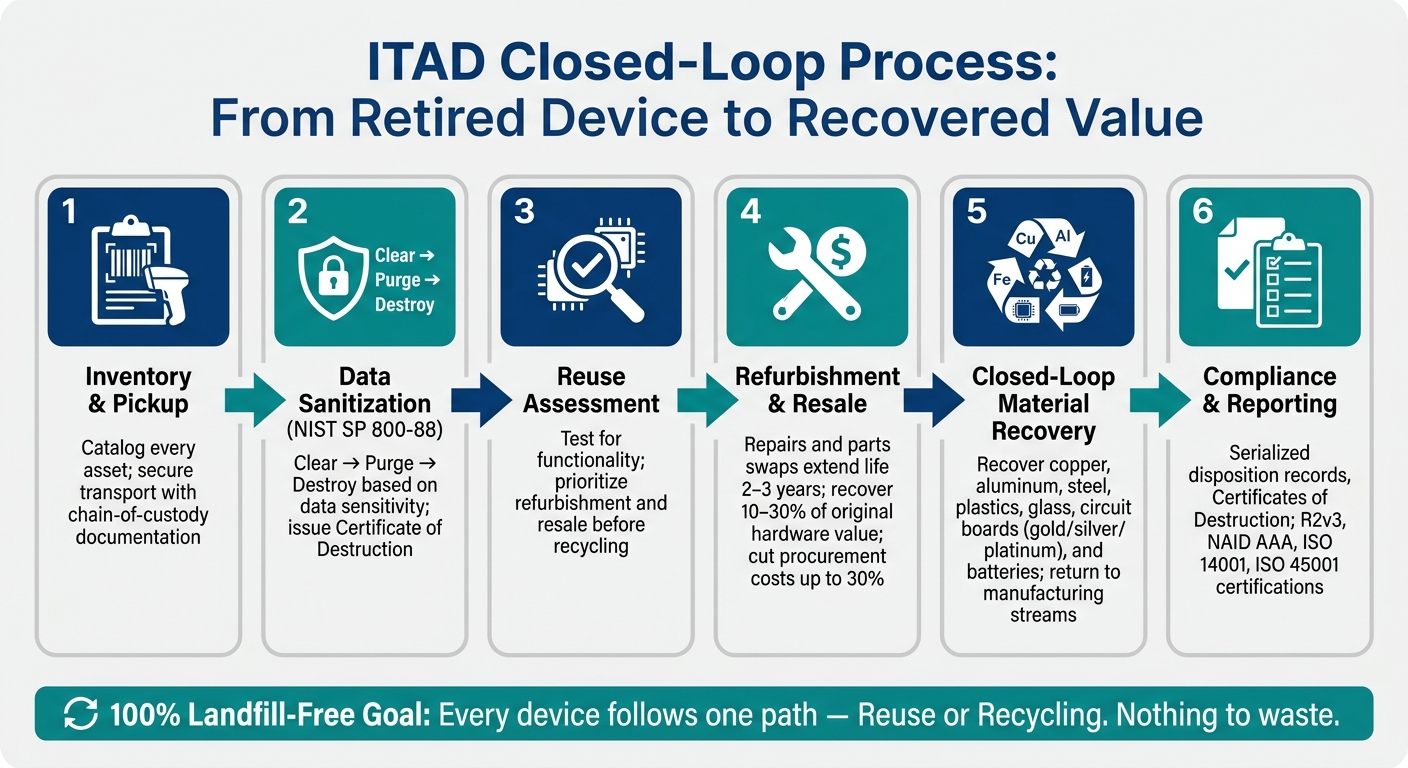
ITAD Closed-Loop Process: From Retired Device to Recovered Value
A well-run ITAD program follows a controlled sequence. Each step affects how much value you get back from retired equipment, how much material stays in circulation, and how safely each device moves to its next destination.
Inventory, Pickup, and Chain of Custody
It starts with an accurate asset catalog. When the catalog is right, recovery decisions stay consistent from pickup forward, and each asset can follow the right path.
Secure pickup and documented transport keep the process accountable. Chain of custody records track every asset from collection through final disposition. That paper trail helps confirm what happened to each device and supports compliance audits.
Data Sanitization Before Reuse or Recycling
No device should move to resale, refurbishment, or recycling until data sanitization is done. That step comes first for a simple reason: if data is still on the device, the risk is still there.
The NIST SP 800-88 guidelines outline three sanitization methods based on data sensitivity:
| Method | Security Level | Reusability | Best For |
|---|---|---|---|
| Clear | Basic | Reusable | Non-sensitive data; routine software tools |
| Purge | High | Reusable | Sensitive or regulated data; forensic recovery tools |
| Destroy | Maximum | Not reusable | Highly confidential data; physical shredding |
A certificate should be issued for audit records. Once data is cleared, the conversation shifts from security risk to asset value.
Refurbishment First, Materials Recovery Second
Reuse keeps the most value in play. Recycling recovers what reuse leaves behind.
Repair and parts management can extend system life by 2–3 years and cut procurement costs by up to 30%. If an asset can't be reused, it moves to dismantling and material recovery. In other words, the material stream comes after reuse, not before.
What Closed-Loop Recycling Recovers From IT Equipment
Once reuse is off the table, the next step is simple: figure out what’s left and where it can go.
That answer depends on the device and its condition. Servers, laptops, monitors, and accessories don’t all break down the same way. What can’t be reused becomes the input for closed-loop recycling.
Key Material Streams From Servers, Laptops, and Peripherals
Different types of equipment lead to different recovery paths. Servers, laptops, desktops, monitors, and peripherals can all produce a mix of reusable parts and recoverable materials.
Common recovered materials include:
- Circuit boards - contain precious metals like gold, silver, and platinum
- Aluminum and steel - common recoverable metals
- Copper - common recoverable metal
- Plastics - recovered from casings and bezels
- Glass - recovered from display panels
- Batteries - lithium-ion cells from laptops and UPS units
The state of those materials at the time of recovery matters a lot. Careful disassembly keeps streams cleaner and more usable later on. Early shredding, by contrast, can lower both the quality and the value of what gets recovered.
Linear Recycling vs. Closed-Loop Recycling
Traditional recycling often treats retired IT equipment like scrap. It gets shredded, broken down, and sorted after the fact.
Closed-loop recycling takes a different path. It treats the device as something that can return to use, either as refurbished hardware or as refined material that goes back into manufacturing.
That shift affects both recovery value and the quality of the material downstream.
| Aspect | Linear Recycling (Traditional) | Closed-Loop Recycling (ITAD) |
|---|---|---|
| Primary Focus | Material recovery through shredding/breakdown | Device reuse, refurbishment, and material return |
| Material Quality | Low - shredded, mixed raw materials | High - intact components and refined metals |
| Landfill Reduction | Partial - residue often ends up in landfills | Maximum - 100% landfill-free policies |
| Value Retention | Low - scrap value only | High - resale of functional assets recovers 10–30% of original hardware value |
Why Zero-Landfill Handling Improves Resource Recovery
A zero-landfill policy helps make sure each device follows one of two paths: refurbishment or recycling into raw materials.
That matters because once material leaves the recovery stream and heads to disposal, its use is gone. Zero-landfill handling keeps remaining components and materials in circulation instead of sending them out as trash.
There’s one more piece to this: data destruction and recordkeeping have to stay tied to the recovery path. If those records drift, the process gets messy fast, and material recovery becomes much harder to track.
Data Security, Compliance, and Standards in Closed-Loop ITAD
Closed-loop ITAD rests on two core controls: certified data destruction and traceable downstream handling. After reuse decisions are made, the records show whether the remaining assets can move into recovery without putting data or compliance at risk.
Choosing the Right Data Destruction Method
The goal isn't to destroy data in the most aggressive way possible. It's to use the least-destructive method that still keeps data safe.
That choice should match the device's condition and the sensitivity of the data. Use software wiping for devices that can be reused. Use degaussing for magnetic media that can't be reused. And use shredding for hardware that's beyond repair or holds highly sensitive data.
Certifications and Records That Support Trust
Certifications show how a provider works. Records show where each device ended up. You need both, because one doesn't replace the other.
R2v3 covers downstream recycling. NAID AAA covers data destruction. ISO 14001 and ISO 45001 support controls around environmental and workplace safety. Serialized Certificates of Destruction and disposition records document each asset's final path for audits and internal reporting.
Those records should flow straight into policy, pickup, and vendor selection. This works best when the controls are built into a written ITAD policy and the vendor workflow from the start.
Building a Closed-Loop ITAD Program With the Right Service Partner
Those controls only matter when they show up in policy. Certifications and destruction records don't do much on their own. They need a repeatable process behind them.
That process starts with two things: a written ITAD policy and a service partner whose day-to-day workflow matches it.
What to Include in an Internal ITAD Policy
A good ITAD policy should be short, specific, and enforceable. The table below shows the core parts and why each one matters for closed-loop results.
| Policy Component | How It Supports Closed-Loop Outcomes |
|---|---|
| Refresh Cycles | Set timelines for hardware updates help organizations retire devices while they still have strong reuse or resale value. |
| Asset Inventory Rules | Mandatory serialized tracking from procurement to retirement helps ensure every device stays accounted for. |
| Data Destruction Standards | Requiring NIST 800-88-compliant wiping or physical destruction makes safe reuse possible. |
| Chain-of-Custody Requirements | A documented trail from pickup to final disposition supports compliance and internal reporting. |
| Refurbish-First Rule | Setting a refurbish-first priority cuts unnecessary material flow to recycling. |
| Zero-Landfill Target | A zero-landfill commitment keeps every material stream directed toward recovery. |
| Track Diversion and Recovery | Tracking diversion rates, CO2 savings, and recovered value supports ESG reporting and helps improve the program over time. |
In plain English, the policy should answer a few simple questions: When do we retire devices? How do we track them? How do we destroy data? And where do those assets go next? If those answers are vague, the process usually gets messy fast.
How Rica Recycling Supports a Bay Area ITAD Plan
Policy turns into action when the service partner follows the same rules.
For businesses, schools, nonprofits, and public agencies in the San Francisco Bay Area, Rica Recycling provides certified electronics recycling, secure data destruction, and IT asset recovery under a 100% landfill-free policy. Services include pickup and drop-off options for retired computers, laptops, servers, and other electronics.
Rica Recycling is compliant with California e-waste regulations and can provide Certificates of Data Destruction for data-bearing assets. That helps keep retired assets moving through a closed loop, from pickup to final reporting.
Conclusion: Secure Retirement and Better Material Recovery Can Work Together
A closed-loop ITAD program turns policy into secure reuse, recovery, and reporting. It covers data sanitization, asset recovery, refurbishment, material recovery, and documented compliance - all in the sequence that decides how much value and how many materials stay in circulation.
Closed-loop thinking improves each part of that sequence. It helps organizations retire devices at the right time, put reuse ahead of recycling, and track every asset through to final disposition. Secure data destruction isn't in the way of reuse. It's the step that makes reuse possible in the first place.
A well-structured ITAD program cuts risk, recovers value, and gives organizations the documentation they need to support sustainability commitments. For that to work, policy, process, and partner need to line up.
FAQs
Why is reuse prioritized before recycling in ITAD?
In IT asset disposition, reuse comes before recycling. The reason is simple: it keeps equipment in use and avoids part of the impact that comes with building new devices.
When hardware is refurbished and redeployed, its lifespan gets extended. That helps conserve raw materials, cut emissions, and often improve financial returns at the same time. Recycling still matters, of course. But it usually comes later, once equipment can no longer be safely restored.
How do I choose between wiping, degaussing, and shredding?
The right method comes down to three things: the device’s condition, your security needs, and whether you plan to reuse or resell it.
- Wiping overwrites data, so it’s usually the best pick for devices you want to reuse or sell.
- Degaussing uses magnetic fields to scramble data. It’s often used for high-security cases or drives that no longer work.
- Shredding permanently destroys broken or high-risk hardware that can’t be repurposed.
What should an ITAD policy include for closed-loop recycling?
An ITAD policy for closed-loop recycling should put value first. That means starting with reuse, refurbishment, and redeployment before moving to material recovery.
It should also require certified partners, NIST SP 800-88 data sanitization, certificates of destruction, a documented serialized chain of custody, and clear reporting on both environmental and financial results.