
ITAD Data Privacy Training: Key Compliance Standards
Most ITAD privacy failures start before pickup. If I retire a laptop, server, SSD, or POS device without the right wipe method, chain-of-custody record, and proof of destruction, I can create audit trouble, breach notice risk, and fines.
Here’s the short version:
- ITAD is not basic e-waste recycling. It focuses on data protection and records, not just material recovery.
- Deleted files and factory resets are often not enough. One cited stat says 59% of used hard drives still held residual data.
- Training has to be role-based. IT, security, legal, compliance, and managers all handle different parts of the process.
- The main rules in play are GDPR, CCPA/CPRA, HIPAA, and PCI DSS.
- The main technical standards are NIST SP 800-88 Rev. 2, ISO 27001, R2v3, and e-Stewards.
- For media leaving company control, Purge is the baseline. For highly sensitive data, Destroy may be the right path.
- Records matter as much as sanitization. Missing serial-level logs or Certificates of Destruction can look like a breach in some cases.
- California adds extra pressure. The article points to CCPA/CPRA duties, SPI handling, and a 24-month record retention window for some privacy records.
A few numbers make the point fast:
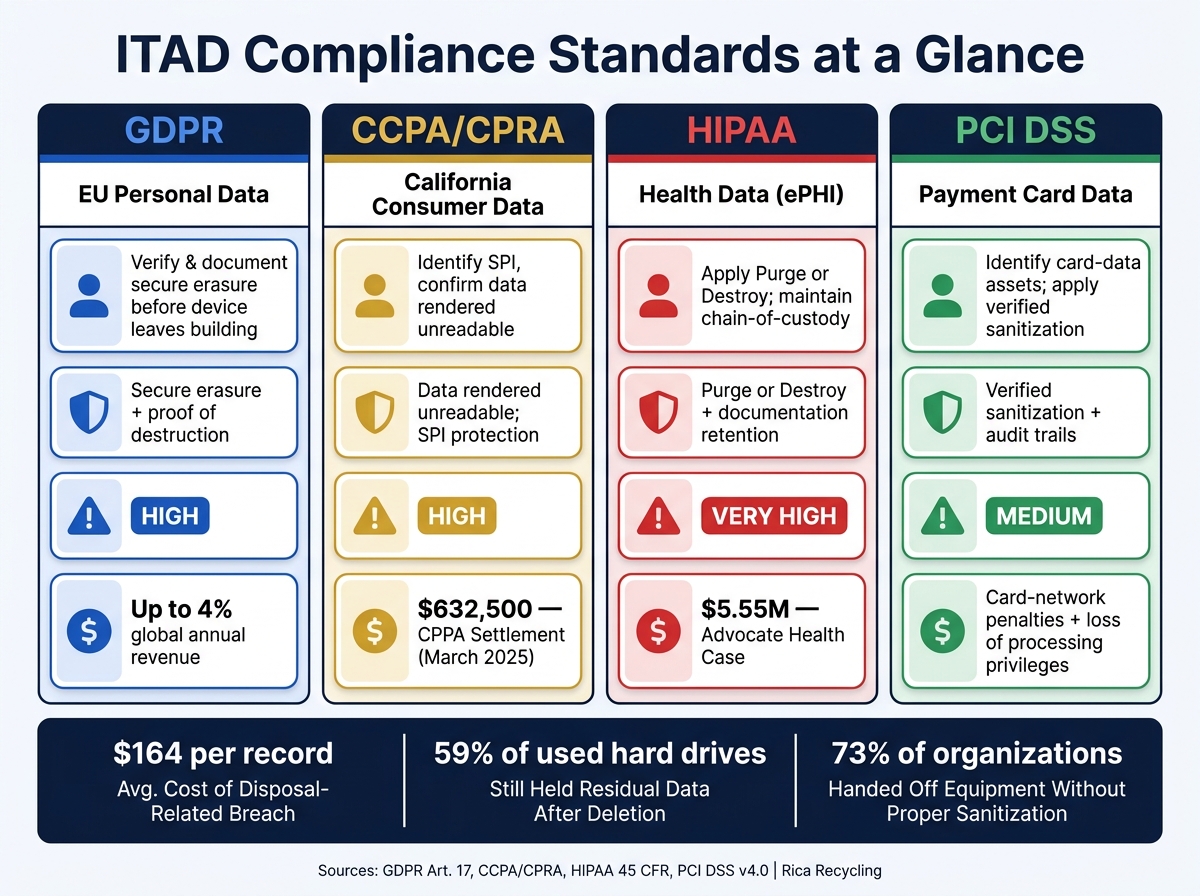
- $164 per record: average cost tied to disposal-related breaches
- $5.55 million: penalty noted in the Advocate Health case
- 73%: share of groups cited as handing off old equipment without proper sanitization steps
- $632,500: March 2025 CPPA settlement noted in the article
If I had to boil the article down to one idea, it would be this: good ITAD training teaches people exactly how to identify data-bearing assets, choose the right sanitization method, log each handoff, and prove the work later.
| Area | What staff need to do |
|---|---|
| Data laws | Know when personal, health, or card data changes the disposal workflow |
| Sanitization | Use the right NIST method for HDDs, SSDs, NVMe drives, and other media |
| Handoffs | Keep storage, pickup, and transfer records complete |
| Audit proof | Retain serial-number tracking, wipe results, and destruction certificates |
| Refresher training | Recheck skills when rules, devices, or incidents change |
So this article is not just about policy. It’s about turning legal rules and sanitization standards into a simple set of repeatable steps people can follow every time a device leaves service.
How to Build a Compliant ITAD Program | R2v3, ISO & Circular Technology Explained
sbb-itb-855056e
Compliance Standards That Shape ITAD Training
ITAD Compliance Standards: Key Rules, Requirements & Penalties
| Standard | Scope | Employee Task | ITAD Obligations | Consequence |
|---|---|---|---|---|
| GDPR | EU personal data | Verify and document secure erasure before device leaves the building | Secure erasure; proof of destruction | High |
| CCPA/CPRA | California consumer data | Identify SPI and confirm data is rendered unreadable before disposal | Data rendered unreadable; SPI protection | High |
| HIPAA | Health data (ePHI) | Apply Purge or Destroy sanitization; maintain chain-of-custody records | Purge or Destroy sanitization; documentation retention | Very high |
| PCI DSS | Payment card data | Identify card-data assets and apply verified sanitization before disposal | Verified sanitization; audit trails | Medium |
Legal rules only matter in daily ITAD work when employees know how to turn them into the same set of steps every time. That usually means clear sanitization rules, documented chain-of-custody, and records that hold up during an audit.
GDPR and CCPA Rules for Personal Data Disposal
Under GDPR, the right to erasure doesn’t stop when a laptop or server reaches end of life. If a device holds personal data, staff need to verify secure erasure and document it before that device leaves the building.
CCPA/CPRA adds another layer for California organizations. It brings in Sensitive Personal Information (SPI), which includes biometric, health, and geolocation data, and those deletion rights still apply after hardware is retired. California Civil Code § 1798.81 also requires personal information to be made unreadable or undecipherable through shredding, erasing, or modifying before disposal.
This isn’t just paperwork. In March 2025, the California Privacy Protection Agency settled with American Honda Motor Co. for $632,500 over CCPA opt-out and procedural violations. It was the agency’s first lead-agency enforcement action.
HIPAA and PCI DSS Controls for Health and Payment Data
HIPAA brings a stricter standard for devices that store or process PHI. Medical devices and workstations need secure disposal, plus a documented chain of custody. Training should show staff when Purge or Destroy sanitization levels are required and how Business Associate Agreements (BAAs) affect vendor handling of those assets.
PCI DSS applies to any device that has handled cardholder data, such as:
- Point-of-sale terminals
- Servers
- Storage media
Staff need to spot those assets and make sure verified sanitization happens before disposal. If that step gets missed, the fallout can include card-network penalties and loss of processing privileges.
California Requirements in Day-to-Day ITAD Work
For California teams, correct data classification matters from the start. Medical data must be identified correctly before disposal, or the wrong workflow can be applied. Certified ITAD vendors also help keep chain-of-custody logs and destruction records in order for audits.
That day-to-day work rests on a simple idea: rules on paper have to become technical sanitization steps, awareness training, and certified handling procedures.
Technical Standards and Certifications Behind ITAD Training
Legal rules tell you what needs protection. Technical standards spell out how teams should sanitize devices, check the work, and keep records. That’s what turns policy into repeatable day-to-day actions. In ITAD, these frameworks shape how staff handle retired assets from intake to final disposition.
| Standard | Sanitization Approach | Employee Competency | Documentation | ITAD Applicability |
|---|---|---|---|---|
| NIST SP 800-88 Rev. 2 | Clear, Purge, Destroy | Verified competency for sanitization staff | Validation and retention records | Core sanitization standard |
| ISO 27001 | Secure disposal and media handling controls | Security awareness and asset handling training | Asset inventories and handoff logs | Governance framework for the full asset lifecycle |
| R2v3 (Appendix B) | Logical sanitization and physical destruction when required | Competency for sanitization work | Serialized device tracking and video monitoring | Operational standard for electronics recycling facilities |
| e-Stewards | Ethical recycling and strict data security protocols | Verified through third-party audits | Certificates of destruction and chain-of-custody records | Environmental and social responsibility standard |
NIST SP 800-88: Clear, Purge, and Destroy Methods
NIST SP 800-88 is the main technical base for most ITAD programs. It sets out three sanitization outcomes: Clear for internal reuse, Purge for external reuse, and Destroy for high-sensitivity or classified data.
Training should show staff how to choose the right outcome based on the device type and the data involved. That point matters a lot with SSDs and NVMe drives. Standard overwrite methods don’t do the job there because wear-leveling spreads data across memory cells in ways that make full erasure harder to confirm.
ISO 27001 Awareness Controls and Chain-of-Custody Practices
ISO 27001 covers secure disposal through asset inventories, restricted access, and approved handoff logs. It does not tell you which erasure method to use.
For ITAD training, that means one thing: audit readiness. Staff need to know how to build and keep records that show each asset was handled the right way at each stage. If someone asks, “Can you prove where this laptop went, who touched it, and when?” the answer should be sitting in the log.
R2v3 and e-Stewards Requirements for Secure ITAD Work
R2v3 Appendix B requires logical data sanitization and unique device identifier (UDI) traceability. In plain terms, every device must be tracked by serial number through the full process. It also requires video surveillance in areas where data-bearing devices are received or stored, with recordings kept for at least 60 days.
Training should make that concrete for employees. Staff need to check that Appendix B appears on the certificate before any data-bearing asset is released. That turns certificate review into part of the handoff workflow, not something left to the vendor alone.
e-Stewards adds third-party audit, strict data-security controls, and destruction records. Both R2v3 and e-Stewards call for handling that can stand up to review. This isn’t just about filling out forms. It’s about being able to trace what happened, device by device, with records that match the work.
What Research Shows About Effective ITAD Training Programs
The standards above mean very little if employees can’t use them the same way every day. In ITAD, problems usually begin when written policy never makes it into day-to-day work. What people do during intake, sanitization, storage, and handoff is what keeps compliance intact - or causes it to fail.
| Training Feature | Supporting Standard / Research | Why It Matters |
|---|---|---|
| Role-Based Modules | GDPR Art. 39, HIPAA 45 CFR § 164.530, CCPA | Matches training depth to each employee’s data-handling duties |
| Scheduled Refresher Cycles | ICO guidance, annual privacy and security rules | Reduces skill fade and keeps training in step with rule changes |
| Skills Checks | R2v3 Appendix B, NIST SP 800-88 | Shows whether staff can carry out and verify sanitization the right way |
| Incident / Near-Miss Review | R2v3 Core 7(a), NIST SP 800-88 | Uses incidents and near-misses to fix weak spots before they turn into breaches |
| Training Records | R2v3 Annex B, CCPA/CPRA, NAID AAA | Shows due care and supports record retention for at least 24 months |
Core Topics Every ITAD Training Program Should Cover
In plain terms, these features turn into four must-teach areas for any ITAD program. Staff should know how to identify all data-bearing assets, choose the right NIST SP 800-88 sanitization method based on data sensitivity, keep chain-of-custody records complete, and spot when a device triggers a specific legal duty.
A useful default is simple: use Purge for any media leaving organizational control, and keep Destroy for highly sensitive or classified assets.
"Purge sanitization renders Target Data recovery infeasible using state-of-the-art laboratory techniques and is the minimum acceptable method for media leaving organizational control."
Role-Based Training by Job Function
A single training track won’t work for every role. Each job maps to a different ITAD task.
- IT and security staff need to verify sanitization, including special handling for SSDs and NVMe drives, where wear-leveling can leave standard overwrites incomplete.
- Compliance and legal teams need to check records, handle vendor due diligence, and keep audit trails in order.
- Management needs to approve controls, assign resources, and own risk governance.
For California-based teams, training should also cover Sensitive Personal Information (SPI) under CPRA. That includes biometric and health data often stored on mobile devices and wearables.
How Audits, Incidents, and Refresher Cycles Strengthen Training
Training works only when it’s checked, updated, and recorded. R2v3 calls for regular refresher training to keep competency in place. Scheduled cycles tied to current privacy and security rules help staff stay current as devices, processes, and regulations shift.
When a process changes, a new device type enters the environment, or a data incident happens, training and sanitization plans should be reviewed. Regulators also expect records showing who was trained, their role, the date, the content version, and the results of skills checks.
Conclusion: Building a Compliance-Aligned ITAD Training Program
Compliance-aligned ITAD training isn't a one-and-done exercise. It needs to be ongoing, based on each person's role, and mapped to more than one standard. In day-to-day work, that means connecting GDPR, CCPA/CPRA, HIPAA, PCI DSS, and technical frameworks like NIST SP 800-88 Rev. 2, ISO 27001, R2v3, and e-Stewards to the tasks employees handle every day. Standards on paper don't do much by themselves. They matter when people follow them the same way, every time.
Just as important, you need documentation that can be tracked back to the source. That's what shows sanitization happened, chain of custody was maintained, and training was completed. In practice, that includes serial-level records, verified sanitization results, and training logs that show who was trained, when they were trained, and which version of the program they received.
Those records also help meet California disposal and retention rules. CCPA/CPRA requires businesses to keep records of consumer rights requests and responses for 24 months, and regulators can look at training records as proof that compliance steps were in place.
A documented disposal partner helps carry those controls past your own walls. Rica Recycling supports secure pickup, data destruction, and California-compliant handling for Bay Area organizations.
FAQs
When is Purge enough?
Under NIST 800-88, Purge is enough for sensitive or regulated data, especially when devices are leaving your organization’s control.
It relies on methods like cryptographic erasure or degaussing to make data mathematically unrecoverable. But that doesn’t mean the job is done the moment the process finishes. Verification and validation are still required.
There’s also an extra layer to watch for: state law. In some states, including California, certain personal data must be physically destroyed even if Purge would otherwise satisfy federal standards.
What records should we keep?
Keep records that show secure ITAD handling and employee training.
- Data destruction: Keep Certificates of Destruction that include device lists, the destruction method, time and location, and the chain of custody.
- Training: Keep records of training dates, topics, session length, trainer credentials, and attendee acknowledgments or attestations.
HIPAA requires keeping these records for six years. CCPA/CPRA requires 24 months. As a general rule, many teams keep them for five to seven years.
Who needs ITAD training?
ITAD training matters for anyone who touches data-bearing IT assets during their lifecycle, including enterprise IT teams, logistics staff, and warehouse crews.
It helps people keep up with regulatory rules, data deletion timelines, documentation standards, sensitive data handling, destruction equipment use, and proper chain-of-custody logs. Rica Recycling supports this work with secure, compliant ITAD services and responsible electronics handling.