
How Refurbishment Supports Circular Economy
Refurbishment offers a practical way to tackle growing e-waste and reduce the environmental impact of electronics. By restoring used devices like laptops and smartphones, refurbishment extends their lifespan, reduces the need for new manufacturing, and cuts carbon emissions. It’s a key part of the circular economy, which focuses on reuse and repair rather than disposal.
Key Points:
- Refurbishment Process: Involves repairing, testing, and cleaning devices to restore them to near-new condition.
- Impact on E-Waste: Over 90% of electronics can be refurbished or recycled, reducing the 62 million tons of annual global e-waste.
- Carbon Savings: Refurbished devices can lower emissions by 77–91% compared to new products.
- Cost Benefits: Refurbished electronics are 30–50% cheaper, making them a budget-friendly option for businesses, schools, and consumers.
- Data Security: Certified refurbishers ensure proper data erasure and compliance with standards like NIST 800-88.
Refurbishment not only helps reduce waste but also promotes smarter consumption habits. Whether you’re an individual or an organization, choosing refurbished devices supports a more resource-efficient way of using technology.
Close the Gap - Refurbishing Electronics to Close the Digital Divide
sbb-itb-855056e
The E-Waste Problem: Challenges of the Linear Economy
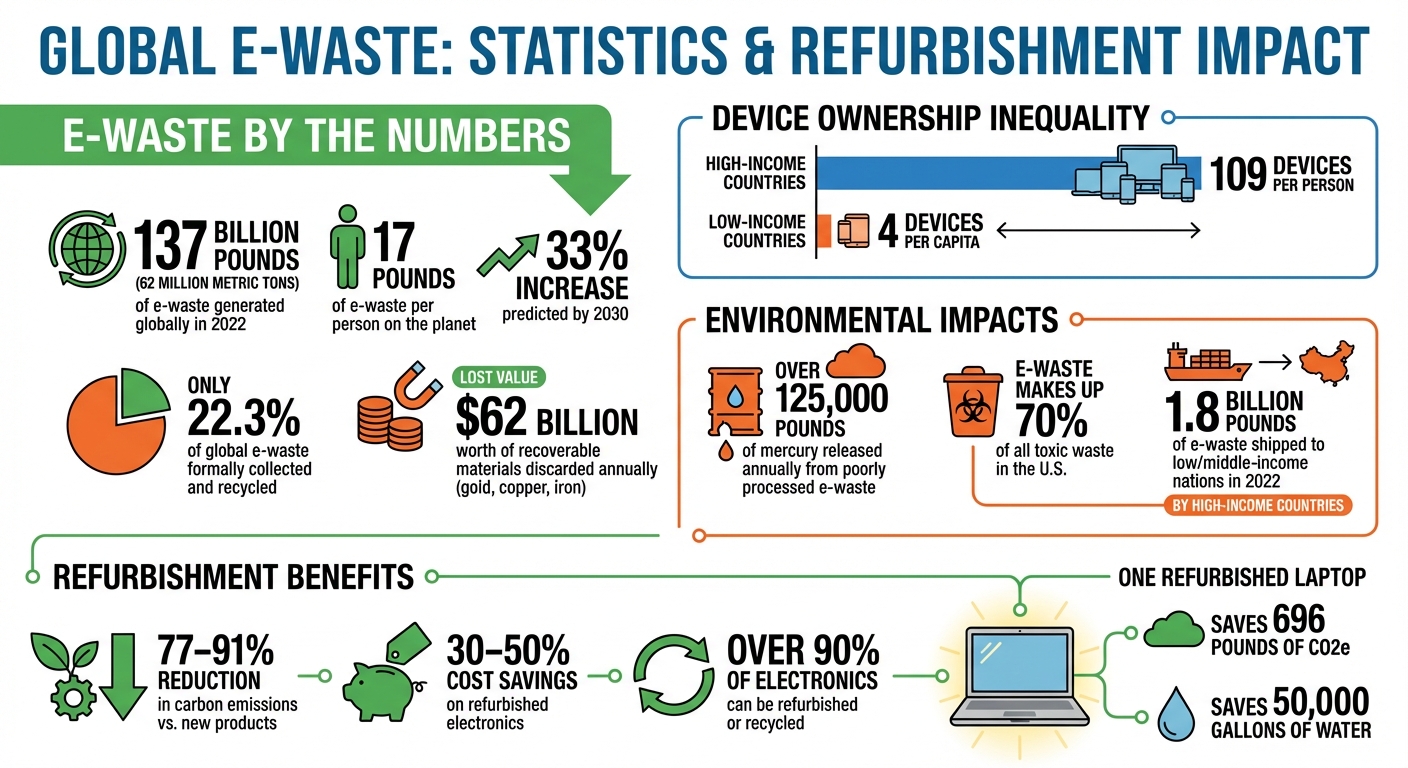
Global E-Waste Statistics and Refurbishment Impact
E-Waste by the Numbers
The scale of e-waste production is staggering. In 2022, the world generated a massive 137 billion pounds (62 million metric tons) of e-waste - equivalent to more than 17 pounds for every person on the planet. And this problem is only growing. By 2030, experts predict a 33% increase in e-waste production. Despite this surge, only 22.3% of global e-waste was formally collected and recycled last year. The rest? It often ends up in landfills or is handled informally, exposing workers and the environment to harmful risks.
Adding to the urgency, nearly $62 billion worth of recoverable materials - like gold, copper, and iron - are discarded annually. This is a massive loss, both economically and environmentally. Meanwhile, the disparity in device ownership reveals another layer of inequality: high-income countries average 109 devices per person, while low-income nations manage with just four per capita. This imbalance highlights how consumption patterns and waste burdens are unevenly distributed.
Environmental and Economic Impacts
The environmental fallout of e-waste is severe. Beyond the sheer volume of waste, improper disposal methods release toxic substances into ecosystems. For example, over 125,000 pounds of mercury are released annually due to poorly processed e-waste. In the U.S., e-waste makes up a shocking 70% of all toxic waste. Harmful materials like lead, mercury, and cadmium seep into the air, soil, and water, creating long-term health and environmental hazards when e-waste is burned or buried.
Compounding these issues is the trend of planned obsolescence. Many manufacturers design products in ways that make repairs difficult, if not impossible. Glued components, sealed parts, and software restrictions push consumers toward replacing devices instead of repairing them. As Kees Baldé, a Senior Scientific Specialist at the United Nations Institute for Training and Research, points out:
"We just consume way too much, and we dispose of things way too quickly. We buy things we may not even need, because it's just very cheap. And also these products are not designed to be repaired".
The problem doesn’t stop at national borders. In 2022, high-income countries shipped 1.8 billion pounds of e-waste to low- and middle-income nations. These countries often lack the infrastructure to process e-waste safely, leaving workers exposed to hazardous conditions. This practice shifts the environmental and health costs onto communities least equipped to handle them. At the same time, the market undervalues the environmental damage caused by producing new devices, masking the true cost of the linear economy. Refurbishment, however, provides a practical way to reduce both the environmental and economic toll of e-waste.
How Refurbishment Supports Circular Economy Goals
Extending Product Lifecycles
Refurbishment can add an extra 2 to 4 years of use to IT hardware, effectively delaying its journey to the landfill and making the most of the energy used during manufacturing. Instead of discarding a four-year-old laptop, refurbishment steps in to repair and upgrade it - like adding more RAM or replacing storage - so it meets current performance standards.
The environmental payoff is striking. Manufacturing a single laptop produces roughly 728 pounds of CO2 emissions, with 70% to 80% of that occurring before the device is even turned on. By extending how long a device is used, refurbishment spreads these emissions over more years, significantly reducing its annual carbon footprint.
Reducing Resource Use and Emissions
When devices last longer, the need for frequent manufacturing decreases, which in turn cuts down on resource consumption. Refurbishment keeps electronics in circulation, reducing the demand for new raw materials and delaying energy-intensive mining for metals like copper, aluminum, gold, lithium, and cobalt. Just one refurbished laptop can avoid up to 696 pounds of CO2e emissions and save approximately 50,000 gallons of water. Refurbished smartphones, on the other hand, slash greenhouse gas emissions by 77% to 91% compared to producing new devices.
Quick action is key. Electronics that are processed soon after retirement - especially those under four years old - retain higher resale and redeployment value before performance starts to degrade. For example, Close the Loop Renewed Solutions reported in January 2026 that they process over 500,000 devices annually across facilities in Texas, Kentucky, and Mexico. More than half of these devices are refurbished and returned to the market, while the rest are dismantled for parts or responsibly recycled. This approach not only reduces the need for raw material extraction but also encourages a shift in how we think about and use technology.
Encouraging Responsible Consumption
Refurbishment doesn’t just benefit the environment - it also changes how businesses and consumers view their electronic devices. Instead of seeing retired electronics as waste, refurbishment highlights their potential for resale or redeployment. This shift in perspective slows the typical 2-to-4-year replacement cycle and can even cut storage costs. Schools, for instance, can rely on refurbished devices that deliver solid performance without the hefty price tag of new equipment. Businesses and consumers also save big, often paying 30% to 50% less per unit when choosing refurbished hardware.
Looking ahead, it’s estimated that by 2026, 60% of large organizations will require circular IT practices in their procurement policies. The growing demand for mid-generation tech - devices between 2 and 4 years old - emphasizes the balance of performance and affordability that refurbished devices offer.
For those looking to extend the life of their tech while cutting down on e-waste, partnering with certified providers like Rica Recycling can help achieve these goals while supporting a more sustainable approach to electronics.
The Refurbishment Process: Turning Waste into Value
Steps in the Refurbishment Process
Refurbishing electronics follows a clear, step-by-step process that transforms used devices into dependable, ready-to-sell products. It all starts with sourcing and collection. Devices come from various channels like corporate returns, trade-ins at retail stores, or individual drop-offs. Each device is logged by serial number to ensure complete traceability throughout the process.
The next step is the initial inspection, where technicians assess key components such as the motherboard, RAM, battery, screen, and ports. This evaluation determines whether a device can be refurbished, if parts should be salvaged, or if it needs to be recycled. Before any repairs begin, certified data erasure tools like Blancco are used to wipe all previous user data. This process complies with NIST 800-88 standards, guaranteeing complete data privacy.
During the repair and upgrade phase, malfunctioning parts - like drained batteries, cracked screens, or unresponsive keyboards - are replaced. Technicians may also enhance performance by upgrading components, such as adding more RAM or installing larger SSDs. Once hardware repairs are complete, licensed operating systems (usually Windows 10 or 11) are installed, along with necessary firmware updates, ensuring the device meets today’s performance expectations.
Quality assurance testing is a critical step. Devices undergo stress tests, performance benchmarks, and boot-up checks to confirm they meet enterprise-grade standards. All test results are logged for accountability. Finally, cosmetic refurbishment takes care of external imperfections like scratches or dents. Each device is graded (A, B, or C) to reflect its physical condition while ensuring full functionality across all grades.
Quality Assurance and Compliance
The testing phase goes beyond basic functionality checks. Refurbishers perform multi-phase diagnostics, including thermal cycling and burn-in tests, to ensure long-term reliability. For batteries, a minimum capacity threshold of 80–85% is enforced; those falling below this level are replaced with new or certified alternatives.
Devices also undergo safety checks to meet certifications like FCC, UL, CSA, and CE, ensuring they comply with industry standards. Compliance checks confirm that devices have not been jailbroken or rooted and that they run genuine, licensed software. Programs like Microsoft Authorized Refurbisher help ensure this authenticity.
"Refurbished units from certified sources outperform new in reliability metrics due to pre-sale stress testing that weeds out early failures." – Grokipedia
Cosmetic grading adds transparency to the process. Grade A devices have minimal wear, Grade B units show minor scratches, and Grade C devices display visible cosmetic damage. Despite these differences in appearance, all grades deliver the same reliable performance. Many refurbished products also come with warranties ranging from 90 days to two years, offering peace of mind comparable to that of new devices.
This thorough approach ensures refurbished electronics meet high standards while offering a second life to devices that might otherwise go to waste.
IT Asset Disposition (ITAD) and Refurbishment
The refurbishment process is further supported by IT Asset Disposition (ITAD) programs, which provide a secure and structured framework for managing retired technology. ITAD services handle the entire lifecycle of IT assets, from decommissioning and data sanitization to evaluation, refurbishment, and resale. This approach turns what could be a disposal cost into an opportunity to recover value from functional devices.
ITAD begins with chain-of-custody tracking, creating an audit trail that ensures compliance with data privacy regulations like GDPR and HIPAA. After certified data erasure, devices are inspected both cosmetically and functionally. Each device is graded to determine whether it can be reused, harvested for parts, or recycled for materials. This step helps identify high-value assets that can be refurbished instead of discarded.
In the San Francisco Bay Area, Rica Recycling exemplifies this process. They offer certified ITAD services that include secure data destruction with certificates of completion and a commitment to a 100% landfill-free policy. Devices are either refurbished and resold or responsibly recycled, aligning with California's strict e-waste regulations.
The financial risks of neglecting proper ITAD practices are significant. In 2020, Morgan Stanley faced a $60 million fine from the Office of the Comptroller of the Currency for failing to oversee IT asset decommissioning. This lapse led to inadequate data sanitization on retired equipment. Such cases highlight why professional ITAD services with verified data destruction and documented compliance are essential for organizations managing retired electronics.
Benefits of Refurbishment for Businesses, Schools, and Consumers
Cost Savings and Affordability
Refurbishment doesn’t just help the planet - it’s also a smart financial move. Businesses and schools can often save between 30% and 60% by opting for refurbished electronics instead of new ones. On top of that, refurbished devices avoid the steep depreciation that new devices face - typically 20% to 30% in just the first year. This means organizations can hold onto more resale value when it’s time to upgrade.
"Many IT departments are shifting toward repair-first policies because the math works. Every reused device stretches the budget".
A great rule of thumb is the "40% rule": if repairing a device costs less than 40% of its replacement value, refurbishment is the more economical choice. Programs like Tech-to-School also make it easier for schools to afford refurbished technology, helping bridge the digital divide. For businesses, investing in refurbished, business-class models - like the Dell XPS or iMac Pro - can often provide better long-term value than consumer-grade options.
Reducing E-Waste
Refurbishment plays a key role in cutting down on global e-waste. With 50 million tons of e-waste generated each year, it’s worth noting that producing new laptops accounts for 70% to 80% of their total lifetime carbon emissions. By extending the life of devices, refurbishment can slash a device’s carbon footprint by 50% to 80% compared to buying new. For example, choosing a refurbished smartphone can reduce its climate impact by an impressive 77% to 91%.
"Making a refurbished [product] requires, on average, 60% less material and 70% less energy, resulting in 80% less carbon emissions".
This sustainability benefit is especially appealing to younger consumers: 47% of Gen Z prefer refurbished tech to help tackle e-waste, compared to just 18% of Baby Boomers. Retailers are also stepping up, introducing refurbished products in physical stores to build trust with customers. These efforts not only help the environment but also make refurbished products an even more compelling choice.
Data Security and Compliance
While cost and environmental benefits are big draws, data security is a critical factor when it comes to refurbished devices. Certified refurbishers follow strict data sanitization protocols, such as those outlined in NIST 800-88, and use secure chain-of-custody practices to protect sensitive information. For maximum security, organizations should ensure their IT asset disposition (ITAD) partner uses a Common Criteria-certified erasure engine.
In the San Francisco Bay Area, Rica Recycling provides certified ITAD services, including secure data destruction with completion certificates, all under a 100% landfill-free policy. Their approach ensures devices are either refurbished for reuse or responsibly recycled, fully complying with California’s strict e-waste regulations. This not only safeguards sensitive data but also transforms potential liabilities into opportunities to recover value.
Conclusion
Key Takeaways
Refurbishment plays a crucial role in the circular economy, giving discarded electronics a second life. It’s a powerful way to tackle e-waste, save money, and cut carbon emissions. Since manufacturing makes up 70% to 80% of a laptop’s lifetime emissions, extending its use can slash its climate impact by 77% to 91%. Plus, it keeps valuable materials like copper, gold, and rare earth elements out of landfills and in circulation. With e-waste growing five times faster than recycling efforts, refurbishment isn’t just a smart choice - it’s a necessary one.
The advantages go beyond the environment. Businesses can turn unused electronics into financial assets, and by 2026, 60% of large organizations are expected to adopt circular IT practices in their procurement policies, making refurbishment a competitive edge. Whether you’re a company, a school, or an individual, choosing refurbishment over buying new is a practical way to contribute to the circular economy.
Next Steps
Looking to cut costs and reduce e-waste? Start by evaluating your electronics lifecycle to identify inefficiencies and unused devices. Stick to the hierarchy: reuse before repair, repair before refurbishment, and refurbishment before recycling. Extending the life of your devices not only minimizes environmental impact but also maximizes their value.
If you’re in the San Francisco Bay Area, Rica Recycling offers certified ITAD services to make the process seamless. They provide secure data destruction, easy pickup and drop-off options, and a 100% landfill-free policy. Whether you’re retiring laptops, servers, or smartphones, partnering with a certified provider ensures your devices are refurbished for reuse or responsibly recycled. This keeps valuable materials in use and out of landfills while helping you stay compliant with California regulations.
FAQs
How do I know a refurbished device will be reliable?
When choosing a refurbished device, reliability often hinges on the refurbisher's thoroughness. Devices that have been carefully inspected, repaired, and tested by a reputable refurbisher are typically dependable. Prioritize options that come with a warranty and clear return policies - these are strong indicators of quality and the refurbisher's confidence in their work. Additionally, check that the refurbisher adheres to strict refurbishment and testing standards to ensure the device performs well and lasts over time.
What should I look for to ensure my data was securely erased?
To ensure your data has been securely erased, look for certification or verification from a trusted provider, such as Rica Recycling. This confirms the data wiping process followed industry standards, meeting strict security and compliance requirements. With certified data wiping, you can feel confident that sensitive information was properly managed and erased.
When should a device be refurbished instead of recycled?
If a device is still working or can be repaired, refurbishing it is a smart choice. This approach often has less environmental impact compared to recycling, particularly for devices under five years old. Refurbishing extends the device's lifespan, cuts down on e-waste, and contributes to a circular economy by keeping products in use for longer.