
Top Federal Agencies Offering E-Waste Training
E-waste training is essential for organizations managing electronics responsibly. Federal agencies like the EPA, DOT, and FedCenter provide targeted programs to ensure compliance with regulations and promote efficient practices for electronics management. Here’s a quick overview:
- EPA: Offers lifecycle training through Federal Green Challenge webinars, focusing on procurement, operations, and end-of-life management. Tools like the Electronics Environmental Benefits Calculator and Total Cost of Ownership Calculator assist in decision-making.
- DOT: Specializes in hazardous materials training, including lithium battery transport, packaging standards, and emergency response protocols.
- FedCenter: Provides training on electronics stewardship, compliance, and data center management, with resources tailored for federal and tribal professionals.
These programs cover topics like secure data destruction, safe transport of hazardous materials, and energy-efficient practices. By leveraging these federal resources, organizations can meet legal requirements, reduce risks, and improve electronics management processes.
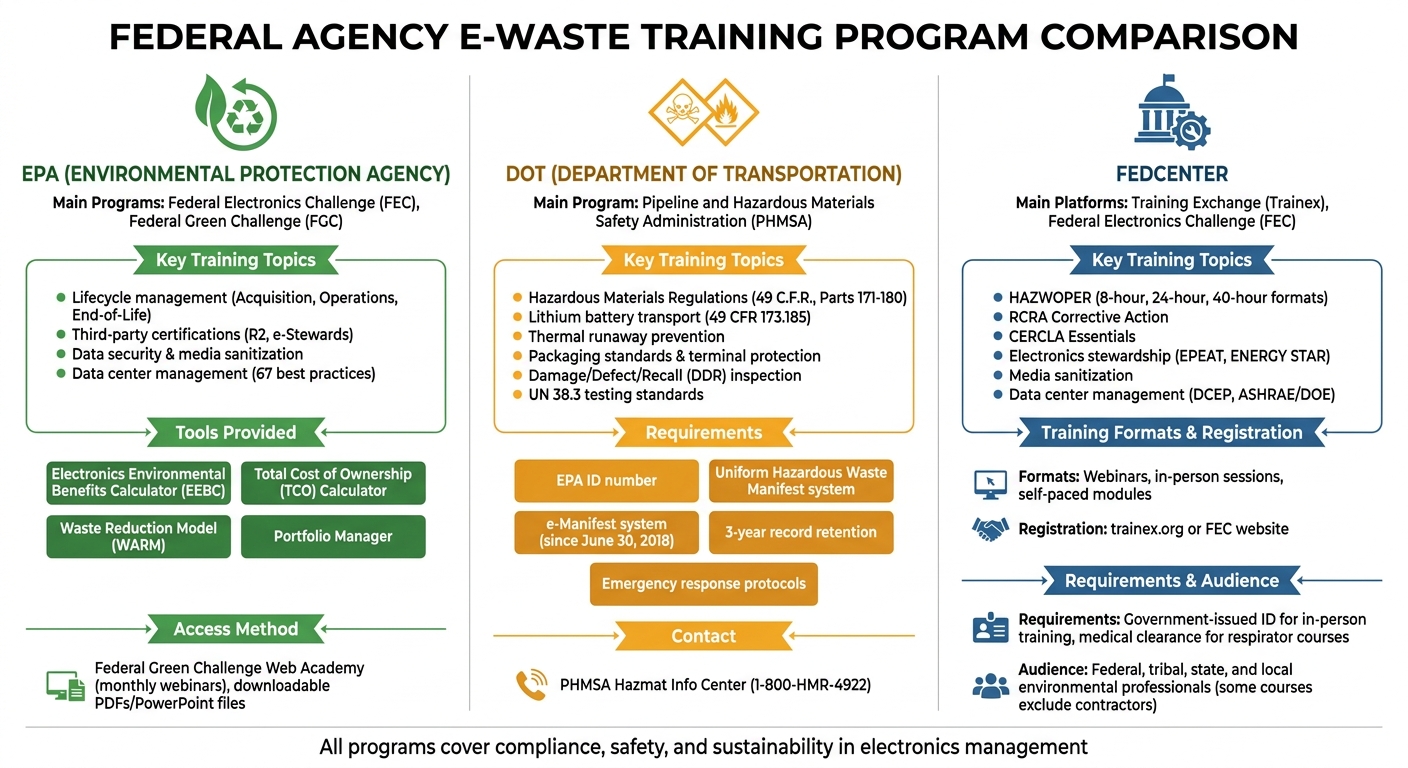
Federal E-Waste Training Programs Comparison: EPA, DOT, and FedCenter
Environmental Protection Agency (EPA) E-Waste Training Programs
Main Topics in EPA Training
The EPA, through its Federal Electronics Challenge (FEC) and Federal Green Challenge (FGC), offers training that addresses the entire lifecycle of electronics. These materials are divided into three key phases: Acquisition and Procurement, Operation and Maintenance, and End-of-Life Management. Each phase is designed to cover compliance requirements and practical strategies.
A major focus of the training is on third-party certifications like R2 and e-Stewards Standards. According to the EPA, "Certified electronics recyclers have demonstrated through audits and other means that they continually meet specific high environmental standards and safely manage used electronics". The training also emphasizes data security, including media sanitization, and provides tools like the "Checklist for Selection of an Electronics Recycler" and "Guidelines for On-Site Reviews of Electronics Recyclers".
For data center management, the EPA collaborates with the Department of Energy (DOE) through the DCEP program. This includes training on 67 best practices for managing HVAC systems, power, and IT equipment in data centers. Additional tools include the Electronics Environmental Benefits Calculator (EEBC), which helps quantify the environmental benefits of EPEAT-registered products, and the Waste Reduction Model (WARM) for tracking greenhouse gas emissions reductions.
These comprehensive topics make it easier for organizations to engage with EPA’s training programs.
How to Access EPA Training
EPA training resources are available through the Federal Green Challenge Web Academy, which hosts monthly webinars and teleconferences. The Federal Electronics Challenge also offers a library of recorded webinars covering key areas like acquisition, operations, and end-of-life management. These materials can be downloaded as PDFs or PowerPoint files for self-guided learning.
Interactive tools provided by the EPA include the Total Cost of Ownership (TCO) Calculator, which compares lifecycle costs of IT equipment, and the Portfolio Manager, designed for managing energy use in buildings and data centers. Fact sheets comparing ENERGY STAR and EPEAT standards are also available for download. For those interested in professional development, the DCEP program trains data center energy assessors, and the ASHRAE/DOE Workshop offers a full-day training session aimed at government, utility, and industry professionals.
sbb-itb-855056e
Department of Transportation (DOT) Hazardous Materials Training
What DOT E-Waste Training Includes
The Department of Transportation (DOT) regulates e-waste containing lithium batteries under its Hazardous Materials Regulations (HMR; 49 C.F.R., Parts 171-180). The Pipeline and Hazardous Materials Safety Administration (PHMSA) explains:
"The HMR apply to any material DOT determines can pose an unreasonable risk to health, safety, and property when transported in commerce".
This includes lithium-ion and lithium-metal batteries found in devices like laptops, power tools, smartphones, watches, wheelchairs, and even vehicles.
Training programs focus heavily on 49 CFR 173.185, which outlines the rules for safely shipping lithium batteries. A key topic is thermal runaway, a chain reaction that releases energy and flammable gases, posing significant safety risks. PHMSA highlights the danger:
"Once ignited, lithium cell and battery fires can be difficult to extinguish... thermal runaway [is] a chain reaction leading to a violent release of stored energy and flammable gas".
This underscores the critical need for proper handling and packaging procedures.
Training also covers essential packaging standards, such as protecting battery terminals to prevent short circuits. Handlers are trained to inspect batteries for damage or recalls (DDR), as these require extra precautions due to higher fire risks. Since January 21, 2022, manufacturers have been required to provide test summary documents confirming that battery designs meet UN 38.3 testing standards.
These training components lay the groundwork for strict certification and recordkeeping obligations.
DOT Certifications and Requirements
Beyond training, DOT enforces rigorous certification and monitoring practices to ensure compliance and safety during e-waste transportation.
To legally transport hazardous e-waste, organizations must obtain a company-wide EPA ID number. Compliance with DOT's HMR and EPA regulations (40 CFR part 263) involves meeting requirements for labeling, marking, placarding, and using approved containers.
Transporters are also required to use the Uniform Hazardous Waste Manifest system and retain signed copies for three years. The e-Manifest system, introduced on June 30, 2018, offers an electronic alternative to traditional paper tracking, simplifying the process. For temporary storage, hazardous waste can be held in DOT-approved containers at transfer facilities for up to 10 days without needing a RCRA storage permit.
Emergency response is another critical area of training. In the event of a spill or discharge during transport, handlers must notify the National Response Center (NRC) immediately. They may also need to file a written report under 49 CFR section 171.16. For additional guidance on compliance or certification, organizations can contact PHMSA's Hazmat Information Center at 1-800-HMR-4922.
Federal Center (FedCenter) E-Waste Training Resources
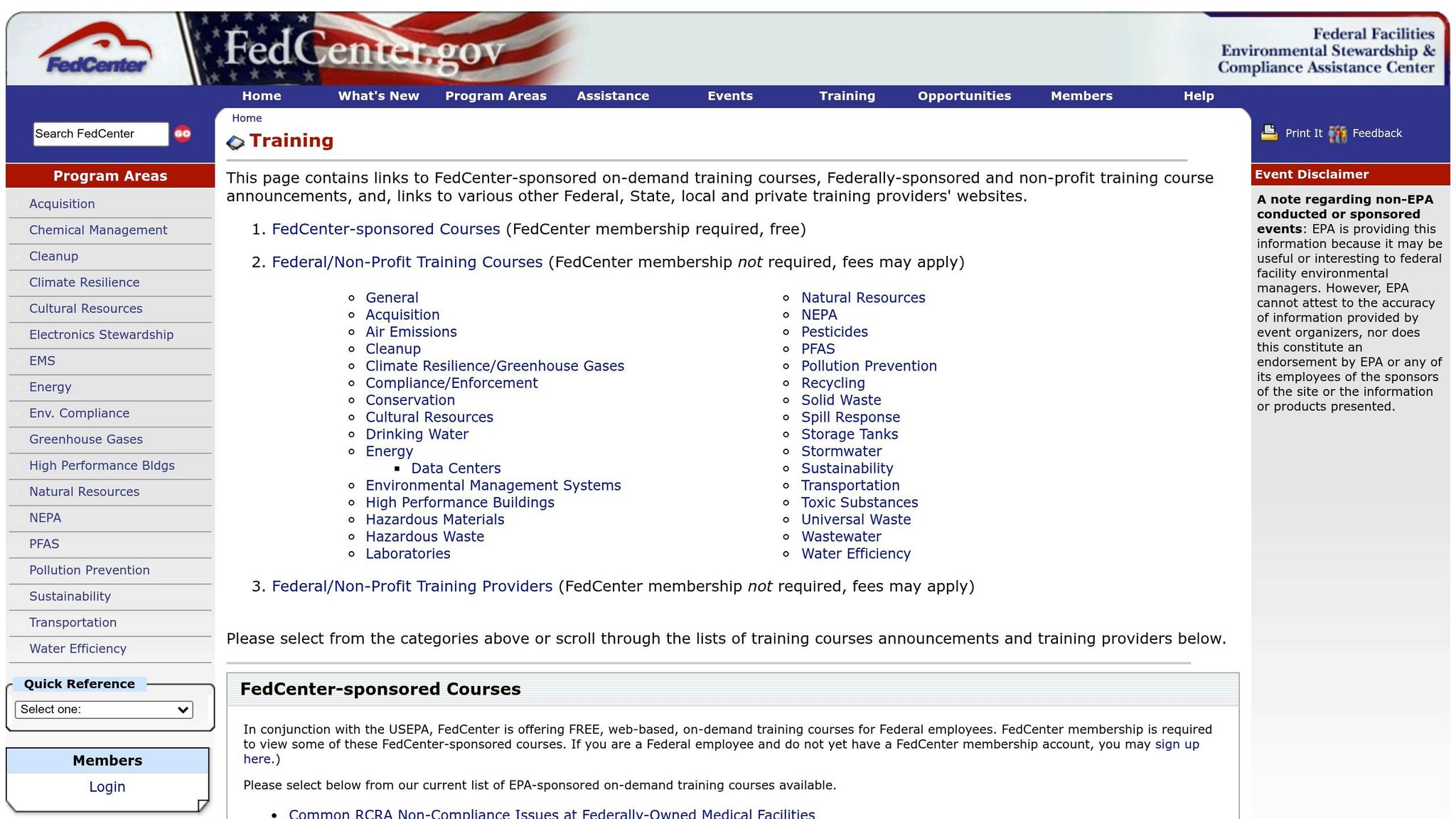
Types of Training Offered
FedCenter is a resource hub for federal, tribal, state, and local environmental professionals, offering specialized training through platforms like the Training Exchange (Trainex) and the Federal Electronics Challenge (FEC). These programs cover every stage of electronics management, from acquisition to final disposal.
Training options include:
- Compliance and Safety Programs: Courses like HAZWOPER (available in 8-hour, 24-hour, and 40-hour formats), RCRA Corrective Action, and CERCLA Essentials focus on regulatory and safety practices.
- Electronics Stewardship Training: Topics range from EPEAT and ENERGY STAR procurement standards to media sanitization and responsible recycling methods.
- Data Center Management Courses: Classes such as the DCEP program and ASHRAE/DOE workshops target efficient data center operations.
Training is available in various formats, including webinars, in-person sessions, and self-paced modules. These options ensure flexibility while addressing specific compliance, safety, and operational requirements, complementing other federal e-waste training initiatives.
How to Register for FedCenter Training
Registering for FedCenter training is simple and user-friendly. You can sign up at trainex.org or through the FEC website by searching for courses. Creating a student profile allows you to track your registrations and access transcripts. If a course is full, you can add your name to the waitlist.
For in-person training, you’ll need a valid government-issued ID. Additionally, medical clearance for respirator use is required for courses like the 40-Hour HAZWOPER or Hazardous Materials Technician training. Note that some courses are limited to government employees and tribal members, excluding contractors, academics, and private sector participants.
To get started, consider attending the "Overview of Annual Reporting and Award Applications" webinar, which provides a detailed guide on using the platform. For further assistance, use the "Contact Us" feature on the FEC website.
How Organizations Can Use Federal E-Waste Training
Federal e-waste training plays a key role in helping organizations comply with regulations while advancing their sustainability goals.
Choosing the Right Training Program
Start by identifying which stage of your electronics lifecycle needs improvement. Federal training programs are structured around three main phases: acquisition and procurement, operation and maintenance, and end-of-life management. If your focus is on purchasing, consider courses covering EPEAT and ENERGY STAR certifications. For IT teams managing equipment, prioritize training on power management and strategies to extend equipment lifespan. For disposal and data security, look for training on NIST 800.88 media sanitization and secure data destruction practices.
Programs are often tailored to specific equipment types, such as data centers, imaging devices, and handheld electronics. To pinpoint gaps and justify energy-efficient measures, tools like the Federal Electronics Acquisition and Procurement Planning Checklist and the Total Cost of Ownership (TCO) Calculator can be invaluable.
Your organization's goals will also shape your training choices. Some programs emphasize compliance with federal sustainability requirements under the Federal Acquisition Regulation (FAR), while others focus on reducing greenhouse gas emissions or strengthening data security measures.
Once you’ve selected the appropriate training, ensure you maintain accurate records to meet compliance requirements.
Keeping Records and Maintaining Certifications
Proper documentation is critical after selecting and completing training. It not only helps with compliance but also supports ongoing improvement. Organizations should track completed training sessions, earned certifications, and annual reporting forms - especially for initiatives like the Federal Electronics Challenge. Keeping detailed records also aids in demonstrating alignment with ISO 14001 Environmental Management System standards when incorporating electronics stewardship into larger sustainability objectives.
For end-of-life electronics, document media sanitization processes to confirm sensitive data has been destroyed before hardware leaves your facility. Use tools like the Checklist for Selection of an Electronics Recycler and the Guidelines for On-Site Reviews of Electronics Recyclers to evaluate third-party vendors. Ensure these vendors hold R2 or e-Stewards certifications, which are essential for responsible recycling. Additionally, federal programs such as Computers for Learning require documenting all transactions through GSAXcess.
Maintaining consistent records not only ensures compliance with federal standards but also enhances your organization’s reputation for sustainability. Collaborating with a reliable local provider can further solidify your commitment to responsible practices. For instance, Rica Recycling offers certified electronics recycling and IT asset recovery services in the San Francisco Bay Area, providing secure data destruction and environmentally friendly handling of electronic devices.
Conclusion
The Value of Certified E-Waste Training
Certified e-waste training equips organizations with the knowledge and tools to manage electronics responsibly throughout their lifecycle - from procurement to disposal. Programs like those outlined above go beyond meeting basic compliance requirements, providing a solid foundation for sustainability and operational efficiency. The National Strategy for Electronics Stewardship, developed through the collaboration of 16 federal departments and agencies, underscores the government’s dedication to setting an example in responsible electronics management.
As the volume of end-of-life electronics continues to grow, trained professionals are becoming increasingly critical. The EPA highlights how responsible electronics recycling not only supports environmental goals but also creates green jobs, promotes the reuse of valuable materials, and strengthens the American recycling and refurbishing industry. These federal efforts aim to turn e-waste challenges into opportunities for progress and environmental stewardship.
Certified training also addresses key organizational priorities such as data security, cost reduction through energy-efficient practices, and risk management. Programs like the Data Center Energy Practitioner (DCEP) initiative and the EPA’s lifecycle management resources empower organizations to lead in their industries while safeguarding the planet and cutting operational costs.
Next Steps for Your Organization
To start leveraging the benefits of certified e-waste training, consider forming an internal electronics stewardship team to oversee the adoption of federal best practices. Resources like the Federal Green Challenge Web Academy provide monthly webinars that can guide your organization on program requirements and new strategies. Additionally, tools such as the Federal Electronics Acquisition and Procurement Planning Checklist can help standardize processes and pinpoint areas for immediate improvement.
For managing electronics at the end of their lifecycle, partner with certified recyclers who hold R2 or e-Stewards certifications. If you're located in the San Francisco Bay Area, Rica Recycling offers certified electronics recycling and IT asset recovery services. Their secure data destruction protocols and 100% landfill-free operations align with California’s e-waste regulations, making it easier to adopt the disposal practices emphasized in federal training programs.
Now is the time to take proactive steps to meet regulatory standards and fulfill your environmental responsibilities.
FAQs
Which agency should I use for e-waste training?
Certified electronics recyclers following standards like the Responsible Recycling (R2) Standard or the e-Stewards® Standard are worth considering. These certifications, endorsed by the US EPA, guarantee safe and responsible handling of e-waste, prioritizing both safety and environmental care.
Do I need DOT hazmat training to ship devices with lithium batteries?
Yes, DOT hazmat training is mandatory for shipping devices that contain lithium batteries. The rules for safe transportation are detailed in 49 CFR 173.185, which outlines the specific requirements for handling and shipping these items.
To meet these regulations, online compliance training courses are available. These courses help ensure that individuals involved in shipping lithium battery devices understand federal safety standards, reducing risks during transportation and promoting safer practices.
What records should I keep for e-waste compliance?
To stay on top of e-waste compliance, it's crucial to keep detailed records of how you manage electronics. This includes:
- Proof of compliance with responsible recycling standards.
- Documentation of waste management processes to show proper handling and disposal.
- Records of media sanitization efforts to confirm secure data removal.
These records not only ensure you’re meeting regulatory requirements but also highlight your commitment to environmentally responsible practices.